The problem is that thermal environments are uniquely punishing. Heat cycling, chemical exposure, and sustained pressure loads degrade polymer seals gradually — often invisibly — until performance drops below an acceptable threshold. By then, secondary damage may already be underway.
This guide covers why polymer seal maintenance matters in thermal systems, the different maintenance approaches available, the early warning signs engineers should monitor, and a practical inspection schedule calibrated to real operating conditions.
Key Takeaways
- Thermal cycling, chemical media, and pressure variation all degrade polymer seals over time. Active management is required.
- Preventive maintenance costs far less than reactive repair after a seal failure in a critical thermal system
- Key failure indicators: compression set, surface cracking, coolant seepage, and unexplained temperature rises near sealed joints
- Maintenance frequency should be driven by operating temperature, duty cycle, and fluid aggressiveness — not the calendar
- Correct compound selection from the start is the single biggest factor in extending seal life and reducing maintenance burden
Why Polymer Seal Maintenance in Thermal Systems Matters
Thermal management systems run under continuous stress. Unlike static sealing environments, these systems subject polymer seals to repeated heat cycles, fluctuating pressures, and often aggressive fluid chemistry — sometimes all at once. A seal that performs adequately on day one may lose meaningful sealing force after months of sustained exposure.
Thermal Compression Set: The Primary Lifespan Killer
The biggest threat to seal longevity in thermal applications isn't a sudden failure — it's gradual, irreversible deformation. As the Parker O-Ring Handbook explains, prolonged high-temperature exposure causes irreversible chemical changes in elastomers: additional crosslinking, increased hardness, volume change, and permanent compression set.
Compression set — measured under ASTM D395, which compresses specimens to 25% of their original height and subjects them to controlled oven exposure — represents the residual deformation remaining after the load is removed. A seal with significant compression set can no longer generate sufficient contact force to maintain a leak-tight interface.
Compression set accumulates before leakage becomes visible. Preventive monitoring catches it early — by the time a leak appears, the damage is already done.
Safety and Compliance Stakes
In regulated environments, seal failures in thermal systems carry consequences beyond repair costs:
- EV battery systems: SAE J3277 requires no sustainable coolant leakage into battery pack headspace — with production leak testing and validated in-line criteria increasingly required
- Semiconductor fabrication: O-ring leak-rate testing is an active documented requirement in SEMI process equipment standards
- Aerospace: Seal inspection protocols are often contractually required as part of OEM maintenance documentation
Beyond compliance, the secondary consequences of seal failure often exceed the cost of the seal itself. INFICON's e-mobility leak testing guidance identifies three specific failure consequences in battery systems:
- Humidity ingress can cause short circuits
- Water reacting with electrolyte can form hydrofluoric acid
- Loss of cooling medium can trigger thermal events
The Cost Logic of Preventive vs. Reactive Maintenance
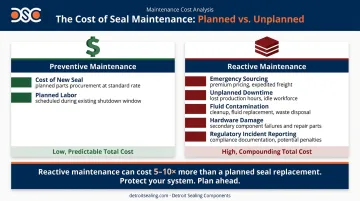
The cost difference between planned and unplanned seal maintenance breaks down simply:
- A scheduled seal replacement requires only the cost of the new seal and planned labor during a shutdown window
- A reactive repair after seal failure adds: emergency sourcing, unplanned downtime, potential fluid contamination of downstream components, possible damage to mating hardware, and in some cases regulatory incident reporting
In high-criticality thermal systems — EV battery cooling, semiconductor process loops — unplanned downtime costs significantly outweigh the cost of a scheduled seal replacement.
Types of Maintenance for Polymer Seals in Thermal Management
Thermal environments vary too widely for a single maintenance strategy. A steady-state coolant loop at 90°C needs different treatment than a rapid-cycle industrial oven pushing 200°C on every pass. The right approach depends on system criticality, operating conditions, and seal material.
Routine Preventive Maintenance
Preventive maintenance is scheduled, systematic, and performed before failure occurs. For polymer seals in thermal systems, it centers on:
Visual and tactile inspection during planned shutdowns or fluid service intervals:
- Surface cracking or a fine network of checks (indicates heat- or ozone-induced hardening)
- Discoloration — yellowing suggests oxidative exposure, charring indicates thermal overexposure
- Permanent flattening or an oval cross-section at the sealing face (compression set)
- Any visible pulling away from the sealing groove
Typical preventive tasks:
- Torque verification on gland fittings
- Leak-check using calibrated pressure testing
- Cleaning of sealing surfaces to remove thermal byproduct deposits that can abrade the seal face
Corrective Reactive Maintenance
Reactive maintenance responds to a failure that has already occurred — active leakage, a sudden temperature spike near a sealed junction, or visible cracking found during inspection. It's unavoidable in some circumstances, but it carries a real penalty.
By the time a polymer seal visibly fails in a thermal system, secondary damage is often already underway: mating hardware may be scored, downstream components contaminated, or a thermal event escalated. These compounding effects make reactive maintenance disproportionately costly.
When reactive replacement is required, compound selection becomes urgent. Sourcing the wrong material for the actual temperature range and fluid chemistry — under availability pressure — compounds the original failure. Working with a distributor that stocks hundreds of compounds across all rubber types, like DSC, gives engineers a direct path to the right replacement without accepting a compromise material.
Predictive and Condition-Based Maintenance
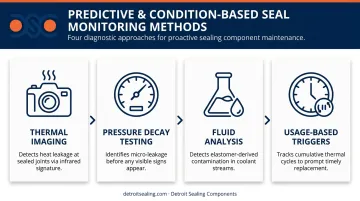
For higher-criticality systems, condition monitoring replaces calendar-based intervals with data-driven triggers:
- Thermal imaging to detect heat leakage or anomalous surface temperatures at sealed joints
- Pressure decay testing to identify micro-leakage before it becomes visible or operationally significant
- Fluid analysis to detect elastomer-derived contamination in the cooling medium — a sign of seal degradation even before a pressure loss is measurable
- Usage-based triggers: tracking cumulative thermal cycles or hours above a temperature threshold to schedule inspection before failure probability increases
This approach is common in aerospace and semiconductor thermal management, where unplanned downtime carries severe operational consequences.
Full Seal Overhaul
A full overhaul — complete seal removal, inspection, and replacement — is warranted in specific situations:
- After a major thermal event or system overheat beyond rated limits
- After reaching the manufacturer's specified thermal cycle limit
- When a system is being repurposed to higher-temperature duty than its original design specified
Overhaul is also the right time to re-evaluate compound selection. If operating temperatures have increased, or the coolant chemistry has changed, upgrading from a standard EPDM or silicone seal to a higher-performance compound — FFKM or fluorosilicone — may reduce future maintenance frequency and total lifecycle cost more than replacing like-for-like.
Signs That Your Polymer Seals Need Maintenance
Seal degradation in thermal systems is gradual. By the time an active leak appears, you're already dealing with unplanned downtime and fluid loss. Catching the warning signs earlier keeps maintenance scheduled — not scrambled.
Visible Physical Degradation
According to Parker's O-Ring Handbook, compression set failure produces a seal that is permanently deformed into a flat-sided oval shape rather than returning to its original round cross-section. Additional visual indicators:
- Surface cracking or checking: fine network of cracks from heat-induced hardening
- Discoloration: yellowing from oxidative exposure, charring from thermal overexposure
- Extrusion damage: a chewed or chipped appearance on the low-pressure side of the gland, indicating pressure or clearance problems
- Shrinkage or groove pullback: the seal has lost enough elasticity to maintain contact force; replace immediately, do not reinstall
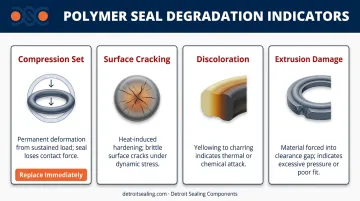
Any seal showing visible compression set should be replaced, not reinstalled.
System-Level Performance Indicators
Physical inspection isn't always the first signal. System-level warning signs often appear first:
- Unexplained rise in coolant consumption or need to top off thermal fluids more frequently
- Temperature readings rising near sealed components without a corresponding change in heat load
- Pressure drop in closed-loop thermal systems that can't be explained by flow rate changes
- Recurring thermal sensor alarms or error codes near sealed junctions — common in EV battery thermal management as an early electronic indicator of seal degradation
Operational Triggers for Unscheduled Inspection
Certain events should trigger an inspection regardless of where the seal sits in its service interval:
- System exposure to a temperature spike beyond the seal's rated maximum
- Accidental contact with an incompatible fluid (wrong coolant formulation, solvent flush)
- Any maintenance event where a sealing joint was disturbed, re-torqued, or reassembled
Polymer Seal Maintenance Schedule for Thermal Systems
Maintenance intervals must account for operating temperature, thermal cycle frequency, fluid aggressiveness, and duty cycle. The following table provides a baseline — adjust to your specific application conditions.
| Interval | Tasks |
|---|---|
| Daily / Per-Use (high-cycle systems) | Check for fluid seepage at seal interfaces; confirm no thermal discoloration at joints; verify pressure is holding within spec |
| Weekly / Monthly | Inspect accessible seals for hardness change; check sealing groove for buildup or corrosion; verify torque on critical gland fittings |
| Quarterly | Run pressure decay or leak-down test on closed-loop systems; document dimensional changes in seal profile; review thermal cycle log against rated cycle limit |
| Annual / Major Service | Remove and inspect all seals visually and dimensionally; replace any seal with compression set beyond published limits; re-evaluate compound selection if operating conditions have shifted |
Practical calibration notes:
- Seals operating at steady-state temperatures above 150°C should be inspected at the shorter end of each interval range
- Intermittent moderate-temperature systems can extend toward the longer end
- Any seal operating near or above its material's rated temperature ceiling is high-criticality. Inspect after every major thermal event, no exceptions.
For annual or major service intervals, DSC's ISO 17025 accredited lab can support custom compound validation and testing for applications requiring higher confidence before redeployment, particularly when operating conditions have changed or a higher-performance compound is under consideration.
Conclusion
Polymer seal maintenance in thermal management systems isn't optional — it's the mechanism by which system reliability is protected over time. Heat cycling, chemical exposure, and continuous pressure loads degrade even well-specified seals along a predictable curve. A structured maintenance approach, calibrated to actual operating conditions, intercepts that curve before it becomes a failure event.
The maintenance plan only works, though, when the right seal material is in place from the start. An undersized compound (wrong for the temperature range or fluid chemistry) will degrade faster than any schedule can compensate for. The right sealing partner — one with genuine compound expertise, fast supply, and ISO 17025-accredited testing capability — is as critical as the inspection schedule itself.
DSC's technical team supports engineers across automotive, semiconductor, aerospace, and other thermal management applications with material selection guidance, FEA-backed seal design, and access to hundreds of compounds, including specialty high-temperature materials like FFKM and fluorosilicone.
Frequently Asked Questions
How often should polymer seals in thermal management systems be inspected?
Inspection frequency depends on operating temperature, duty cycle, and system criticality. High-temperature or continuous-duty systems require quarterly inspections at minimum, plus visual checks before each use in high-cycle environments. Moderate-duty systems can follow a semi-annual schedule, adjusted based on thermal cycle history.
What are the most common failure modes of polymer seals in high-temperature applications?
The three primary failure modes are thermal compression set (permanent deformation reducing sealing force), oxidative hardening and surface cracking, and extrusion into adjacent clearances caused by softening at elevated temperature. Compression set is the most common and often occurs before any visible leakage appears.
Which polymer seal material is best suited for thermal management applications?
The right material depends on your temperature range and fluid media:
- EPDM — water/glycol coolant systems up to ~150°C
- Silicone (VMQ) — moderate-to-high temperatures up to 225°C
- Fluorosilicone (FVMQ) — adds fuel and oil resistance in the same temperature range
- FFKM — aggressive high-temperature or chemically demanding environments up to 320°C
How can you tell if a polymer seal has experienced thermal compression set?
Compression set appears as a permanent flat spot on the seal's sealing face — it no longer springs back to a round cross-section after load is removed. This signals reduced contact force and compromised sealing performance, often before any leakage is detectable.
Can polymer seals be reused after being removed during a maintenance overhaul?
Reuse is not recommended. Once removed, a seal's compression set state and surface condition can't be fully assessed by visual inspection alone. Reinstalling a degraded seal risks early failure in a critical system, making the cost of a new seal a straightforward trade-off.
What happens if the wrong polymer compound is used in a thermal management seal application?
An incompatible compound will swell, harden, or rapidly degrade when exposed to the actual operating temperature or fluid chemistry. For example, EPDM is incompatible with mineral oil products, and VMQ silicone degrades in superheated steam above 121°C. The result is premature failure, potential contamination of the thermal fluid, and possible damage to mating components.