Introduction
A seal that performs flawlessly at peak operating temperature can crack, leak, or lose compression set integrity the moment temperatures drop — and vice versa. That's the core challenge in temperature swing applications: the full thermal delta, not just the peak value, determines whether a seal holds or fails.
Consider oil and gas downhole tools that swing from arctic surface conditions to scorching wellbore temperatures, or semiconductor processing chambers that cycle repeatedly between ambient and extreme process heat. In these environments, repeated expansion and contraction cycles degrade O-ring performance in ways that single-extreme conditions simply don't replicate.
Not all elastomers handle this equally. A compound rated for +400°F may become brittle below -20°F. One that stays flexible at -100°F can degrade permanently under sustained heat. The right material choice depends on understanding both ends of the range — not just the high end on a datasheet.
This guide covers the five O-ring materials best suited for extreme temperature swing applications, how to evaluate them, and what industries depend on them most.
Key Takeaways
- Temperature swings degrade compression set through repeated expansion/contraction cycles, unlike single-extreme failures that stress a seal only once
- Top five materials for temperature swing applications: FKM, Silicone (VMQ/FVMQ), FFKM, EPDM, and HNBR
- Selection depends on chemical environment, static vs. dynamic use, and cycle speed — no one material fits all profiles
- Specifying "silicone" or "FKM" isn't enough; compound grade within each family drives real-world temperature performance
- The right seal requires evaluating your full operating envelope — temperature range, media, and duty cycle together
Why Extreme Temperature Swings Are a Unique Sealing Challenge
Temperature swing applications don't just expose O-rings to heat or cold — they subject seals to repeated mechanical stress through expansion and contraction. This distinction matters for material selection.
What Compression Set Actually Means
Compression set is the percentage of an O-ring's original cross-section that fails to recover after being compressed. Per ASTM D395 (2025), compression set tests measure a rubber compound's ability to retain elastic properties after prolonged compressive stress. The European Sealing Association (ESA) links increasing compression set directly to reduced contact stress and eventual leakage.
In thermal cycling, compression set accumulates progressively. Each swing between hot and cold reduces the seal's ability to spring back until sealing force falls below the threshold needed to prevent leakage — even if the material itself hasn't visibly cracked or degraded.
It's also worth noting that elastomers expand roughly an order of magnitude more than metals. Gland fill and squeeze must be verified at both temperature extremes, not just at ambient.
Two Primary Failure Mechanisms
Thermal cycling accelerates two distinct failure modes:
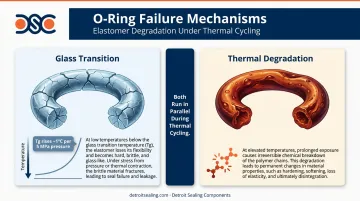
Glass transition — Below a material's glass transition temperature (Tg), modulus increases sharply, resilience drops, and the elastomer becomes rigid and brittle. Note: per the ESA's sealing guide, Tg can rise ~1°C per 5 MPa of applied pressure — so pressurized systems may hit glass transition at higher temperatures than datasheets indicate.
Thermal degradation — Sustained high heat causes irreversible chemical changes that destroy elasticity. When a system cycles between both extremes, both failure modes run in parallel — compounding degradation faster than either condition would alone.
Test Standards Engineers Should Know
ASTM D1329 / ISO 2921 — Temperature-retraction (TR-10) testing for evaluating low-temperature viscoelastic behavior
ASTM D395 — Compression set testing, essential for evaluating seal integrity after prolonged compression at both temperature extremes
Always review material datasheets against the full temperature delta of your application, not just the peak value
ASTM D1329 / ISO 2921 — Temperature-retraction (TR-10) testing for low-temperature viscoelastic behavior
ASTM D395 — Compression set testing at both temperature extremes
Always evaluate datasheets against the full temperature delta, not just the peak value
Per Parker's technical guidance, the practical static sealing limit sits roughly 15°F below the TR-10 value. Treat TR-10 as a screening metric — not a full thermal cycling qualification.
Best O-Ring Seals for Extreme Temperature Swings
The five materials below cover the core options for most temperature swing scenarios. Each was selected for proven wide-range performance, availability across multiple compound formulations, and adoption across demanding industrial sectors.
Viton (FKM)
FKM is the most widely specified elastomer for high-temperature sealing. It combines superior heat resistance with excellent resistance to fuels, oils, hydraulic fluids, ozone, and oxygen — making it the go-to choice for automotive, oil and gas, and many industrial applications.
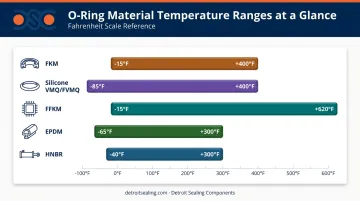
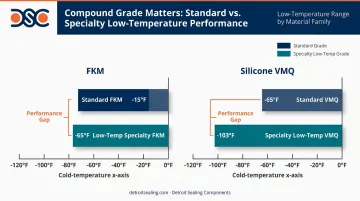
For temperature swing use, FKM's key advantage is low compression set at elevated temperatures, better than most elastomers. The tradeoff: standard grades begin to stiffen around -15°F. For applications with deep cold swings, low-temperature FKM formulations are essential Parker's compound data shows specialty grades reaching as low as -65°F, compared to the -15°F baseline of general-purpose FKM.
| Spec | Detail |
|---|---|
| Temperature Range | ~-15°F to +400°F (standard); specialty low-temp grades to -65°F |
| Key Strengths | Superior fuel, oil, and chemical resistance; excellent heat aging; low compression set at high temperatures |
| Best For | Automotive engine and fuel systems, oil & gas downhole tools, industrial hydraulic systems |
Silicone (VMQ / FVMQ)
Silicone offers the widest thermal range of any common elastomer family Parker's compound data shows specialty VMQ grades performing down to -103°F, with standard grades typically rated to -65°F. Fluorosilicone (FVMQ) extends chemical resistance to include fuels and oils while retaining similar cold performance.
The critical limitation: per Parker's O-Ring Handbook, silicone has poor tensile strength and abrasion resistance and is not recommended for dynamic sealing. It excels in static applications where wide temperature range is the primary requirement.
| Spec | Detail |
|---|---|
| Temperature Range | VMQ: ~-103°F to +450°F; FVMQ: ~-100°F to +350°F |
| Key Strengths | Widest thermal range of common elastomers; excellent ozone/UV resistance; flexible at very low temperatures |
| Best For | Static seals in outdoor equipment, food-grade and medical applications, semiconductor furnace seals |
FFKM (Perfluoroelastomer)
FFKM is the premium-tier material for the most demanding dual-extreme applications. As described by Parker and PPE (Perlast), FFKM is effectively a rubber form of PTFE, combining near-universal chemical resistance with the elastomeric properties needed to maintain a reliable seal across a wide thermal range.
Greene Tweed's Chemraz is rated to 315°C / 599°F, with Parker listing specialty grades reaching 320°C / 608°F. Low-temperature formulations extend cold performance to -40°F. A documented Greene Tweed case study showed Chemraz SD625 O-rings cycling from 250°F down to 8°C multiple times daily in pharmaceutical processing, extending maintenance intervals by 3x compared to standard elastomers.
FFKM is the right call when temperature cycling occurs alongside aggressive chemical exposure. The cost premium over FKM or silicone makes an application review essential before specifying.
| Spec | Detail |
|---|---|
| Temperature Range | ~-40°F to +599°F depending on grade |
| Key Strengths | Near-universal chemical resistance; excellent compression set over wide thermal range; long service life |
| Best For | Semiconductor processing, pharmaceutical manufacturing, chemical processing, critical aerospace seals |
EPDM
EPDM is the first choice for outdoor and water-contact applications subject to wide seasonal or operational temperature swings. Parker rates compound E0803-70 at -70°F to +250°F, with excellent resistance to ozone, UV, weathering, steam, and water-based media including acids and disinfectants.
The critical limitation: EPDM is incompatible with petroleum-based oils, fuels, and hydrocarbon fluids. This eliminates it from oil and gas, automotive fuel systems, and most industrial hydraulic applications. For water treatment, HVAC, agricultural equipment, and renewable energy installations where temperature swings involve no petroleum contact, it's an excellent fit.
| Spec | Detail |
|---|---|
| Temperature Range | ~-70°F to +250°F |
| Key Strengths | Outstanding ozone/UV/weather resistance; excellent steam and water compatibility; good low-temperature flexibility |
| Best For | Water and sanitary systems, HVAC, agricultural equipment, outdoor renewable energy installations |
HNBR (Hydrogenated Nitrile)
HNBR is the mechanically superior upgrade over standard NBR — offering better resistance to heat and ozone while retaining strong oil and fuel resistance. Parker and Trelleborg both identify HNBR as particularly suited for applications where elevated temperatures and mechanical wear occur together, making it a strong candidate for dynamic sealing in oil-rich environments.
Temperature range runs approximately -40°F to +302°F for standard formulations, depending on compound. This makes HNBR well-suited for moderate temperature swing applications in automotive drivetrains, oilfield equipment, and hydraulic systems where a standard NBR seal would degrade prematurely under heat and chemical exposure.
| Spec | Detail |
|---|---|
| Temperature Range | ~-40°F to +302°F (standard); low-temp grades extend further |
| Key Strengths | Superior mechanical strength vs. NBR; oil and fuel resistant; good abrasion resistance for dynamic use |
| Best For | Automotive drivetrain systems, oilfield equipment, hydraulic seals, industrial compressors |
How to Choose the Right O-Ring for Temperature Cycling
Start With the Full Temperature Delta
The most common selection mistake: specifying a material based on peak temperature alone. A compound rated for +400°F may crack at -20°F if the system regularly reaches that low. The complete temperature delta is the primary specification parameter — not the high end or low end on its own.
Use TR-10 (ASTM D1329) as your low-temperature screening metric. A material's practical static sealing limit is approximately 15°F below its TR-10 value. Review TR-10 data from the specific compound datasheet, not just the polymer family classification.
Evaluate Compression Set Across the Full Range
For temperature swing applications, compression set data must be reviewed at both extremes: not just at ambient or at the high-temperature limit. Request test data from your supplier for the specific compound, evaluated at conditions representative of your actual operating cycle.
When standard grades don't cover the required thermal delta, DSC's ISO 17025 accredited lab can perform material evaluation and custom compound development to close that gap.
Match the Material to the Motion Type
Static and dynamic applications have different failure drivers:
- Dynamic applications (rotating shafts, reciprocating pistons): require strong wear resistance and low friction. HNBR and FKM are the primary candidates.
- Static applications can tolerate lower tear strength in exchange for wider thermal range. Silicone and FFKM perform well here.
Getting this wrong causes premature failure even when the material is thermally well-matched — so confirm the motion type before finalizing any selection.
Cross-Reference Chemical Compatibility
A strong thermal profile means nothing if the compound degrades in the process fluid. Always evaluate chemical resistance alongside temperature range. Two common mismatches:
- EPDM's wide temperature capability is incompatible with petroleum-fluid systems
- Silicone's thermal range fails where media causes swell
Use the full application envelope — media, temperature, pressure, and motion — as your selection framework.
Specify Compound Grade, Not Just Material Family
"FKM" or "silicone" is an incomplete specification. Within each material family, compound formulations vary significantly:
- Standard FKM: low end ~-15°F
- Low-temperature FKM specialty grades: down to -65°F
- Standard VMQ: ~-65°F
- Specialty low-temperature VMQ: down to -103°F
DSC carries hundreds of compounds across all rubber types, from standard FKM to specialty FFKM grades. That depth lets engineers match the specific compound to their actual swing profile rather than defaulting to whatever a standard catalog carries.
Conclusion
Selecting an O-ring for extreme temperature swings means evaluating the complete thermal delta, understanding how compression set accumulates through cycling, accounting for glass transition and thermal degradation risks, and matching chemical and mechanical requirements simultaneously. No single material handles all of these demands equally.
The five materials covered here — FKM, Silicone/FVMQ, FFKM, EPDM, and HNBR — represent the core options for most temperature swing scenarios. The right choice depends on your specific swing profile, media, motion type, and criticality.
Detroit Sealing Components (DSC) stocks hundreds of compounds across all rubber types, including standard and specialty formulations for demanding thermal cycling applications. DSC's ISO 17025 accredited lab supports:
- Compound performance testing across temperature extremes
- Custom material development when standard grades fall short
- Application engineering for aerospace, oil and gas, semiconductor, agriculture, and industrial customers
Contact DSC at 313-887-4695 to discuss your specific sealing requirements.
Frequently Asked Questions
What is the best O-ring for high temperatures?
Viton (FKM) is the most widely used high-temperature O-ring material, balancing heat resistance, chemical compatibility, and compression set performance up to approximately 400°F. For sustained temperatures above that threshold, FFKM is the premium option; certain grades are rated beyond 570°F.
What is the maximum temperature for an O-ring?
Maximum temperature is material-dependent. Standard FKM reaches approximately 400°F; FFKM specialty grades exceed 570°F. Always consult the specific compound datasheet rather than the polymer family rating, as pressure and chemical exposure can affect the practical upper limit.
What O-ring material handles both extreme heat and extreme cold?
Silicone (VMQ) offers the widest thermal range of common elastomers, reaching approximately -103°F to +450°F in specialty grades, making it the top choice for wide-swing static applications in non-oil environments. For chemically aggressive environments, FFKM provides the broadest combined thermal and chemical resistance.
What causes O-ring failure during temperature cycling?
Repeated temperature swings degrade compression set: the seal loses its ability to return to its original shape, reducing contact stress until leakage occurs. Glass transition (brittleness at cold extremes) and thermal degradation (permanent chemical changes at high heat) are the two primary failure mechanisms. Cycling between extremes accelerates both.
What is the lowest temperature rating for O-rings?
Specialty low-temperature silicone compounds function down to approximately -100°F, while PTFE-based and encapsulated O-rings can reach -200°F or lower. The TR-10 test (ASTM D1329) determines a material's minimum functional temperature. The practical static sealing limit falls approximately 15°F below that TR-10 value.
Is EPDM a good O-ring material for outdoor temperature swings?
EPDM performs well in outdoor temperature cycling due to its excellent ozone, UV, and weather resistance and solid low-temperature flexibility down to approximately -70°F. It must be avoided in systems containing petroleum-based oils or hydrocarbon fluids; FKM or HNBR are the appropriate alternatives for those systems.