O-rings are one of the simplest and most relied-on seals in industrial equipment. If you’ve ever dealt with a leak in a pump, valve, hydraulic cylinder, compressor, or housing, there’s a good chance an O-ring was (or should have been) part of the solution. The challenge isn’t understanding that an O-ring “stops leaks.”
The challenge is choosing the right one because the wrong material, the wrong size, or the wrong seal style can lead to swelling, extrusion, premature wear, and repeated failures.
This guide is built to be practical and fast. You’ll get a clear definition, how O-rings actually seal, where they work best (and where they don’t), a material and sizing breakdown you can use immediately, the most common failure modes and fixes, and a simple “what to use instead” comparison when an O-ring isn’t the right answer.
Key Takeaways
O-rings are circular elastomer seals that stop leaks by squeezing in a groove.
They’re used in static (no movement) and dynamic (moving) sealing; dynamic needs more care.
Material choice depends on media + temperature + motion, + pressure.
Most failures come from wrong material, wrong squeeze, extrusion gap, or bad installation.
If the application is too harsh, use X-rings / back-up rings / hydraulic seals / wipers/V-seals instead.
What are O-ring seals?
An O-ring seal is a circular sealing ring (usually rubber or another elastomer) that prevents liquid or gas from leaking by compressing inside a machined groove between two surfaces.
When installed correctly, that squeeze creates a tight sealing line that works for both static joints (no movement) and many dynamic applications (movement), depending on the duty cycle and design.
Key parts of the O-ring
ID (Inner Diameter): the size of the hole in the center of the O-ring.
Cross-section (thickness): the diameter of the O-ring “cord” (how thick the ring is).
Durometer: the rubber hardness (commonly measured in Shore A); it impacts extrusion resistance, sealing force, and wear.
Groove/Gland: the channel the O-ring sits in; the groove dimensions control squeeze, stretch, and sealing reliability.
What O-rings are not
Not a universal fix for every leak. Some conditions need a different seal style (high-pressure extrusion risk, high-wear dynamic motion, contamination exclusion, etc.).
Not “set-and-forget” without design. Groove (gland) sizing and surface finish matter as much as the O-ring itself.
Not immune to chemistry. If the material doesn’t match the fluid, temperature, or cleaning chemicals, the O-ring can swell, crack, soften, or take compression set and fail early.
How do O-rings work?
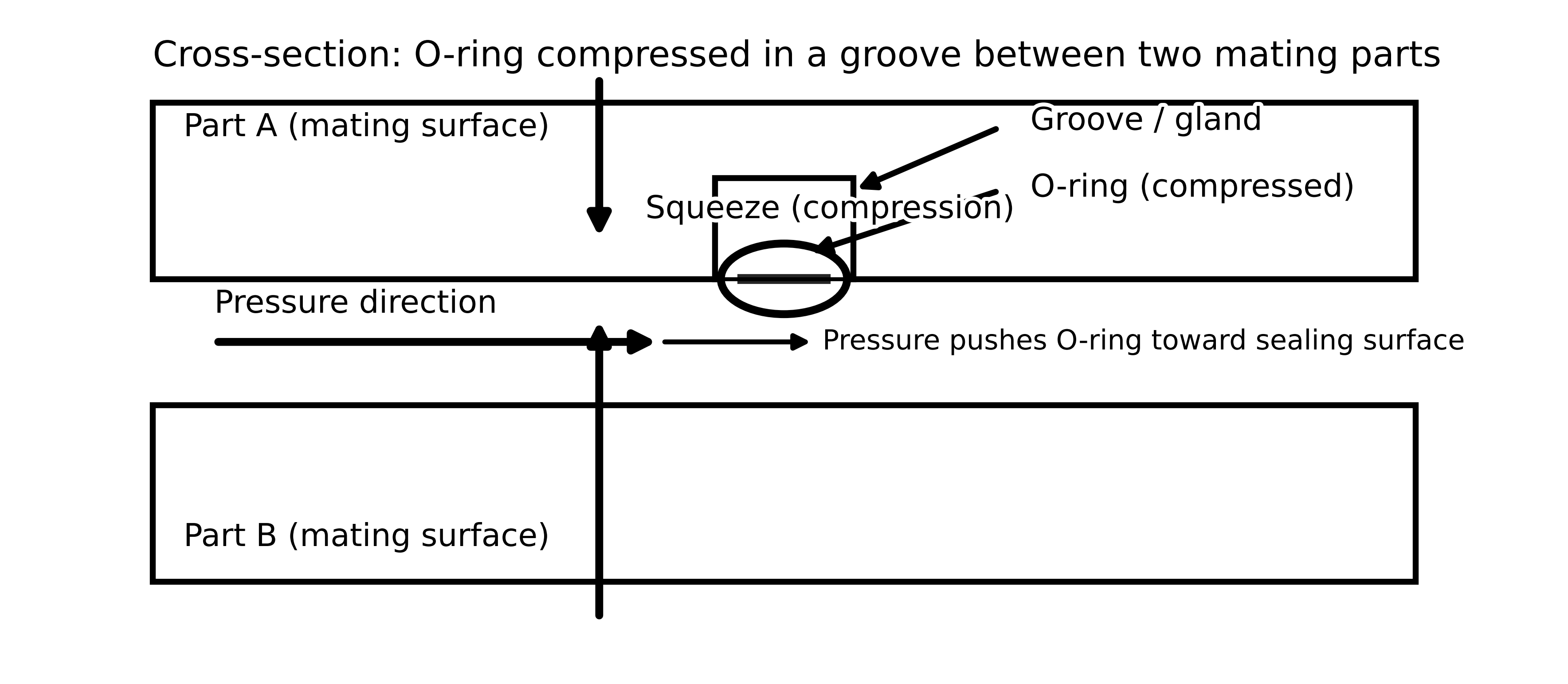
O-rings seal in a simple, repeatable way:
Squeeze: The O-ring sits in a groove (gland). When the two parts come together, the O-ring gets compressed. That controlled squeeze is what starts the seal.
Sealing line: Compression makes the rubber “flow” slightly and conform to tiny surface imperfections, creating a continuous sealing line all the way around the ring.
Pressure assist: In many applications, system pressure pushes the O-ring more firmly against the low-pressure side of the groove and mating surface. Done right, higher pressure can actually increase sealing force up to the point where extrusion risk becomes the limiting factor.
Static vs dynamic: what changes?
The core sealing principle is the same in both cases (controlled squeeze in a groove), but motion changes the rules:
Static sealing (no movement): The O-ring is compressed and stays put. Success is mostly about correct gland geometry, surface condition, and material compatibility over time.
Dynamic sealing (movement present): The O-ring must seal while sliding or rotating, so it’s no longer just a “seal”—it also becomes a wear component. That means friction control, lubrication, and installation quality start to matter much more.
If you remember one thing: O-rings work when the groove controls the squeeze, and the material matches the real operating conditions, pressure, temperature, media, and (especially) motion.
What are O-rings used for?
O-rings are used anywhere you need a simple, reliable seal to stop liquid or gas leakage between two parts. The best way to think about applications is by how the parts move and what the seal is exposed to because that determines material choice, groove design, and expected life.
Static sealing examples
Static applications are the most common and typically the most forgiving. O-rings are used to seal:
Covers and end caps on housings and gearboxes
Flange joints in piping, manifolds, and process equipment
Valve bodies, fittings, and threaded ports (where an elastomer seal prevents weeping)
Enclosures and inspection plates that need repeated open/close access
Dynamic sealing examples
Dynamic applications involve sliding or rotating contact, which increases wear and makes design/material selection more critical. O-rings are used in:
Hydraulic and pneumatic cylinders (rod and piston sealing in lighter-duty cases)
Reciprocating rods and plungers in actuators and pumps
Rotating shafts and swivels (typically lower speed/lower duty designs)
Valve stems and spools where motion is frequent and friction matters
Environment-driven examples
Even if the geometry is the same, the environment can change what works:
Hot/cold cycling: thermal expansion/contraction can stress seals and accelerate compression set
Chemical exposure: oils, fuels, solvents, disinfectants, and cleaners can swell, soften, or crack the wrong compound
Abrasive contamination: dust, grit, metal fines, or slurry can abrade sealing surfaces and cut seal life fast
Outdoor/ozone/UV exposure: certain elastomers age faster without the right formulation
Why the “right” O-ring matters
In real operations, an O-ring failure isn’t just a drip; it can mean unplanned downtime, scrapped product, safety exposure, environmental cleanup, or repeat service calls. That’s why high-uptime applications treat O-rings as engineered components: the right material + correct sizing + proper groove design is usually cheaper than a single failure event.
What are O-rings made of?
Most O-rings are made from elastomers (rubber-like polymers) formulated into specific compounds. Two “NBR” O-rings can behave very differently because fillers, cure system, hardness (durometer), and post-curing all change real-world performance.
What “material selection” really means
You’re not choosing “rubber.” You’re matching the compound to:
Compatibility: Will the seal resist the actual fluid/gas and any cleaning agents?
Temperature: Continuous temperature plus spikes/cycling (hot/cold swings accelerate set and aging).
Compression set: How well it holds sealing force over time (especially in static joints).
Dynamic wear: If there’s motion, the O-ring becomes a wear part—friction and abrasion matter more.
Materials Shortlist Guide
Material | Best for (fast) | Avoid when | Cost tier |
|---|---|---|---|
NBR (Buna-N) | General-purpose; many oil/fuel seals | Ozone/weather; harsh chems (case-by-case) | Low |
HNBR | Tougher duty; higher heat than NBR | Some solvents (verify) | Medium |
EPDM | Water/steam; outdoor/ozone | Oils/fuels | Low |
FKM (Viton®) | Heat + oils/fuels/chemicals | Some hot water/steam; low-temp flexibility needs | Medium–High |
Silicone (VMQ/LSR) | Low temps; purity/clean applications | High abrasion/tear; some media | Medium |
FFKM | Extreme chemicals + high heat | Cost-sensitive builds | Very High |
Engineering notes for each material
NBR (Buna-N)
Temp notes: Moderate range (depends heavily on compound)
Media notes: Common choice for oils/fuels; verify against exact fluid/additives
Dynamic suitability: Medium (works, but friction/wear must be managed)
Compliance note: Food/water grades exist; verify certification/compound
HNBR
Temp notes: Higher heat capability than NBR (compound-dependent)
Media notes: Strong mechanical performance for tougher duty cycles
Dynamic suitability: Medium High (often selected for durability)
Compliance note: Verify per compound and requirement
EPDM
Temp notes: Often used across wide low-to-mid ranges (compound-dependent)
Media notes: Great for water/steam in many cases; generally poor with petroleum oils/fuels
Dynamic suitability: Medium
Compliance note: Potable water/food formulations available — verify certification
FKM (Viton®)
Temp notes: Typically stronger high-temp resistance (compound-dependent)
Media notes: Strong with many oils/fuels/chemicals; always verify with your exact media
Dynamic suitability: Medium (can do dynamic, but friction/heat still matter)
Compliance note: Verify per compound and any industry spec
Silicone (VMQ/LSR)
Temp notes: Excellent low-temp flexibility; heat capability varies by grade
Media notes: Good for many mild media; not ideal for some oils/solvents, verify
Dynamic suitability: Low–Medium (tear/abrasion limits in harsher dynamic use)
Compliance note: Medical/purity grades exist (e.g., USP Class VI), verify
FFKM
Temp notes: High temperature capability (grade-dependent)
Media notes: Chosen when chemical resistance is the priority and failure is expensive
Dynamic suitability: Medium (performance depends on compound + surface finish)
Compliance note: Verify purity/cert requirements for your process
Coatings & lubrication
When it helps
Easier installation (fewer nicks/twists)
Lower friction/heat in dynamic use
Reduced stick-slip in light motion
When it doesn't
It won’t fix material incompatibility
It won’t fix a bad gland (wrong squeeze/clearance/surface finish)
Rule: only use lubricants/coatings that are compatible with the compound + process media + cleaners.
How do you measure and size an O-ring?
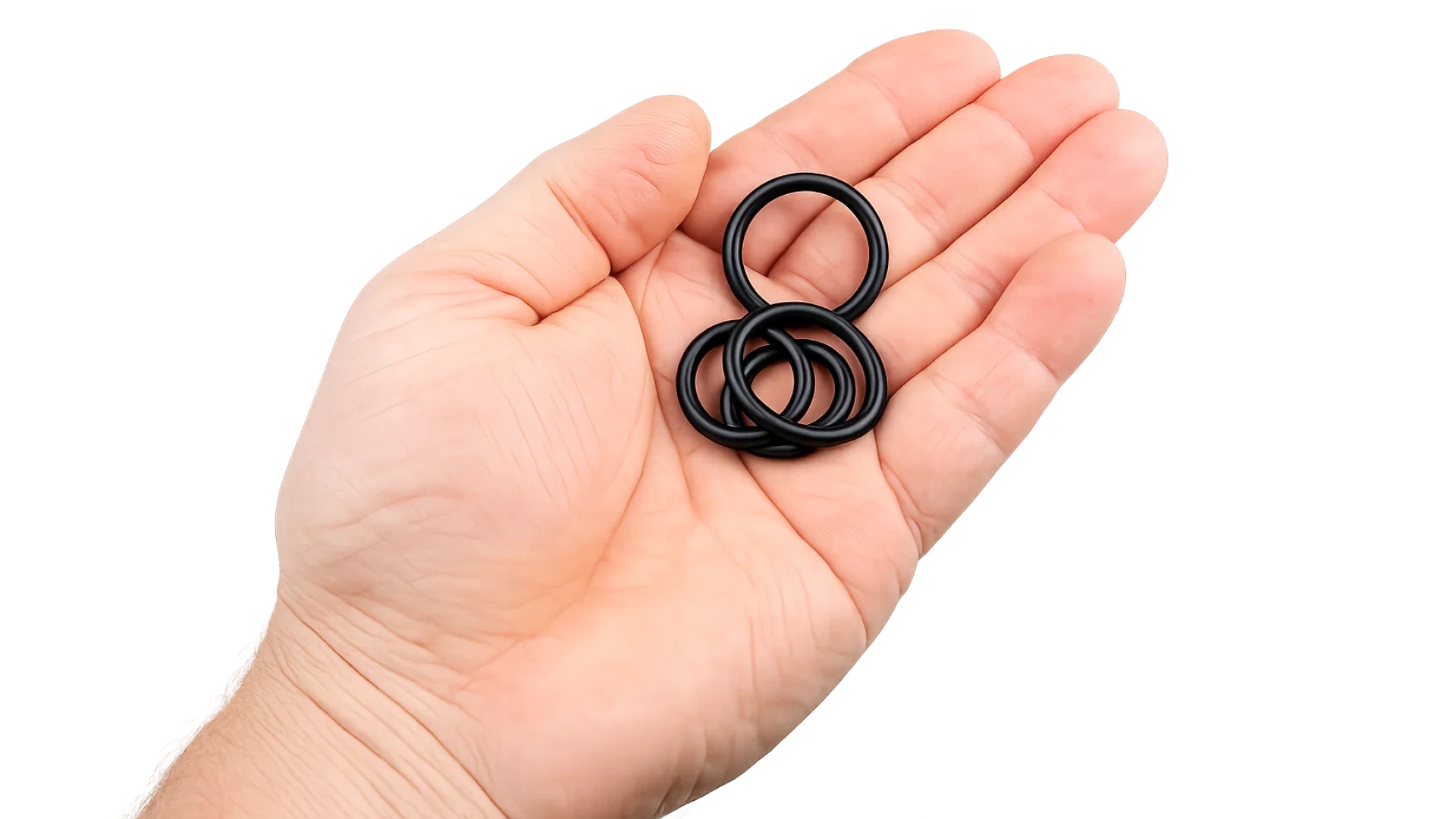
When people get O-rings “almost right,” sizing is usually why. The good news: you only need two measurements to identify an O-ring correctly, and everything else is just making sure it fits the groove the way it’s supposed to.
The only measurements that matter
ID (Inner Diameter): the diameter of the center hole.
Cross-section (CS/thickness): how thick the O-ring cord is.
That’s it. If you have an ID + cross-section, you can match an O-ring to standard size charts or a supplier’s catalog.
Standards (quick mention, no rabbit hole)
The most common O-ring sizes are organized under:
AS568 (inch-series sizes commonly used in the U.S.)
Metric / JIS (metric-series sizes; often used in global equipment and imported components)
You don’t need to memorize standards; you just need to know which system your equipment uses, so you don’t accidentally mix inch and metric parts.
Common sizing mistakes (and how to avoid them)
Measuring the OD instead of ID + CS. OD can be misleading because it changes with stretch/compression.
Mixing inch and metric sizes. A “close” match can still leak or fail early.
Measuring a worn or flattened O-ring. A compression set makes the cross-section smaller than the original.
Ignoring stretch. Forcing a small ID onto a large diameter can over-stretch and thin the cross-section.
Assuming “same size” means “same performance.” Durometer and material matter just as much as geometry.
When an O-ring kit helps vs when you need the exact spec
Use an O-ring kit (assortment) when you’re doing routine maintenance on common fittings/ports, and you need a fast, workable replacement you can confirm quickly (fit, no pinch, no leak) without putting a critical asset at risk.
Insist on the exact spec when the seal is tied to uptime or safety, high pressure, any meaningful motion (dynamic), aggressive chemicals/cleaners, wide temperature swings, or a non-standard groove, because a “close” size or wrong compound can turn into repeat leaks, accelerated wear, or downtime.
How do you choose the right O-ring fast?
Use this 5-question checklist. If you can answer these, you can usually pick the right material + hardness + size (or quickly spot when you need a different seal style).
The 5-question checklist
What media touches the seal?
List the actual fluid/gas (and additives), plus any cleaners/CIP chemicals it will see.
What’s the temperature range?
Minimum, maximum, and any spikes or thermal cycling.
Is it static or dynamic?
No movement vs sliding/rotating. If dynamic, note the type of motion + speed/frequency.
What pressure does it see (and is extrusion a risk)?
Include normal pressure, spikes, and whether there’s a clearance/gap that could let the O-ring extrude.
Any compliance/cleanliness requirements?
Potable water, food contact, medical/cleanroom, low-outgassing, etc. (Specify the standard if you have one.)
The fastest way to get a correct recommendation
When requesting an O-ring recommendation or quote, send this minimum spec set:
Size: ID + cross-section (or the standard size if known)
Material requirement: media + temperature (and cleaning chemicals)
Application type: static vs dynamic + motion details
Pressure: normal + spikes + any extrusion/clearance concern
Context: quantity, lead-time target, and any compliance requirement
That single bundle prevents “almost right” O-rings and cuts rework, leaks, and repeat orders.
Why do O-rings fail (and how do you prevent it)?
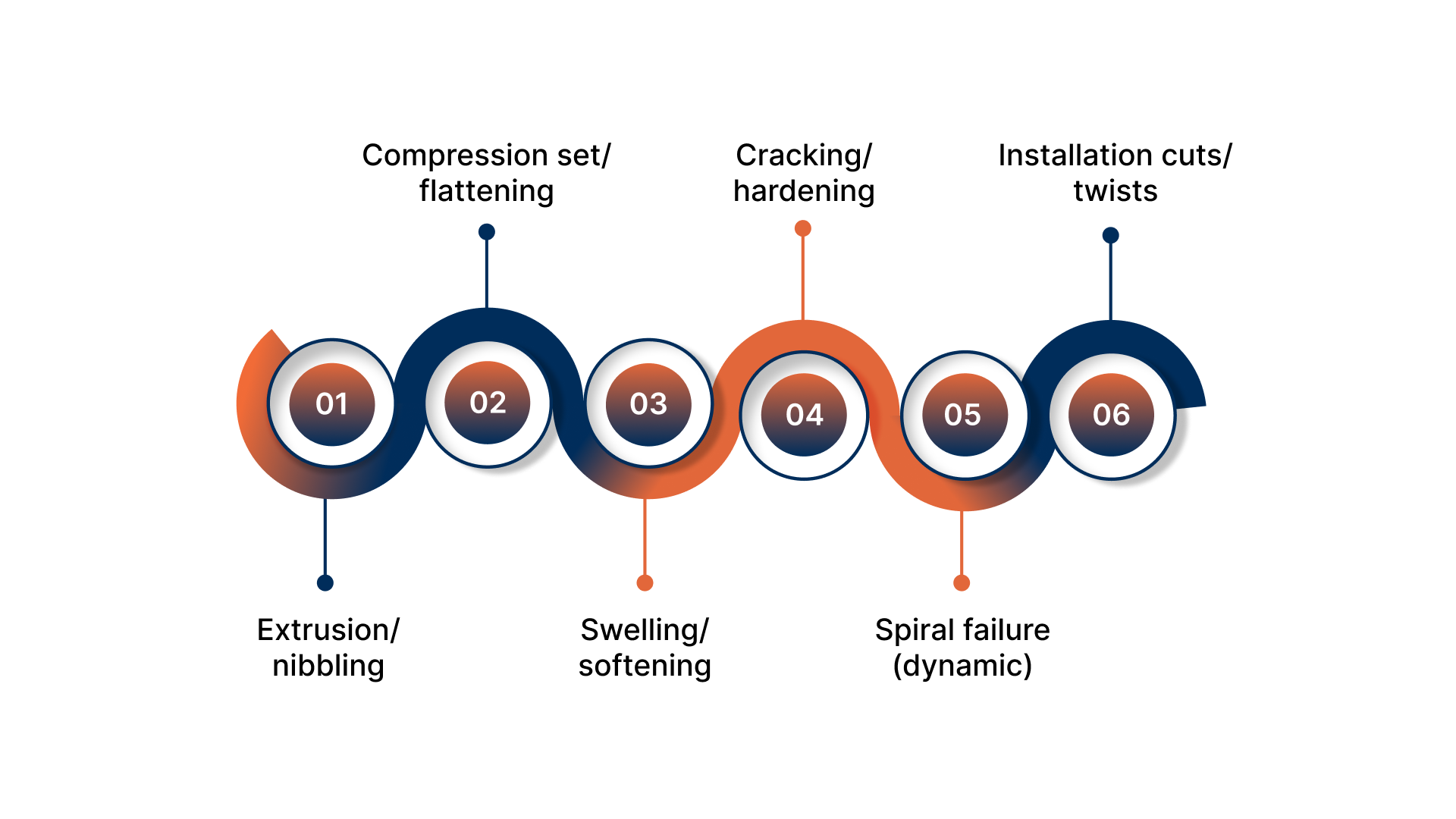
Most O-ring failures aren’t “mysteries”; they’re predictable symptoms of the wrong material, wrong gland conditions, or the wrong seal style for the duty. Use this as a quick troubleshooting map: what you see → what it usually means → what to change first.
Failure modes → fastest fix
Extrusion/nibbling
Looks like: chewed edges, small bites missing, ragged “shaved” areas on the low-pressure side
Most likely cause: too much clearance gap for the pressure, pressure spikes, O-ring too soft
Fastest fix: add a back-up ring, increase hardness (durometer), reduce clearance, or change seal style for the pressure
Compression set/flattening
Looks like: O-ring stays flattened after removal, won’t rebound, leaks after time-in-service
Most likely cause: compound not suited for temperature/time, insufficient recovery, over-squeeze, long static dwell at heat
Fastest fix: choose a compound with better compression-set resistance for the temp; verify squeeze/gland; avoid heat-soak if possible
Swelling/softening
Looks like: ring grows, feels gummy, rolls or extrudes easily, loss of shape/strength
Most likely cause: chemical incompatibility (fluid/additives/cleaners)
Fastest fix: switch to a compatible compound (don’t “band-aid” with lube); confirm all exposures, including cleaners/CIP fluids
Cracking/hardening
Looks like: surface cracks, brittleness, chunks breaking off, loss of elasticity
Most likely cause: heat aging, ozone/UV, incompatible chemicals, low-temp brittleness (depending on material)
Fastest fix: pick a compound rated for the environment (heat + ozone/UV + media); store/handle correctly; consider protective design if exposed
Spiral failure (dynamic)
Looks like: twisted “corkscrew” shape or diagonal wear marks; inconsistent sealing in reciprocating motion
Most likely cause: dynamic motion + friction causing the ring to roll/twist, poor lubrication, marginal groove design
Fastest fix: move to an X-ring (often more stable in dynamic), improve lubrication, reduce friction drivers, or use a dedicated dynamic seal
Installation cuts/twists
Looks like: nicks, slices, shaved spots, pinched sections; immediate or early leak
Most likely cause: sharp edges/threads, no lead-in chamfer, dry install, over-stretching during assembly
Fastest fix: add chamfers/assembly sleeves, lubricate with a compatible lubricant, use proper tools, avoid twisting during install
Prevention checklist
Match compound to every exposure (process media + additives + cleaning chemicals)
Confirm temperature range + spikes/cycling, not just “normal operating.”
Validate pressure + pressure spikes, then check extrusion risk (clearance gap)
Keep gland geometry and surface finish within spec (most “mystery leaks” start here)
For dynamic sealing, control friction (material choice + lubrication + surface condition)
Improve assembly: chamfers, deburring, proper lube, avoid over-stretching
When in doubt, save the failure sample and document: media, temp, pressure, motion, time-to-fail
When to stop changing materials and change the seal
If you’ve already tried the right material and you still see extrusion/nibbling at pressure, repeat wear in dynamic motion, or spiral/twist damage, that’s usually a sign the application wants a different setup like O-ring + back-up ring, an X-ring, or a purpose-built hydraulic/dynamic seal, rather than “another O-ring compound.”
When an O-ring isn’t the right seal
When you hit those repeat-failure patterns, the next step isn’t another material swap; it’s a faster decision: which seal style is actually built for your duty cycle and failure driver.
The table below is a quick “use this when” guide to help you move from symptoms (motion, pressure spikes, extrusion marks, contamination, cylinder duty) to the right option: X-rings, back-up rings, hydraulic seals, or V-seals/wipers without overcomplicating it.
If this is your situation… | Use this | Why is it the better fit | What to verify (so it actually works) |
|---|---|---|---|
Static joint, moderate pressure, normal duty (covers, housings, flanges) | O-ring | Simplest, lowest-cost seal when there’s no motion | Correct squeeze + correct compound for media/temp |
Dynamic motion (reciprocating/rotary) and you’re seeing twist/rolling, uneven wear, or inconsistent sealing | X-ring | More stable in motion; reduces twist risk vs an O-ring | Groove compatibility, lubrication plan, surface finish |
High pressure or pressure spikes + you see extrusion/nibbling (chewed edges) | O-ring + back-up ring | Back-up ring blocks extrusion into clearance gaps | Gap/clearance, pressure direction, back-up ring placement |
Hydraulic cylinder duty (high cycles, side loading, contamination, tight leakage control) | Hydraulic seal set | Purpose-built for wear + pressure + leakage control (O-rings are often not the primary dynamic seal here) | Gland design, rod/piston surface finish, system contamination |
Rotating shaft where contamination exclusion matters (dust, slurry, washdown splash) | V-seal / wiper (as an excluder) | Keeps dirt out and helps protect the primary seal | Shaft finish, speed, runout/misalignment; usually not the only seal |
You keep “fixing” by changing compounds, but failures repeat (wear, extrusion, spiral damage) | Change seal style first (X-ring / back-up ring / hydraulic seal) | Repeating failure patterns usually point to a design/duty mismatch, not just material | Motion type, pressure spikes, gap/clearance, installation damage points |
Sanitary/clean environments (potable/food/medical) | O-ring or X-ring in certified compound | Geometry often stays; the compound + documentation controls the risk | Certification requirements, traceability, cleaning chemicals/CIP exposure |
Bottom line: choose the seal style based on the failure driver: motion points you toward X-rings or hydraulic seals, pressure/extrusion points to an O-ring + back-up ring, and contamination control points to V-seals/wipers, so you fix the root cause instead of repeating the same O-ring failure cycle.
Why Detroit Sealing Components for O-rings and sealing support?
Detroit Sealing Components supports O-ring programs in two practical ways: supply (stocking/distribution) and selection support when the application is harsh, or failure is expensive.
Stocked supply for repeat demand: helps teams avoid downtime and reorders when they’re buying across multiple sizes and compounds.
Material guidance tied to conditions: support for matching compound/durometer to media, temperature, pressure, and motion—where most failures start.
Next-step sealing options: access to X-rings, back-up rings, hydraulic seals, and kits when an O-ring isn’t the right design for the duty.
Engineering mindset (when failures repeat): references capabilities like FEA and structured problem-solving methods for selection/validation.
For the fastest match, share ID + cross-section, media + temperature, pressure/spikes, and whether it’s static or dynamic, plus gland details/drawing if you have it. Get an O-Ring Match Fast.
Conclusion
O-rings are simple by design, but reliable sealing isn’t about guessing—it’s about matching the size, compound, and seal style to the real operating conditions.
Start with the basics (ID + cross-section, media, temperature, pressure, and motion), watch for the failure signatures that point to design limits, and don’t hesitate to step up to X-rings, back-up rings, or purpose-built dynamic seals when the duty demands it.
If you want to eliminate trial-and-error, validate the groove design and operating conditions before swapping materials and step up to X-rings, back-up rings, or dedicated dynamic seals when the duty demands it.
FAQs
What are O-rings used for?
O-rings are used to seal liquids or gases between two parts. They’re common in static joints (covers, housings, flanges) and are also used in some dynamic applications (sliding/rotating parts) when the groove design, lubrication, and material are chosen correctly.
How do O-rings work?
An O-ring sits in a groove (gland) and seals by controlled compression (squeeze). That squeeze creates a continuous sealing line, and system pressure often pushes the O-ring harder into the sealing surface, improving sealing—until extrusion risk becomes the limiting factor.
What are O-rings made of?
Most O-rings are made from elastomer compounds such as NBR, HNBR, EPDM, FKM, silicone, or FFKM. The “right” material depends on fluid/gas compatibility, temperature range, pressure, and whether there’s motion (wear/friction).
How do I measure an O-ring?
Measure ID (inner diameter) and cross-section (thickness). Avoid measuring only the outer diameter, and don’t measure a severely flattened/worn ring if you can help it—compression set can throw off the cross-section.
Do O-rings need lubrication?
Sometimes. Lubrication can help reduce friction, prevent installation damage, and improve life in dynamic applications. But it won’t fix the wrong material or a bad groove—use only lubricants compatible with the O-ring compound and the media.
Why do O-rings fail?
The most common causes are material incompatibility (swell/soften/crack), compression set, extrusion from pressure/clearance gaps, dynamic wear/spiral failure, and installation damage (cuts/twists). Matching the material and seal style to the duty cycle is the fastest way to prevent repeats.