Introduction
A single failed O-ring can trigger an unplanned shutdown, a costly leak, or a contamination event — across automotive, aerospace, oil & gas, food processing, and semiconductor manufacturing alike. What's less obvious is where many of those failures start: the storage room, not the field.
Many engineers focus on material selection and sizing, then assume the seals will perform as specified when installation day arrives. The problem is that elastomers age. Poor storage conditions can degrade an O-ring well before its rated shelf life expires, while proper storage can preserve seals right through their rated window.
This guide covers what you need to know to protect that investment:
- Material-specific shelf life ratings per SAE AS5316
- How cure dates and expiration windows are calculated
- Storage environment requirements
- How to inspect seals before installation
Key Takeaways
- SAE AS5316 defines shelf life by material: FKM, Silicone, and EPDM are unlimited; NBR is 15 years; Polyurethane 5 years; SBR just 3 years
- Those ratings only hold under correct storage conditions — temperature, humidity, ozone, and physical deformation all shorten seal life
- Cure dates use a quarter-year format; the shelf life clock starts at the last day of the cure quarter
- FIFO stock rotation prevents seals from quietly aging past their rated life on a warehouse shelf
- Seals past their labeled date aren't automatically scrap — inspection determines fitness
O-Ring Shelf Life by Material Type
The Governing Standard
SAE AS5316 (published November 2022) is the current industry standard for storage of elastomeric seals and seal assemblies prior to hardware assembly. It supersedes the historical SAE ARP5316D (2014). Compliance is driven by contract and procurement specifications rather than universal mandate — but AS5316 is widely adopted as the practical reference across aerospace, oil & gas, and defense supply chains.
Parker Hannifin's O-Ring and Engineered Seals Division explicitly accepts AS5316 as a sound basis for establishing shelf life, making their published ratings a reliable tier-1 reference.
Shelf Life Reference Table
| Material Name | Common Trade Name | ASTM Abbreviation | Shelf Life Rating |
|---|---|---|---|
| Fluorocarbon | Viton | FKM | Unlimited |
| Perfluoroelastomer | Kalrez | FFKM | Unlimited |
| Silicone | — | VMQ | Unlimited |
| Fluorosilicone | — | FVMQ | Unlimited |
| Ethylene Propylene | EPDM | EP/EPDM | Unlimited |
| Butyl | — | IIR | Unlimited |
| Tetrafluoroethylene Propylene | Aflas | FEPM | Unlimited |
| Nitrile | Buna-N | NBR | 15 Years |
| Hydrogenated Nitrile | — | HNBR | 15 Years |
| Chloroprene | Neoprene | CR | 15 Years |
| Polyacrylate | — | ACM | 15 Years |
| Ethylene Acrylic | — | AEM | 15 Years |
| Polyurethane (millable) | — | AU | 5 Years |
| Styrene Butadiene | — | SBR | 3 Years |
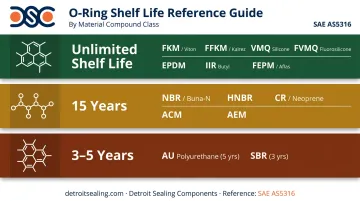
Ratings per Parker O-Ring Division AS5316-based guidance under proper storage conditions. HNBR, ACM, and AEM are included in Parker's expanded list; these are not directly covered in AS5316 text.
What "Unlimited Shelf Life" Actually Means
Materials like FKM, Silicone, EPDM, and FFKM show no inherent chemical pathway for degradation from normal atmospheric exposure. Their polymer backbone resists ozone attack, oxidation, and thermal aging under ambient conditions.
"Unlimited" doesn't mean invulnerable. It means the material has no theoretical ceiling when stored correctly. Physical mishandling, contact with incompatible substances, or elevated temperatures can still damage these seals.
Why NBR and SBR Age Faster
Shorter-lived materials like NBR and SBR contain carbon-carbon double bonds in their polymer chains that are reactive sites for:
- Oxidation — oxygen attacks the chain, causing hardening and eventual cracking
- Ozone attack — ozone cleaves double bonds aggressively, producing surface cracking even at very low concentrations
- Thermal degradation — elevated temperatures accelerate all chemical aging processes
The result is hardening, surface cracking, or in some cases, surface tackiness — none of which are compatible with functional sealing. These processes aren't instantaneous, but they accelerate quickly under poor storage conditions.
That means the clock on a 15-year NBR seal can start running long before it reaches you, depending on how the distributor stores and turns over inventory. DSC stocks O-rings across all major elastomer families — NBR, FKM, HNBR, EPDM, Silicone, FFKM, Fluorosilicone, Chloroprene, Polyurethane, and more — with inventory management practices designed to protect rated shelf life from warehouse to delivery.
How Cure Dates and Expiration Dates Are Calculated
The Quarter-Year System
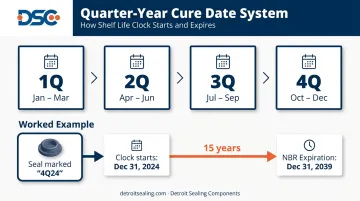
The rubber industry uses a quarter-year dating convention to mark when a seal was vulcanized. Quarters map as follows:
- 1Q = January–March
- 2Q = April–June
- 3Q = July–September
- 4Q = October–December
The shelf life clock starts at the last day of the cure quarter, per Parker and Apple Rubber manufacturing practice. SAE AS5316 references "time of manufacture" without explicitly prescribing the quarter method — so treat quarter-based dating as manufacturer practice rather than AS5316 text.
Worked example: An O-ring molded in November 2024 is marked 4Q24. The cure quarter ends December 31, 2024. For an NBR seal with a 15-year rating, expiration falls on December 31, 2039.
Confirming Cure Date Documentation
Buyers should confirm with their supplier how cure dates are marked — the format affects expiration calculations directly. Key details to verify with your supplier:
- Marking location: individual packaging, lot documentation, or certificates of conformance
- Format used: quarter-year notation (e.g., 4Q24) vs. exact manufacture date
- Consistency across suppliers: mixed formats can lead to inconsistent expiration calculations that affect stock rotation decisions
Getting this right upfront prevents gaps in traceability — particularly for aerospace, automotive, and oil & gas applications where documentation audits are routine.
Shelf Life Is a Guideline, Not a Guarantee
A stated expiration date assumes correct storage throughout the seal's life. Proper handling preserves quality through the rated window; poor conditions can cause failure well before that date arrives. The rating reflects material science under controlled conditions — seals stored in heat, UV exposure, or near ozone sources can degrade in months, regardless of what the label says.
FIFO Stock Rotation
First In, First Out (FIFO) stock rotation should be standard practice for O-ring inventories. Older stock gets consumed before newer stock, preventing seals from silently aging past their rated life in the back of a warehouse. This matters most for NBR and SBR inventories, where rated shelf life windows are shortest.
O-Ring Storage Best Practices
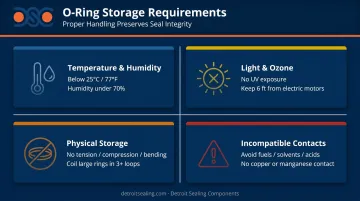
The storage environment directly determines whether an O-ring reaches its rated shelf life. The requirements below draw from ISO 2230-based guidance (Trelleborg, June 2024) and the Parker O-Ring Handbook.
Temperature and Humidity Control
- Preferred storage temperature: below +25°C (+77°F) per ISO 2230-based guidance
- Parker O-Ring Handbook maximum: 49°C (120°F) for longest storage life
- Avoid direct heat sources — radiators, boilers, and direct sunlight
- Relative humidity must stay below 70% for general rubber products
- Below 65% for polyurethanes specifically
- No condensation permitted
- Seals stored in sealed moisture-proof bags automatically satisfy the humidity requirement
Light, Radiation, and Ozone
UV radiation degrades elastomer surfaces. Ozone is particularly aggressive toward materials with unsaturated polymer chains.
- Store O-rings away from direct sunlight and intense artificial light with UV content
- Cover storage room windows with UV-blocking coatings or red/orange screens
- Keep storage areas free from ozone-generating equipment: mercury vapor lamps, high-voltage electrical equipment, motors producing electrical discharge
- Per the Parker O-Ring Handbook, don't store O-rings within six feet of an operating electric motor
- Exclude combustion gases and organic vapors from storage areas
Deformation and Physical Stress
Seals stored under mechanical stress develop permanent set — they lose the elasticity needed to form an effective seal.
- Store O-rings free from tension, compression, bending, twisting, or hanging
- Large-diameter O-rings should be coiled into at least three equal loops to avoid creasing
- Never stack heavy items on top of bagged seals
Contact with Incompatible Materials
- Avoid contact with fuels, greases, acids, solvents, and cleaning fluids (or their vapors)
- Keep seals away from copper and manganese, which can trigger material breakdown
- Do not store different elastomer compounds in contact with each other — cross-contamination between rubber types can cause surface degradation
- Individual packaging or separate containers minimize cross-contamination risk
How to Inspect an O-Ring Before Use
An O-ring past its labeled shelf life date is not automatically scrap. Conversely, a seal still within its rated window may already be compromised if it was stored improperly. Both scenarios warrant inspection before installation.
Pre-Installation Inspection Checklist
Before installing any O-ring — particularly from aging stock — check for the following disqualifying conditions:
- Surface cracking or checking — fine cracks indicate ozone or oxidation damage; use 10x magnification (per Trelleborg guidance) since surface checking is often invisible to the naked eye
- Hardening or loss of resilience — lightly compress the seal and release; it should spring back promptly
- Tackiness or surface softening — indicates chemical breakdown of the polymer
- Permanent deformation or flat spots — creasing from improper storage creates localized weak points
- Discoloration — unusual color changes may indicate chemical exposure
- Visible tears, cuts, or abrasion — any mechanical damage is cause for rejection
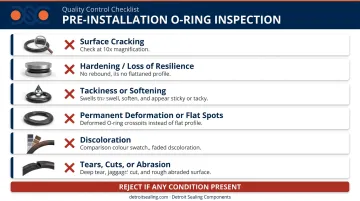
At 2x magnification with adequate illumination on an unstretched O-ring, Trelleborg's guidance holds that cracks, ruptures, or blisters above specified limits are not acceptable.
When Visual Inspection Isn't Enough
For critical applications in aerospace, oil & gas, semiconductor manufacturing, or healthcare, visual and tactile inspection alone may not provide a reliable result. Aged seals in high-stakes environments warrant compound verification or mechanical testing.
DSC operates an ISO 17025 accredited laboratory capable of material development and testing, including reliability analyses under real application conditions — useful when seal failure carries safety or operational consequences.
Conclusion
O-ring shelf life isn't bureaucratic paperwork — it reflects real material chemistry. The ratings exist because elastomers age, and the rate of aging depends heavily on how seals are stored between manufacture and installation. Following the storage requirements outlined in ISO 2230 and SAE AS5316 is the practical path to protecting your seal investment.
The complete approach looks like this:
- Select the right compound for the application's temperature, media, and service life requirements
- Source from suppliers who maintain proper storage practices and provide cure date documentation
- Track cure dates using quarter-year notation and apply FIFO rotation to all O-ring inventory
- Control the storage environment — temperature below 25°C, humidity below 70%, no UV or ozone exposure, seals stored without deformation
- Inspect every seal before installation, regardless of shelf life status
Most seal failures that trace back to storage are entirely avoidable. Getting the compound right, sourcing from a supplier who tracks cure dates, and maintaining a disciplined storage environment — those three steps eliminate the majority of premature failures before a seal ever reaches the assembly line. DSC maintains cure date documentation and stocks hundreds of compounds across all rubber types, so the sourcing side of this checklist is straightforward to execute.
Frequently Asked Questions
Do O-rings have a shelf life?
Yes — most elastomeric O-rings carry defined shelf life ratings governed by SAE AS5316. Ratings vary by material — FKM and Silicone are rated unlimited, NBR carries 15 years, and SBR just 3 years. Actual storage conditions determine whether a seal reaches its rated life.
What is the shelf life of elastomers?
Shelf life ratings under SAE AS5316 guidance:
- 3–5 years: SBR (3 yrs), Polyurethane/AU (5 yrs)
- 15 years: NBR, HNBR, Chloroprene
- Unlimited: FKM, EPDM, Silicone, Fluorosilicone, FFKM
All ratings assume correct storage conditions.
What is the shelf life of Viton?
Viton (FKM) O-rings carry an unlimited shelf life rating based on Parker's AS5316-aligned guidance. The material's fluorocarbon chemistry resists oxidation, ozone, and thermal aging under ambient conditions. "Unlimited" still requires proper storage — inspect seals for hardening, cracking, or surface damage before installation regardless of age.
What is the cure date of an elastomer?
The cure date is when the elastomeric seal was vulcanized during manufacturing. It's recorded in quarter-year format — for example, 2Q24 means the seal was cured in the second quarter of 2024 (April–June). This date is the starting reference point for calculating shelf life expiration.
How should O-rings be stored?
Follow these storage essentials to protect shelf life:
- Keep temperature below 25°C (77°F) with humidity under 70% (65% for polyurethanes)
- Shield seals from sunlight, UV exposure, and ozone-generating equipment
- Store flat without tension, compression, or deformation
- Segregate from incompatible metals, fluids, and other elastomer compounds
What temperature should rubber be stored at?
ISO 2230-based guidance recommends storage below +25°C (+77°F), with a preferred target of +15°C (+59°F). The Parker O-Ring Handbook cites a maximum of 49°C (120°F) — exceed this threshold and storage life degrades rapidly.