What makes selection difficult is that "oil resistant" means different things for different materials. A compound that seals mineral oil reliably at 200°F may swell, harden, or lose tensile strength in contact with synthetic lubricants or at elevated temperatures. Choosing by familiarity or price alone is how premature failures happen.
This guide compares the five most proven oil-resistant gasket materials — NBR, FKM/Viton, Neoprene, PTFE/ePTFE, and HNBR — covering performance specifications, ideal applications, and the selection criteria that actually matter in service.
Key Takeaways
- NBR (Nitrile) is the go-to for petroleum oils, mineral oils, and hydraulic fluids at moderate temperatures — best performance-to-cost ratio
- FKM/Viton handles aggressive fuels, synthetic lubricants, and high-heat oil service beyond NBR's limits
- Neoprene (CR) suits crude/unrefined oil and outdoor environments at lower cost, but fails with refined fuels and synthetic lubricants
- For aggressive chemistries, high-purity systems, or cryogenic service, PTFE/ePTFE is chemically inert across virtually all oil types
- HNBR fills the gap between NBR and FKM for hot oil, sour gas, and oilfield use where mechanical durability matters
What Are Oil Resistant Gaskets and Why Does Material Selection Matter
Oil-resistant gaskets are sealing components engineered for sustained direct contact with petroleum-based fluids, synthetic oils, hydraulic fluids, and fuels — without swelling, cracking, or losing compressive strength under operating conditions.
Rubber compounds don't respond uniformly to oil — they react at the molecular level based on their formulation. For NBR, the ACN content — which Zeon lists from 19% to 50% — directly controls the oil resistance versus low-temperature flexibility tradeoff. Higher ACN content improves fuel and oil resistance but limits cold-temperature performance. Change the compound, and you change the performance envelope entirely.
This matters in practice because compatibility ratings from standard chemical resistance charts are based on laboratory immersion tests at room temperature. As Trelleborg cautions in their compatibility guide, those ratings may not capture real service effects from additives, impurities, elevated temperature, or mechanical stress. Screening data is a starting point, not a deployment guarantee.
Oil-resistant gaskets are mission-critical across several industries:
- Automotive engines and transmission systems
- Oil & gas pipelines, valves, and drilling equipment
- Hydraulic and pneumatic systems
- Agriculture and construction equipment
- Chemical processing and industrial machinery
Each environment carries its own temperature range, pressure load, fluid chemistry, and compliance requirements. That's why the material comparisons below matter: the right compound in one application can fail quickly in another.
Top 5 Oil Resistant Gasket Materials Compared
The five materials below represent the most commonly specified options for oil resistance across industrial, automotive, and process applications. Evaluation criteria include oil swell resistance, operating temperature, pressure compatibility, and breadth of real-world application.
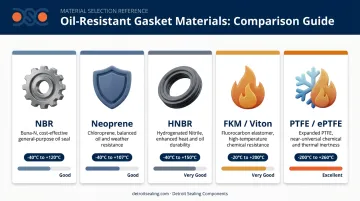
Nitrile (NBR — Buna-N)
NBR is a synthetic rubber copolymer with ACN content typically ranging from 19–50%. It's the industry default for sealing refined petroleum oils, mineral oils, and hydraulic fluids — practical, widely available, and economical for standard oil service.
What sets NBR apart: Strong compatibility with aliphatic hydrocarbons, mineral oils, diesel fuel, and hydraulic fluids. Works with a broad range of flange materials and fits most standard gasket geometries. Its main weaknesses are poor ozone/UV resistance and reduced service life above approximately 250°F.
| Property | NBR Performance |
|---|---|
| Temperature Range | –40°F to 250°F (–40°C to 121°C); shorter life near upper limit |
| Oil Resistance | Very good — refined petroleum, mineral oil, hydraulic fluids; moderate for some synthetics |
| Best Applications | Automotive engine gaskets, oil seals, hydraulic system gaskets, fuel system seals, storage tank gaskets |
Viton / FKM (Fluoroelastomer)
FKM is a premium fluoroelastomer with strong resistance to aggressive fuels, sour gas, aromatic hydrocarbons, and synthetic lubricants. It originated in aerospace sealing and has become the standard for high-temperature and chemically demanding oil service.
What sets Neoprene apart: Handles crude and unrefined oil adequately, ages well outdoors, and performs in HVAC and marine sealing where UV and ozone exposure are concerns.
The compatibility ceiling is clear in Trelleborg's ratings — Neoprene earns a "U" (unsatisfactory) for diesel and automotive gasoline, and shows approximately 120% volume swell in IRM 903 oil at 70 hours. Not a substitute for NBR or FKM in refined fuel or synthetic lubricant service.
| Property | Neoprene Performance |
|---|---|
| Temperature Range | –35°F to 212°F (–35°C to 100°C); short-term to 120°C |
| Oil Resistance | Moderate — crude/unrefined oils; not recommended for refined fuels or synthetic lubricants |
| Best Applications | Crude oil systems, HVAC equipment, marine applications, outdoor sealing, refrigeration |
PTFE / Expanded PTFE (ePTFE)
PTFE and ePTFE are non-elastomeric fluoropolymers that are chemically inert across virtually all oil and chemical types. Where rubber compounds face compatibility limits, PTFE doesn't — making it the default choice for aggressive fluid chemistry, high-purity environments, and extreme temperature ranges.
What sets PTFE/ePTFE apart:
- Garlock's GYLON product line is rated from –450°F to 500°F; GORE ePTFE sheet gasketing extends to 600°F
- ePTFE conforms to irregular flange surfaces — useful on worn or pitted flanges
- Complies with FDA 21 CFR 177.1550 for food-contact applications
- Requires higher bolt load than rubber gaskets; standard sheet is subject to cold flow under sustained compressive load (modified/expanded grades address this significantly)
| Property | PTFE/ePTFE Performance |
|---|---|
| Temperature Range | –450°F to 500°F+ (–268°C to 260°C+) depending on grade |
| Oil Resistance | Excellent — chemically inert to virtually all petroleum and synthetic oils |
| Best Applications | Chemical processing, food/pharma oil systems, aggressive solvent environments, cryogenic systems, high-purity applications |
HNBR (Hydrogenated Nitrile Butadiene Rubber)
Hydrogenating standard NBR produces HNBR — a process that significantly improves heat resistance, ozone resistance, and mechanical strength while retaining NBR's core oil and fuel compatibility. It's increasingly specified where standard NBR performance isn't sufficient but FKM cost isn't justified.
What sets HNBR apart: Parker rates heat resistance up to 150°C (300°F), with Zeon's Zetpol grades capable of prolonged exposure at 160°C. Freudenberg lists compatibility with mineral oils, petrol, diesel, and hydraulic oils H, H-L, and H-LP.
On the comparison front, Trelleborg rates HNBR "A" for automotive gasoline — a clear step up from standard NBR's "U" rating for the same fluid. HNBR also qualifies to NORSOK M-710 and API 6A standards for oilfield H₂S and RGD service.
| Property | HNBR Performance |
|---|---|
| Temperature Range | –40°F to 300°F (–40°C to 150°C); select Zetpol grades to 160°C |
| Oil Resistance | Very good to excellent — superior to NBR for hot oil, sour gas, synthetic engine lubricants |
| Best Applications | Automotive engine seals, oilfield downhole components, power steering, hot oil service, H₂S environments |
Key Factors When Selecting an Oil Resistant Gasket Material
Key Factors When Selecting an Oil Resistant Gasket Material
No single material covers every oil application. The right choice depends on five variables — temperature, fluid chemistry, pressure, regulatory requirements, and total cost.
Operating Temperature
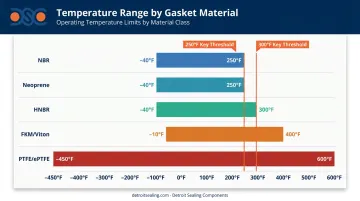
Temperature is the most decisive variable in material selection. As operating temperature increases, the viable material options narrow:
- Below 250°F: NBR handles most petroleum oil applications adequately
- 250°F to 300°F: HNBR is the practical upgrade, offering better heat stability without FKM cost
- Above 300°F sustained: FKM is required; NBR will experience accelerated compression set and seal loss
- Cryogenic to 500°F+: PTFE/ePTFE covers the widest thermal range of any common gasket material
Fluid Chemistry
The specific fluid determines which compounds are chemically compatible:
| Fluid Type | NBR | HNBR | FKM | CR | EPDM |
|---|---|---|---|---|---|
| Mineral oil | ✓ | ✓ | ✓ | Moderate | ✗ |
| Diesel fuel | ✓ | ✓ | ✓ | ✗ | ✗ |
| Automotive gasoline | ✗ | ✓ | ✓ | ✗ | ✗ |
| Synthetic lubricants | Moderate | ✓ | ✓ | ✗ | ✗ |
| Sour gas (H₂S) | ✗ | ✓ | ✓ | ✗ | ✗ |
EPDM should never be used in petroleum oil or fuel applications — it earns an "unsatisfactory" rating across all hydrocarbon fluid types and will swell and degrade.
Pressure and Mechanical Load
Static vs. dynamic applications and system pressure directly affect gasket behavior:
- Softer compounds like Neoprene work for low-pressure static sealing
- PTFE or metal-core hybrid gaskets are required at elevated pressures
- Over-torquing softer materials can cause extrusion and seal loss
- PTFE requires higher bolt load to achieve initial seating versus elastomers
Regulatory Compliance
Specific certifications restrict or enable material choices in regulated industries:
- FDA 21 CFR 177.1550 — covers PTFE/ePTFE for food-contact applications
- FDA 21 CFR 177.2600 — specific Viton/FKM grades for repeated food contact
- NSF/ANSI 61 — drinking water system components including gaskets
- NORSOK M-710 / API 6A / ISO 23936-2 — oilfield qualification for FKM and HNBR in H₂S and RGD service
Standard NBR and Neoprene do not meet FDA or NSF-61 requirements. For applications where compliance is required, third-party testing against the relevant standard — not just a material datasheet — is the only reliable confirmation. DSC operates an ISO 17025 accredited lab to test custom compounds against application-specific standards for food, pharmaceutical, and oil & gas service.
Cost vs. Service Life
The lowest-cost material rarely delivers the lowest total cost. Consider:
- Neoprene at low upfront cost may require 3–4x replacement frequency versus NBR in similar service
- NBR vs. FKM: FKM costs more per gasket but can extend service intervals significantly in high-temp or aggressive fluid environments
- Labor and downtime costs for replacing failed gaskets typically far exceed the material cost differential
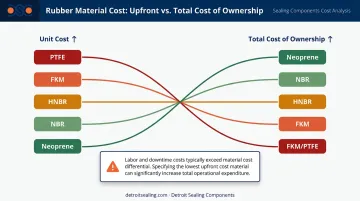
Calculate replacement frequency and downtime cost, not just unit price.
Conclusion
No single material covers every oil sealing application. The practical framework:
- NBR — the workhorse for petroleum oils, mineral oils, and hydraulic fluids at moderate temperatures
- FKM/Viton — the high-performance choice for aggressive fuels, synthetic oils, sour gas, and sustained heat
- Neoprene — economical for crude oil and outdoor environments, not for refined fuels
- PTFE/ePTFE — broadest chemical resistance, best for aggressive chemistries and regulated applications
- HNBR — the upgrade path from NBR when heat, ozone, sour fuel, or mechanical demands exceed standard NBR capability
Evaluate operating conditions as a system: temperature, fluid chemistry, pressure, compliance requirements, and total replacement cost. The most expensive failures usually trace back to a material that was available and familiar — not right for the application.
DSC stocks hundreds of compounds across all five material families covered in this guide. For applications where standard grades fall short, DSC's ISO 17025 accredited lab develops and tests custom-formulated compounds matched to your specific fluid, temperature, and pressure conditions. If you need help narrowing down a material or building a spec, DSC's technical team is the right starting point.
Frequently Asked Questions
Which gasket sealant is best for oil?
Nitrile (NBR) is the most widely used material for general oil sealing involving petroleum-based fluids and hydraulic oils. For high temperatures or aggressive refined fuels, Viton/FKM is the superior choice. The right answer depends on oil type, operating temperature, and pressure.
What is the difference between NBR and FKM gaskets for oil resistance?
NBR offers good resistance to petroleum-based oils at moderate temperatures and is cost-effective for most standard industrial applications. FKM provides superior resistance to a broader range of oils, synthetic lubricants, and fuels at significantly higher temperatures, though at a higher material cost.
Can EPDM gaskets be used in oil applications?
No. EPDM has very poor resistance to petroleum oils and hydrocarbon fuels — it will swell and degrade rapidly on contact. EPDM works for water, steam, and outdoor/UV environments, not oil or fuel service.
What temperature range can Nitrile gaskets handle in oil service?
Standard NBR handles approximately –40°F to 250°F (–40°C to 121°C) in oil service. Sustained exposure near the 250°F upper limit accelerates compression set and reduces service life. For consistently high-temperature applications, HNBR or FKM is the better choice.
How do I verify chemical compatibility between a gasket material and my fluid?
Start with the material's published chemical resistance chart for your specific fluid. For critical applications, request ASTM D471 volume swell test data from the manufacturer and, where possible, conduct immersion testing at actual service temperature before deployment.
What is the most cost-effective oil-resistant gasket material for general industrial use?
Nitrile (NBR) delivers the best performance-to-cost ratio for standard industrial applications involving petroleum-based fluids and hydraulic oils. Neoprene is a lower-cost alternative for unrefined crude oil at low pressures, but NBR's broader fluid compatibility makes it the practical default for most oil service environments.