NBR gaskets are common in oil- and fuel-adjacent equipment because nitrile handles many petroleum-based fluids well. But NBR isn’t a default; it’s a material choice that only works when the media, temperature, and exposure conditions support it.
To avoid wrong buys (and repeat leaks), confirm two things early: does NBR actually fit your environment, and if it does, are you specifying it completely (thickness, cut/drawing, temperature profile, and any cleaning exposures). This guide starts with that material fit-check, then shows how to spec NBR so the gasket performs the way the joint expects.
Key Takeaways
Start with material fit: confirm NBR is compatible with your media + cleaners + temperature profile.
NBR isn’t one spec: compound/grade matters for heat performance and compression set.
Where NBR usually fits: many oils, fuels, and petroleum-based fluids (verify additives/exposure time).
Where NBR often fails: outdoor ozone/UV/weathering and unknown/aggressive chemical exposures (verify before ordering).
Most “wrong gasket” orders are incomplete specs: include media, temp (incl. spikes), thickness, and a drawing/cut details, and switch to EPDM/FKM/HNBR if NBR isn’t the right family.
What is an NBR gasket?
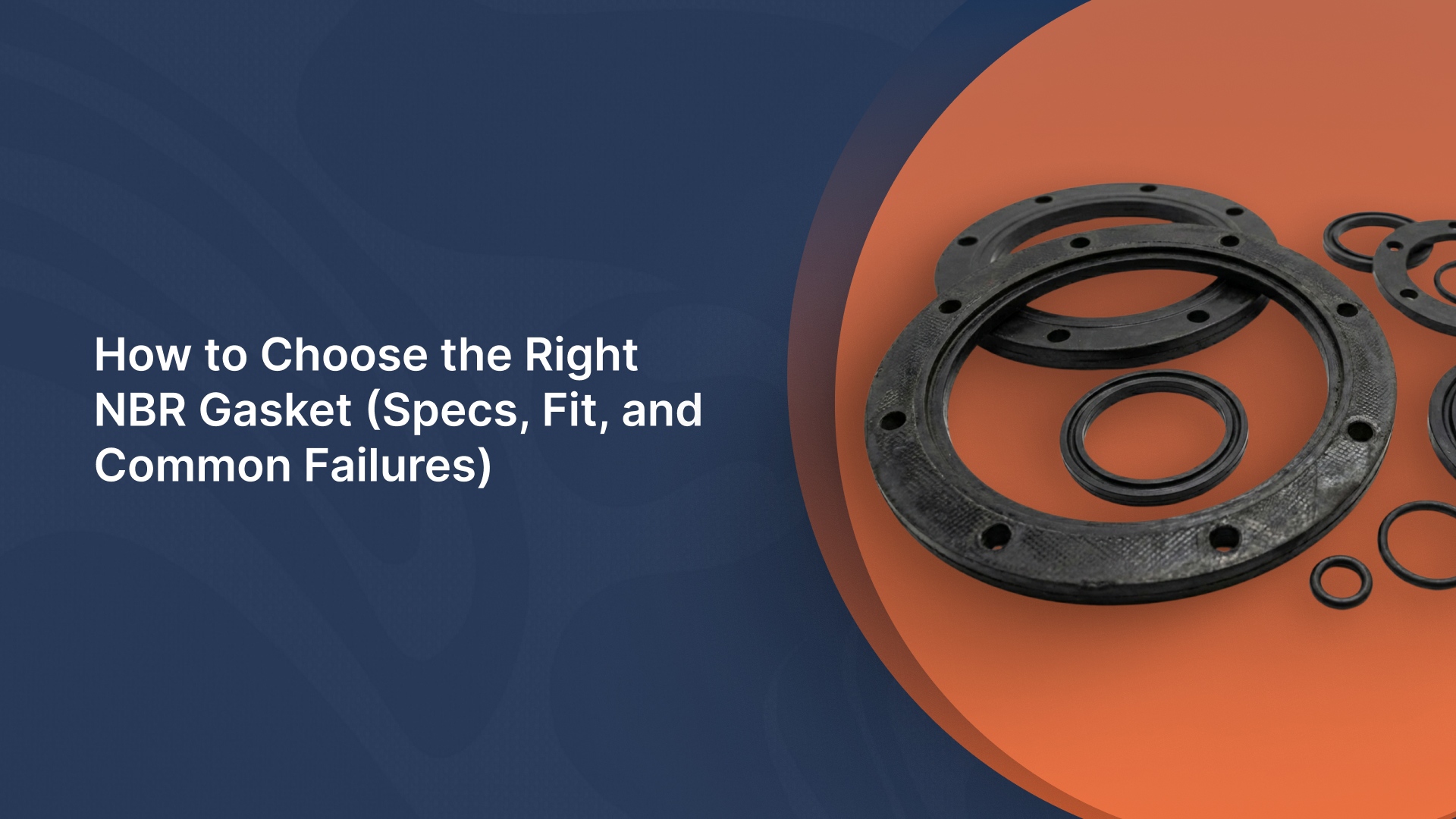
An NBR gasket is a gasket made from nitrile rubber (NBR), also commonly called nitrile or Buna-N. It’s used to seal between two mating surfaces, like flanges, covers, housings, and ports, to prevent leakage.
NBR is widely used because it performs well in many industrial environments, especially where oils and fuels are involved. One important note: “NBR” is a rubber family, not a single performance level, so temperature capability, compression set, and chemical resistance depend on the compound/grade.
Should you use NBR for this gasket?
Decide on the material first. Thickness and cut only matter after the elastomer is right.
Use this quick screen based on what actually drives gasket success: media, temperature profile, and environmental exposure.
Use NBR when…
The gasket contacts oils, fuels, lubricants, or many petroleum-based fluids (verify additives and exposure time).
The chemical exposure is known and controlled (not a mixed/unknown process stream).
You need a cost-effective industrial gasket for indoor/non-weathered service.
The application is a common hydraulic/industrial fluid service, and you can confirm the actual fluid + temperature.
Avoid NBR when…
The gasket will see outdoor ozone/UV/weather (higher risk of aging/cracking over time).
Temperatures are beyond what your specific NBR grade can handle, especially with heat soak or cycling (hardening/compression set risk).
The chemical environment includes uncertain/mixed chemicals, strong solvents, or aggressive cleaners, and compatibility isn’t verified.
The application is compliance-driven (food/potable/medical/clean) unless you’re specifying an explicitly certified NBR compound with required documentation.
If any “avoid” condition applies, switch materials instead of trying another NBR cut. If NBR is the right family, most failures come from an incomplete spec (grade, thickness, cut/drawing, and compression control), here’s how to avoid that.
If NBR fails the fit check: fastest material switch
The fix here is usually switching elastomer families, not trying another NBR cut.
Quick decision table
Material | Best for | Avoid when | Relative cost |
|---|---|---|---|
NBR (baseline) | Oils/fuels; general industrial sealing (verify media) | Outdoor/ozone/UV; uncertain chemicals; heat beyond grade | $ |
EPDM | Water-based service, outdoor/ozone resistance, many washdown exposures | Oils/fuels and many petroleum fluids | $ |
FKM | Higher heat + many oils/fuels/chemicals (verify media) | Some hot-water/steam; low-temp flexibility needs | $$$ |
HNBR | Tougher duty than NBR (strength/heat), many oil/hydraulic contexts | Some aggressive chemicals/solvents (verify) | $$ |
Use these when NBR is in the avoid column:
EPDM: choose for water-based fluids + outdoor/ozone/UV exposure (don’t use it for oils/fuels).
FKM: choose for higher heat or when you need broader chemical headroom in oil/fuel service (verify compatibility; watch hot water/steam and low-temp needs).
HNBR: choose when NBR is close but you need more heat + mechanical durability in demanding hydraulic/industrial duty (still verify chemical exposure).
Note: exact performance depends on compound/grade and service conditions use this as direction, then verify compatibility and temperature limits before finalizing.
How do you spec an NBR gasket correctly? (RFQ-ready checklist)
Most wrong gasket orders happen because the RFQ is missing a few inputs. Use this checklist to get the right material/thickness/cut with minimal back-and-forth.
What you need to specify (minimum)
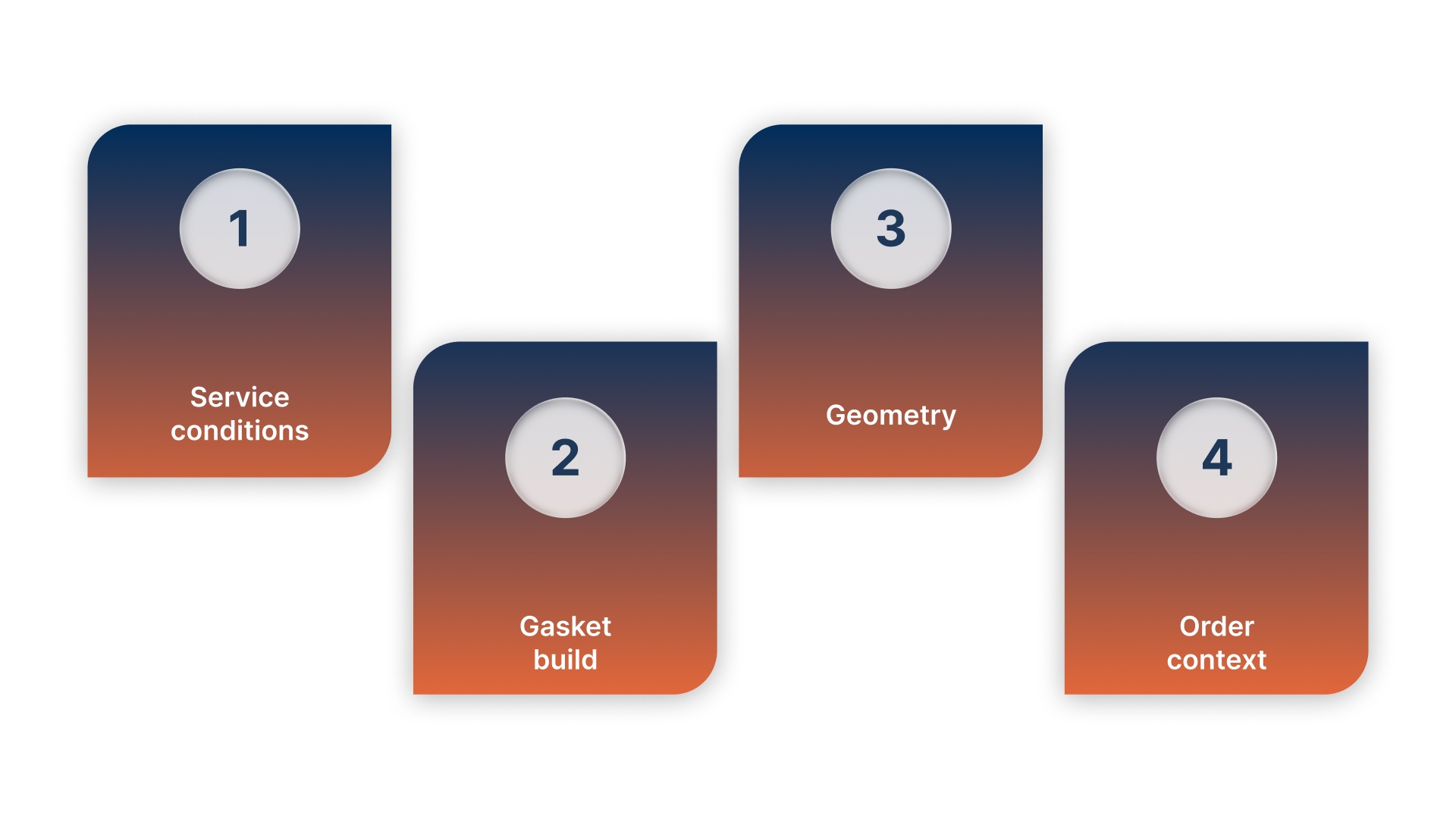
Service conditions: media (including cleaners), temperature range, pressure/bolt load (if known)
Gasket build: gasket type + thickness (+ durometer only if your spec calls for it)
Geometry: dimensions or drawing (best) + flange standard if applicable
Order context: quantity, lead time, and any compliance standard (if applicable)
Send this to get the right quote fast (copy/paste)
Media (incl. cleaners): ___
Temperature (min/max/spikes): ___
Pressure/bolt load (if known): ___
Gasket type (sheet/die-cut/etc.): ___
Thickness: ___
Hardness/durometer (if required): ___
Dimensions/drawing/flange standard: ___
Quantity + timeline: ___
Compliance standard (if applicable): ___
Why NBR gaskets leak or fail (and the fastest fix)
Most NBR gasket failures aren’t “mystery material problems.” They’re usually joint/compression problems that show up as leaks, blowouts, or early set. Use these fast checks to correct the root cause.
Leak at low/moderate pressure (no visible gasket damage) → insufficient compression or uneven bolt load → re-torque correctly (pattern + spec), verify flange flatness/misalignment, and confirm gasket thickness is appropriate for the joint
Leak after heat cycling → relaxation/compression set + bolt load loss → re-check torque after thermal cycles (if procedure allows), consider a grade/thickness better suited to the temperature, and confirm the joint is designed to maintain compression.
Blowout/extrusion at the joint → pressure spikes + unsupported gasket edge/gap → improve support (reduce extrusion gap, add containment features), adjust thickness, and validate that the joint design matches pressure duty
Cuts/tears during assembly or immediate leak → installation damage or sharp edges → deburr/chamfer, use correct alignment, avoid sliding the gasket across sharp surfaces, and confirm cut quality/handling.
Swelling/softening only in certain lines/cleaning cycles → media/cleaner exposure mismatch → verify the full exposure list (process fluid + cleaners) and switch compound/material if needed (don’t keep re-cutting the same grade)
When to stop tweaking the gasket and change the approach
If you keep seeing blowouts, repeat leaks after re-torque, or failures tied to pressure spikes/thermal cycling, the fix is usually joint design and compression control, not “another gasket.”
At that point, validating flange condition, compression targets, and support/containment with the right material guidance and a supplier who can help you spec it correctly, becomes the fastest path to a stable seal, which is where Detroit Sealing Components can help.
Why Detroit Sealing Components for NBR gaskets and sealing support?
If you’re trying to stop leaks and stop re-ordering the “next guess,” DSC’s value is that we don’t just point you to a rubber sheet; we support the actual gasket solution: geometry, material, and repeat supply.
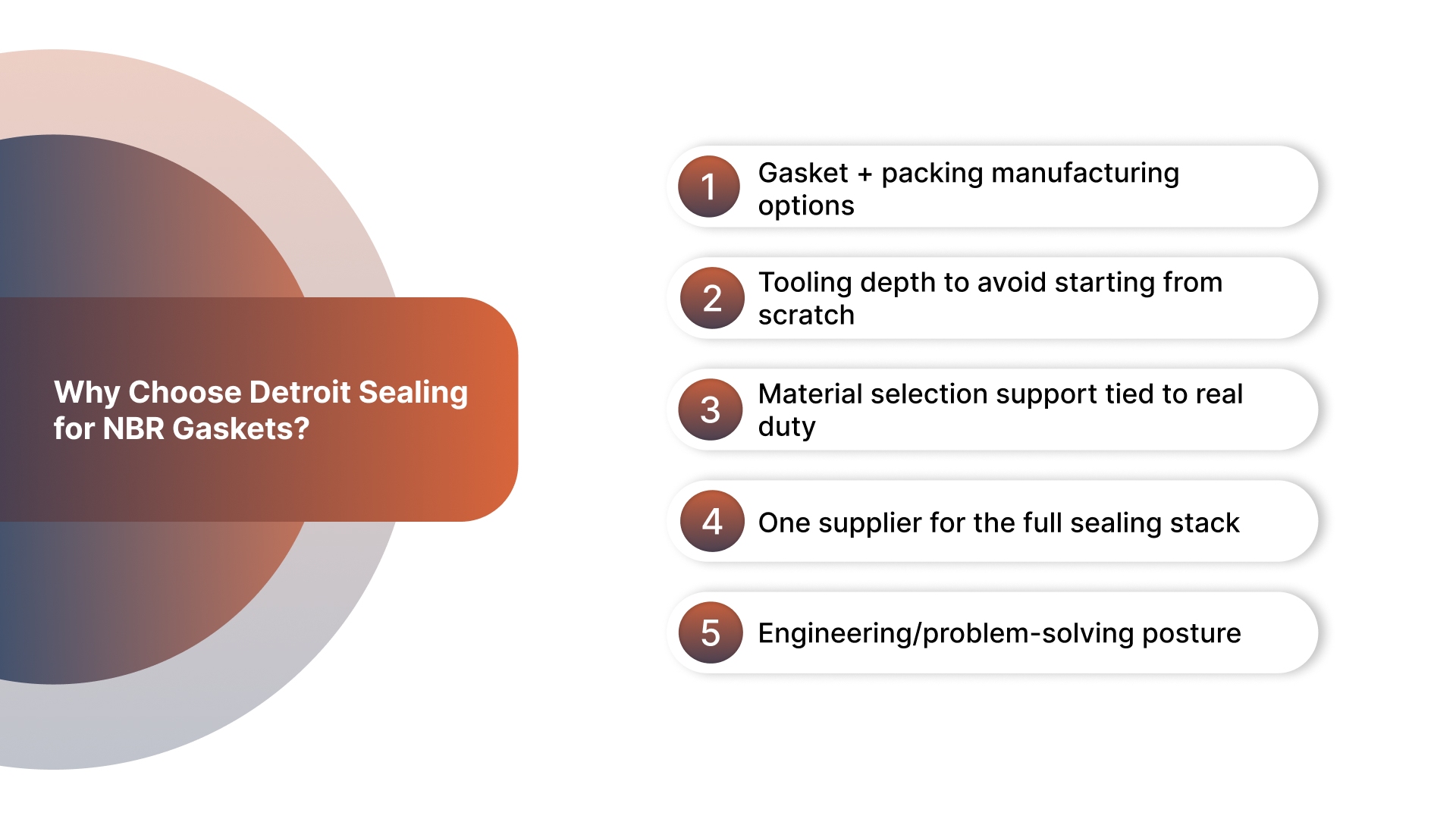
Gasket + packing manufacturing options (molded, not generic): DSC offers molded gaskets/packings produced via compression, transfer, and injection molding, which is a better fit than “cut-from-sheet” when you need repeatability, complex shapes, or higher-volume consistency.
Tooling depth to avoid starting from scratch: DSC highlights a large library of existing tooling (8,000+ tooled articles) and the ability to produce custom geometries when the part isn’t already tooled, useful when your gasket is non-standard, or you’re replacing an OEM profile.
Material selection support tied to real duty: Our gasket/packing offering is positioned around selecting the right material and design for the application (the difference between a gasket that seals once and one that survives heat, media exposure, and cycle time).
One supplier for the full sealing stack: DSC’s catalog spans gaskets/packings plus related sealing components (O-rings, X-rings, back-up rings, hydraulic seals, washers, diaphragms, etc.), which helps when the “gasket problem” is really a system sealing problem.
Engineering/problem-solving posture (when failures repeat): DSC references capabilities like FEA and structured problem-solving approaches to support selection and durability, relevant when you’re troubleshooting recurring failures, not just placing a reorder.
If you want DSC to match the right gasket approach quickly, request a quote/stock check and send your drawing + media + temperature (and thickness if you know it).
Conclusion
Getting reliable NBR gasket performance comes down to one habit: spec the environment and the gasket build up front (media/cleaners, temperature, joint compression/support, thickness, and geometry).
When NBR isn’t a fit, switching to EPDM, FKM, or HNBR early is usually cheaper than chasing repeat leaks. If failures persist, validate joint compression/support before changing materials again.
FAQs
What does NBR mean in gaskets?
NBR stands for nitrile butadiene rubber—a rubber family commonly used for gaskets because it performs well in many industrial environments, especially where oils and fuels are present. Actual performance depends on the compound/grade.
Is NBR the same as nitrile or Buna-N?
In most sourcing and gasket contexts, yes—NBR, nitrile, and Buna-N are used interchangeably. (Specs can still vary by formulation, hardness, and additives.)
Are NBR gaskets oil and fuel-resistant?
Generally, NBR is chosen specifically because it performs well with many petroleum-based oils and fuels. Always verify against your exact fluid, additives, temperature, and exposure time; those details can change the result.
What temperature can NBR gasket material handle?
There isn’t one universal number—temperature capability varies by compound/grade and service conditions (including spikes and cycling). Treat published ranges as typical guidance and confirm with the supplier for your exact gasket compound.
When should I use EPDM instead of NBR?
Choose EPDM when the service is water-based, involves steam/washdown conditions, or the gasket sees outdoor ozone/UV/weather exposure. EPDM is typically a poor choice for oils and fuels, where NBR is often the baseline.