Introduction
A single gasket failure can trigger a cascade of consequences: uncontrolled leaks, process contamination, regulatory violations, unplanned downtime, and in worst cases, safety incidents. Despite these stakes, gasket selection is routinely treated as a purchasing decision — not an engineering one.
The world's 500 largest companies lose approximately $1.4 trillion annually to unplanned production stoppages, and improperly specified sealing components are a documented contributor. With hundreds of materials across metallic, semi-metallic, and non-metallic categories, selection driven by habit or unit cost is a liability.
This guide covers what engineers need to make defensible material selections: a clear breakdown of gasket categories, the six technical factors that govern material fit, and how to match compound properties to real operating conditions.
Key Takeaways
- Gasket materials fall into three categories — non-metallic (elastomeric/rubber, PTFE, graphite), semi-metallic, and metallic — each suited to different pressure, temperature, and media conditions
- The six critical selection factors are: chemical compatibility, temperature range, pressure rating, compression set/durometer, regulatory compliance, and flange surface finish
- Material selection is always a trade-off — optimizing for chemical resistance often means sacrificing temperature range, and vice versa
- Wrong material selection causes swelling, hardening, premature failure, leaks, and costly downtime — a $10 gasket failure can shut down a $10,000/hour production line
- When standard compounds fall short, custom compound development with ISO 17025 lab validation can close the gap
What Is Gasket Material?
A gasket material is the medium used to create a static seal between two mating surfaces — flange faces, housing joints, valve bodies — preventing leakage of fluids, gases, or contaminants under pressure and temperature conditions.
The FSA/ESA Gasket Handbook classifies industrial gasket materials into three primary categories.
Non-Metallic Gaskets
These include elastomeric rubber compounds (Nitrile, EPDM, Neoprene, Silicone, Viton/FKM) and sheet materials (PTFE, compressed fiber, flexible graphite). They are flexible, conformable, and suited for low-to-moderate pressure and temperature service.
Non-metallic gaskets are the most commonly specified type across general industry, food and beverage, water/sanitary, and chemical applications. Rubber held 40% of gasket and seal materials revenue in 2024 — a figure that reflects how broadly elastomeric materials appear across industrial sectors.
Semi-Metallic Gaskets
Spiral wound, Kammprofile, corrugated metal, and jacketed designs combine a metal core with soft filler materials — typically graphite or PTFE. This construction balances structural integrity with compressibility, making semi-metallic gaskets the standard choice for high-pressure and high-temperature environments such as oil and gas, power generation, and refining.
Metallic Gaskets
Ring type joints and solid metal gaskets require higher bolt loads but deliver creep resistance and structural stability under extreme conditions. They demand tighter flange surface finish tolerances and are common in upstream oil and gas and high-pressure piping systems.
Operational Consequences of Getting It Wrong
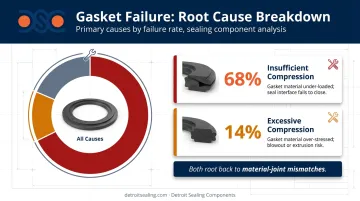
Choosing the wrong material from any of those three categories carries real costs. An FSA survey reported by James Walker found that 68% of gasket failures stem from insufficient compression and 14% from excessive compression — both of which trace back to mismatches between material properties and joint design. Gaskets are among the cheapest components in an assembly, but their failure consequences are rarely cheap.
Correct material selection directly affects:
- Maintains zero leaks under operating pressure and temperature
- Reduces wear on flange faces and fasteners over time
- Extends maintenance intervals and cuts unplanned downtime
- Meets compliance requirements in food, pharma, and potable water systems
- Ensures containment of hazardous or process-critical media
Key Factors for Gasket Material Selection
No single factor determines the right material. Engineers must evaluate the full operating environment — chemical exposure, thermal limits, mechanical load, applicable standards, and joint geometry — before specifying anything.
Chemical and Media Compatibility
The fluid or gas being sealed determines which compounds are chemically viable. Incompatible materials will swell, harden, or degrade, losing their ability to maintain a seal.
| Compound | Compatible Media | Key Limits |
|---|---|---|
| Nitrile (NBR) | Mineral oils, petroleum fuels, greases, aliphatic hydrocarbons | Attacked by ozone, oxidizing agents |
| EPDM | Hot water, steam, ozone, outdoor/weathering exposure | Attacked by petroleum oils |
| Neoprene (CR) | General ozone, aging, moderate chemical resistance | Check solvents and refrigerants individually |
| Silicone (VMQ) | Food/pharma contact, wide temperature range, outdoor | Poor mechanical strength vs. other rubbers |
| Viton/FKM | Hydrocarbon fuels, aggressive chemicals, high-temp fluids, aromatics | Attacked by ketones |
| PTFE | Near-universal chemical inertness | Can cold-flow (creep) under sustained low load |
Operating Temperature Range
Every compound has defined upper and lower service temperature limits. Exceeding them causes hardening, brittleness, or permanent deformation — all of which break the seal. Engineers must design around peak temperature extremes, including transient spikes, not average conditions.
Quick-reference temperature ranges from the FSA/ESA Gasket Handbook:
| Compound | Continuous Service Range |
|---|---|
| Nitrile (NBR) | -30°C to 100°C (-22°F to 212°F) |
| Neoprene (CR) | -40°C to 121°C (-40°F to 250°F) |
| EPDM | -51°C to 149°C (-60°F to 300°F) |
| Viton/FKM | -15°C to 199°C (-5°F to 390°F) |
| Silicone (VMQ) | -59°C to 232°C (-75°F to 450°F) |
| PTFE | -210°C to 260°C (-346°F to 500°F) |
| Flexible Graphite | -240°C to 525°C (oxidation-inhibited) |
Both process medium temperature and ambient temperature must be accounted for. A gasket exposed to an 80°C fluid in a 50°C enclosure faces a different combined load than the same fluid in an ambient outdoor environment.
Pressure Rating and Flange Load
Gasket material must satisfy two load conditions simultaneously:
- Initial seating stress (y factor) — the minimum compressive load required to conform the gasket to the flange surface and initiate a seal
- Maintenance factor (m factor) — the residual stress needed to sustain that seal under internal operating pressure
Softer elastomeric gaskets are appropriate for low-to-moderate pressures. As pressure increases, semi-metallic and metallic constructions become necessary. FSA pressure examples span from cork at 345 kPa (50 psi) to Style BX ring joints at 344–1,034 bar (5,000–15,000 psi).
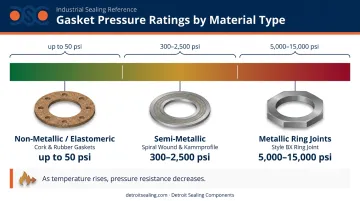
There is also a critical interaction between the two ratings: as temperature increases, pressure resistance generally decreases. Pressure and temperature must always be verified together, not independently.
Compression Set and Durometer
Compression set is the permanent deformation a gasket material retains after sustained compressive load. High compression set means the material won't recover when the joint relaxes — causing leaks over time. This is especially critical in applications with cyclic loading, vibration, or thermal cycling.
Compression set is tested per ASTM D395 under constant deflection or constant force conditions. There is no universal failure threshold; the acceptable limit depends on the joint design and load retention requirements.
Durometer (Shore A scale for rubber) measures material hardness:
- Lower Shore A values — softer, more conformable materials that accommodate irregular flange surfaces with moderate bolt load
- Higher Shore A values — harder materials suited to higher pressures and tighter flange tolerances
Examples: EPDM gaskets are available at 60 Shore A; Neoprene at 80 Shore A. The ideal durometer depends on flange surface quality, available bolt load, and sealing pressure requirements.
Industry Standards and Regulatory Compliance
In regulated industries, material compliance is a selection prerequisite — not a post-specification checkbox. Non-compliant materials risk product contamination, failed inspections, and regulatory penalties.
Key standards engineers must verify before specifying:
- FDA 21 CFR 177.2600 — rubber articles in repeated food contact
- NSF/ANSI/CAN 61 — drinking water system component health effects
- USP Class VI / USP <88> — biological reactivity testing for pharmaceutical and medical contact
- MIL-PRF-1149D — synthetic rubber gasket materials for defense/aerospace at 50 and 65 durometer
- ASTM D1330 — rubber sheet gaskets for water, air, and low-pressure steam
Material documentation and traceability from the supplier are just as critical. The FDA identifies product-contact equipment gaskets as a significant potential source of microbiological contamination — meaning compliance verification must extend to production documentation, not just a datasheet designation.
When sourcing for regulated applications, confirm that the supplier can provide compound-level certification documentation. DSC stocks materials certified to FDA 21 CFR 177.2600, NSF 61, NSF 42, USP Class VI, and additional international standards for drinking water applications including WRAS and W270.
Flange Surface Finish and Joint Configuration
Surface finish directly limits sealing performance — a gasket spec that's correct on paper will leak if the flange face doesn't meet the required finish range. FSA/ESA recommended finish ranges by gasket type:
| Gasket Type | Recommended Ra (Surface Finish) |
|---|---|
| Soft cut / elastomeric | 3.2–12.5 μm |
| Spiral wound / Kammprofile | 3.2–6.3 μm |
| Metal jacketed | < 2.5 μm |
| Solid metallic | < 1.6 μm |
Softer elastomeric gaskets are more forgiving of surface variation. Metallic gaskets require tighter tolerances to seat properly — a rougher flange face that works with rubber will cause a ring joint to leak.
Joint configuration also matters: gasket type (full-face vs. ring), ID/OD dimensions, thickness, and bolt pattern must match the flange specification exactly. Garlock notes that gasket performance generally decreases as material thickness increases, requiring higher compressive loads to achieve equivalent sealing.
How DSC Can Help
Selecting the right gasket material is only half the equation — sourcing it reliably is the other. Detroit Sealing Components (DSC) is a sealing distributor headquartered in Plymouth, MI, with decades of experience matching engineers to the right compounds, geometries, and certifications for their specific applications.
With over 8,000 tooled gasket articles and an ISO 17025 accredited laboratory, DSC supports projects from early design through final specification — whether that means pulling a stocked compound or developing a custom formulation from scratch. Engineers can engage the technical team at any phase, with CAD and FEA capabilities available to validate geometry before production commits.
Key capabilities:
- Hundreds of compounds across all rubber types, including NBR, EPDM, FKM, HNBR, FFKM, Silicone, Neoprene, and more
- Custom molded gaskets from standard geometries to complex shapes built to exact specifications
- ISO 17025 accredited lab for material development, custom compound formulation, and testing
- CAD and FEA support for seal design optimization
- Compliance-ready materials certified to FDA 21 CFR 177.2600, NSF 61, USP Class VI, and other industry standards
- Nationwide distribution from Plymouth, MI, positioned near major shipping lanes for fast delivery
- Sectors served: automotive, oil and gas, aerospace, food and beverage, water/sanitary, healthcare, semiconductor, renewable energy, and general industry

Conclusion
Gasket material selection is an engineering decision with measurable operational consequences. The right material satisfies the chemical, thermal, mechanical, and regulatory requirements of the specific application simultaneously — familiarity and low cost are secondary considerations.
Those requirements can shift over time. Any of the following are reasons to revisit the material specification:
- Process modifications or new fluid chemistries
- Temperature profile changes
- Recurring seal failures or shortened service life
Periodic review of gasket performance matters as much as the initial selection.
When standard compounds fall short or the operating environment is particularly demanding, DSC's technical team brings access to hundreds of compounds, ISO 17025 accredited lab testing, and application experience across industries to help prevent failures before they happen. Contact DSC to discuss your application.
Frequently Asked Questions
How do you choose the right gasket material?
Evaluate the full operating environment before specifying anything. Six factors must align:
- Chemical/media compatibility
- Temperature range (including transient peaks)
- Pressure rating
- Compression characteristics (compression set and durometer)
- Applicable regulatory standards
- Flange surface finish
Optimizing for one while ignoring the others is a common path to premature failure.
Are rubber gaskets heat resistant?
Heat resistance varies significantly by compound. Nitrile handles up to 100°C (212°F); Neoprene reaches 121°C (250°F); EPDM goes to 149°C (300°F); Viton/FKM to 199°C (390°F); Silicone to 232°C (450°F). For temperatures beyond these limits, PTFE (260°C) or flexible graphite (525°C in controlled oxidation conditions) are the standard options.
What is the most common gasket material used in industrial applications?
Nitrile (Buna-N) is among the most widely used rubber gasket compounds due to its oil and fuel resistance and cost-effectiveness. EPDM dominates water, steam, and outdoor applications. PTFE is the preferred choice where broad chemical resistance is required and creep behavior can be managed through joint design.
What happens if you use the wrong gasket material?
An incompatible material will swell, harden, crack, or degrade, causing leaks, equipment damage, unplanned downtime, regulatory non-compliance, and potential safety hazards. The cost of failure, including lost production and remediation, consistently exceeds the cost of specifying the correct material from the start.
What is the difference between metallic, semi-metallic, and non-metallic gaskets?
Non-metallic gaskets (rubber/elastomeric, PTFE, graphite sheet) are soft and conformable, suited for low-to-moderate conditions. Semi-metallic designs combine a metal core with soft fillers for high-pressure and high-temperature service. Fully metallic gaskets handle extreme conditions but require significantly higher bolt loads and tighter flange surface finish tolerances.
How does temperature affect gasket material selection?
Every compound has a rated temperature range; outside that range it hardens at low extremes or softens and deforms at high ones. Select a material whose limits cover the system's peak operating temperature, including transient spikes. Temperature and pressure interact directly — elevated heat reduces load-bearing capacity, so verify both conditions together.