Introduction
Selecting the wrong seal material is an expensive mistake. A seal that degrades in contact with petroleum oil, cracks under thermal cycling, or swells when exposed to the wrong solvent doesn't just fail — it takes production lines down with it. For engineers and procurement teams across automotive, oil & gas, and industrial manufacturing, that choice happens constantly.
Nitrile butadiene rubber (NBR) has become the default seal material precisely because it handles those conditions reliably and at scale. According to SKF, NBR elastomers in 70 to 90 Shore A hardness are the most widely used rubbers in the fluid-power industry — backed by strong oil resistance, solid mechanical properties, and a price point that holds up in high-volume production.
This guide covers what technical buyers need to evaluate before specifying NBR: how ACN content affects performance, which chemical environments NBR handles (and which it doesn't), where it's used across industries, and how it compares to FKM, EPDM, and HNBR.
Key Takeaways
- NBR seals operate from -30°C to +100–120°C and excel in petroleum oil, hydraulic fluid, and fuel environments
- ACN content (18–50%) determines the trade-off between oil resistance and cold-temperature flexibility
- NBR is unsuitable for aromatic hydrocarbons, ketones, chlorinated solvents, and ozone/UV exposure
- For higher heat (above 120°C), consider HNBR or FKM; for water/outdoor use, consider EPDM
- FDA-compliant NBR grades exist for food-contact applications; compliance must be verified per compound
What Is an NBR Seal?
NBR (Nitrile Butadiene Rubber) is a synthetic copolymer produced from two monomers: acrylonitrile (ACN) and butadiene. You'll also see it listed under trade names including Buna-N and Perbunan, or in ARLANXEO's product lines as Krynac and Baymod N.
Britannica confirms that the material was patented in 1934 by chemists Erich Konrad and Eduard Tschunkur at IG Farben. That longevity reflects something real: few synthetic elastomers have proven as versatile across industrial sealing demands.
How ACN Content Shapes Performance
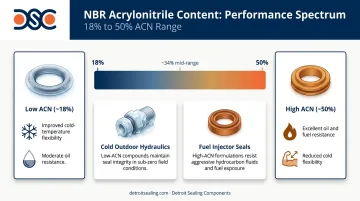
The acrylonitrile content is the single most important variable in NBR formulation. Per Parker's NBR eHandbook, sealing compounds range from 18% to 50% ACN, and that ratio directly controls the performance tradeoffs:
| ACN Content | Oil & Fuel Resistance | Low-Temp Flexibility |
|---|---|---|
| Higher (closer to 50%) | Excellent | Reduced |
| Lower (closer to 18%) | Moderate | Improved |
Manufacturers select the ratio to match operating conditions. A fuel injector seal in a warm engine bay favors high ACN for chemical resistance; a hydraulic seal on cold outdoor equipment calls for a lower-ACN compound to maintain flexibility at low temperatures.
Common NBR Seal Formats
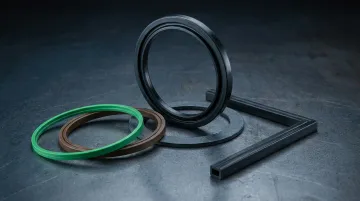
NBR can be molded into virtually any seal geometry:
- O-rings (static and dynamic)
- Flat gaskets and packings
- Hydraulic piston and rod seals
- Pneumatic wiper and rod seals
- Diaphragms (for pumps, actuators, and regulators)
- Backup rings (typically 90 Shore A)
- Radial shaft seals
That geometry range — from simple O-rings to diaphragms and shaft seals — is why NBR shows up as the default specification in automotive, agriculture, oil & gas, and general industrial applications alike.
Key Properties of NBR Seals
Temperature Range
Standard NBR operates between approximately -30°C and +100–120°C (-22°F to +248°F). Parker's O-Ring Handbook rates heat resistance up to 100°C, with reduced service life at 121°C. Trelleborg's Chemical Compatibility Guide aligns with this, citing short-term exposure up to +120°C.
Cold-temperature performance varies more widely — certain NBR formulations achieve flexibility down to -57°C depending on compound and ACN content.
Chemical Resistance
NBR's polar polymer structure gives it strong resistance to:
- Petroleum-based and mineral oils
- Hydraulic fluids (HFA, HFB, HFC classifications)
- Fuels: gasoline, diesel, kerosene, naphtha
- Aliphatic hydrocarbons including propane and butane
- Diluted acids and alkalis
- Silicone oils and greases
- Alcohols
For engineers specifying seals in fluid power or fuel-handling systems, this chemical profile covers the majority of everyday media.
Mechanical Properties
Parker's O-Ring Handbook specifies a 1,000 psi (7 MPa) minimum tensile strength threshold for dynamic sealing applications. Common durometer grades run from 60 to 90 Shore A, with 70 and 80 Shore A typically offering the best balance of sealing force and flexibility.
90 Shore A compounds are standard for backup rings and high-pressure hydraulic applications.
NBR also delivers:
- Abrasion resistance suited for wear-intensive dynamic applications (per Parker's qualitative rating)
- Compression set of ~30–40% at 100°C over 70 hours for standard NBR 70; high-temperature grades drop closer to 20%
- Good tear resistance under repeated compression cycles
Gas Impermeability
ARLANXEO confirms that NBR exhibits high gas impermeability. Parker's handbook provides measured permeability values for propane (1.28 × 10⁻⁸ std cc·cm/cm²·sec·bar) and methane at 25°C, while Trelleborg rates NBR as compatible with natural gas. This positions NBR as a practical choice for gas distribution and energy applications — though regulatory approvals such as EN 549 and DVGW must be verified at the compound level.
Benefits of NBR Seals: Why They're the Industry Standard
Cost-Effectiveness at Scale
NBR is among the most economical synthetic elastomers available. No single authoritative source publishes an exact price ratio between NBR and FKM, but the cost advantage is well established across the industry — Parker identifies NBR as one of the few polymers accounting for the majority of O-rings produced worldwide. For procurement teams sourcing high volumes of O-rings, gaskets, or hydraulic seals, that cost gap is meaningful.
Broad Chemical Compatibility
The combination of petroleum-oil resistance, hydraulic-fluid compatibility, and fuel tolerance means NBR covers the majority of industrial fluid environments without requiring a more expensive alternative. That breadth also translates directly into format flexibility — NBR's compatibility advantage is compounded by its ability to be compounded and molded into nearly any seal geometry.
Versatility Across Formats and Industries
NBR can be compounded across hardness ranges (60–90 Shore A) and molded into virtually any seal geometry. Detroit Sealing Components (DSC) stocks standard NBR O-rings in 70 and 90 Shore A across major international sizing standards — AS568, JIS B2401, BS 4518, Metric, and others — alongside custom-molded formats:
- Diaphragms
- Gaskets
- Hydraulic cylinder seals
- Bonded components
When no standard compound meets the application's requirements, DSC's ISO 17025 accredited lab can develop and validate custom NBR formulations to application-specific criteria.
Performance in Dynamic Applications
NBR's balance of elasticity and mechanical toughness suits it well for applications with movement. Stiffer fluoroelastomers can crack under repeated dynamic flex — NBR holds its sealing function through compression cycles in hydraulic cylinders, pneumatic actuators, and rotating shaft seals without that brittleness risk.
Where NBR Seals Are Used: Key Industry Applications
Automotive and Transportation
NBR is a standard specification for fuel system seals, engine components, and transmission applications. Parker explicitly lists NBR compounds for gasoline, diesel, kerosene, naphtha, and lubricating oil contact — covering the full range of automotive fuel and lubrication system media. Off-road and agricultural equipment with hydraulic systems and fuel lines apply the same NBR specification.
Oil & Gas and Industrial Hydraulics
NBR seals hydraulic cylinders, valves, and pump components where mineral oil-based hydraulic fluids are the working medium. Valve Magazine identifies NBR (nitrile) among the select elastomers used in oil and gas valve seals. For gas distribution — natural gas, propane, butane lines — NBR's gas impermeability makes it appropriate, subject to compound-level certification requirements.
DSC serves this vertical with HNBR packer elements rated for explosive decompression resistance. Compounds are certified to NORSOK M-710, ISO 23936, and API6A for customers requiring full material traceability documentation.
Food and Beverage
21 CFR 177.2600 explicitly lists acrylonitrile-butadiene copolymer among permitted elastomers for repeated-use rubber food-contact articles, with defined extractive limits. FDA-compliant NBR grades exist — but compliance is a compound-level designation, not a blanket property of all NBR. DSC offers sealing materials certified to FDA CFR 177.2600, NSF 51, NSF 61, and WRAS, with documentation available per compound.
Agriculture, Construction, and General Industry
Construction and agricultural equipment rely heavily on hydraulic seals operating under variable pressure and environmental conditions. NBR's oil resistance and mechanical durability make it the standard choice for these systems.
Across automated assembly, conveyor systems, and pneumatic actuators, NBR's combination of low cost and broad chemical compatibility makes it the practical first choice for general industrial machinery. Common applications include:
- Hydraulic cylinder rod and piston seals
- Pneumatic actuator o-rings and backup rings
- Conveyor and assembly line valve seals
- Agricultural equipment hydraulic packings
NBR Seal Limitations: When to Choose a Different Material
NBR performs well within its design envelope — but push it outside those boundaries and performance drops quickly. Knowing where it falls short is just as important as knowing where it excels.
Poor Ozone, UV, and Weathering Resistance
NBR degrades rapidly under sustained ozone, UV, or outdoor weathering exposure. For these environments, EPDM or neoprene (CR) are the appropriate alternatives — both offer significantly better atmospheric aging resistance.
Chemical Incompatibilities
NBR fails in contact with several chemical groups:
- Aromatic hydrocarbons: benzene, high-aromatic fuels
- Ketones and polar solvents: acetone, MEK
- Chlorinated hydrocarbons: trichloroethylene, chloroform
- Glycol-based brake fluids: cause rapid swelling and softening
- Acetic acid: accelerates surface degradation
FKM/Viton is the most common alternative for these chemical environments, offering broad resistance to aromatic fuels, polar solvents, and chlorinated compounds.
Limited High-Temperature Performance
Above approximately 120°C, NBR's service life drops off sharply. For higher-temperature applications, the alternatives by ceiling are:
- HNBR: up to ~150°C (Parker gives -32 to +149°C)
- FKM/Viton: up to ~205°C (Parker gives -26 to +205°C)
- PTFE: below -73°C to above +204°C
NBR vs. Other Seal Materials
| Property | NBR | FKM (Viton) | EPDM | HNBR |
|---|---|---|---|---|
| Max temp | ~120°C | ~205°C | ~150°C | ~149°C |
| Min temp | ~-30°C | ~-26°C | ~-45°C | ~-32°C |
| Oil/fuel resistance | Excellent | Excellent | Poor | Excellent |
| Ozone/UV resistance | Poor | Excellent | Excellent | Good |
| Relative cost | Low | High | Low-moderate | Moderate |
| Dynamic flex | Good | Fair | Good | Very good |
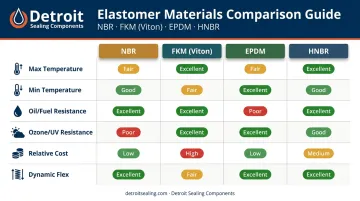
The table above summarizes the headline numbers — but the right choice depends on your specific operating conditions. Here's what the data means in practice.
NBR vs. FKM: FKM handles higher temperatures and resists aromatic chemicals, ozone, and UV that destroy NBR. NBR costs significantly less, performs better in cold environments, and flexes more readily under dynamic loads. Choose FKM for chemical severity or sustained heat; choose NBR for most oil/fuel applications where cost and flexibility matter.
NBR vs. EPDM: These materials have nearly opposite strength profiles. EPDM excels in water, steam, and outdoor environments but cannot tolerate petroleum oils. NBR is the reverse. Don't use EPDM in oil contact; don't use NBR in water or ozone-heavy environments.
NBR vs. HNBR/XNBR: When standard NBR approaches its thermal or mechanical limits, two upgraded variants are worth considering:
- HNBR — the polymer backbone is hydrogenated, eliminating double bonds and improving heat resistance to ~150°C and ozone stability, at a moderate cost premium
- XNBR (carboxylated NBR) — retains full oil resistance while delivering significantly better abrasion and tear resistance for high-wear dynamic seals
Frequently Asked Questions
What is an NBR seal?
An NBR seal is a sealing component made from Nitrile Butadiene Rubber — a synthetic copolymer of acrylonitrile and butadiene. It's widely used in industrial, automotive, and hydraulic applications for its excellent resistance to petroleum oils, fuels, and hydraulic fluids, combined with strong mechanical durability.
How does NBR compare to Viton and silicone?
NBR is more cost-effective and more flexible in cold temperatures than FKM (Viton), but FKM handles higher temperatures and a broader chemical range including aromatics and ozone. Silicone outperforms NBR in extreme temperature ranges and biocompatibility, while NBR offers better mechanical strength and oil resistance.
What temperature range can NBR seals handle?
Standard NBR operates between approximately -30°C and +100–120°C (-22°F to +248°F). The exact range depends on ACN content and compound grade: higher-ACN grades push toward the upper limit, while lower-ACN grades improve cold-temperature performance.
What chemicals are NBR seals NOT compatible with?
Avoid NBR with these chemical types, which cause swelling or material degradation:
- Aromatic hydrocarbons (benzene, high-aromatic fuels)
- Ketones (acetone) and chlorinated solvents (trichloroethylene, chloroform)
- Glycol-based brake fluids and acetic acid
What is the difference between NBR and HNBR?
HNBR (Hydrogenated NBR) has its polymer double bonds chemically saturated, raising heat resistance to ~149–150°C and improving ozone resistance and aging performance. It costs more than standard NBR but delivers longer service life in dynamic or high-temperature applications.