Both materials offer solid oil resistance and good compression set performance in general service. The problems surface when conditions get demanding: extreme temperatures, aggressive chemical exposure, outdoor weathering, or applications where replacement intervals carry real cost consequences. That's where a poor material call becomes expensive quickly.
This guide breaks down the technical differences between Nitrile (NBR) and Viton (FKM), explains where each material fits — and where it fails — and gives engineers and procurement teams a practical framework for making the right call.
Key Takeaways
- Nitrile (NBR) is the most widely used O-ring material globally — cost-effective, excellent for petroleum oils and hydraulic fluids, reliable in moderate-temperature industrial environments
- Viton (FKM) offers superior heat resistance (up to ~204°C continuous) and far better chemical resistance — at a significant cost premium
- Nitrile's weak spots: ozone, UV, weathering, ketones, halogenated solvents
- Viton struggles with: very low temperatures, ketones, amines, and Skydrol hydraulic fluid
- Choosing correctly means evaluating temperature range, chemical exposure, and total cost of ownership — upfront price is rarely the whole picture
Viton vs. Nitrile O-Rings: At a Glance
| Dimension | Nitrile (NBR) | Viton (FKM) |
|---|---|---|
| Material Composition | Acrylonitrile-butadiene copolymer (18–50% ACN content) | Fluorocarbon polymer (fluoroelastomer); 66–70% fluorine content depending on grade |
| Temperature Range | -30°C to +100°C general; +120°C short-term | -17°C to +204°C continuous; intermittent peaks to +316°C |
| Chemical Resistance | Excellent for petroleum oils, fuels, hydraulic fluids, water; poor with ketones, ozone, halogenated solvents | Outstanding with fuels, acids, solvents, ozone, UV; poor with ketones, amines, Skydrol |
| Physical Durability | High abrasion and tear resistance; strong mechanical performance | Good compression set resistance; lower abrasion resistance than NBR |
| Relative Cost | Lower — industry's default general-purpose material | Significantly higher — premium material for demanding environments |
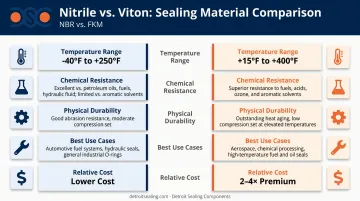
Key takeaways:
- Both handle petroleum-based fluids well; the performance gap widens above 100°C or in chemically aggressive environments
- Nitrile outperforms Viton in high-wear mechanical applications due to superior abrasion resistance
- Viton's low-temperature limit (-17°C) is a common selection mistake — NBR reaches -30°C
- Cost difference is significant; Viton is a targeted upgrade, not a universal replacement for NBR
What Are Nitrile (NBR) O-Rings?
Nitrile — also called NBR or Buna-N — is a synthetic copolymer of acrylonitrile (ACN) and butadiene. According to the Parker O-Ring Handbook, NBR is the most commonly used elastomer for O-rings because of its petroleum-fluid resistance and strong mechanical properties.
Core Performance Properties
- Petroleum resistance: Excellent compatibility with oils, fuels, hydraulic fluids, silicone greases, and water
- Mechanical strength: High abrasion and tear resistance — makes NBR the preferred choice in dynamic sealing applications with significant physical wear
- Temperature range: -30°C to +100°C in general service; short-term peaks to +120°C per Trelleborg's chemical compatibility data
- Compression set: Reliable retention of seal geometry under sustained compression in standard environments
NBR's ACN content — which varies from 18% to 50% — directly affects performance. Higher ACN improves oil and fuel resistance but reduces low-temperature flexibility and can worsen compression set. In demanding applications, specifying ACN level by fluid type and operating temperature makes a measurable difference in seal life.
Key Limitations
NBR degrades under prolonged exposure to:
- Ozone, UV radiation, and outdoor weathering
- Ketones and acetone
- Phosphate ester hydraulic fluids
- Nitro hydrocarbons and halogenated solvents (e.g., trichloroethylene, carbon tetrachloride)
- High-aromatic fuels
When operating conditions exceed these limits, HNBR (Hydrogenated Nitrile) is a practical upgrade. Parker documents HNBR heat resistance up to 150°C with improved ozone and chemical resistance — at a higher cost than standard NBR, but well below Viton pricing.
DSC stocks NBR O-rings across standard AS568 imperial and metric series, in 70 and 90 durometer hardness, with HNBR available in its Infinite-Size O-Ring product line for applications where standard NBR falls short.
Use Cases
NBR is the default choice for:
- Hydraulic and pneumatic systems
- Fuel system seals (standard petroleum fuels)
- General-purpose gaskets and packings
- Water and sanitary seals
- High-wear mechanical applications
MarketsandMarkets research confirms the NBR market is driven by O-ring and seal demand in automotive and oil & gas sectors — both high-volume, cost-sensitive environments where NBR's economics give it a structural advantage over premium alternatives.
What Are Viton (FKM) O-Rings?
Viton is a registered trademark of The Chemours Company for its line of fluoroelastomer (FKM) products. Introduced in 1957 to meet aerospace sealing requirements, Viton is now the go-to material wherever seal failure carries unacceptable consequences: chemical processing reactors, fuel injectors, and downhole tools alike.
Core Performance Properties
The Chemours Viton Selection Guide documents that Viton compounds remain substantially elastic in laboratory air oven aging up to 204°C, with intermittent exposure capability up to 316°C. Specific service-life limits include 3,000 hours at 232°C and 1,000 hours at 260°C — performance no NBR compound approaches.
Beyond heat resistance, Viton delivers:
- Outstanding resistance to fuels, acids, silicone fluids, halogenated hydrocarbons, and oxidizing agents
- Excellent weathering resistance — ozone and UV exposure cause minimal degradation
- Good compression set performance across a wide service temperature range
Grade Differences Matter
Not all Viton is equal. Fluorine content, the key driver of chemical resistance, varies by grade:
| Grade | Fluorine Content | Best For |
|---|---|---|
| Viton A | ~66% | Standard chemical and heat resistance; covers most applications |
| Viton B | ~68% | Improved resistance to specific solvents and fuels |
| Viton F | ~70% | Aggressive chemical environments requiring maximum fluid resistance |
Higher fluorine content improves fluid resistance but reduces low-temperature flexibility. Viton A covers the majority of industrial applications; B and F grades are reserved for specialty environments.
Key Limitations
Avoid standard Viton in contact with:
- Ketones (MEK, acetone) or low-molecular-weight esters and ethers
- Amines and high-pH caustics
- Hot hydrofluoric acid
- Skydrol 500 B4 and similar phosphate ester hydraulic fluids
Low-temperature performance is also a real constraint. Standard Viton A has a TR-10 (low-temperature retraction) of -17°C, adequate for most industrial environments but not for dynamic sealing in cold climates or cryogenic applications. GLT-type Viton grades extend this to -30°C.
Cost is the other limitation worth noting. Viton carries a significant per-unit premium over NBR, though the TCO case is well supported. Chemours documents a case where Viton seals on process equipment saved $4,000 per year in maintenance costs by preventing hot-solvent leaks. Parker's O-Ring Handbook similarly notes that Viton reduces fluid-power maintenance costs through longer uninterrupted service life.
Use Cases
Viton is the preferred or required material in:
- Aerospace fuel systems, firewall seals, and manifold gaskets
- Automotive fuel injection, turbo systems, and crankshaft/valve stem seals
- Chemical processing reactors, swivel joints, and flange gaskets handling solvents and reactive chemicals
- High-temperature fluid power applications
DSC stocks FKM O-rings in 75 and 90 durometer across the full standard size range. Its ISO 17025 accredited lab can also develop custom Viton compounds for applications where standard grades don't meet the spec.
Viton vs. Nitrile: Which Is Right for Your Application?
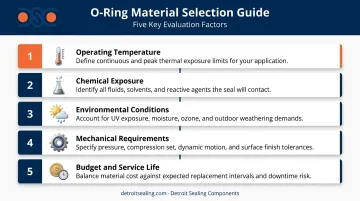
This decision involves five variables — evaluate all of them before specifying a material.
The Five Decision Factors
- Operating temperature — full duty cycle range, not just peak
- Chemical exposure — identify every fluid the seal contacts, including cleaning agents and incidental exposure
- Environmental conditions — indoor/enclosed vs. outdoor/UV-exposed vs. chemically aggressive atmosphere
- Mechanical requirements — static or dynamic sealing, abrasion potential, pressure cycling
- Budget and service life — upfront cost per seal vs. replacement frequency and downtime cost
Situational Recommendations
Choose Nitrile when:
- Operating temperatures stay within -30°C to +100°C
- Primary fluids are petroleum oils, standard hydraulic fluids, or water
- The environment is indoor and controlled
- Abrasion resistance is a priority (high-wear dynamic seals)
- Volume and cost constraints are significant factors
Choose Viton when:
- Temperatures exceed 100°C on a sustained basis
- Aggressive chemicals, solvents, or acids are present
- Outdoor, UV, or ozone exposure is unavoidable
- Long service intervals justify the higher upfront cost
- Seal failure carries safety or high-downtime-cost consequences
Industry Guidance
| Industry | Typical Material | Rationale |
|---|---|---|
| Automotive (hydraulic systems) | Nitrile | Moderate temperature, standard fluids, cost pressure |
| Automotive (fuel injection/turbo) | Viton | High heat, fuel exposure, tight replacement intervals |
| Aerospace | Viton | Extreme performance requirements, zero-failure tolerance |
| Chemical processing | Viton | Aggressive solvents and acids exceed NBR limits |
| Agriculture/construction | Nitrile | Abrasion-heavy, cost-sensitive, standard fluid exposure |
| Food & beverage | Either (FDA-grade compound required) | Material family depends on temperature and CIP chemistry |
The TCO Angle
Those industry patterns reflect a broader cost reality: material choice affects more than the unit price on a purchase order.
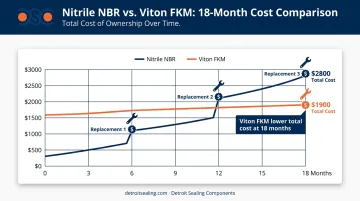
A Viton O-ring that lasts three times longer in a demanding environment is often the more cost-effective choice — even at a significantly higher unit price. If a Nitrile seal requires replacement every 6 months in a high-temperature chemical environment while a Viton seal lasts 18 months or more, the labor, downtime, and procurement overhead from three NBR replacements can easily exceed the Viton premium.
DSC stocks hundreds of compounds across both Nitrile and Viton material families, including specialty and custom-compounded grades. When standard materials don't meet application requirements, DSC's ISO 17025 accredited lab supports custom compound development and testing. DSC's technical team is available to work through material selection for complex or borderline applications.
Conclusion
Neither Viton nor Nitrile is universally superior. The right O-ring material is the one matched to the specific conditions of the application — temperature envelope, chemical exposure, mechanical demands, and budget reality.
Nitrile is the practical workhorse for the majority of general industrial applications: cost-effective, mechanically robust, and well-suited to petroleum fluid environments at moderate temperatures. Viton earns its premium in environments where seal failure carries real consequences — sustained high heat, aggressive chemical exposure, outdoor weathering, or long service intervals where replacement access is limited or costly.
A mismatched compound doesn't just fail prematurely — it often fails at the worst possible moment. Matching material to application from the start is the most cost-effective maintenance decision you can make.
For application-specific material selection support, contact the DSC technical team at 313-887-4695 or explore DSC's O-ring product range — with access to hundreds of compounds and an ISO 17025 accredited lab for custom material development — to find the right compound for your application.
Frequently Asked Questions
Are Viton O-rings better than nitrile?
"Better" depends entirely on the application. Viton outperforms Nitrile in high-temperature and aggressive chemical environments. Nitrile is the superior choice for cost-sensitive applications with moderate temperatures and standard petroleum or hydraulic fluid exposure.
What are Viton O-rings good for?
Viton excels in high-temperature sealing, resistance to fuels, acids, solvents, and hydrocarbons, and in environments with UV or ozone exposure. Common applications include aerospace fuel systems, chemical processing equipment, automotive fuel injection, and turbocharger seals.
Is Viton ok for gasoline?
Yes, Viton (FKM) has excellent resistance to gasoline and petroleum-based fuels, confirmed by Parker, Chemours, and Trelleborg compatibility data. It is a preferred choice for fuel system seals, particularly where high temperature or pressure is a factor.
Do Viton O-rings swell?
Viton is highly resistant to swelling from oils, fuels, and most hydrocarbons. It does experience degradation from ketones, low-molecular-weight esters, and amines — fluids where even standard grades can fail. For aggressive fluid environments, verify grade compatibility before specifying.
Can Nitrile O-rings be used outdoors?
Standard NBR is not recommended for prolonged outdoor use. Poor resistance to ozone, UV radiation, and weathering causes surface cracking and accelerated degradation. For outdoor applications, Viton or EPDM are the more appropriate choices.
What is the difference between FKM and Viton?
Viton® is a Chemours trademark for a specific line of FKM fluoroelastomer products. FKM is the ASTM D1418 material designation for the broader fluorocarbon rubber family. All Viton is FKM, but FKM products from other manufacturers are not Viton — the distinction is commercial, not chemical.