Specify NBR where HNBR is required, and you're looking at accelerated degradation, early seal failure, and unplanned maintenance. Overspecify HNBR where NBR would do the job, and you've added unnecessary material cost to every unit in production.
The distinction matters most in high-stakes environments. According to Siemens' 2024 True Cost of Downtime report, automotive unplanned downtime costs manufacturers $2.3M per hour — context that makes the right seal material selection far more than a purchasing decision.
This article breaks down the chemistry, performance data, and application logic behind both materials so you can make that call with confidence.
Key Takeaways
- NBR is cost-effective and oil-resistant: reliable for standard sealing up to ~120°C
- HNBR upgrades that baseline: rated to 150°C+, with stronger chemical resistance and longer mechanical service life
- The performance gap comes from hydrogenation — saturating NBR's polymer backbone removes its vulnerability to heat and ozone
- Choose NBR for budget-sensitive, moderate-duty applications; choose HNBR when heat, aggressive chemicals, or longer service life are non-negotiable
- Both are available in O-rings, gaskets, oil seals, and custom-molded shapes; the specific compound grade within each type shapes final performance
HNBR vs NBR: Quick Comparison
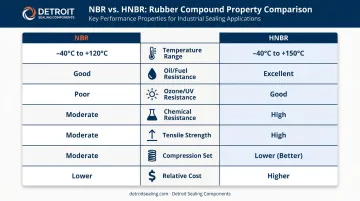
The table below summarizes the key performance differences at a glance — use it as a starting point before diving into the detailed breakdown.
| Property | NBR | HNBR |
|---|---|---|
| Temperature Range | -40°C to +120°C (short-term peak) | -40°C to +150°C–165°C depending on grade |
| Oil/Fuel Resistance | Excellent | Excellent |
| Ozone/UV Resistance | Poor | Excellent |
| Chemical Resistance | Petroleum oils, fuels, greases | All NBR resistances, plus ozone, H₂S, CO₂, refrigerants, dilute acids |
| Tensile Strength | ≥8–14 MPa (by hardness) | ≥15 MPa; up to 40 MPa in some grades |
| Compression Set at 150°C | Not rated for continuous use | 18.4%–31.9% after 70h; <15% peroxide-cured |
| Relative Cost | Lower | Higher — offset by longer service life |
| Best For | Standard automotive, hydraulics | Under-hood, oilfield, A/C, high-heat dynamics |
What Is NBR?
NBR (Nitrile Butadiene Rubber) is a synthetic copolymer of acrylonitrile (ACN) and butadiene. The ACN content — typically ranging from 18% to 50% — is the primary performance lever. Higher ACN content improves resistance to petroleum oils and hydrocarbon fuels while reducing swell in oil-wetted assemblies. The trade-off: as ACN rises, low-temperature flexibility decreases.
That tunability is why NBR became the dominant elastomer for fuel and oil sealing — engineers can dial in ACN content to match a specific fluid environment and operating temperature window.
Performance Characteristics
NBR's core strengths:
- Petroleum fluid resistance — mineral oils, greases, hydraulic fluids, and hydrocarbon fuels
- Hardness range — available from 50–90 Shore A, giving wide flexibility in sealing geometry
- Tensile strength — Trelleborg's compound data lists ≥8 MPa at 50 Shore A, rising to ≥14 MPa at 70 Shore A
- Temperature — standard NBR operates from -40°C to approximately +100°C continuously, with short-term peaks to +120°C
NBR's main limitation comes from its unsaturated polymer backbone, which is vulnerable to ozone, UV light, and oxidative degradation. In outdoor or under-hood environments where ozone exposure is real, NBR hardens and cracks well before its sealed-environment service life would suggest.
Where NBR Fits
NBR is the practical choice for:
- Fuel system O-rings and seals (petroleum-based fuels)
- Hydraulic system seals in industrial and mobile equipment
- Automotive oil seals and related fluid-contact components
- Water and sanitary system seals (within its temperature range)
- Agriculture and construction equipment operating in ambient-to-moderate temperatures
The global NBR market reached $3.12B in 2025, projected to grow to $5.00B by 2033 at 6.1% CAGR. That volume supports an extensive ecosystem of compound variants — meaning engineers rarely have to compromise on ACN grade, hardness, or cure system for standard sealing requirements.
What Is HNBR?
HNBR (Hydrogenated Nitrile Butadiene Rubber) starts as NBR and undergoes selective catalytic hydrogenation — a process that saturates the butadiene units in the polymer backbone while leaving the nitrile side groups intact. Removing those double bonds eliminates NBR's heat and ozone vulnerability, producing measurably higher temperature resistance and longer service life under aggressive conditions.
The degree of hydrogenation varies by grade. Zeon's Zetpol HNBR grades span 80% to >99.5% hydrogenation across ACN ranges of 19%–50%, while LANXESS Therban energy-sector compounds typically target 34%–49% ACN. Higher hydrogenation levels translate directly into better heat and ozone resistance — which is why grade selection matters before specifying a compound.
Performance Characteristics
HNBR's advantages over NBR are measurable, not just qualitative:
- Temperature range — Parker rates HNBR at 149°C continuous; Zeon's Zetpol grades extend to 160°C; LANXESS Therban to 165°C with short-term capability above 180°C
- Tensile strength — Trelleborg HNBR compounds list ≥15 MPa; LANXESS Therban grades reach up to 40 MPa
- Compression set at 150°C — Parker EOG HNBR compounds: 18.4%–31.9% after 70 hours; peroxide-cured HNBR achieves <15% after 70 hours at 150°C
- Long-term oil stability — Zeon reports <5% volume swell after 1,512 hours in automatic transmission fluid
- Chemical compatibility — Parker lists HNBR as compatible with sour gas, water/glycol, R-134a refrigerant, dilute acids, dilute bases, aliphatic hydrocarbons, and ozone
For CO₂ and H₂S resistance specifically — critical in oilfield environments — LANXESS Therban data shows no defects or cracks in 34% and 43% ACN HNBR compounds after CO₂ testing at 100°C and 12 MPa.
Where HNBR Fits
HNBR is the right call when operating conditions push past NBR's capability:
- Automotive A/C systems — refrigerant-resistant shaft seals and compressor seals (R-134a and next-generation refrigerants)
- Engine and under-hood components — front cover gaskets, intake manifold gaskets, oil pan gaskets where heat cycling is sustained
- Power steering and timing system seals — dynamic seals requiring retention of mechanical properties at elevated temperatures
- Oilfield downhole applications — blowout preventers, wellhead seals, inflatable packers, downhole packer elements, drill bit journal bearing seals
- Water swellable packers and pipe protectors in well construction
Parker positions HNBR as a cost-effective bridge between standard nitrile and fluorocarbon elastomers, which matters when FKM/Viton is technically capable but budget-prohibitive for a given application.
HNBR vs NBR: Which Should You Choose?
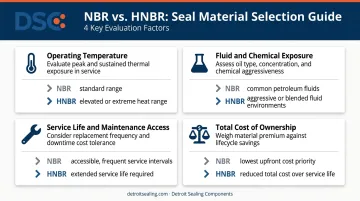
The decision comes down to four variables evaluated together, not in isolation.
The Four-Factor Framework
Peak and sustained operating temperature — If continuous temps exceed 100°C or peaks reach 120°C+, NBR is at or past its ceiling. HNBR's 150°C–165°C continuous range provides meaningful headroom.
Fluid and chemical exposure — Both handle petroleum oils well. The gap opens with ozone, refrigerants, H₂S, CO₂, or dilute acids — where HNBR holds and NBR degrades.
Service life and maintenance access — In hard-to-reach or high-cost-to-service locations (downhole tools, engine timing systems), seal longevity directly affects maintenance economics. HNBR's lower compression set at temperature means it maintains sealing force longer.
Total cost of ownership vs. upfront material cost — HNBR costs more per unit. But if HNBR doubles the service interval, the lifecycle math often favors the premium material.
Situational Guidance
Choose NBR when:
- Operating temperatures stay consistently below 100°C (short-term peaks to 120°C acceptable)
- Fluids are standard petroleum-based, no ozone or aggressive chemical exposure
- Budget is a primary constraint and conditions are moderate-duty
- Application examples: standard hydraulic O-rings, fuel system gaskets in controlled environments, water/sanitary seals
Choose HNBR when:
- Temperatures exceed 120°C continuously, or peak above that regularly
- Ozone, refrigerants, H₂S, CO₂, or acids are present
- Seal failure has high downstream cost — downhole tools, engine systems, A/C compressors
- Extended service intervals are required and replacement access is limited
Where DSC Fits In
Once you've worked through the four-factor framework, sourcing the right compound and geometry is the next step. Detroit Sealing Components stocks both NBR (60–90 Shore A) and HNBR (70–90 Shore A) across O-rings, gaskets, oil seals, and custom-molded components.
When a standard grade doesn't meet application-specific requirements, DSC's ISO 17025 accredited lab handles compound validation testing and custom material development — including oilfield HNBR compounds formulated to NORSOK M-710, ISO 23936, and API 6A standards. CAD and FEA capabilities support seal geometry evaluation alongside material selection.
Neither material is universally superior. HNBR doesn't replace NBR where NBR performs adequately — it just costs more. The right choice depends on your specific operating conditions, and getting that call right the first time is cheaper than a premature seal failure.
Real-World Application Examples
Automotive A/C: The R-134a Transition
When automotive A/C systems transitioned from R-12 to R-134a refrigerant, NBR seals that had performed adequately in R-12 systems showed accelerated degradation in R-134a environments. SAE paper 940595, published in 1994, evaluated HNBR elastomers specifically developed to handle R-134a contact — assessing permeation resistance, explosive decompression behavior, and low-temperature performance. HNBR became the material of record for refrigerant-side compressor shaft seals as a direct result of that performance gap.
Oilfield: Sour Gas Packer Elements
A 2022 Wiley study examined NBR and HNBR packer elements under sour conditions representative of field operations: H₂S concentrations from 0.0002% to 5%, lab testing at 121°C and up to 55.2 MPa for 7 and 14 days, and field temperatures from 47°C to 148°C. Evaluation followed ISO 23936-2 acceptance criteria:
- Hardness change within +10/−20 Shore A units
- Volume change within +25%/−5%
- Tensile and elongation change within ±50%
A 90 Shore A NBR packer maintained acceptable mechanical properties at 134°C, 47 MPa, and 3.5% H₂S — which shows that NBR doesn't universally fail in sour service. Compound selection and hardness matter. At the upper boundaries of temperature and pressure, however, HNBR's thermal stability and lower compression set at 150°C make it the more reliable specification for extended service intervals.
The common thread in both scenarios: under-specifying costs more than the material premium — measured in unplanned downtime and accelerated replacement cycles.
Conclusion
NBR and HNBR serve distinct performance tiers built for different operating demands. NBR remains the practical, cost-effective choice for most petroleum-fluid sealing applications where temperatures and chemical exposure stay moderate. HNBR earns its price premium where sustained heat, ozone, refrigerants, or aggressive oilfield chemistry make NBR an inadequate long-term choice.
Selecting the right compound the first time protects both the system and the budget. Detroit Sealing Components works with automotive OEMs, oil and gas operators, and industrial manufacturers to identify the right NBR or HNBR compound for the application — from standard O-rings to complex custom-molded components. DSC's technical team draws on an extensive compound library and ISO 17025 accredited testing to back every recommendation. Contact DSC at 313-887-4695 to discuss your sealing requirements.
Frequently Asked Questions
What is the temperature range of HNBR?
HNBR typically operates from -40°C to +150°C–165°C depending on grade and supplier. Peroxide-cured specialty grades can handle short-term exposures above 180°C. The hydrogenated backbone — with its saturated carbon chain — is what enables this thermal stability compared to standard NBR.
What is the temperature range for NBR material?
Standard NBR compounds operate from -40°C to approximately +100°C continuously, with short-term tolerance to +120°C. ACN content affects both ends: higher ACN raises oil resistance but reduces low-temperature flexibility, while special low-ACN grades can operate to -60°C.
Is HNBR good for water?
HNBR has adequate water and water/glycol resistance for many applications, and Parker lists water/steam as compatible. For dedicated water or aqueous media service, EPDM is the preferred choice. HNBR's core strength is oil, fuel, and chemical resistance.
Is NBR good for gasoline?
Yes — NBR has good resistance to petroleum-based fuels including gasoline, particularly in higher ACN grades, and is widely used in fuel system seals and O-rings. Oxygenated blends with high ethanol content or aromatic-rich fuels at elevated temperatures can present compatibility concerns; verify with supplier data for those specific media.
What is the difference between Viton and HNBR?
Viton (FKM) offers broader chemical resistance and higher continuous temperature capability — up to 204°C per Chemours' published data — compared to HNBR's 149°C–165°C range, but at significantly higher cost per unit. HNBR is the practical alternative where temperatures stay below 150°C and full fluorocarbon capability isn't required.
What material is equivalent to HNBR?
No single elastomer is a direct drop-in equivalent. FKM (Viton) covers similar chemical and high-temperature demands at higher cost, while NBR is HNBR's lower-performance predecessor at lower cost. The right choice depends on which HNBR property needs matching: FKM steps up for temperature, NBR steps down where conditions allow.