The right sealing material must balance temperature tolerance, chemical resistance, pressure rating, and application motion type simultaneously. A mismatch on any one of these axes shortens seal life and drives up total operating cost — sometimes dramatically.
This guide covers the main categories of sealing materials, six selection factors that matter most, and how to match material properties to real-world application demands.
Key Takeaways
- Material families span general-purpose elastomers (NBR, EPDM), high-performance fluoropolymers (FKM, PTFE), and specialty thermoplastics (PEEK, PU)
- The six critical selection factors: operating temperature range, chemical compatibility, pressure and load, static vs. dynamic motion, environmental exposure, and regulatory compliance
- No single material is universally best — a compound that excels in oil resistance may fail rapidly under UV or ozone exposure
- Mismatched seal material is a leading cause of premature failure — total cost of ownership matters more than upfront price
- For demanding or regulated applications, compound-specific lab testing confirms compatibility before deployment
What Are Sealing Materials?
Sealing materials are engineered compounds selected to create a reliable barrier between two surfaces — preventing leakage of fluids or gases while withstanding the mechanical, thermal, and chemical stresses of the operating environment. As Trelleborg defines it, sealing means filling a gap between static or moving surfaces to separate media.
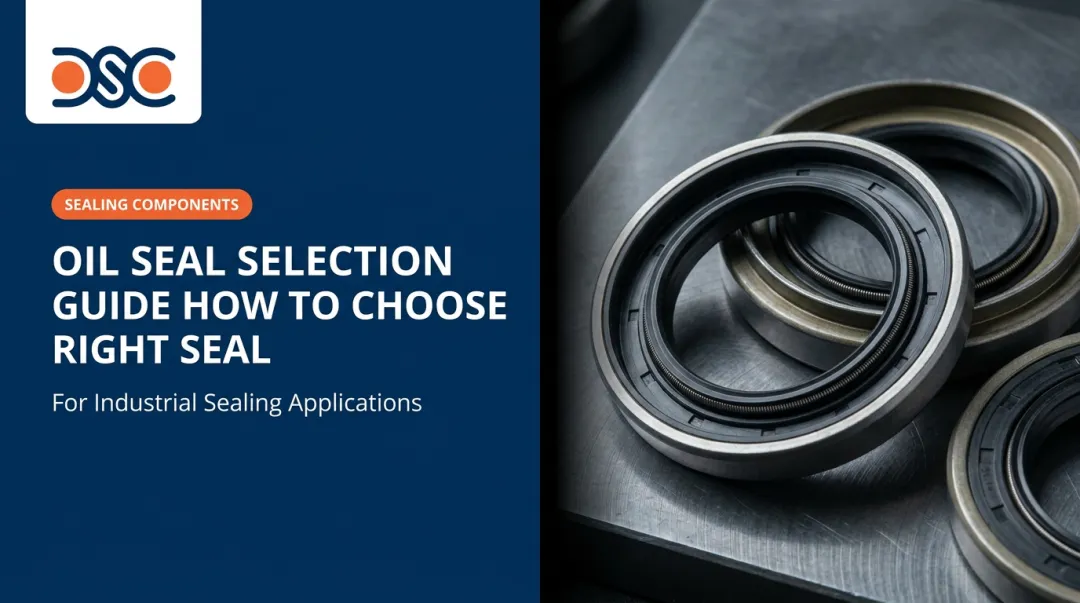
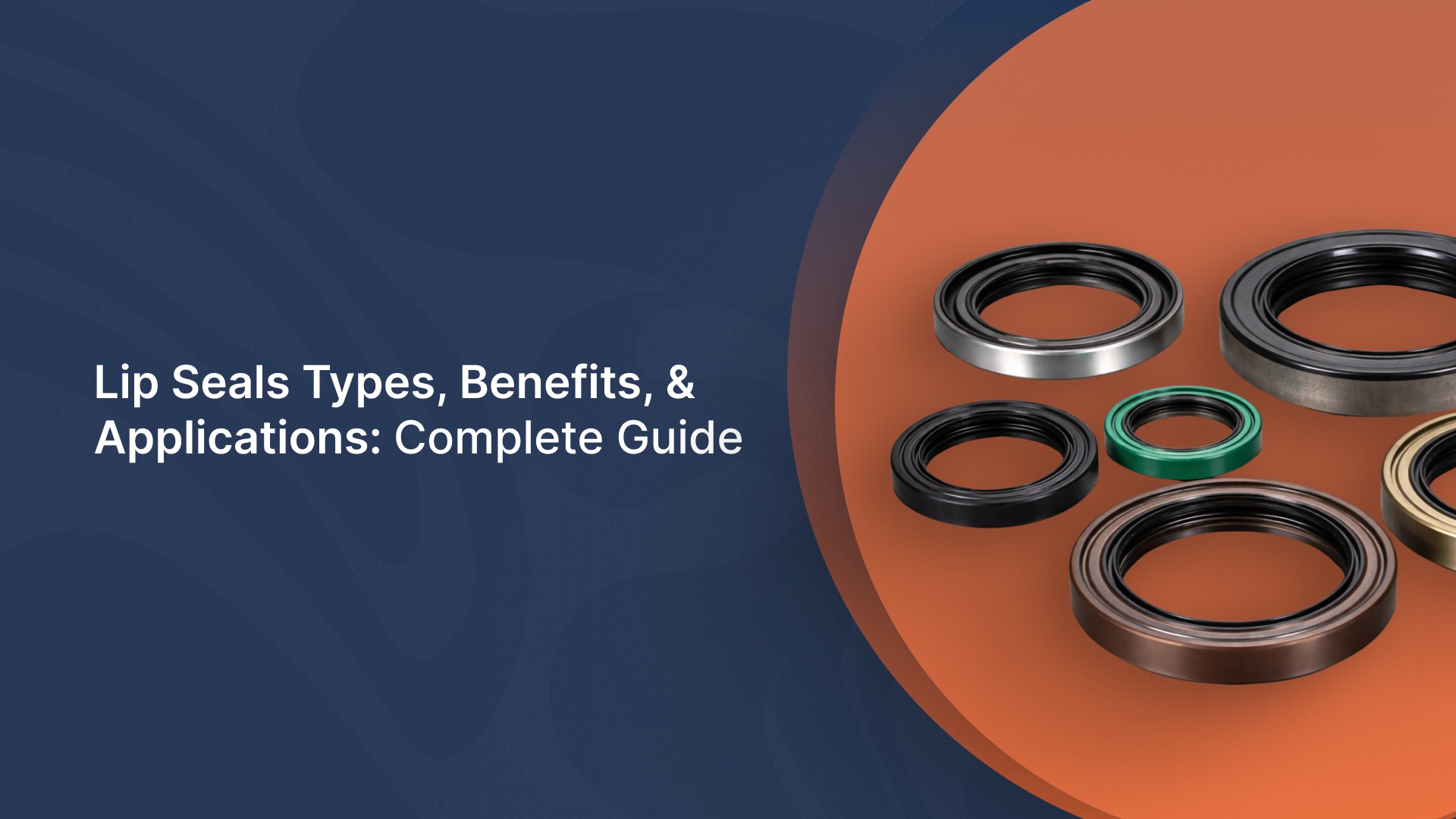
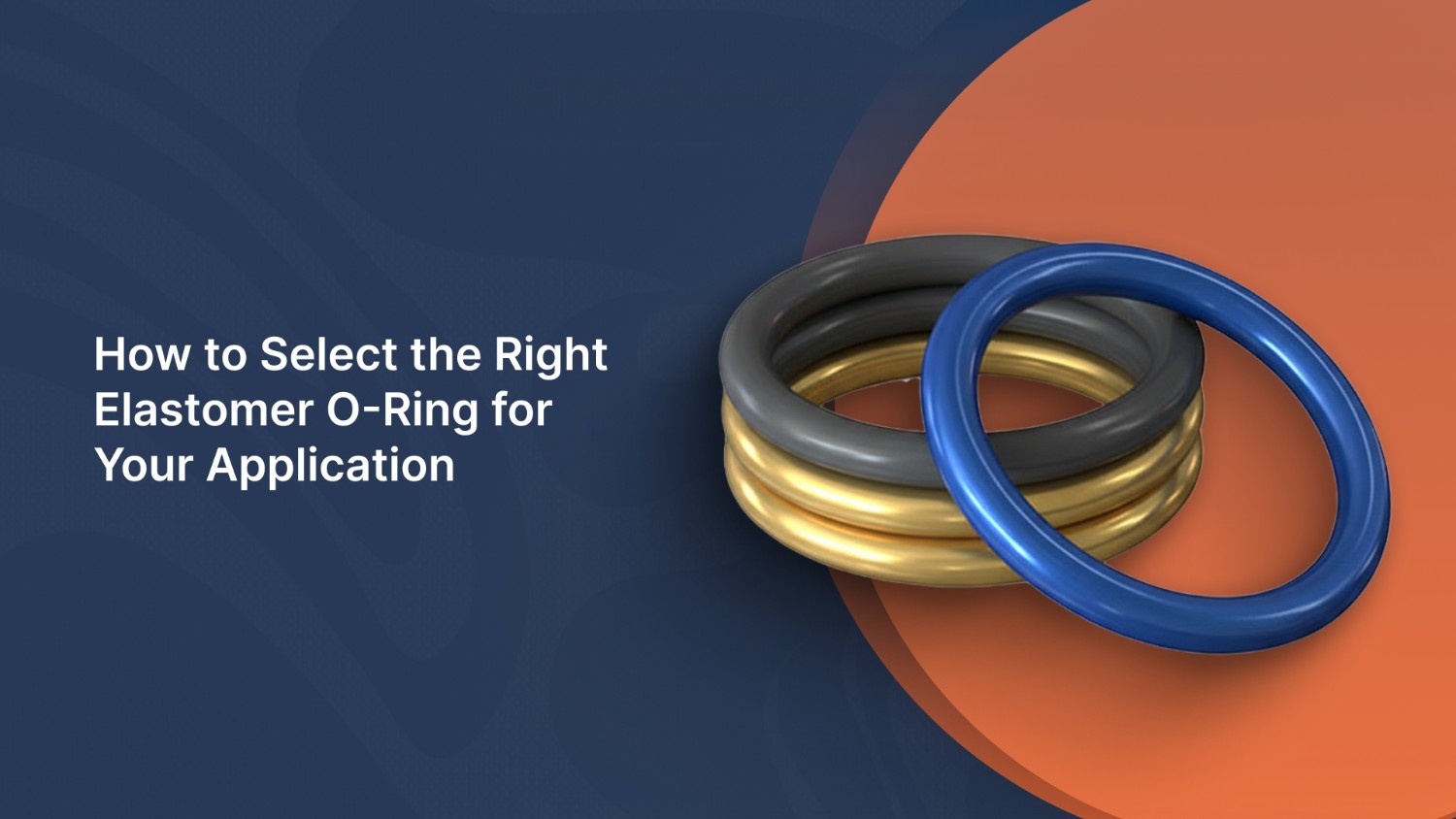
Seals appear in many physical forms: O-rings, gaskets, lip seals, diaphragms, rod seals, and custom-molded shapes. Form factor determines how a seal fits into an assembly. The material compound, however, determines how it performs — governing compatibility, longevity, and failure risk.
Core Performance Requirements
A sealing material must deliver five properties simultaneously:
- Fluid/air tightness under operating pressure
- Compression set resistance — the ability to recover elastically after being compressed, defined by ISO 815-1:2014 as resistance to permanent plastic deformation
- Thermal stability across the full operating temperature range, including transient peaks
- Chemical compatibility to the specific media being sealed
- Mechanical durability under static or dynamic load
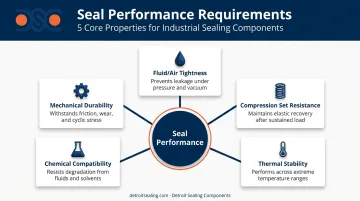
These properties trade off against each other. A material chosen purely for chemical resistance may sacrifice compression set performance. Sound material selection weighs all five factors together against the actual operating conditions.
Common Types of Sealing Materials
Sealing materials fall into three broad families: rubber elastomers, fluoropolymers and fluoroelastomers, and specialty thermoplastics. Detroit Sealing Components (DSC) maintains access to hundreds of compounds across all rubber types — from standard NBR to advanced FFKM — giving engineers access to both standard and custom-formulated options across every family below.
Rubber Elastomers: NBR, EPDM, and Neoprene
NBR (Nitrile Butadiene Rubber) is the industry workhorse for petroleum-based fluid sealing. It handles mineral oils, hydraulic fluids, greases, and fuels across a normal operating range of -30°C to +100°C (per Trelleborg's O-ring catalog). NBR is widely used in automotive, oil and gas, and hydraulic systems. Its weaknesses are ozone, UV radiation, and polar solvents — applications involving any of these require a different compound.
EPDM (Ethylene-Propylene-Diene Rubber) is the preferred choice for water, steam, dilute acids, and outdoor environments. Peroxide-cured EPDM reaches +150°C; sulfur-cured grades top out around +130°C. Its ozone and UV resistance is excellent. One hard limit: EPDM is incompatible with mineral oil products, so any application combining water and petroleum requires careful compound segregation.
Neoprene (CR) sits in the middle — offering reasonable ozone and weathering resistance, good abrasion resistance, and moderate chemical resistance. Common in refrigerant sealing, door and window sealing, and diaphragm applications. CR is not the top performer in any single category, but its balance makes it a practical choice where no single extreme condition dominates.
Fluoroelastomers: FKM, FFKM, and PTFE
FKM (Viton/Fluorocarbon Rubber) is the premium elastomer for aggressive chemical environments and elevated temperatures. Trelleborg confirms a normal range of -20°C to +200°C, with select high-performance grades extending further. FKM covers acids, aromatic hydrocarbons, fuels, and most hydraulic fluids, giving it the broadest chemical resistance spectrum among elastomers. In demanding duty cycles, the higher unit cost is offset by longer seal service life.
PTFE (Polytetrafluoroethylene) offers near-universal chemical inertness and continuous service to 260°C per Parker's PTFE Seals Design Guide. Its low friction coefficient makes it attractive for food and pharmaceutical applications where FDA 21 CFR 177.1550 compliance is required. The key caveat: PTFE lacks elastomeric memory and requires an energizer (typically a metallic spring) to maintain a dynamic seal — it is not a drop-in elastomeric replacement.
FFKM (Perfluoroelastomer) is the extreme-environment upgrade, combining elastomeric compression recovery with PTFE-level chemical resistance. Trelleborg rates FFKM to +240°C, with specialty types reaching +325°C. DSC sources FFKM compounds for demanding applications including oil and gas packer elements requiring explosive decompression resistance. This material is also used in semiconductor and chemical processing where both chemical purity and elastomeric recovery are non-negotiable.
Specialty Materials: Silicone, Polyurethane, HNBR, and PEEK
| Material | Normal Temp Range | Strengths | Limitations |
|---|---|---|---|
| Silicone (VMQ) | -50°C to +175°C | UV/ozone resistance, food/medical suitability | Poor abrasion resistance, high friction |
| Polyurethane (PU) | -50°C to +110°C | Abrasion resistance, high-load dynamic sealing | Hydrolysis risk in hot water/steam |
| HNBR | -30°C to +140°C | Upgraded heat, ozone, abrasion vs. NBR | Higher cost than standard NBR |
| PEEK | Continuous use to 260°C | Extreme temperature and chemical stability | Rigid thermoplastic; used for backup rings and structural elements |
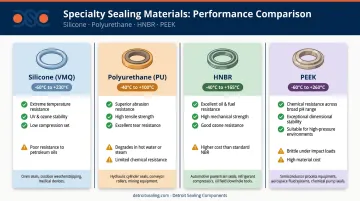
Silicone covers static and light-dynamic sealing well — food contact, medical equipment, and outdoor enclosures — but its high surface friction rules it out for high-speed dynamic seals. Polyurethane is purpose-built for reciprocating hydraulic cylinders and wiper applications where wear resistance and load capacity take priority.
For applications that outgrow standard NBR but don't justify FKM pricing, HNBR is the practical middle ground: it adds roughly 40°C of heat tolerance and substantially better ozone and abrasion resistance over NBR at a fraction of FKM's cost.
Key Factors for Sealing Material Selection
Material selection is a multi-dimensional engineering decision. The six factors below connect material properties to measurable operational outcomes: seal lifespan, system uptime, maintenance frequency, and compliance risk.
Operating Temperature Range
Temperature is the primary screening criterion. Thermal excursions above a material's rated range cause permanent compression set, cross-linking breakdown, or cracking — all leading directly to leakage. Both steady-state operating temperature and peak transient temperature must be assessed before any material can be considered.
Approximate continuous-service temperature ranges by material:
| Material | Normal Operating Range |
|---|---|
| NBR | -30°C to +100°C |
| EPDM (peroxide-cured) | Up to +150°C |
| HNBR | -30°C to +140°C |
| Silicone (VMQ) | -50°C to +175°C |
| FKM | -20°C to +200°C |
| PTFE | Up to +260°C (continuous) |
| FFKM | Up to +240°C; specialty grades to +325°C |
Ranges are compound-dependent. Always verify against the specific grade's datasheet.
Fluid and Chemical Compatibility
Chemical incompatibility causes swell, hardening, or disintegration of the seal matrix — effects that accelerate at elevated temperatures. Compatibility must be assessed for the exact fluid, including additives and concentration levels. "Hydraulic oil" is not one fluid; different additive packages can produce sharply different elastomer interactions.
The Trelleborg Chemical Compatibility Guide rates material-fluid combinations from A (very good) to U (unsuitable). Charts are a useful starting point, but they reflect generalized data. For specific fluid formulations or regulated applications, ASTM D471 is the standardized test method for evaluating rubber property changes (mass, volume, hardness, tensile strength) after liquid immersion.
When generic compatibility data isn't sufficient, DSC's ISO 17025 accredited lab can run application-specific compound testing against your actual fluid and operating conditions.
Pressure and Mechanical Load
Pressure drives three design decisions: Shore hardness, cross-section geometry, and backup ring configuration. Under-specified seals extrude into clearance gaps, causing leakage and mechanical damage. Trelleborg's data puts real numbers to this: O-rings without backup rings are limited to 5 MPa static working pressure for IDs over 50mm; add a backup ring and that ceiling rises to 40 MPa.
Parker's O-ring handbook identifies 70 to 80 Shore A as the optimal range for most applications. Dynamic applications (reciprocating or rotating) add friction, heat, and wear to the equation. Compound hardness, lubricity, and surface finish all interact, making application mode a required input alongside pressure rating.
Static vs. Dynamic Application
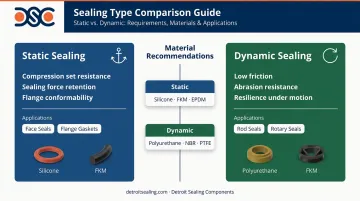
The motion type fundamentally changes what a seal must do. Static seals (face seals, flange gaskets) need strong compression set resistance to hold sealing force over time. Dynamic seals (rod seals, rotary seals) must also handle low friction, abrasion resistance, and resilience under continuous micro-motion.
The distinction matters practically: silicone performs well in static gasket applications but fails quickly as a rotary seal due to high surface friction. Polyurethane thrives in reciprocating hydraulic applications. Matching motion type to material properties prevents early-cycle fatigue failures that are often misattributed to poor installation.
Environmental and UV Exposure
Outdoor applications expose seals to ozone, UV radiation, and moisture cycling. These conditions attack the polymer backbone of NBR and natural rubber, causing surface cracking and elasticity loss even without any fluid contact.
Materials with inherent UV and ozone resistance:
- EPDM
- Silicone (VMQ)
- FKM
- PTFE and FFKM
- Neoprene (CR) — moderate resistance
For construction equipment, agriculture, and renewable energy installations, specifying outdoor-grade compounds from the outset prevents degradation failures that occur months before any fluid-contact issue would appear.
Regulatory and Industry Compliance
Certain industries impose material approval requirements that override engineering preference alone:
- FDA 21 CFR 177.2600 — Rubber articles for repeated food contact; sets extractives limits for finished articles
- NSF/ANSI/CAN 61 — Drinking water system components, including joining and sealing materials
- USP <87>/<88> — Biological reactivity for medical and biotech applications
- SAE AMS7276 — FKM molded sealing rings for high-temperature fluid-resistant applications
- API Specification 6A — Wellhead and tree equipment for oil and gas
- ATEX 2014/34/EU — Equipment for explosive atmospheres
A non-compliant material, even one that seals effectively, creates product liability and regulatory exposure. One detail engineers frequently overlook: certifications apply at the compound level, not the material family level. Multiple FKM compounds exist; not all carry AMS7276 approval.
DSC maintains compound-level certification documentation for food, medical, potable water, and aerospace applications, with traceability to specific standard specifications.
How DSC Can Help
Detroit Sealing Components (DSC) is a stocking distributor with decades of experience in precision molded rubber, sourcing and supplying sealing components for industrial applications from standard O-rings to complex custom-molded geometries.
DSC's material portfolio spans over a dozen elastomer families: FKM, NBR, HNBR, XNBR, EPDM, ACM, VMQ, FVMQ, LSR, CR, ECO, IIR, SBR, FFKM, AEM, PU/AU/EU, and TPU. That breadth means engineers rarely need to compromise on material family due to supply constraints.
What DSC brings to seal selection:
- Stocks O-rings across international standards (AS 568, BS 4518, JIS B2401, Metric, and more), from 0.5mm ID to 1600mm ID, available for immediate fulfillment from Plymouth, MI
- Designs custom-molded components using CAD and finite element analysis — FEA maps stress concentrations, sealing force distribution, and assembly loads before any tooling is committed
- Develops and validates custom compounds through an ISO 17025 accredited lab, providing compound-specific test data rather than generic datasheet reliance
- Documents certification traceability at the compound level for FDA 21 CFR, NSF 61, USP Class VI, and aerospace specifications including AMS standards
- Provides application-specific technical consultation to match material, geometry, and pressure/motion requirements without overspecifying
DSC supplies engineers across automotive, oil and gas, food and beverage, semiconductor, healthcare, aerospace, renewable energy, and water treatment — sectors where specifying the wrong seal material isn't just a quality issue, it's a failure mode with real operational cost.
Conclusion
Sealing material selection is an application engineering exercise, not a commodity procurement decision. Temperature range, fluid compatibility, pressure duty, motion type, environmental exposure, and compliance requirements must all align with the chosen compound — a mismatch on any one axis shortens service life and introduces risk.
The most effective approach is to map actual service conditions to material performance data, then validate critical selections through compound-specific testing rather than relying on material family assumptions. For complex applications, labs with ISO 17025 accreditation and broad compound libraries — covering hundreds of formulations across all rubber types — can run validation testing that goes beyond standard datasheet comparisons.
Seal performance should also be reviewed periodically. Three conditions commonly trigger requalification:
- Operating conditions shift (temperature, pressure, or cycle frequency)
- Fluid formulations change (new additive packages, alternative fluids)
- Regulatory requirements update (food-grade, medical, or environmental compliance)
A scheduled review cadence — tied to maintenance intervals or major process changes — catches compatibility drift before it causes failures, protecting both equipment reliability and compliance status well after initial commissioning.
Frequently Asked Questions
How do I choose the right sealing material?
Start with four core parameters: operating temperature range, fluid and chemical compatibility, pressure and load conditions, and motion type (static vs. dynamic). Any material meeting all four should then be screened for environmental exposure and regulatory compliance before finalizing. For critical or regulated applications, compound-specific lab testing — such as that performed in an ISO 17025 accredited lab — confirms what generic compatibility data cannot.
What are the criteria for gasket selection?
Gasket selection centers on compression set resistance (to maintain sealing force without mechanical recovery), surface conformability to the mating flange, chemical resistance to the sealed media, and operating temperature. Gasket thickness and hardness also affect bolt load distribution — an under-compressed gasket loses sealing force over time regardless of material quality.
What materials make good seals?
NBR, FKM, EPDM, Silicone, PTFE, and Polyurethane cover the majority of industrial sealing needs. The best material is always application-specific: NBR for petroleum fluids, FKM for aggressive chemicals and high heat, EPDM for water and outdoor environments, PTFE for near-universal chemical inertness where dynamic sealing isn't required.
What are the different types of sealants?
Formed and molded seals — O-rings, gaskets, lip seals, diaphragms — differ from liquid and paste sealants like anaerobic compounds, silicone RTV, and thread sealants. This guide focuses on molded sealing components, where material compound determines performance; liquid sealants follow different selection criteria and are not interchangeable in most mechanical applications.
How do I know my oil seal size?
Oil seal sizing requires three measurements: shaft diameter (inner bore), outer housing bore diameter, and seal width. Calipers or bore gauges work for measuring existing seals. Manufacturer part numbers and cross-reference tables can match dimensions to standard profiles, and DSC's technical staff can assist with non-standard sizes or unusual configurations.
Which is better: Viton or PTFE rear main seal?
FKM (Viton) offers better dynamic sealing and elastomeric recovery for most crankshaft applications. PTFE provides lower friction and broader chemical resistance but requires an engineered energizer — typically a spring or interference fit — to maintain sealing force; the right choice comes down to running temperature, oil type, and service life goals.