Introduction
A wrong oil seal choice rarely announces itself immediately. Instead, it shows up weeks or months later as a lubricant leak, a contaminated bearing, or an unplanned shutdown—at which point the repair cost dwarfs what a correct seal would have cost.
The stakes are real. According to Siemens' 2022 industrial downtime report, unplanned downtime costs Fortune Global 500 industrial companies roughly $1.5 trillion annually—about 11% of total turnover. In automotive manufacturing alone, a single lost production hour exceeds $2 million.
Oil seals are small components, but they sit at the center of that equation. Getting the selection right means evaluating six interdependent factors: seal type, lip material, temperature range, shaft speed and surface finish, pressure conditions, and dimensional fit. Miss one, and the entire selection can fail.
This guide covers each factor in detail, giving you what you need to select with confidence—and avoid the failures that come from getting it wrong.
Key Takeaways
- Oil seals retain lubricants and exclude contaminants along rotating shafts in gearboxes, pumps, motors, and axles
- Selection requires matching six factors simultaneously: seal type, lip material, temperature, shaft speed, pressure, and dimensions
- NBR handles most general oil and grease applications at moderate temperatures
- FKM is the go-to for high heat, aggressive chemicals, and demanding environments
- PTFE offers the broadest fluid resistance but requires a finer shaft surface finish
- A material-fluid mismatch or dimensional error causes premature failure regardless of installation quality
- For unusual or demanding conditions, consult a supplier with access to a broad compound library
What Is an Oil Seal?
An oil seal (also called a radial shaft seal or lip seal) is a dynamic sealing component that retains lubricants and excludes contaminants along a rotating shaft. You'll find them in gearboxes, hydraulic pumps, electric motors, agricultural axles, and anywhere a shaft passes through a housing that contains oil or grease.
Three Core Structural Elements
As described by both SKF and Trelleborg, every standard oil seal consists of:
- Outer case (metal or rubber-covered metal) pressed into the housing bore to create an interference fit
- Sealing lip (rubber or PTFE) that contacts the shaft directly and performs the actual sealing
- Garter spring that keeps consistent radial pressure on the lip as it wears over time
Common Oil Seal Types
Oil seal types are standardized under DIN 3760/DIN 3761 and ISO 6194-1. The most frequently encountered configurations:
| Type | Construction | Best For |
|---|---|---|
| Type A / R | Single lip, rubber-covered case | General use, minor bore imperfections |
| Type AS / RST | Double lip with dust exclusion lip | Dirty, dusty, outdoor environments |
| Type B / M | Single lip, metal case | Clean bores, high-volume OEM applications |
| Type C / GV | Double metal case, heavy-duty | Aggressive environments, heavy equipment |
| PTFE lip seal | PTFE lip on metal case | High speed, high chemical resistance |
| Cassette seal | Integrated multi-lip assembly | Wheel-end and axle applications |
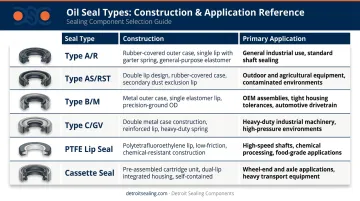
Type selection comes before material selection in the decision sequence — knowing the construction first narrows which compounds and specifications actually apply.
Where Oil Seals Are Used
Key application environments include gearboxes, hydraulic pumps, electric motors, agricultural machinery axles, automotive drivetrains, conveyor systems, wind turbine pitch systems, and food processing equipment. Each environment places different demands on the seal, which is why type and material choices vary so significantly across industries.
Key Factors for Selecting the Right Oil Seal
Oil seal selection is a layered decision. An error in any single dimension can invalidate an otherwise correct choice. The six factors below represent the framework sealing engineers use to match a seal to its actual operating environment.
Seal Type and Lip Design
Outer case material determines installation requirements:
- Rubber-covered cases (Type R/RST) self-seal minor surface imperfections in the housing bore and are more forgiving during installation
- Metal cases (Type M/GV) require a clean, well-finished bore but are often more cost-effective in high-volume OEM settings
Lip design should match environmental exposure:
- Single-lip seals suit clean environments where the primary need is lubricant retention
- Double-lip seals add a secondary dust exclusion lip on the air side, which is necessary for agricultural, construction, and mining applications where airborne contaminants are constant
Rubber Material and Fluid Compatibility
The lip material must be chemically compatible with the fluid being sealed. Incompatible rubber degrades, hardens, or swells — leakage follows quickly and worsens until the seal fails entirely.
Key material properties by compound:
| Material | Temperature Range | Strengths | Watch Out For |
|---|---|---|---|
| NBR | -20°F to +250°F | Cost-effective, general oil/grease | Aromatic hydrocarbons, some synthetics |
| FKM | -40°F to +400°F | High heat, broad chemical resistance | Low-temperature flexibility limits |
| VMQ (Silicone) | -90°F to +400°F | Wide temperature span | Low wear resistance — avoid high-friction dynamic applications |
| EPDM | -60°F to +300°F | Hot water, steam, ozone resistance | Petroleum-based oils |
| ACM | -40°F to +275°F | High oil resistance, improved heat over NBR | Lower low-temp performance than NBR |
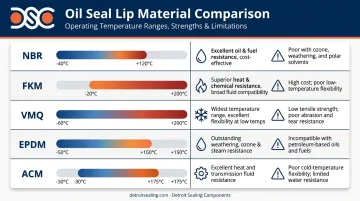
Temperature ranges sourced from Parker's 2021 Rotary Seal Design Guide.
DSC's compound library covers all of these families — plus HNBR, FVMQ, FFKM, and others — for applications where standard compounds fall short.
Operating Temperature and Shaft Speed
These two factors are linked because lip friction generates heat at the shaft contact zone. At high speeds, that frictional heat adds to ambient and fluid temperature, so the seal's actual thermal load always exceeds the housing temperature reading.
Reference limits by material:
- NBR lips: up to 3,000 fpm
- FKM and PTFE lips: up to 6,000 fpm
Exceeding these limits accelerates lip wear and generates enough frictional heat to harden or crack the rubber. Always evaluate speed and temperature together, not in isolation.
Shaft Surface Finish and Hardness
Shaft condition is where many seal failures originate — even when the seal material and size are correct.
Parker's design guide specifies:
- Surface roughness: 8–17 micro-inch Ra (plunge-ground finish recommended)
- Lead angle: below 0.05 degrees — spiral machining marks act as a pump mechanism that drives fluid past the lip regardless of lip condition
- Shaft hardness: at least 30 Rc for standard service; 45 Rc for abrasive or high-pressure environments
Trelleborg's guidance adds that at peripheral speeds above 10 m/s, shaft hardness should reach 60 HRC to resist the wear that the lip motion generates.
If a customer provides shaft drawings showing spiral-ground finish or insufficient hardness, that needs to be resolved before seal selection proceeds.
Pressure Conditions
Standard oil seals are low-pressure components. Internal pressure lifts the lip away from the shaft, breaking sealing contact.
- Standard elastomeric lip seals: rated for 3 psi / 0.20 bar (Parker) or ~0.05 MPa (Trelleborg)
- Above these limits, reinforced or pressure-rated designs are required
- Parker's high-pressure profile handles up to 300 psi / 20 bar; Trelleborg's HP20 reaches 20 MPa at limited speed
Using a standard oil seal in a pressurized housing doesn't just cause leakage — it causes pop-out, where internal pressure ejects the seal axially from the bore.
Seal Dimensions
Oil seals are specified by three dimensions:
- Inside diameter (ID) — must match shaft diameter
- Outside diameter (OD) — must match housing bore diameter
- Width (W) — must fit the groove depth
These numbers are typically stamped on the seal itself. Standard bore tolerance is H8; shaft tolerance requirements vary by manufacturer specification.
A fourth dimension that often goes unexamined: total eccentricity — the combined shaft runout and housing bore misalignment. Trelleborg notes that excessive shaft runout prevents the lip from tracking shaft movement at speed. No amount of correct material selection or sizing compensates for this.
How Detroit Sealing Components (DSC) Can Help
DSC is a precision sealing solutions distributor with decades of experience in molded rubber goods, serving industrial buyers across the US with nationwide distribution from its Plymouth, Michigan warehouse.
For oil seal applications, DSC matches capabilities directly to application requirements:
- Compound range — hundreds of formulations across NBR, FKM, VMQ, EPDM, ACM, HNBR, FVMQ, FFKM, and PTFE, matched to fluid compatibility, temperature range, and speed requirements
- Custom compound development — DSC's ISO 17025 accredited lab develops and validates formulations when standard materials fall short on fluid resistance, temperature limits, or regulatory fit
- CAD and FEA support — for non-standard geometries, engineering tools simulate seal deformation, stress distribution, and assembly forces before production begins
- Stocked inventory — standard sizes held in Plymouth, MI, near major shipping lanes for fast, cost-effective fulfillment
- Regulated industry compliance — FDA CFR 177.2600 compliant materials for food and beverage; materials meeting USP Class VI, NSF 61, and NSF 42 for sanitary applications
When a customer provides application parameters—shaft diameter, fluid type, operating temperature, shaft speed—DSC's technical staff works through the selection framework to identify the right seal for that specific operating environment.
Conclusion
Oil seal selection doesn't reward shortcuts. Seal type, lip material, temperature range, shaft speed, pressure rating, and dimensional fit all have to align with actual operating conditions—not just nominal specs from a catalog.
The goal isn't the most popular seal. It's the seal that matches your specific fluid, temperature, speed, and environment. That distinction is what separates equipment that runs reliably for years from equipment that fails in months.
Selection isn't a one-time event. When operating conditions change—fluid reformulation, speed increases, temperature excursions—seal specifications should be re-evaluated. Applications evolve; your seal spec should too.
Frequently Asked Questions
What is the best material for oil seals?
There's no universal answer. NBR is the most widely used for general oil and grease applications due to its balance of cost and performance. FKM is preferred for high-temperature or chemically aggressive environments. Match the material to the fluid being sealed, the operating temperature, and the shaft speed.
What are the most common types of oil seals?
The most common configurations are single-lip rubber-covered (Type R/A), double-lip with dust exclusion lip (Type RST/AS), metal-cased single lip (Type M/B), and heavy-duty double-metal-cased (Type GV/C). PTFE lip seals and cassette seals cover high-speed and wheel-end applications respectively.
How do I determine the correct oil seal size?
Oil seals are specified by three dimensions: inside diameter (shaft OD), outside diameter (housing bore diameter), and width. These are usually stamped on the seal itself. Standard housing bore tolerance is H8—confirm shaft and bore dimensions before ordering.
What causes oil seals to fail prematurely?
The most common causes are wrong material selection (chemical or thermal incompatibility), shaft surface finish that's too rough or has spiral lead marks, shaft speed beyond the lip's rated limit, incorrect installation that damages the lip, and inadequate lip lubrication at initial startup.
Can standard oil seals be used in high-pressure applications?
No. Standard oil seals are rated for very low internal pressures (around 3 psi / 0.20 bar per Parker's specifications). Elevated pressure causes the lip to lift off the shaft and can eject the seal from the bore entirely. Higher-pressure applications require reinforced designs or purpose-built high-pressure seal profiles.
What is the difference between a single-lip and double-lip oil seal?
A single-lip seal retains lubricant; a double-lip seal adds a secondary lip on the air side to block contaminants (dirt, dust, water) from reaching the primary lip. Double-lip designs are the right choice for agricultural, construction, and outdoor machinery where contamination exposure is continuous.