Introduction
An engineering manager sends out an RFQ for custom seal rings and receives three quotes ranging from $5 to $50 per unit—each based on different assumptions because the specs were never clearly defined. This scenario plays out daily in procurement departments, causing project delays and budget overruns.
The problem usually isn't supplier quality—it's the RFQ itself. Industry data suggests companies issuing unclear RFQs experience 20% higher supplier dropout rates and face 10–15% higher project costs due to specification misalignment. Accurate quotes start with the buyer communicating exact requirements through a well-structured RFQ.
This guide provides a systematic framework for writing sealing component RFQs that eliminate ambiguity, ensure supplier understanding, and result in accurate, comparable quotations. You'll learn exactly what information to include, how to structure your request, and which common mistakes to avoid.
Key Takeaways
- Complete RFQs cover exact dimensions with tolerances, material specs, surface finish, operating conditions, and expected quantities
- Missing tolerance ranges, material hardness, and application environment details are the most common causes of inaccurate quotes
- Follow this order: component ID → dimensional specs → material requirements → quality standards → commercial terms
- Require standardized quote formats and specify which technical questions suppliers must answer for direct comparison
- A detailed RFQ upfront cuts back-and-forth, reduces cost surprises, and makes supplier comparison straightforward
Essential Information to Include in Your Sealing Component RFQ
Every sealing component RFQ should begin with clear component identification. Specify the part name, reference number (if applicable), and intended application or industry—for example, "mechanical seal ring for centrifugal pump in oil & gas application." That application context is what separates a quote based on assumptions from one grounded in your actual requirements.
Dimensional Specifications
List all critical dimensions with tolerance ranges using standard notation. Include:
- Inner diameter (ID): 50mm ±0.05mm
- Outer diameter (OD): 75mm ±0.08mm
- Thickness: 5mm ±0.03mm
- Special features: grooves, chamfers, or custom geometries
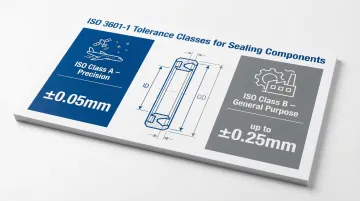
Specify measurement standards and reference datums to eliminate interpretation errors. Reference ISO 3601-1 for O-rings or SAE AS568F for aerospace applications. ISO 3601-1 defines two primary tolerance classes: Class A (Precision) for aerospace and critical applications, with tolerances as tight as ±0.05mm. Class B (General Purpose) covers standard industrial applications with wider tolerances up to ±0.25mm.
Material and Grade Requirements
Define material type and specific grade when known. Examples include:
- "Tungsten carbide grade YG8" (equivalent to ISO K10)
- "Silicon carbide, reaction-bonded"
- "Nitrile rubber (NBR), 70 Shore A ±5"
If you don't know the exact grade, describe the application requirements instead: operating temperature range, chemical exposure, and pressure conditions. A distributor with an ISO 17025 accredited lab and access to a broad compound library—like Detroit Sealing Components—can translate those parameters into a material recommendation.
Include required material properties:
- Hardness range (HRA scale for carbides, Shore A for elastomers)
- Density specifications
- Chemical resistance requirements per ASTM D2000 classification
Surface Finish and Quality Standards
Specify surface finish requirements using Ra values with clear distinctions between critical and non-critical surfaces:
- Sealing face: Ra 0.2µm or better
- Non-sealing surfaces: Ra 1.6µm acceptable
Reference applicable industry standards (ISO 4287, ASTM, DIN) and indicate whether inspection reports or material certifications are required. For dynamic seals, Parker's O-Ring Handbook recommends Ra 0.40µm for reciprocating contact surfaces, while static seals can accept Ra 1.60µm.
Operating Conditions and Application Context
Describe the complete operating environment:
- Temperature range: -20°C to +150°C
- Pressure: 150 bar continuous, 200 bar peak
- Media contact: hydraulic oil (ISO VG 46)
- Expected service life: 5,000 operating hours
These operating parameters drive material selection as much as any dimensional spec. EPDM, for instance, performs well in hot water and steam but degrades in mineral oils—while FKM handles broad oil exposure at elevated temperatures. Suppliers need this context to recommend the right compound, not just the cheapest one that fits the geometry.
Step-by-Step Process for Writing an Effective RFQ
Step 1: Gather Internal Requirements
Before drafting anything, pull together input from the teams closest to the application:
- Engineering: dimensional requirements, tolerance limits, material constraints
- Operations: production volume, uptime requirements, assembly compatibility
- Maintenance: failure history, known wear patterns, replacement frequency
Review existing drawings, specifications, or samples of current components to establish baseline requirements. Catching gaps at this stage prevents expensive specification changes after quotes come in.
Step 2: Create a Structured RFQ Document
Organize information into clear sections:
- Component Overview: Part identification and application
- Technical Specifications: Dimensions, tolerances, materials
- Quality Requirements: Standards, certifications, inspection needs
- Commercial Terms: Quantity, delivery schedule, payment terms
- Submission Instructions: Format, deadlines, required attachments
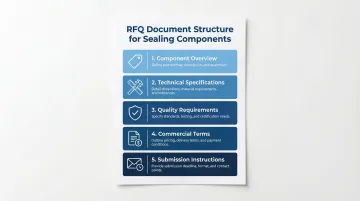
Use tables for dimensional data and bullet points for requirements to improve readability and reduce supplier interpretation errors.
Step 3: Define Evaluation Criteria
Specify how quotes will be evaluated to help suppliers understand what matters most:
- Price weighting (e.g., 40%)
- Technical compliance (30%)
- Lead time (15%)
- Certifications and quality documentation (15%)
Request suppliers provide quotes in a standardized format with line items for unit price, tooling costs (if applicable), lead time, minimum order quantity, and payment terms. Standardizing the format makes side-by-side comparison straightforward and reduces back-and-forth clarification.
Step 4: Include Submission Guidelines
Set clear deadlines:
- Questions accepted until: [Date]
- Quote submission deadline: [Date]
- Pricing validity period: 90 days
Specify required attachments: technical data sheets, material certifications, quality control procedures, or references from similar projects. For critical applications requiring FDA compliance or NSF certifications, explicitly state these documentation requirements.
Step 5: Review and Validate Before Distribution
Have a technical expert review the RFQ for completeness and clarity. Missing information results in either no quotes or inconsistent quotes that are difficult to compare.
Consider sending the RFQ to a trusted supplier first for feedback before broad distribution. A supplier familiar with your application type will flag gaps that internal reviewers often miss — and you'll get cleaner quotes from everyone else as a result.
Material and Grade Specifications for Sealing Components
For carbide seal rings, specify the grade precisely. "Tungsten carbide with 6% cobalt binder" or "YG6 equivalent" tells suppliers the hardness-toughness balance you need. Common grades differ in meaningful ways:
- YG6 (ISO K10/K20 equivalent): General-purpose wear resistance for most sealing applications
- YG8 (ISO K10): Higher toughness, better suited for metal forming and impact-prone environments
Elastomeric seals require a different approach—start with polymer type and operating range:
- NBR (Nitrile): -30°C to +100°C, excellent for mineral oils
- EPDM: -50°C to +150°C, excellent for water/steam, incompatible with oils
- FKM (Viton): -20°C to +200°C, broad chemical and heat resistance
- FFKM: -20°C to +320°C, extreme conditions, highest cost
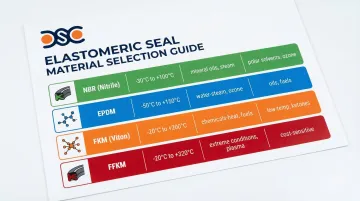
Specify hardness using Shore A durometer rating (e.g., "70 Shore A ±5"). Lower hardness provides better sealing at low pressures, while higher hardness (90 Shore A) resists extrusion in high-pressure applications.
When uncertain about material selection, describe your operating conditions and ask suppliers to recommend materials with written justification. DSC's ISO 17025 accredited lab and ISO 9001:2015 certified quality system can evaluate your conditions, recommend appropriate compounds, and develop custom formulations when standard materials don't meet your application needs.
Common Mistakes That Lead to Inaccurate Quotes
Most quoting errors trace back to the same few gaps in the RFQ. Watch for these:
- Missing tolerance specifications — Without defined acceptable ranges, suppliers either over-engineer the part (driving up cost) or quote inadequate precision. Specifying unnecessarily tight tolerances can increase costs by 2 to 24 times compared to standard tolerances with no functional benefit.
- Undefined surface finish requirements — Suppliers default to their standard finish, which may not match your sealing face needs. Too rough causes abrasive wear; too smooth prevents lubrication film formation in dynamic seals.
- No application context — Omitting pressure, temperature, and media exposure leaves suppliers unable to flag material or design risks. The result: quotes for components that fail in the field and require costly replacements.
How to Evaluate and Compare Supplier Quotes
Create a comparison matrix with columns for each supplier and rows for critical factors:
| Supplier | Unit Price | Tooling Cost | Lead Time | Material Grade | Certifications | MOQ |
|---|---|---|---|---|---|---|
| Supplier A | $12.50 | $500 | 6 weeks | NBR 70A | ISO 9001 | 500 |
| Supplier B | $10.75 | $750 | 8 weeks | NBR 75A | ISO 9001, FDA | 1000 |
| Supplier C | $15.00 | $0 | 4 weeks | HNBR 70A | ISO 9001, NSF 61 | 100 |
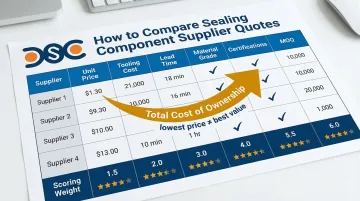
Look beyond unit price. A lower-priced quote may use inferior materials, looser tolerances, or missing certifications — all of which drive up total cost through premature failures or compliance failures.
Once you've identified gaps or concerns, follow up directly with each supplier. Ask for clarification on:
- How their proposed material or specification differs from your RFQ requirements
- What performance trade-offs accompany any substitutions
- Whether tooling costs are amortized, one-time, or refundable
- How they handle out-of-tolerance parts or quality escapes
When to Include Additional Technical Requirements
For critical applications involving high pressure, hazardous materials, or safety-critical systems, specify additional requirements:
- Non-destructive testing (NDT) methods
- Batch traceability and lot numbering
- Specific manufacturing process controls
- First article inspection reports
Beyond testing and traceability, your RFQ should also call out any industry-specific compliance standards. State the applicable standard and the documentation you need — material certificates, inspection reports, or third-party test data. Common examples include:
- FDA (food contact applications)
- API (oil & gas equipment)
- ASME (pressure vessels and piping)
Drinking water applications carry their own regional requirements — NSF 61, NSF 42, WRAS, or ACS certifications, depending on where the end product is sold.
Conclusion
Writing an effective sealing component RFQ eliminates ambiguity through complete dimensional specifications, clear material requirements, and sufficient application context. The precision you invest upfront—specifying exact tolerances, surface finishes, and operating conditions—directly determines the accuracy of supplier quotes. Vague specifications routinely produce a 10x price variance across responses; detailed ones produce quotes you can actually compare.
That upfront effort also saves time downstream by reducing back-and-forth clarifications and filtering out unsuitable bids before they waste anyone's time.
To keep improving with each procurement cycle:
- Maintain an RFQ template for your most common sealing component types
- Document which specifications proved critical and which drove unnecessary cost
- Update the template after each cycle based on supplier feedback and quote outcomes
Over time, this turns the RFQ process from a one-off scramble into a repeatable system that consistently delivers accurate, actionable quotes.
Frequently Asked Questions
What should be included in a sealing component RFQ?
A complete RFQ should cover these core elements:
- Dimensional specifications with tolerances
- Material and grade requirements
- Surface finish standards (critical for sealing faces)
- Operating conditions: temperature, pressure, and media
- Quantity and delivery requirements
- Applicable certifications or industry quality standards
What does RFQ stand for?
RFQ stands for "Request for Quotation"—a procurement document that solicits price quotes from suppliers for specific products with clearly defined specifications, allowing buyers to compare offers based on price, quality, and terms.
Which is better for sealing components: neoprene or EPDM?
EPDM performs better for water, steam, or ozone/UV exposure (-50°C to +150°C), while neoprene offers better oil resistance and wider temperature versatility. The best choice depends on your application environment, which is why your RFQ should describe operating conditions rather than pre-selecting materials.
What are the main types of rubber used for seals?
Natural rubber offers excellent elasticity but poor chemical and heat resistance. Synthetic rubbers are engineered for specific conditions: Nitrile (NBR) for oil resistance, EPDM for weathering, Viton (FKM) for high temperature and chemical exposure, and Silicone (VMQ) for extreme temperature ranges.
What is the ISO standard for rubber gaskets?
ISO 3601 covers O-ring dimensions and tolerances, ISO 1629 classifies elastomer types, and ISO 2230 addresses storage guidelines. Reference the standards specific to your component type so suppliers know the quality baseline expected.
How specific should tolerance requirements be in a sealing component RFQ?
Tolerances should be as tight as your application demands — no tighter. Over-specifying drives up cost; under-specifying causes performance failures. Sealing faces typically require ±0.05mm or tighter, while non-critical dimensions can use standard tolerances.