Seal failures rarely happen because seals are "weak"; they happen because the wrong O-ring type or construction was selected for the duty condition. In hydraulic, fluid power, processing, and mechanical systems, even a small mismatch in O-ring design can lead to leakage, extrusion, or premature wear.
While O-rings look simple, they are manufactured in multiple configurations, constructions, and size systems that directly impact performance under pressure, motion, chemical exposure, and temperature variation.
This guide explains the true types of O-ring seals, their construction differences, and how those variations affect performance in demanding industrial environments.
Key Takeways
O-rings differ by size standard (AS568 vs ISO 3601), construction (molded, spliced, encapsulated, coated), and cross-section, not just material.
Standard AS568 molded O-rings have cross-sections from 0.040″ to 0.275″, while metric O-rings follow ISO 3601 dimensional systems.
Material selection must match operating limits, such as NBR (−35°C to +120°C), FKM (−20°C to +205°C), and PTFE (−200°C to +260°C).
Proper gland design requires 20–30% compression for static seals and pressure control to prevent extrusion above ~1,500 psi.
Common failure modes include extrusion, compression set, chemical swell, and abrasion, all linked to incorrect configuration or material choice.
What Are O-Ring Seals?
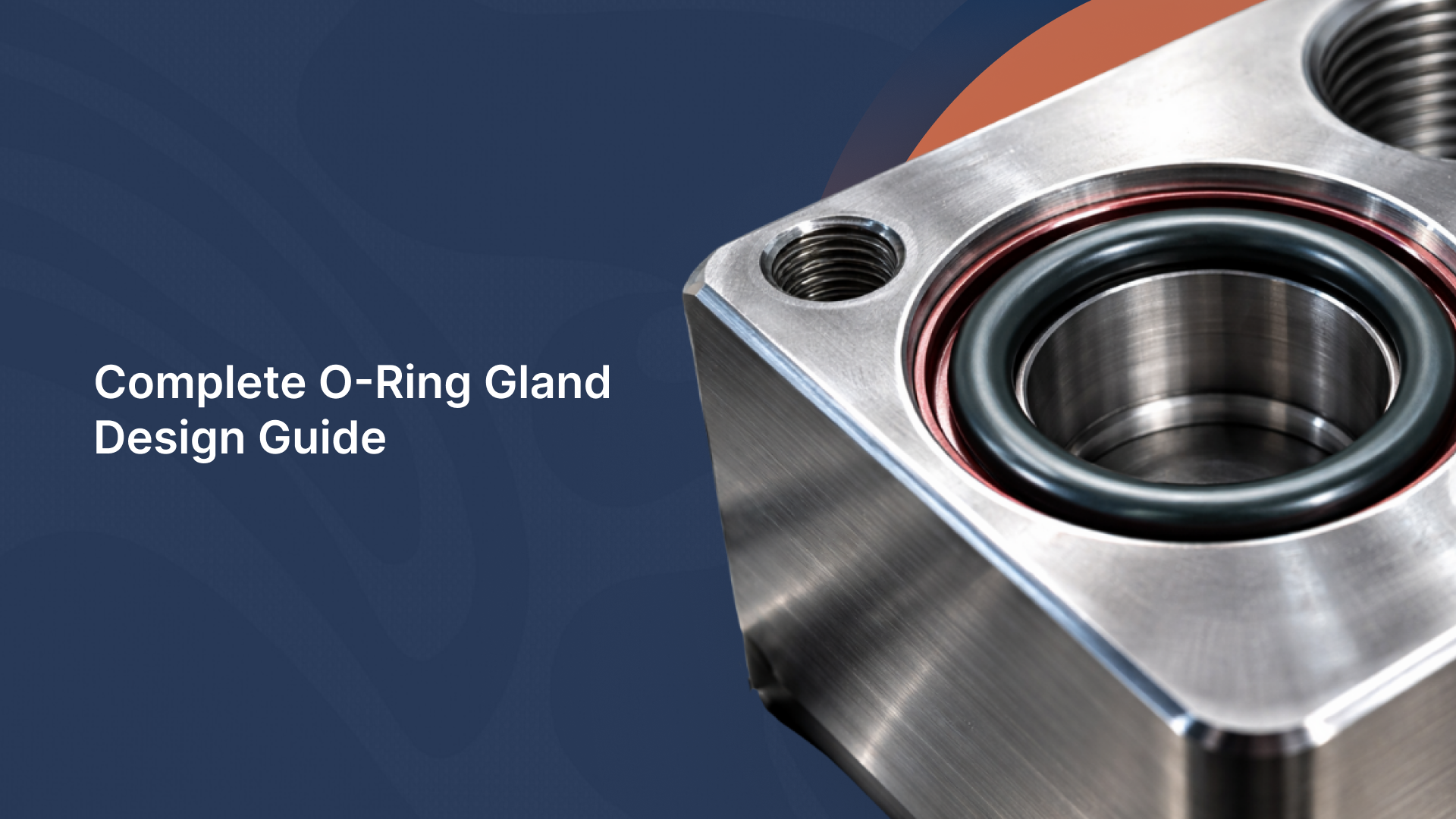
An O-ring is a torus-shaped elastomeric seal with a round cross-section designed to seal between two mating surfaces under compression. When installed in a properly designed gland, system pressure energizes the O-ring, increasing sealing force.
O-rings are used in static and dynamic sealing, but their performance depends heavily on the size standard, cross-section accuracy, and construction type, not just material. Understanding these distinctions is key to selecting the correct O-ring configuration.
Let's examine the primary types of O-ring seals based on design and construction.
Different Types of O-Ring Seals: Key Specifications
Not all O-rings are the same. Differences in manufacturing method, dimensional system, and surface treatment determine how they perform in service.
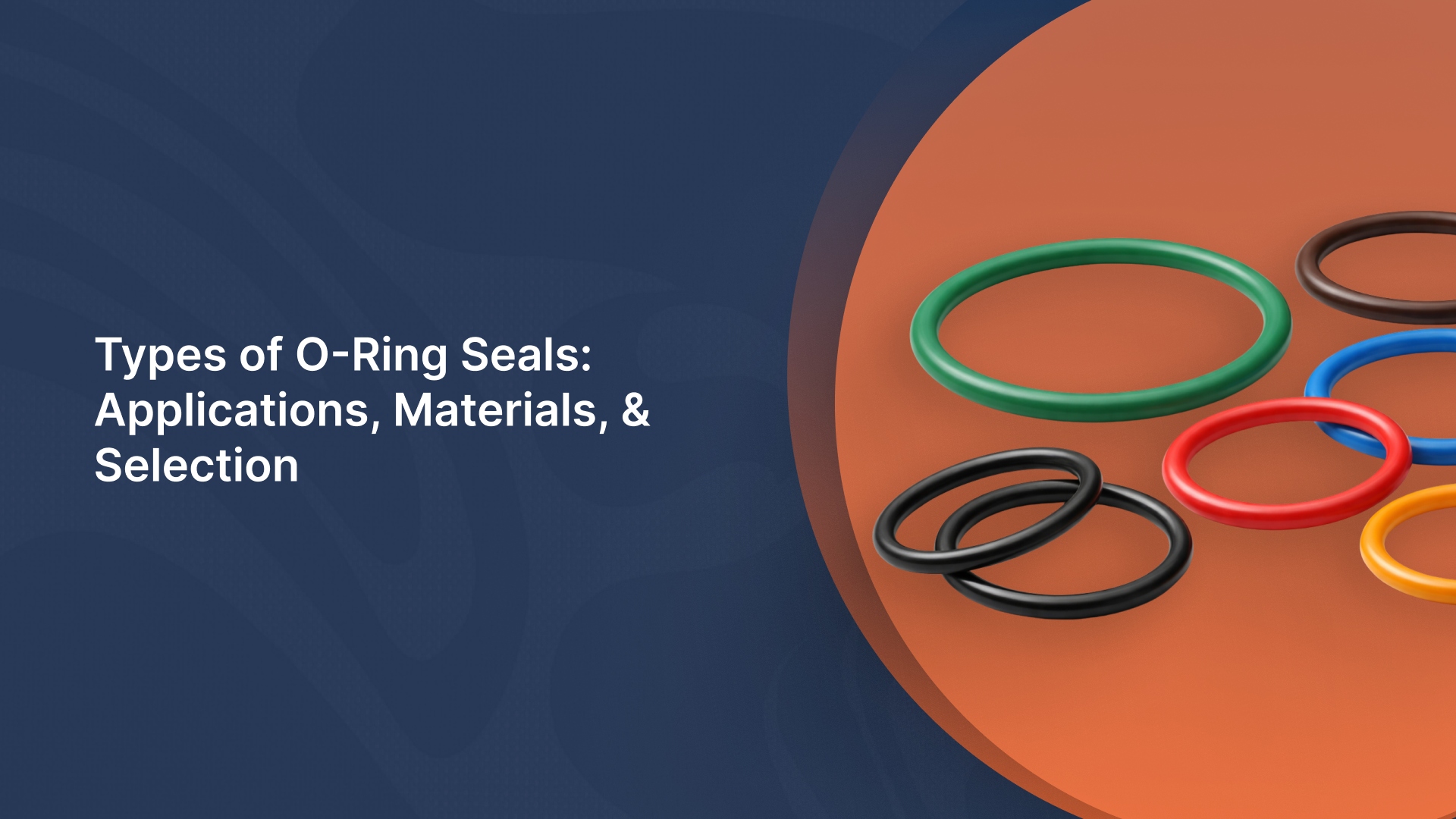
Here are the different types of O-ring seals:
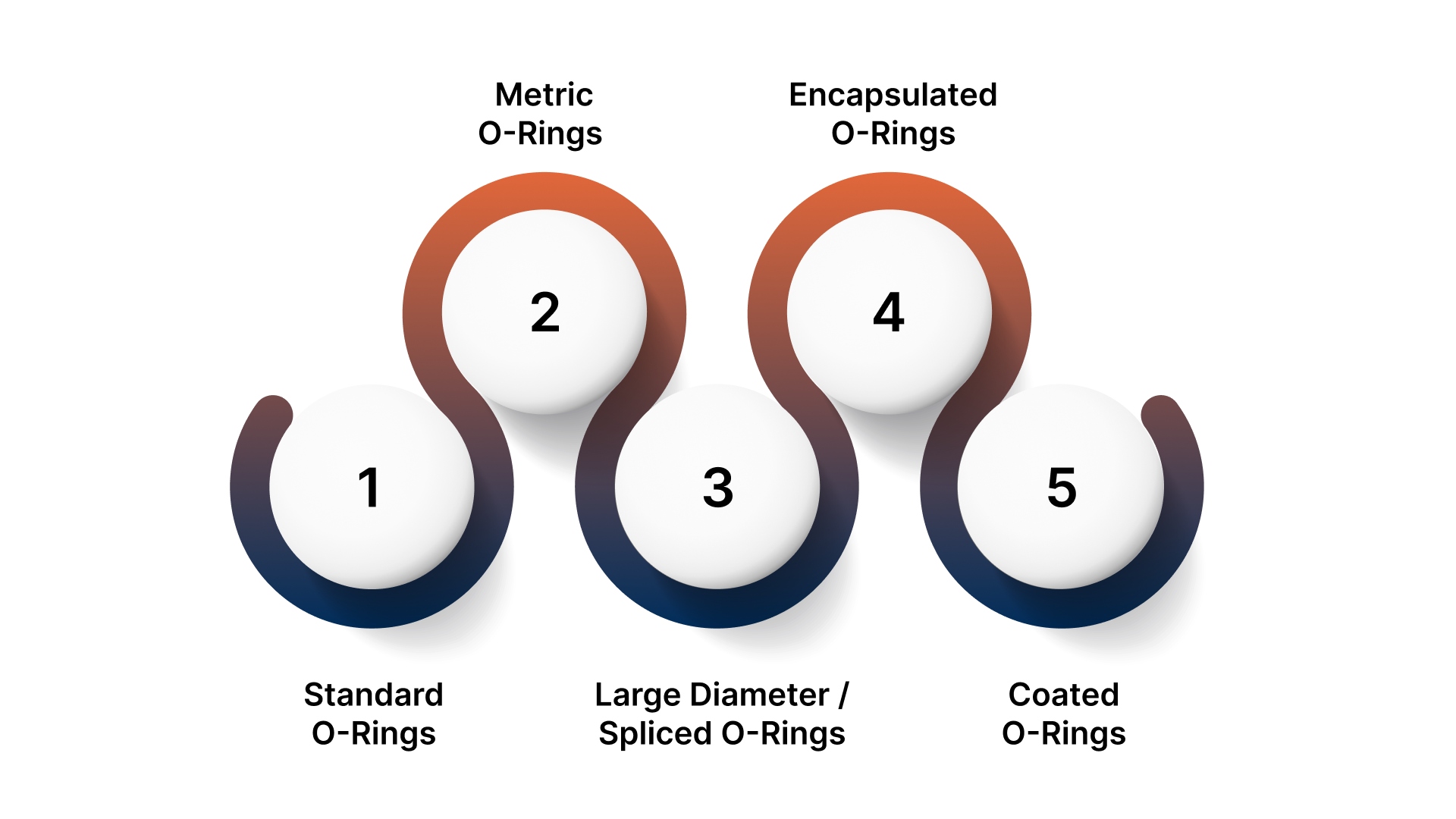
Standard O-Rings
These are the most widely used O-rings in North American systems.
Specifications:
Defined by AS568 dash sizes
Cross sections: 0.040″ to 0.275″
Tight dimensional tolerances for gland sealing
Used in static and moderate dynamic sealing
Metric O-Rings
Metric O-rings follow international dimensional standards.
Specifications:
Defined by inside diameter (ID) × cross-section
Standardized under ISO 3601
Common in global equipment and European systems
Compatible with metric gland designs
Large Diameter / Spliced O-Rings (Infinite O-Rings)
Used where standard molded diameters are insufficient.
Specifications:
Produced by splicing extruded cord
Virtually unlimited inner diameter
Used in large flanges, tanks, hatches
Requires precision splice for pressure sealing
Encapsulated O-Rings
Designed for chemical resistance beyond elastomer capability.
Specifications:
Elastomer core (usually silicone or FKM)
Encapsulated with FEP or PFA jacket
Combines elasticity with chemical resistance
Lower elastic recovery compared to solid elastomers
Coated O-Rings
Standard O-rings with surface treatments to improve installation or performance.
Specifications:
Surface coatings: PTFE, silicone, or dry-film lubricants
Reduces friction during assembly
Improves resistance to stick-slip in dynamic glands
Maintains base elastomer properties
These O-ring types are selected based on operating conditions such as pressure, chemical exposure, and motion.
Understanding where each configuration fits helps ensure reliable sealing performance in industrial systems.
Applications of Different O-Ring Seals Across Industries
O-ring seals are crucial components used across various industries to ensure the reliability and efficiency of machinery and systems.
Below is a table highlighting the applications:
O-Ring Type | Applications | Industries |
Standard Molded O-Rings | Static flanges, hydraulic fittings | Industrial, automotive |
Metric O-Rings | Metric hydraulic and pneumatic systems | Global OEM equipment |
Large Diameter O-Rings | Manways, tank lids, access covers | Oil & gas, process plants |
Encapsulated O-Rings | Aggressive chemicals, solvents | Chemical processing, pharma |
Coated O-Rings | Tight installation spaces, dynamic glands | Fluid power, machinery |
O-ring configuration alone does not determine performance. Material selection is equally critical for handling temperature, fluids, and environmental exposure.
Key O-Ring Seal Materials and Their Performance Benefits
Material choice determines how an O-ring responds to temperature extremes, fluid exposure, and long-term compression.
Even the correct size O-ring can fail prematurely if the elastomer properties do not match the operating environment.
Below are the primary O-ring materials and their performance characteristics:
Material | Temperature Range | Benefits |
Nitrile Butadiene Rubber (NBR) | -35°C to +120°C | Excellent resistance to petroleum oils and fuels |
Fluorocarbon Rubber (FKM) | -20°C to +205°C | High temperature stability and strong chemical resistance |
Ethylene Propylene Diene Monomer (EPDM) | -45°C to +120°C | Strong resistance to water, steam, ozone, and weathering |
Silicone Rubber | -60°C to +230°C | Flexibility at extreme temperatures and low compression set |
PTFE (Teflon) | -200°C to +260°C | Outstanding chemical resistance and high-temperature stability |
Now let’s look at the selection factors that determine which O-ring configuration and material will perform reliably in your system.
Choosing the Right O-Ring Seal
Selecting the correct O-ring requires more than matching material to fluid. Performance depends on dimensional standards, gland geometry, pressure loading, and operating environment.
To make the right choice, consider the following checklist:
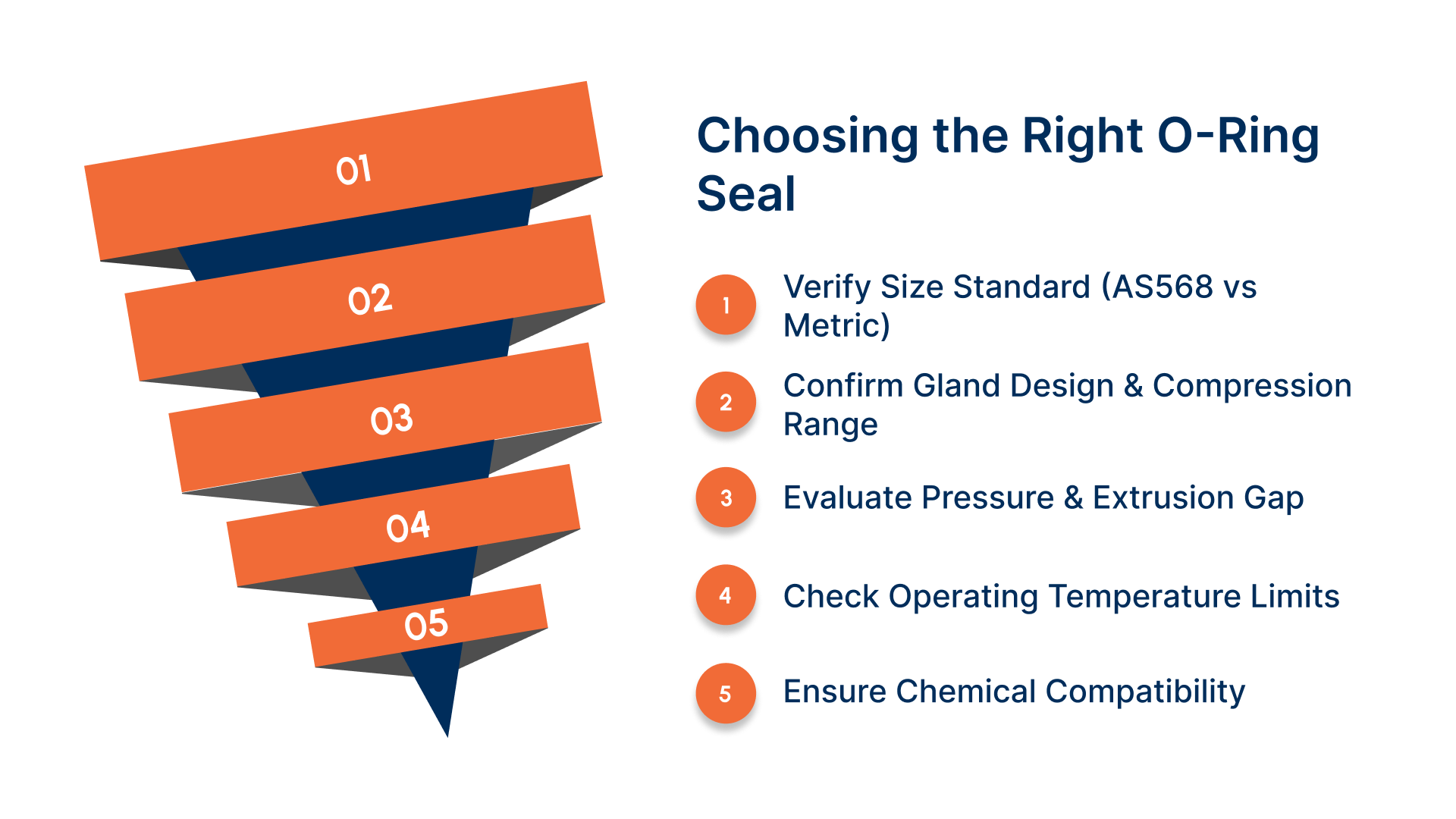
Verify Size Standard (AS568 vs Metric): Confirm the system uses inch-series (AS568) or metric (ISO 3601) dimensions to ensure proper squeeze and gland fill. Mixing standards leads to incorrect compression and leakage.
Confirm Gland Design and Compression Range: O-rings typically require 20–30% compression in static seals and 10–20% in dynamic applications. Over-compression accelerates compression set and wear.
Evaluate Pressure and Extrusion Gap: High pressure increases the risk of extrusion into clearance gaps. Applications above 1,500 psi often require backup rings to prevent seal damage.
Check Operating Temperature Limits: Verify both continuous and peak temperature exposure. Exceeding elastomer limits causes hardening, softening, or permanent deformation.
Ensure Chemical Compatibility: Fluid exposure can cause swelling, shrinkage, or degradation. Always cross-check elastomer compatibility with oils, solvents, gases, or process chemicals.
Even the correct elastomer compound will fail if gland dimensions and pressure conditions are not properly accounted for.
5 Common O-Ring Failures and How to Prevent Them
Even properly sized O-rings can fail when operating conditions exceed design limits or gland parameters are incorrect. Recognizing failure modes helps prevent repeat issues.
Below are the common O-ring failures and how to prevent them:
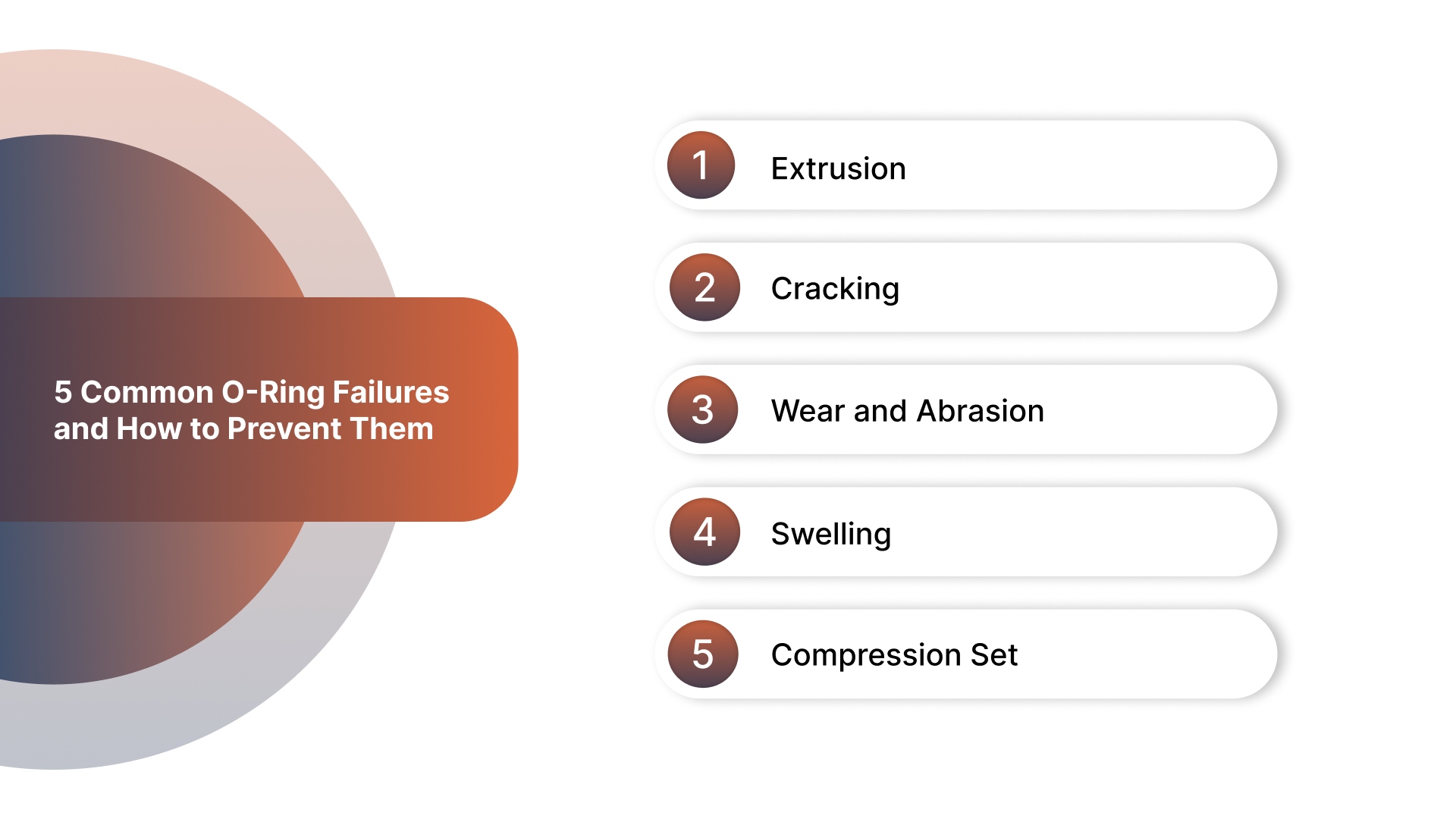
Extrusion: Occurs when the O-ring is forced into the clearance gap under high pressure, often above 1,500 psi.
Prevention: Use backup rings and ensure gland clearances are within recommended limits.
Cracking: Caused by chemical attack, ozone exposure, or temperature extremes.
Prevention: Select materials compatible with the operating fluid and temperature range.
Wear and Abrasion: Results from friction in dynamic sealing applications.
Prevention: Ensure proper lubrication, surface finish, and use abrasion-resistant compounds.
Swelling: Happens when the elastomer absorbs incompatible fluids, changing volume and hardness.
Prevention: Verify chemical compatibility before material selection.
Compression Set: The O-ring loses elasticity after long-term compression or heat exposure, reducing sealing force.
Prevention: Use compounds with low compression set characteristics and avoid over-compression in gland design.
Now that common O-ring failures and how to prevent them are covered, let's explore how Detroit Sealing Components can help you find the right O-ring solutions for your applications.
Detroit Sealing Components: Your Partner in O-Ring Solutions
At Detroit Sealing Components, we specialize in supplying high-quality O-ring products for demanding industrial applications. We provide both standard and custom O-rings, manufactured to strict dimensional tolerances and performance requirements.
Our focus on precision and reliability supports consistent sealing performance across a wide range of operating environments.
What We Provide:
Standard O-Rings: Available in AS568, metric, and custom sizes with optional coatings and lubricants to support installation and performance requirements.
O-Ring Kits: Pre-sorted kits with commonly used AS568, JIS, and metric O-ring sizes for maintenance, service, and repair operations.
Infinite Size O-Rings: Custom large-diameter O-rings produced without traditional tooling limits, suitable for oversized sealing applications.
Explore our full range of sealing solutions and find the right O-ring for your application. Check out our product catalog today!
Wrapping Up
O-ring performance depends on correct selection of type, size standard, material, and gland design, not just elastomer choice. Understanding these factors helps prevent leakage, extrusion, and premature seal failure in demanding industrial systems.
At Detroit Sealing Components, we supply precision O-rings designed to meet strict dimensional and performance requirements across a wide range of operating conditions.
Contact us to discuss your O-ring requirements and find the right solution for your application.
FAQs
Can O-ring seals be reused?
Reuse is generally not recommended in critical applications. O-rings can take a compression set, and removal often causes surface damage that reduces sealing reliability.
How do I know if my O-ring is the right size?
Correct sizing depends on matching the O-ring to the gland dimensions and maintaining the recommended squeeze percentage. Incorrect gland fill or stretch can lead to leakage or extrusion.
What factors affect the lifespan of an O-ring seal?
Service life depends on temperature exposure, pressure cycling, chemical compatibility, and dynamic motion. Exceeding design limits accelerates aging and compression.
Are O-rings suitable for high-temperature applications?
Yes, materials such as FKM and silicone are commonly used in elevated temperature environments. The material must be selected based on continuous and peak temperature exposure.
Can O-rings be used in underwater applications?
Yes, materials like EPDM are widely used for water and steam environments. Material selection should always consider fluid compatibility and operating temperature.