Viton® (FKM) O-rings are often chosen for higher-temperature sealing, but the phrase “temperature range” is where most spec mistakes start. Different charts give different numbers because FKM performance depends on the exact compound/grade, how long it’s exposed to heat, and what media (including cleaners) it sees.
This guide keeps it practical: what “range” really means (continuous vs peak), why answers vary, and the fast checks you need to confirm whether an FKM O-ring will hold sealing force in your actual conditions.
Answer Box: Typical FKM (Viton®) O-ring temperature guidance
Chemours lists typical continuous-service thermal guidance of about –40°F to +400°F (–40°C to +204°C) for certain Viton® FKM compounds.
But “temperature range” isn’t one universal number: the real limit depends on the exact compound/grade, time at temperature, and media exposure (including cleaners)—so treat published ranges as screening guidance and verify the datasheet for your specific grade and duty cycle.
Next step: Use the checks given below to confirm whether your case is a continuous service, intermittent peaks, or a design/compound mismatch (media/cleaners, pressure spikes, motion, gland control).
Key Takeaways
Don’t trust one FKM temperature range number. Limits vary by compound/grade.
Separate continuous vs peak. Time at temperature drives compression set and loss of sealing force.
The media can lower the real limit. Include process fluid + additives + cleaners when judging suitability.
Verify before you spec. Confirm your temp profile, exposure list, pressure/spikes, and static vs dynamic to avoid wrong buys.
What “temperature range” actually means for an O-ring
When you see a “FKM temperature range,” it’s easy to read it as a single safe operating window. In practice, temperature capability depends on how long the seal stays at temperature and whether the number quoted is continuous service or a short-term peak.
Continuous service is the temperature the O-ring can tolerate for sustained operation without quickly losing sealing force.
Short-term peaks are brief excursions (spikes) that may be survivable, but they can still accelerate aging, especially if peaks happen frequently.
What usually fails first at heat
Compression set: the O-ring takes a “set,” rebounds less, and the sealing force drops over time.
Hardening/aging: the elastomer stiffens, reducing its ability to conform and maintain a seal.
Loss of sealing force: the practical outcome of set + aging, leaks can show up even if the ring still “looks fine".
Cold-side note: Minimum temperature isn’t just about storage, it’s about startup sealing. If the compound gets too stiff at low temperatures, it may not conform well enough to seal until the system warms up.
Why You’ll See Different FKM(Viton®) Temperature Ranges
First, quick clarification: FKM is the elastomer family (fluoroelastomer). Viton® is a well-known brand name for certain FKM materials. In practice, people often say “Viton®” when they mean “FKM,” but the exact compound/grade is what determines real performance.
Why you’ll see different “temperature ranges” online (and why one number can be misleading):
Compound/grade/family differences: Two FKM O-rings can have very different low-temp flexibility, heat-aging behavior, and compression set resistance depending on formulation.
Time at temperature (aging): A brief spike and thousands of hours of continuous heat are not the same; long exposure accelerates hardening and permanent set.
Media exposure (including cleaners): The temperature limit is tied to what touches the seal. Process fluids, additives, and cleaning chemicals can change swell, softness, and aging rate with temperature.
Static vs dynamic service: Motion adds friction and localized heat, turning the O-ring into a wear part and shrinking the “safe” operating window compared to static sealing.
Gland design (squeeze/clearance): Near the high end, especially with pressure spikes, clearance and squeeze control determine whether the seal holds or fails by extrusion/nibbling, even if the material is “rated” for the temperature.
Bottom line: if two sources give you different “FKM temperature ranges,” they’re usually describing different compounds, exposures, or duty cycles, so the only reliable answer is the one tied to your specific grade and conditions.
FKM Temperature Limits at a Glance
Use this as a quick reality check: are you dealing with continuous heat, short peaks, or near-limit behavior, and what needs to be verified before you rely on any published range?
Condition | What it means | What to verify |
|---|---|---|
Typical continuous guidance | Published continuous-service guidance for many FKM compounds is often shown around –40°F to +400°F (–40°C to +204°C) as a baseline reference. Verify your exact grade. | Your exact FKM compound/grade, whether the seal is static or dynamic, and the full media + cleaners exposure. |
Short-term peak guidance | Brief excursions above continuous limits may be survivable, but repeated peaks accelerate aging and set. | How high + how long + how often the peaks occur (duty cycle) and whether pressure spikes happen at the same time. |
Near-limit behavior (what changes first) | The O-ring may still “look fine,” but sealing force drops as compression set and hardening increase. | Signs of compression set, loss of resilience, and whether the joint can tolerate reduced sealing force (squeeze/bolt load retention). |
Low-temp / startup risk | Low temperatures can make the compound stiff, delaying sealing at startup or causing leakage until warm-up. | Minimum temperature, startup conditions, and whether the compound’s low-temp flexibility is suitable for your application. |
If your application sits near the hot or cold edge (or sees spikes), treat the “range” as a starting point and verify the specific compound and duty cycle before locking the spec.
Temperature Pitfalls That Cause Premature FKM O-Ring Failure
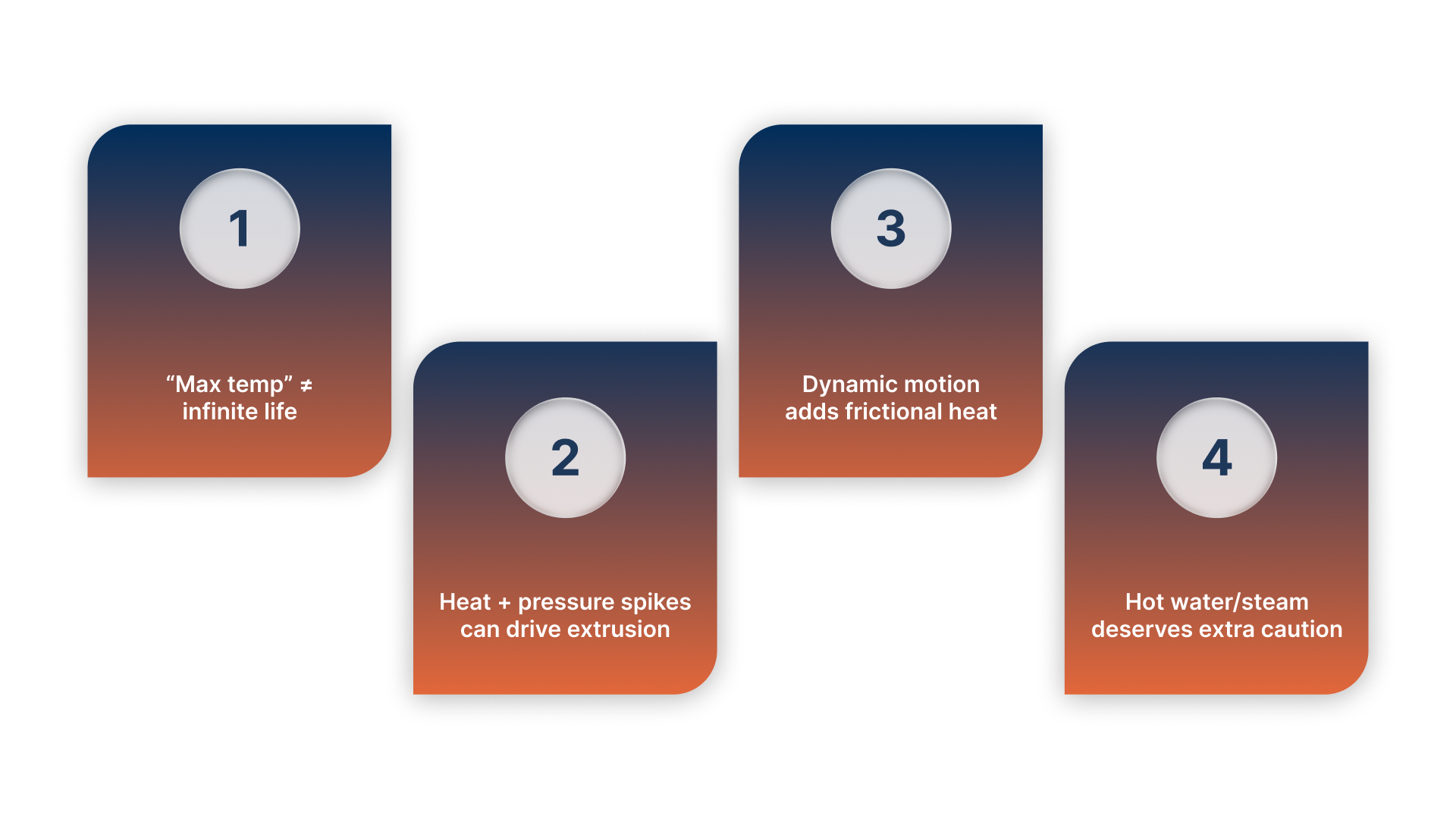
Most “FKM temperature failures” happen when the application treats a published range like a guarantee. These are the four traps that cause the most wrong specs:
“Max temp” ≠ infinite life: High heat accelerates aging. Even if the O-ring doesn’t visibly crack, compression set and hardening can quietly reduce sealing force until leaks show up later.
Heat + pressure spikes can drive extrusion: At elevated temperature, the material is generally less resistant to deformation, so clearance gaps and pressure spikes make extrusion/nibbling more likely unless the joint has proper support (or uses a back-up ring).
Dynamic motion adds frictional heat: Sliding/rotary interfaces create local heat and wear. What works statically at a temperature may fail dynamically unless friction is controlled (surface finish, lubrication, seal style).
Hot water/steam deserves extra caution: Don’t assume “high-temp rated” means “steam-safe.” Always verify the specific compound’s compatibility and include the full exposure list: process media, additives, and cleaners/CIP.
Treat FKM “temperature range” as a starting point. If you’re near the limit, the outcome is usually decided by duty cycle, pressure spikes/clearance support, motion friction, and the exact compound, not the headline number.
How to verify the right FKM O-ring fast
Most “wrong FKM temp range” calls come from missing context. If you can answer the items below, you can usually confirm suitability quickly or spot that you need a different compound or seal setup.
What touches the seal (everything): the actual fluid/gas, plus additives, flushes, and any cleaners/CIP.
Your real temperature profile: normal operating range, worst-case peaks, and how long/how often the seal lives at peak.
Pressure behavior: normal pressure plus spikes (spikes are what trigger extrusion and sudden failures).
Is there motion? Static vs dynamic, and if dynamic, the motion type (sliding/rotary) and speed/cycle rate.
What size is it? ID + cross-section (CS) so you’re not “close enough” on fit.
What does the gland look like (if you have it): groove dimensions or a drawing clearance, and squeeze often decides performance near limits.
Any required documentation/compliance: only if your application requires a specific standard or traceability.
If any of these are unknown, treat the published range as guidance, not a go/no-go decision.
How Detroit Sealing Components helps you spec FKM O-rings with confidence
The “FKM temperature range” is rarely a single number that can be copied and pasted. The spec only becomes reliable when it’s tied to your compound grade, media/cleaners, time at temperature, pressure spikes, and whether there’s motion.
Detroit Sealing Components supports that decision with both supply and sealing product breadth:
O-rings for real operating conditions (not just a chart): DSC supplies molded rubber sealing products, including O-rings and engineered sealing components, and supports matching the compound to media + temperature profile (continuous vs peaks).
When temperature + pressure creates extrusion risk: DSC offers back-up rings to pair with O-rings when pressure spikes/clearance make extrusion/nibbling the limiting factor.
When motion is part of the problem: DSC’s catalog includes X-rings and hydraulic seals, which are common “next step” options when dynamic wear/friction at temperature is what actually drives failures (not the published temp range).
If your application needs more than standard parts, DSC positions engineering/quality capabilities (including analysis/validation approaches) to support seal selection and reliability when failures repeat, or duty cycles are harsh.
Send your media + cleaners, temperature profile (continuous vs peaks), pressure/spikes, and whether it’s static or dynamic (plus size and gland details if you have them), and DSC can help narrow the correct FKM O-ring approach for your conditions.
Conclusion
If you want temperature performance you can rely on, tie the “range” to what actually drives seal life: hours at temperature, full chemical exposure (including cleaners), pressure spikes, and whether motion adds frictional heat.
Once those are defined, selecting the right FKM grade and seal setup becomes a spec decision, not trial and error.
FAQs
What is the temperature range of FKM O-rings?
You’ll usually see a “typical range” published, but the usable range depends on the specific FKM compound/grade, your media/cleaners, and whether the temperature is continuous or short-term peaks. Treat ranges as guidance until you validate the exact grade.
What’s the maximum temperature FKM O-rings can handle?
The real limiter is often time at temperature (compression set + hardening), not an instant “max.” If you’re near the high end, confirm continuous vs peak exposure, pressure spikes, and the compound’s datasheet.
What’s the minimum temperature for FKM O-rings?
Minimum temperature is about flexibility at startup. If the compound stiffens too much at your lowest temperature, it may not conform well enough to seal until the system warms up, so confirm low-temp performance for the exact grade.
Is Viton® the same as FKM?
FKM is the material family (fluoroelastomer). Viton® is a brand name used for certain FKM materials. In sourcing, people often use them interchangeably, but performance still depends on the compound/grade.
Do pressure/spikes affect high-temperature performance?
Yes. At elevated temperature, elastomers are generally easier to deform, so pressure spikes + clearance gaps can increase extrusion/nibbling risk. That’s a design/support issue (often requiring better containment or a back-up ring), not just a “higher-temp rubber” issue.