The consequences of a wrong call are tangible. As the Parker O-Ring Handbook explicitly warns, failure, improper selection, or improper use of O-ring products can cause death, personal injury, and property damage. Even short of catastrophic failure, mismatched materials drive unplanned downtime, fluid leaks, and accelerated replacement cycles — all avoidable costs.
This article breaks down silicone versus rubber O-rings across the performance factors that actually matter: temperature range, chemical compatibility, mechanical durability, compression behavior, and cost. You'll also get a practical decision framework for matching material to application.
Key Takeaways
- Silicone (VMQ) excels in wide temperature ranges, UV/ozone resistance, and FDA-compliant food or medical applications
- Nitrile (NBR): the default choice for oil, fuel, and hydraulic fluid contact — cost-effective with strong mechanical performance
- "Rubber O-ring" covers many materials — NBR, EPDM, HNBR, and neoprene each require deliberate selection
- FVMQ (fluorosilicone) bridges the gap for applications requiring both fuel/oil resistance and a wide thermal range
- Let application context drive compound selection, not price alone
Silicone vs Rubber O-Rings: Quick Comparison
Here's a side-by-side view of the critical performance dimensions:
| Property | Silicone (VMQ) | Nitrile (NBR) |
|---|---|---|
| Operating temperature | -50°C to +175°C (short: +230°C) | -30°C to +100°C (short: +120°C) |
| Oil/fuel resistance | Poor — not suited for petroleum media | Excellent — designed for mineral oils and greases |
| UV/ozone resistance | Excellent | Weak — degrades in prolonged outdoor exposure |
| Tensile strength | Lower mechanical strength | ≥14 MPa (NBR 70 Shore A) |
| Compression set | Higher — limits dynamic sealing use | <25% after 24h at 100°C |
| Relative cost | ~3–4× standard NBR | Baseline — lowest cost elastomer |
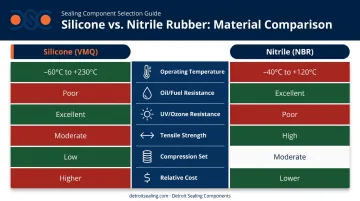
Temperature data and tensile/compression set benchmarks sourced from Trelleborg O-Rings and Back-up Rings.
These two materials solve fundamentally different problems. The sections below cover the chemistry, failure modes, and application context behind each property.
What Are Silicone O-Rings?
Silicone O-rings are elastomeric seals built on a polydimethylsiloxane (silicone polymer) backbone — a structure combining silicon and oxygen rather than the carbon-based chains found in organic rubbers. That inorganic Si-O backbone is what gives silicone its distinctive combination of thermal stability, chemical inertness, and biocompatibility.
Where Silicone Performs Best
- Temperature extremes: VMQ operates from -50°C to +175°C with short-term tolerance to +230°C (no standard rubber compound matches this range)
- Environmental durability: Outstanding resistance to UV radiation, ozone, and weathering; silicone ages predictably and retains properties over long service life in exposed environments
- Biologically inert, non-toxic, and odorless — properties required in food, medical, and pharmaceutical applications
- Static sealing stability: Long-term dimensional stability in static applications where compression cycling is minimal
Where Silicone Falls Short
- Poor petroleum resistance: Standard VMQ degrades against hydrocarbon oils, fuels, and petroleum-based fluids. Specifying it in hydraulic or fuel systems is a common and costly mistake
- Lower mechanical strength: Softer than nitrile, with reduced tear resistance and higher susceptibility to abrasion
- Compression set: After repeated compression cycles, silicone recovers shape more slowly than nitrile or EPDM, making it a poor fit for dynamic, high-frequency sealing
Silicone Subtypes Worth Knowing
| Subtype | Key Advantage | When to Specify |
|---|---|---|
| VMQ (standard) | Wide temperature range, ozone/aging resistance | Static seals, food/medical, high-temp environments |
| FVMQ (fluorosilicone) | Improved hydrocarbon and fuel resistance vs. VMQ | Mixed fuel/oil + thermal exposure requirements |
| High-temp VMQ variants | Short-term tolerance to ~230°C | Extreme-heat static applications |
DSC stocks both VMQ and FVMQ compounds. VMQ is available from -60°C to 225°C, with sizes ranging from 0.5mm ID × 0.4mm CS up to 1600mm ID × 50mm CS, covering most standard and custom application requirements.
Silicone O-Ring Applications
Silicone dominates in environments where purity, temperature, or regulatory compliance matters most:
- Food and beverage processing: Food-grade VMQ formulations can comply with FDA 21 CFR 177.2600, which governs rubber articles in repeated food contact. Compliance must be verified at the compound level, since "silicone" as a generic material does not automatically confer FDA status
- Medical devices and pharmaceutical manufacturing: Biocompatibility and sterilization tolerance (autoclave, steam, EtO) make silicone the standard choice
- Aerospace and high-temperature automotive systems: Static seals in engine compartments and exhaust-adjacent systems where temperature peaks exceed rubber limits
- Semiconductor and cleanroom environments: Silicone's chemical inertness and low outgassing suit high-purity processing requirements
DSC's food-grade and sanitary sealing solutions are certified to FDA 21 CFR 177.2600, WRAS, NSF 61, NSF 42, and additional international standards — covering applications across food processing, pharmaceutical, and drinking water systems.
What Are Rubber O-Rings?
"Rubber O-ring" describes a category, not a single compound. Industrial rubber O-rings include nitrile (NBR), EPDM, neoprene (CR), and HNBR — and selecting the wrong one within that category is just as problematic as choosing silicone for an oil-service application.
Nitrile (NBR): The Industrial Workhorse
NBR is the dominant O-ring material globally, holding 45% of the O-ring market according to Persistence Market Research — a position driven by its oil resistance, mechanical performance, and low unit cost.
Key NBR properties (70 Shore A benchmark per Trelleborg):
- Tensile strength: ≥14 MPa
- Compression set: <25% after 24h at 100°C
- Operating range: -30°C to +100°C (short-term: +120°C)
- Handles mineral oils, greases, hydraulic fluids, and fuels reliably
- Degrades under UV/ozone exposure; upper temperature is limited compared to silicone
EPDM: Water and Steam Specialist
EPDM handles what NBR cannot: hot water, steam, glycol-based brake fluids, and prolonged outdoor weathering. Its operating range runs from -45°C to +150°C with short-term tolerance to +175°C.
The critical limitation: EPDM is essentially incompatible with petroleum and mineral oils. Using EPDM in an oil-service application is a compound-selection error with predictable consequences.
HNBR: When NBR's Temperature Isn't Enough
Hydrogenated NBR extends NBR's upper temperature limit to +140°C (short-term +160°C) in mineral oil/grease contact, with tensile strength ≥15 MPa. It costs more than standard NBR but bridges the gap before moving to premium compounds like FKM.
Rubber O-Ring Applications
With compound properties in context, the application picture becomes clear. Rubber compounds — particularly NBR — dominate in high-volume, cost-sensitive environments where oil and fuel contact is the defining condition:
- Hydraulic and pneumatic systems (hydraulic applications represent roughly 49% of O-ring demand per Persistence Market Research)
- Automotive fuel and engine systems
- Industrial machinery, pumps, and compressors
- Oil and gas equipment
- Agricultural and construction machinery
DSC stocks NBR in 70 and 90 durometer hardness, with EPDM, HNBR, and CR available across its full compound range.
Silicone vs Rubber O-Rings: Which Should You Choose?
The decision comes down to five variables: operating temperature, contact media, dynamic vs. static duty, regulatory requirements, and total cost of ownership. Work through them in order.
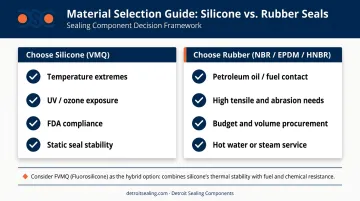
Decision Framework
Choose silicone (VMQ) when:
- Operating temperatures exceed -30°C to +100°C standard rubber limits
- The application involves prolonged UV, ozone, or outdoor weathering exposure
- FDA compliance or biocompatibility is required (food, medical, pharmaceutical)
- Long-term aging stability in a static seal outweighs abrasion resistance requirements
Choose rubber (NBR/EPDM/HNBR) when:
- The application involves constant contact with petroleum oils, fuels, or hydraulic fluids
- High tensile strength and abrasion resistance are needed (dynamic seals, mechanical cycling)
- Budget, availability, and high-volume procurement are primary drivers
- Hot water or steam service is involved (use EPDM specifically)
The FVMQ Middle Ground
When an application requires both fuel/oil resistance and silicone-range temperatures (aerospace fuel system static seals and automotive assemblies with combined hydrocarbon and thermal exposure are common examples), fluorosilicone (FVMQ) is the compound to reach for. It offers significantly better chemical resistance than standard VMQ in hydrocarbons, aromatic mineral oils, and fuels, while retaining a working range of approximately -60°C to +175°C.
FVMQ carries a meaningful cost premium over both NBR and standard VMQ. Budget for it only when no single-family compound can meet both the thermal and chemical demands of the application.
When Standard Selections Fall Short
Not every application fits cleanly into one compound category. A customer running a hydraulic system at elevated temperatures — above what NBR handles reliably but not quite at the threshold where FVMQ makes economic sense — faces exactly the kind of competing-requirements scenario where compound verification matters.
In those cases, DSC's ISO 17025 accredited lab can run custom material development and testing against specific application conditions, rather than relying on generic datasheet ranges. DSC's technical team also applies FEA analysis to predict seal behavior under real operating loads before full implementation, which cuts trial-and-error costs on critical assemblies.
Conclusion
Silicone and rubber O-rings aren't competing for the same applications — they serve different performance domains. Silicone owns the temperature extremes, regulated industries, and weathering-exposed environments. Rubber, led by nitrile, owns the oil-service, high-cycle, cost-sensitive industrial world.
For procurement and engineering teams, the takeaway is straightforward: match the material to the actual service conditions. Getting that call right the first time avoids unplanned downtime and cuts replacement frequency — keeping systems within spec without the rework.
When the application involves competing requirements or tight regulatory constraints, compound selection gets more complex. DSC's sealing specialists carry hundreds of compounds across all rubber types, backed by an ISO 17025 accredited lab for material verification and custom formulation when standard options don't cover the spec.
Frequently Asked Questions
Frequently Asked Questions
How do silicone O-rings compare to rubber O-rings in terms of advantages and disadvantages?
Silicone offers superior temperature range, UV/ozone resistance, and FDA compliance — but performs poorly against petroleum oils and has lower tensile strength than nitrile. Rubber (especially NBR) wins on oil resistance, mechanical toughness, and cost but degrades faster in outdoor environments and has a narrower thermal window.
What is the best material for O-rings?
The right material depends entirely on the application. Nitrile is the go-to for oil-heavy industrial use; silicone for extreme temperatures or food and medical environments; EPDM for water, steam, and glycol service. What the seal contacts, how it moves, and what regulations apply all determine the correct choice.
Do silicone O-rings dry out?
Silicone resists drying out far better than organic rubbers because its inorganic polymer backbone withstands oxidation and UV breakdown. Exposure to incompatible chemicals or improper storage can still degrade performance, so follow manufacturer guidelines.
Can silicone O-rings be used with hydraulic fluid?
Standard VMQ silicone should not be used in petroleum-based hydraulic systems; its hydrocarbon resistance is poor. Fluorosilicone (FVMQ) offers improved compatibility, but NBR and HNBR remain the standard, validated choices for most hydraulic applications.
Are silicone O-rings FDA approved for food and beverage use?
Food-grade silicone O-rings can be formulated to meet FDA 21 CFR 177.2600 and related food-contact regulations. Compliance must be verified at the compound level: the finished article must meet extractive limits, not just the base material type.
What is the temperature range of rubber O-rings vs. silicone O-rings?
Standard NBR operates from -30°C to +100°C (short-term +120°C). VMQ silicone handles -50°C to +175°C with short-term tolerance to +230°C. For applications near or beyond NBR's limits, silicone or a specialty compound like HNBR or FVMQ should be specified.