Introduction
Specifying a nitrile seal based on material family alone — without accounting for compound grade, media, or duty cycle — is one of the most reliable ways to engineer a premature failure. Yet it happens constantly.
The core problem: "nitrile" describes a family of compounds, not a single material with fixed properties. Acrylonitrile content, plasticizer selection, antioxidant packages, and vulcanization chemistry all shift where the thermal limits actually fall. Published ratings assume controlled lab conditions that real applications rarely match.
This guide covers the decisions that actually matter when specifying NBR for temperature-sensitive applications:
- What nitrile seal temperature ratings mean at the compound level
- How ACN content moves the low-temperature boundary
- Which field conditions reduce the effective thermal ceiling
- When NBR should be replaced with HNBR or FKM
Charts and comparison tables are included throughout to support material selection.
Key Takeaways
- Standard NBR seals run continuously from -40°F to 212°F (-40°C to 100°C); short-term excursions up to ~248°F (120°C) are possible but accelerate aging
- ACN content (18–50%) is the primary lever: higher ACN improves oil resistance but raises the cold-side brittleness point
- Ratings assume dry-heat lab conditions: media immersion, dynamic friction, and compression set each reduce the effective ceiling
- Exceeding thermal limits causes hardening, compression set loss, and seal extrusion
- For continuous service above ~248°F (120°C), consider switching to HNBR or FKM
What Nitrile Seal Temperature Rating Actually Means
Temperature rating is a compound-level specification, not a fixed material constant. It describes the span over which an NBR compound maintains adequate elasticity, compression set recovery, and sealing force. Two seals both labeled "nitrile" can have meaningfully different thermal behavior depending on their formulation.
Continuous Service vs. Short-Term Peak
Most published datasheets cite continuous service temperatures — the long-term thermal aging limit below which the compound retains acceptable mechanical properties over its service life. A separate short-term peak rating covers brief excursions, which may be tolerated but contribute cumulatively to thermal aging.
According to Trelleborg's Materials Chemical Compatibility Guide, standard NBR carries a continuous rating of -30°C to +100°C (-22°F to +212°F), with short-period exposure up to +120°C (+248°F).
Parker's compound-specific data shows individual NBR formulations reaching 250–275°F. These are compound-specific ratings, not a universal NBR ceiling.
Why Rating Is a Design Parameter, Not a Compatibility Check
At temperature extremes, the modulus, elongation, and compression set of a compound shift in ways that affect clamp load and leak prevention. This means temperature rating governs:
- Seal groove design and cross-section selection
- Material approval for the application duty cycle
- Compression set margin available at end-of-life
Ratings are validated under specific test conditions — ASTM D2000, ASTM D395, ISO 1817, or similar — assuming a defined compression percentage, fluid medium, and duty cycle. Field conditions often differ from those assumptions.
Nitrile Seal Temperature Range: Standard Limits and the ACN Content Effect
Nominal Operating Range
| Condition | Temperature |
|---|---|
| Continuous service (Trelleborg generic NBR) | -22°F to +212°F (-30°C to +100°C) |
| Conservative long-term design ceiling | 212°F (100°C) |
| Short-period excursion limit | Up to 248°F (120°C) |
| Compound-specific Parker NBR examples | Up to 275°F (135°C) |
| Formulated low-temperature types | Down to -76°F (-60°C) |
The 248°F (120°C) figure appears frequently in published guidance but represents a short-term tolerance, not a continuous-service target. Sustained exposure above 212°F (100°C) initiates thermal oxidation and permanent compression set loss in most standard NBR compounds.
How ACN Content Shifts the Range
Acrylonitrile (ACN) content — typically 18–50% by weight — is the primary lever controlling the temperature-versus-chemical resistance trade-off in NBR. The relationship is a direct trade-off: as ACN increases, oil resistance improves but low-temperature flexibility decreases.
| ACN Content Level | ACN % Range | Low-Temperature Flexibility | Fluid/Oil Resistance |
|---|---|---|---|
| Low ACN | 18–28% | Highest (cold-service focus) | Lower |
| Medium ACN | 29–39% | Moderate | Moderate |
| High ACN | 40–50% | Lowest (cold-side limit rises) | Highest |
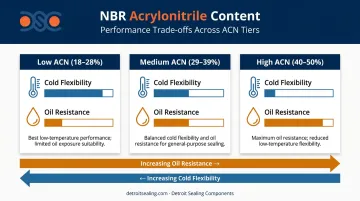
Key implication for procurement: Ordering "nitrile O-rings" without specifying ACN content may result in a high-ACN compound that becomes brittle in cold-start hydraulic or refrigeration applications. Exact brittleness points vary by formulation — ask your supplier for compound-specific specs.
HNBR as an Elevated-Temperature Extension
When the application exceeds standard NBR limits, hydrogenated nitrile (HNBR) is the direct upgrade. Its hydrogenated backbone resists thermal oxidation far better than standard NBR while retaining the same oil and fuel resistance profile.
| Manufacturer / Source | Continuous Temperature Range |
|---|---|
| Trelleborg (generic HNBR) | -22°F to +284°F (-30°C to +140°C) |
| Parker compound examples | Up to 300°F (149°C) |
| Arlanxeo Therban | -40°C to +165°C |
HNBR's chemical resistance profile is nearly identical to standard NBR. The practical case for upgrading is thermal aging resistance and a higher sustained-heat ceiling — factors that matter most in under-hood automotive, oil field, or continuous high-heat industrial service.
Factors That Modify Effective Temperature Performance in Real Applications
Lab testing establishes rated temperature under controlled conditions. Field performance is lower than the datasheet ceiling — often by a meaningful margin — due to four compounding factors.
Media and Fluid Interaction
Oil or fuel immersion at elevated temperatures accelerates oxidative degradation faster than dry-heat exposure alone. ISO 1817:2024 identifies three mechanisms: absorption of liquid by rubber, extraction of soluble constituents, and chemical reaction with the rubber matrix.
A seal operating in petroleum fluid at 200°F (93°C) will age differently — and often faster — than a seal running dry at the same temperature. This is why chemical compatibility and temperature must always be evaluated together, not sequentially.
Compression Set Accumulation
Sustained exposure near the upper temperature limit causes NBR to take a permanent set in the groove. The sequence:
- High temperature softens the compound and reduces elastic recovery
- Compression set percentage increases over time
- Contact stress at the sealing interface drops below the threshold needed to prevent leakage
- The seal that initially created adequate sealing force fails progressively — not suddenly
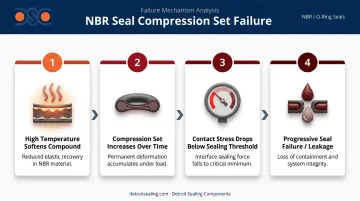
Parker identifies compression set as the most common O-ring failure mode, noting that an effective seal requires a continuous seal line — which compression set loss directly interrupts.
Static vs. Dynamic Application Demands
In dynamic applications — hydraulic cylinders, rotating shafts — friction generates localized heat at the seal lip, raising the effective temperature well above the bulk fluid temperature. This means the functional upper limit for a dynamic nitrile seal is lower than for a static face seal in the same system, even with identical bulk fluid temperatures.
Compound Formulation and Hardness
Antioxidant packages, plasticizer content, and vulcanization chemistry vary between NBR compounds even within the same ACN range. Published rubber research confirms that NBR is a complex system — polymer matrix plus processing agents, antioxidants, and plasticizers — all of which influence thermal aging behavior differently.
DSC carries hundreds of NBR compounds across hardness grades from 60 to 90 Shore A. Combined with ISO 17025 accredited lab testing, this enables compound-level validation against actual service conditions rather than generic datasheet assumptions.
Nitrile vs. Other Seal Materials: Temperature Range Comparison
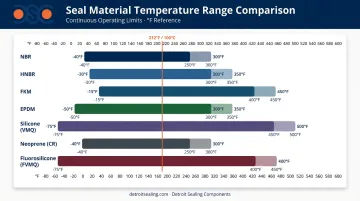
Material Temperature Comparison Chart
| Material | Continuous Low | Continuous High | Short-Term High | Best Fit |
|---|---|---|---|---|
| NBR (Nitrile) | -22°F (-30°C) | +212°F (+100°C) | +248°F (+120°C) | Petroleum fluids, general hydraulic |
| HNBR | -22°F (-30°C) | +284°F (+140°C) | +320°F (+160°C) | High-temp oil/fuel, refrigerant |
| FKM (Viton®) | -4°F (-20°C) | +392°F (+200°C) | +446°F (+230°C) | High-temperature, aggressive chemicals |
| EPDM | -49°F (-45°C) | +302°F (+150°C) | +347°F (+175°C) | Steam, water, glycol-based coolants |
| Silicone (VMQ) | -58°F (-50°C) | +347°F (+175°C) | +446°F (+230°C) | Extreme temp range, food/medical |
| Neoprene (CR) | -31°F (-35°C) | +194°F (+90°C) | +248°F (+120°C) | Refrigerants, weather resistance |
| Fluorosilicone (FVMQ) | -58°F (-50°C) | +347°F (+175°C) | +392°F (+200°C) | Fuel + wide temperature combination |
Source: Trelleborg Materials Chemical Compatibility Guide; Parker O-Ring Material Offering Guide. Ranges represent generic material families; compound-specific ratings vary.
Why NBR Remains the Default
The table above is a decision aid for knowing when to upgrade — not a ranking of overall quality. NBR remains the correct baseline for a wide range of applications because:
- Cost and availability are markedly better than HNBR or FKM
- Oil, fuel, and petroleum fluid resistance is strong across the ACN range
- Mechanical strength and abrasion resistance suit dynamic sealing applications
- The temperature range covers the majority of industrial hydraulic, automotive, and oil and gas service conditions
That said, two fluid categories consistently catch engineers off-guard: coolants and refrigerants. Both require fluid-specific — not category-level — verification before committing to NBR.
Coolant and Refrigerant Guidance
For glycol-based coolant systems, Trelleborg rates EPDM "A" (acceptable) for ethylene glycol and diethylene glycol — as does NBR. However, for glycol-based brake fluids specifically, Trelleborg rates NBR "U" (unsuitable) while EPDM remains rated "A." Specify the exact fluid, not just the fluid category.
For refrigerant applications, compatibility depends on the refrigerant type:
- HFC refrigerants (R-134a): May be compatible with NBR in some configurations
- HFO refrigerants and CO2 (R-744): Require verification against the refrigerant manufacturer's elastomer compatibility data before specifying NBR or HNBR
Compatibility claims don't transfer reliably across refrigerant families — confirm against the specific refrigerant in use.
What Happens When Nitrile Seals Exceed Their Temperature Rating
High-Temperature Failure
Thermal oxidation causes cross-link changes and loss of elastic recovery. A seal that has exceeded its thermal limit typically shows:
- Surface glazing or crazing — a shiny, brittle outer layer
- Dimensional shrinkage — the seal appears smaller than its original cross-section
- Brittleness — the compound cracks under flex with little force
- Permanent compression set — the seal retains the shape of the groove rather than returning to its original cross-section
A 2026 study on NBR mechanical behavior reported that under thermal-oxidative conditions, NBR hardness increases continuously, with a marked rise after 7 days at 125°C — confirming that even modest excursions above the continuous service ceiling produce measurable, cumulative property change.
Low-Temperature Failure
Below the glass transition point, NBR stiffens and loses the ability to conform to mating surfaces. Sealing force drops sharply without any change in material chemistry. The compound hasn't been permanently altered, but it can't seal. The seal will leak until temperature returns to the functional range, unless a cold-side excursion causes cracking under mechanical load.
Cold-temperature failure is most relevant at system startup. Observable signs include:
- No sealing force at startup — the stiffened seal can't conform to mating surfaces
- Leakage on initial pressurization — clears once operating temperature is reached
- Cracking under mechanical load — if flexed while cold, permanent damage may occur
A high-ACN compound that performs well at operating temperature may be completely non-functional during a cold-weather start cycle.
System Consequences
Thermal seal failure in hydraulic, oil and gas, or automotive systems results in fluid leakage, pressure loss, and potential component damage. In regulated industries — food and beverage, healthcare, aerospace — operating outside the specified temperature envelope may require material revalidation or affect compliance status. Verify requirements with your certifying body or material supplier before specifying a seal at its thermal boundary.
Common Misinterpretations of Nitrile Temperature Ratings
Three errors show up repeatedly in how engineers and buyers apply published nitrile temperature ratings.
Treating the Rated Maximum as a Safe Operating Ceiling
A seal rated to 248°F (120°C) run continuously at 245°F (118°C) has essentially no margin for compression set accumulation, media interaction, or dynamic heat generation. Conservative design practice maintains a buffer below the rated ceiling for continuous-duty seals. The appropriate margin depends on application conditions and should be confirmed through compound-level testing, not assumed from a single published number.
Ordering "Nitrile" Without Specifying ACN Grade
A procurement engineer who specifies "nitrile O-rings" without ACN content requirements may receive a high-ACN compound optimized for oil resistance that becomes non-functional at cold-start temperatures the system regularly sees. The compound — not just the material family — determines actual service limits. DSC's technical staff routinely helps buyers match ACN grade, hardness, and formulation to the specific temperature and media demands of an application.
Assuming One Published Range Applies to All NBR
Trelleborg's generic NBR guidance and Parker's compound-specific listings show different upper limits for good reason: they describe different formulations. Always request compound-level data for critical applications.
Conclusion
Nitrile seal temperature rating is a compound-level, condition-dependent parameter. The standard -40°F to 212°F (-40°C to 100°C) continuous-service range narrows when media immersion, dynamic friction, compression set accumulation, and ACN content are properly accounted for. The 248°F (120°C) short-term excursion limit is not a design target — it is a ceiling above which permanent degradation begins.
Getting the ACN grade right, maintaining adequate thermal margin, and validating under real field conditions matter as much as the published spec. When an application consistently pushes nitrile toward its limits, HNBR or FKM should be evaluated rather than continuing to run the same compound at its ceiling.
That's where material selection support becomes practical. DSC stocks a wide selection of nitrile and HNBR sealing compounds across multiple hardness grades and works with technical buyers to match the right material specification to the temperature and media demands of their application. For applications where generic datasheet values aren't sufficient, DSC's ISO 17025 accredited lab supports compound-level testing and validation.
Frequently Asked Questions
What temperature range can nitrile seals be used in?
Standard general-purpose NBR carries a continuous service rating of -22°F to +212°F (-30°C to +100°C), with short-term excursions tolerated up to about 248°F (120°C). ACN content shifts this range: low-ACN formulations extend cold-side performance, while high-ACN compounds trade cold flexibility for better oil resistance.
What temperature can rubber O-rings withstand?
Temperature resistance varies substantially by material. Silicone (VMQ) handles up to approximately 347°F (175°C) continuously, FKM up to 392°F (200°C), NBR to around 212°F (100°C), and EPDM to 302°F (150°C). Always match material selection to both temperature range and the specific media in contact.
What O-rings are coolant resistant?
EPDM is the standard choice for glycol-based engine coolants, with confirmed compatibility for ethylene glycol and diethylene glycol; NBR is unsuitable for glycol-based brake fluids. For high-temperature coolant systems, evaluate EPDM or HNBR against the specific fluid and operating temperature.
What kind of O-ring for refrigerant?
NBR may be compatible with standard HFCs like R-134a in some configurations, but modern HFO refrigerants and CO2 (R-744) systems require verification against the refrigerant manufacturer's compatibility data. Always confirm against the specific refrigerant — not just the refrigerant category.
What is Viton incompatible with?
FKM (Viton®) has poor resistance to low-molecular-weight ketones (acetone, MEK), primary amines, steam above 302°F (150°C), and glycol ether-based brake fluids. Despite its broad chemical resistance profile, FKM is not suitable for every high-temperature application and must be matched to the specific media.