Introduction
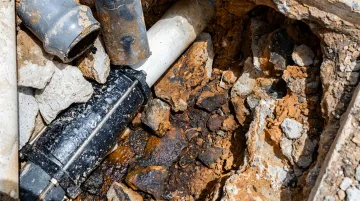
A pressurized distribution line develops a slow leak at a push-on joint six months after installation. The excavation crew finds the gasket swollen, soft, and no longer generating sealing force. The cause: a standard SBR gasket specified for a route running through petroleum-contaminated fill. The repair costs tens of thousands of dollars — and the problem was preventable.
Gasket material selection is one of the most consequential decisions in water main design, yet it often defaults to "whatever ships with the pipe."
This guide covers:
- What nitrile (NBR) gaskets are and how they differ from standard compounds
- Why they're specified for contaminated-soil water main environments
- Which certifications to require from suppliers
- How to match compound grade to specific site conditions
Whether you're a water main engineer building a project specification or a contractor verifying supplier documentation, this is your reference.
Key Takeaways
- Nitrile (NBR) gaskets are the correct upgrade from SBR when hydrocarbon-contaminated soil or groundwater is confirmed — or when contamination risk is documented at the site
- Maximum service temperature is 150°F for water and sewer push-on applications
- NSF/ANSI 61 certification is mandatory for potable water contact; 49 states require it
- Use ASTM D6284 (not F2854) as the chloramine resistance test standard for rubber gaskets
- For installations in cold climates (below 14°F / -10°C), confirm acrylonitrile content with your supplier — lower ACN content improves low-temperature flexibility
What Are Nitrile Gaskets and Why Are They Used in Water Main Systems?
Nitrile rubber — formally acrylonitrile-butadiene rubber (NBR) — is a synthetic elastomer engineered for resistance to oils, hydrocarbons, and petroleum-based fluids. Standard SBR gaskets perform well in clean soil, but when groundwater carries fuel contamination, the rubber swells, softens, and loses sealing force. NBR holds its seal.
Where Gaskets Actually Matter
In a water main system, gaskets create the pressure-tight seal between pipe sections at three joint types:
- Push-on (Tyton-style) joints — the most common in ductile iron distribution piping
- Mechanical joints — used at fittings, valves, and connections
- Flanged connections — used at appurtenances and tie-ins
A failed gasket creates a contamination pathway into the water supply and requires full excavation to repair — two outcomes that carry significant cost and regulatory exposure.
When to Specify Nitrile
Both McWane and AMERICAN (two major ductile iron pipe manufacturers) identify specific conditions where nitrile is the correct specification over standard SBR:
- Hydrocarbons or refined petroleum oils present in surrounding soil
- Non-aromatic petroleum products, hydraulic fluids, or fuel oil in service
- Proximity to fuel storage tanks or gas mains
- Sanitary sewer crossings with grease-laden waste
- Raw or reclaimed water lines with elevated oil content
Nitrile is also acceptable for standard drinking water, sanitary sewer, reclaimed water, raw water, and stormwater service — making it a reliable choice across a broad range of water and wastewater applications, not just contaminated-site work.
One firm limit to keep in mind: AMERICAN's Fastite push-on gasket data lists 150°F as the maximum service temperature for NBR in water and sewer applications. Verify this limit before specifying NBR in any process water line that operates above that threshold.
Key Material Properties of Nitrile Gaskets for Water Mains
Oil and Fuel Swell Resistance
NBR's defining property is resistance to swell when exposed to oils and petroleum products. SBR and EPDM gaskets absorb hydrocarbon-contaminated groundwater, swell, and progressively lose sealing force. NBR resists this degradation.
ASTM D471 is the standard test method for measuring rubber swell in liquids. When evaluating suppliers, ask for test data using IRM 903 oil or ASTM Fuel B to compare compounds directly.
Compression Set and Long-Term Sealing
Compression set is the permanent deformation a gasket retains after being held under load — and it gets less attention than it deserves. A gasket with high compression set gradually loses its spring-back, meaning joint sealing force diminishes over time and slow leaks become likely before anyone detects a problem.
ASTM D395 covers compression set testing for rubber. When reviewing compound data sheets, look for low compression set values under the temperature and deflection conditions closest to your service environment. Ask your supplier for this data — it should be available for any compound sold into water main service.
Hardness and Durometer
AMERICAN's Fastite push-on gaskets are dual-hardness molded components: approximately 85 durometer Shore A on the smaller (stiffer) end and approximately 65 durometer Shore A on the larger (softer) sealing end. This dual-hardness design balances pressure resistance with conformability to pipe surface variations. Standard mechanical joint gaskets typically fall near 70 ± 5 Shore A, though this should be confirmed against AWWA C111 for the specific product being sourced.
Acrylonitrile Content and Cold-Climate Considerations
Nitrile isn't a single compound — it's a family. The acrylonitrile (ACN) content determines the balance between oil resistance and low-temperature flexibility:
- High ACN (~50%) — best oil/fuel resistance, but low-temperature flexibility only to approximately -3°C
- Medium ACN — balanced performance, suitable for most temperate climates
- Low ACN (~17%) — improved cold-weather flexibility, but reduced oil resistance
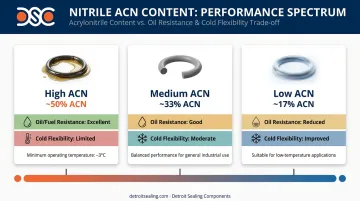
Contractors installing water mains in cold climates should confirm the compound's low-temperature rating with the gasket supplier before ordering. A high-ACN compound that performs well in Louisiana may crack during installation in Minnesota.
Known Limitations
Nitrile has real weaknesses that matter in field conditions:
- Poor ozone and UV resistance — gaskets stored improperly or left exposed on a jobsite can degrade before installation
- Degraded performance with aromatic solvents and ketones — if the contamination profile includes gasoline, aromatic hydrocarbons, or ketone-based solvents, EPDM or Viton (FKM) should be specified instead
Compliance and Certification Standards for Water Main Nitrile Gaskets
NSF/ANSI 61 — Non-Negotiable for Potable Water
Any gasket in contact with drinking water must carry NSF/ANSI 61 certification. This standard establishes minimum health-effects requirements for materials and components that contact drinking water, ensuring the gasket compound doesn't leach harmful contaminants at regulated concentrations.
Per NSF's ASDWA survey data, 49 states have requirements for water treatment and distribution components to comply with NSF/ANSI/CAN 61. In practice, this means nearly every public water authority in the U.S. will require certification documentation before accepting an installation. Obtain it before the gaskets leave the supplier's facility.
NSF maintains a gasket and gasket-material certification program to NSF/ANSI/CAN 61 — verified listing in this database is more reliable than a product data sheet claim.
AWWA Standards — C111 and C207
Two AWWA standards govern water main gasket applications:
- AWWA C111/A21.11-23 — covers rubber-gasket joints for ductile-iron pressure pipe and fittings; this is the primary standard for push-on and mechanical joint gaskets in water distribution
- AWWA C207-23 — covers steel pipe flanges for waterworks service, sizes 4 in. through 144 in.; relevant for flanged connections at valves and appurtenances
AWWA C111 does not specify elastomer compounds by name, but major ductile iron pipe manufacturers offer NBR gaskets within their C111-compliant product families. Require suppliers to document C111 conformance on their product submittal.
Chloramine Resistance — ASTM D6284
Many U.S. water utilities disinfect with chloramine (a chlorine-ammonia blend) rather than free chlorine. Chloramines are far more aggressive toward elastomers — they cause cracking, swelling, and tensile strength loss in gasket materials not formulated for this exposure.
The correct test standard is ASTM D6284, which covers the effects of aqueous solutions with available chlorine and chloramine on rubber articles. Note: ASTM F2854 is not the correct standard for this application — confirm D6284 with your supplier when requesting chloramine resistance data. If the utility uses chloramine disinfection, require D6284 test results before finalizing the compound specification.
NSF/ANSI 372 — Lead Content
NSF/ANSI/CAN 372 and NSF 61 serve distinct purposes:
- NSF 61 — governs leaching and health effects from materials contacting drinking water
- NSF 372 — addresses lead content in drinking water system components (a compliance declaration, not a leaching test)
For rubber gaskets, 372 documentation is straightforward to obtain. Confirm your supplier carries it and include it in the submittal package for any potable water main project.
DSC's Testing Capabilities
Sourcing nitrile gaskets from a supplier with an ISO 17025 accredited testing laboratory — such as Detroit Sealing Components — allows buyers to verify the specific compound meets NSF/ANSI 61 requirements and the project's chloramine resistance specifications before installation. Product data sheets don't provide that level of assurance. DSC can also custom develop and test compounds to meet specific project requirements when standard offerings don't fit.
Nitrile vs. Other Gasket Materials: Choosing the Right Compound
The five elastomers used in water main gaskets each occupy a distinct role. Here's how they compare on the factors that drive specification decisions:
| Elastomer | Best For | Oil/HC Resistance | Max Temp (Water/Sewer) | Chloramine Note |
|---|---|---|---|---|
| SBR | Standard clean-soil potable water | Poor | 150°F | Acceptable at normal concentrations |
| EPDM | High-temp, dilute chemical, or ketone exposure | Poor | 212°F | Acceptable; consider CR or FKM for higher resistance |
| NBR/Nitrile | Non-aromatic petroleum, fuel oil, grease, hydraulic fluid | Excellent | 150°F | Acceptable at normal concentrations |
| Neoprene/CR | Wastewater with grease; elevated chloramine environments | Good | 200°F | Recommended for increased chloramine resistance |
| FKM/Viton | Aromatic hydrocarbons, gasoline, strong solvents, high temp | Excellent | 212°F | Recommended for highest chloramine resistance |
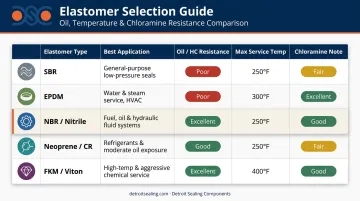
Source: AMERICAN Fastite Gasket data; McWane Specialty Gaskets
The Decision Logic
- SBR — use it when geotechnical data confirms clean soil and the utility uses standard disinfection. It ships standard with most ductile iron pipe for good reason.
- Nitrile (NBR) — upgrade when a geotechnical report identifies hydrocarbon-contaminated soil or groundwater along the pipeline route. It's the go-to compound for urban infrastructure projects cutting through industrial or historically developed corridors.
- FKM/Viton — specify when the contamination profile includes aromatic hydrocarbons (gasoline, BTEX compounds) or strong solvents. Budget for the cost premium.
- EPDM — use when the primary concern is elevated temperature or dilute chemical exposure, not petroleum contamination.
In practice, mixing gasket materials within a single project is acceptable — each segment should be specified for its local conditions. Joint type, size, manufacturer's mark, and country of origin are molded into the side of every push-on gasket per ANSI/AWWA C111, making field identification reliable.
Selection, Installation, and Storage Best Practices
Specification Checklist
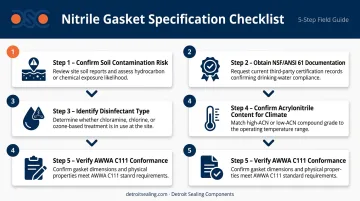
Before finalizing a nitrile gasket specification for any water main project:
- Confirm soil contamination risk via geotechnical report — don't assume clean conditions on urban or industrial routes
- Obtain NSF/ANSI 61 documentation from the supplier, verified against the NSF product listing database
- Identify the utility's disinfectant type — if chloramine, require ASTM D6284 test data for the specific compound
- Confirm acrylonitrile content is appropriate for the installation climate's cold-temperature requirements
- Verify AWWA C111 conformance is documented in the product submittal
Once the specification is locked, field execution is where most failures actually occur. According to McWane, displaced or rolled gaskets are among the most common errors during ductile iron pipeline joint assembly. Both are preventable:
Installation: The Two Failures That Actually Happen
- Rolled gaskets — caused by insufficient lubrication or too-rapid pipe insertion; the gasket folds over on itself and creates an immediate or delayed leak
- Displaced gaskets — pipe misalignment during insertion pushes the gasket out of its seating recess before the joint closes
Two non-negotiable rules for push-on joints:
- Use only NSF/ANSI 61-certified lubricant supplied by the pipe manufacturer — McWane's pipe joint lubricants are certified to NSF/ANSI 61 for potable water applications
- Never use petroleum-based grease as a substitute — it will degrade both SBR and nitrile gaskets and void any NSF compliance
For mechanical joint gaskets, uniform gasket seating requires correct bolt torque and proper sequence. Reference AWWA C111 or the pipe manufacturer's installation manual for bolt torque values and tightening patterns — don't estimate.
Storage and Handling
Nitrile gaskets can fail before they ever reach a joint. Ozone cracking, UV damage, and petroleum contamination are all avoidable — if storage is handled correctly:
- Cool, dark environment — away from direct sunlight and high-UV artificial lighting
- Original packaging until installation
- Separated from petroleum products, solvents, and electrical equipment (which generates ozone)
Reject any gasket showing surface crazing, tackiness, permanent deformation, or visible cracking before it goes into a joint. The cost of a new gasket is trivial compared to the cost of excavating a failed joint six months later.
Frequently Asked Questions
What is the best gasket material for water?
The right material depends on service conditions. SBR handles standard potable water lines in clean soil. Nitrile (NBR) is the correct choice when hydrocarbon-contaminated soil is confirmed or suspected. EPDM suits higher-temperature or dilute chemical environments, and FKM offers the broadest chemical resistance at the highest cost. All gaskets in drinking water contact must carry NSF/ANSI 61 certification.
Are nitrile gaskets good for water mains?
Yes — NBR is an excellent choice wherever oil, fuel, or petroleum contamination is a documented risk. It delivers reliable swell resistance and maintains sealing force in conditions that would cause SBR to fail. The caveats are real: poor UV and ozone resistance requires proper storage, and aromatic solvents or ketones call for FKM instead.
What is the pressure rating of nitrile rubber gaskets?
Push-on and mechanical joints in ductile iron water mains are typically rated for 350 psi working pressure (450 psi including surge), per U.S. Pipe data. Compressed aramid-fiber/NBR flanged gaskets can reach 1,200 psi, with the exact rating varying by formulation, thickness, and flange class.
What gasket should I use for high-pressure water main flanged connections?
For high-pressure flanged connections, compressed aramid-fiber/nitrile (NBR) sheet gaskets or semi-metallic spiral wound gaskets are the standard options. The choice depends on pressure class, temperature, and the chemical environment. For standard water distribution pressures, a properly specified push-on or mechanical joint nitrile gasket is sufficient.
What is the pressure rating of an AWWA C207 flange gasket?
AWWA C207-23 defines working pressure limits by class: Class B (86 psi), Class D (175 psi for 1–12 in., 150 psi for 14–144 in.), Class E (275 psi), and Class F (300 psi). Gasket material must meet or exceed the flange class rating at operating temperature; verify against the C207 standard and your flange supplier's documentation.