Both nitrile (NBR) and silicone (VMQ) are synthetic elastomers used across virtually every industrial sector, but they're engineered for fundamentally different environments. What performs reliably in a petroleum hydraulic system will swell and fail in a medical sterilizer — and vice versa.
This guide breaks down the chemistry, performance differences, and application-specific guidance you need to make the right call.
Key Takeaways
- Nitrile (NBR): Best for petroleum-based oils, fuels, and hydraulic fluids at -40°F to 212°F; strong mechanical properties, lower cost
- Silicone (VMQ): Best for extreme temperatures (-58°F to 347°F), food/medical contact, UV/ozone exposure, and long-term static sealing
- Fluid media, temperature range, mechanical load, and regulatory requirements determine the correct choice — neither material is universally better
- HNBR extends nitrile's heat range; fluorosilicone (FVMQ) adds oil resistance to silicone's thermal advantages
Nitrile vs. Silicone O-Rings: Quick Comparison
| Property | Nitrile (NBR) | Silicone (VMQ) |
|---|---|---|
| Temperature Range | -40°F to ~212°F (short-term to 250°F) | -58°F to 347°F (short-term to 446°F) |
| Oil/Fuel Resistance | Excellent | Poor — swells and degrades |
| UV/Ozone Resistance | Poor | Excellent |
| Tensile Strength | High (~14 MPa at 70 Shore A) | Lower — not suited for high-pressure dynamic sealing |
| Compression Set | Good at moderate temps | Excellent recovery at elevated temps |
| Biocompatibility | Not rated | Suitable for food/medical with certified compounds |
| Cost | Lower — preferred for high-volume production | Higher — offset by longer service life in high-temp or chemically aggressive environments |
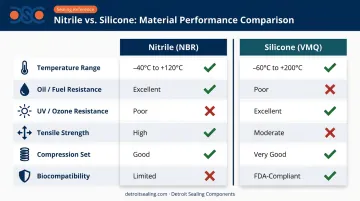
Temperature ranges per Trelleborg O-Rings and Back-up Rings and Parker O-Ring Handbook ORD 5700.
All values are compound-dependent — actual performance varies by formulation.
What Are Nitrile O-Rings?
Nitrile (NBR) is a copolymer of acrylonitrile and butadiene. The acrylonitrile (ACN) content — typically 18% to 50% — directly controls the key performance trade-off: higher ACN content means better oil resistance but reduced flexibility at low temperatures. Lower ACN improves cold-temperature flexibility and compression set.
Per Trelleborg's Materials Chemical Compatibility Guide, NBR is the most widely used elastomer in the seal industry, driven by its unmatched balance of oil resistance and cost.
Why Nitrile Dominates Industrial Sealing
Core performance advantages:
- Exceptional resistance to petroleum-based oils, fuels, and hydraulic fluids
- Tensile strength up to 14 MPa at 70 Shore A hardness
- Good compression set for static sealing applications
- Cost-effective in high-volume production environments
- Widely available in standard AS568, metric, and other sizing systems
Where nitrile breaks down:
- Poor resistance to ozone and UV radiation — degrades with prolonged outdoor exposure
- Not compatible with ketones, chlorinated solvents, or strong acids
- Upper temperature limit of approximately 212°F continuous service (short-term to 250°F)
Where Nitrile O-Rings Are Used
Nitrile is the default sealing material wherever petroleum-based media is involved:
- Engine oil seals, transmission seals, and fuel system components in automotive
- Wellhead equipment, pipeline seals, and valve packing in oil & gas
- Hydraulic cylinders on mobile agricultural and construction equipment
- Pneumatic fittings, hydraulic power units, and compressors across general industry
DSC stocks NBR O-rings in 70 and 90 Shore A hardness across the full AS568 series and multiple international sizing standards, giving industrial buyers a single source for standard and volume orders.
What Are Silicone O-Rings?
Silicone (VMQ — vinyl methyl silicone) is built on a silicon-oxygen backbone rather than a carbon-based chain. That molecular structure gives silicone its exceptional thermal stability and biological inertness, two properties carbon-based elastomers cannot fully replicate.
Why Silicone Excels Where Nitrile Cannot
Core performance advantages:
- Wide operating temperature range: -58°F to 347°F normal service, with short exposure up to 446°F
- Excellent resistance to UV, ozone, and weathering
- Strong electrical insulation properties
- Biocompatibility that supports food-contact and medical device applications
- Low compression set at elevated temperatures, meaning seals recover their original shape effectively after prolonged compression
Where silicone fails:
- Not compatible with petroleum-based oils, fuels, or hydrocarbon solvents — swelling and rapid degradation occur
- Lower tensile strength and abrasion resistance compared to nitrile
- Higher per-unit cost; not practical for high-volume general industrial use where nitrile performs adequately
Where Silicone O-Rings Are Used
Silicone is the preferred material when temperature extremes, sterility, or regulatory compliance govern the specification:
- Food and beverage processing equipment, beverage dispensing, and FDA 21 CFR 177.2600-compliant sealing applications
- Sterilization equipment, drug delivery components, and diagnostic devices evaluated under ISO 10993-1 for biocompatibility
- Automotive HVAC climate system sealing (non-fuel-contact) where elevated temperatures occur
- Cleanroom-compatible enclosure sealing in electronics and semiconductor environments
- UV and ozone-exposed outdoor installations, including renewable energy systems
DSC carries VMQ silicone compounds from 45 to 90 Shore A hardness and stocks FDA 21 CFR 177.2600-compliant compounds as part of its sanitary and drinking water product line. USP Class VI materials are available for medical and pharmaceutical applications, with compliance documentation provided upon request.
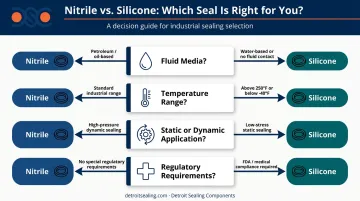
Which Should You Choose?
The four questions engineers need to answer before specifying a material:
- What fluid media will the seal contact? Petroleum/hydrocarbon → nitrile. Water-based, dilute chemical, or no fluid contact → evaluate silicone.
- What is the operating temperature range? Standard industrial range → nitrile. Extremes above 250°F or below -40°F → silicone.
- Is the application static or dynamic? High-pressure dynamic sealing with abrasion → nitrile's mechanical strength is essential. Low-stress static sealing → silicone's compression set recovery works well.
- Are there regulatory requirements? FDA food-contact or medical biocompatibility requirements → silicone with verified compound documentation.
Clear-Cut Recommendations
Choose nitrile when:
- The application involves petroleum-based fluids, hydraulic oils, or fuels
- Operating temperature stays within -40°F to 212°F
- High mechanical strength under pressure is required
- Cost efficiency matters in high-volume production
Choose silicone when:
- Temperature demands exceed what nitrile handles (especially above 250°F or below -40°F)
- Biological inertness is required for food, pharmaceutical, or medical contact
- The seal is exposed to UV radiation, ozone, or outdoor weathering
- Long-term static compression without permanent set matters
When Standard Compounds Don't Fit
Some applications sit at the edge of both materials' capabilities. Two specialty compounds address the most common gaps:
- HNBR (Hydrogenated Nitrile): Extends nitrile's heat resistance — Parker reports water and steam service up to 300°F, with intermittent service to 340°F. Improved ozone and aging resistance over standard NBR.
- FVMQ (Fluorosilicone): Adds added oil and fuel resistance to silicone's thermal profile. Trelleborg places its range at -76°F to 347°F, with better chemical resistance than standard VMQ — though it still doesn't match nitrile in straight petroleum applications.
DSC stocks both HNBR and FVMQ compounds. For applications where the standard NBR vs. VMQ choice doesn't fit, DSC's ISO 17025 accredited lab can develop and test custom compounds against specific fluid, temperature, and mechanical parameters.
Customers don't need to commit to full production before bench validation — compound performance is confirmed against real-world parameters first.
Wrong material selection isn't just a cost-per-unit problem. O-ring failure in a hydraulic system, food processing line, or medical device means unplanned downtime, potential contamination, or regulatory exposure. Getting the compound right the first time reduces total cost of ownership — and in high-consequence applications, that difference is rarely small.
Conclusion
Choosing between nitrile and silicone comes down to what your application actually demands. Nitrile delivers unmatched value for petroleum-contact, high-pressure industrial work. Silicone is the stronger choice where thermal extremes, biocompatibility, or environmental exposure are the governing constraints.
Before specifying either material, evaluate your fluid media, temperature range, mechanical requirements, and any compliance obligations. When applications cross multiple criteria — or when a standard compound simply doesn't exist for your conditions — DSC's technical team offers material selection support backed by an extensive compound library and ISO 17025 accredited lab testing.
Frequently Asked Questions
Frequently Asked Questions
Are nitrile O-rings better?
Nitrile is the better choice specifically for petroleum-based oils, fuels, and hydraulic fluids at moderate temperatures. It's not universally superior — in high-temperature, food-grade, UV-exposed, or medical environments, silicone or another material will outperform it.
Which O-ring material is best overall?
No single material is universally best. Nitrile suits oil and fuel environments; silicone handles temperature extremes and biocompatible applications; FKM/Viton covers aggressive chemical exposure. The right choice depends on fluid media, temperature range, mechanical stress, and any applicable regulatory requirements.
Can silicone O-rings be used with oil?
Standard silicone O-rings are not recommended for petroleum-based oils or fuels, as they tend to swell and degrade. Fluorosilicone (FVMQ) offers improved oil resistance while retaining silicone's thermal performance, though it still doesn't match nitrile in dedicated petroleum applications.
What temperature can nitrile O-rings withstand?
Standard NBR handles approximately -40°F to 212°F in continuous service, with shorter service life at 250°F. HNBR extends the upper limit; Parker documents water and steam service up to 300°F. Performance at the extremes depends on the specific compound formulation and fluid compatibility.
Are silicone O-rings food safe?
Silicone O-rings can be produced to meet FDA 21 CFR 177.2600 for repeated food contact, but compliance isn't automatic across all silicone compounds. Buyers should verify that the specific compound, cure system, and finished article are certified — and obtain documentation from their supplier.
What is the difference between NBR and VMQ O-rings?
NBR (nitrile butadiene rubber) and VMQ (vinyl methyl silicone) are the engineering designations for nitrile and silicone O-rings respectively. NBR is a carbon-based polymer prized for oil and fuel resistance; VMQ is a silicon-oxygen inorganic polymer prized for thermal stability and biocompatibility. Both abbreviations are used interchangeably with their common names in engineering specifications.