The fix isn't always expensive. It's often a matter of specifying the right sealing component for the actual operating environment — the right material, the right geometry, the right design for the pressure and media involved.
This article covers what distinguishes advanced seals and gaskets from standard components, the main types used in industrial machinery, how to match materials to operating conditions, and what to consider when selecting sealing solutions that will genuinely protect your equipment.
Key Takeaways
- Seals prevent leakage between moving parts; gaskets seal static mating surfaces — both are critical to system integrity
- Material selection is the single most important factor in sealing performance; NBR, EPDM, FKM, silicone, and PTFE each cover distinct operating conditions
- The FSA/ESA Gasket Handbook attributes 75% of leaking flange connections to installation conditions — not material defects
- Proper assembly — surface finish, groove dimensions, and bolt load — matters as much as material selection
- Custom sealing solutions — modified O-rings to complex molded shapes — fill gaps where standard components fall short
What Are Advanced Seals and Gaskets — and Why They Matter for Machinery Protection
Seals vs. Gaskets: A Clear Distinction
These two terms get used interchangeably, but they describe different things.
Seals are used in dynamic applications — they prevent fluid or gas leakage between parts that move relative to each other. A rotating shaft, a reciprocating piston, a hydraulic cylinder rod: these all need seals designed to handle motion while maintaining contact and preventing leakage.
Gaskets fill the space between two static, non-moving mating surfaces. Flanged pipe connections, valve bodies, heat exchanger heads — anywhere two surfaces bolt together and need to contain pressure or prevent contamination entry.
Both handle fluid and gas containment. The mechanical context — static or dynamic — determines which applies, and that distinction drives every material and design decision downstream.
What Makes a Sealing Solution "Advanced"
Standard catalog components handle general conditions. Advanced seals and gaskets are engineered to specific combinations of:
- Operating pressure range and pressure cycling frequency
- Temperature extremes (both minimum and maximum) and thermal cycling
- Chemical exposure — the media the seal contacts, including any cleaning agents
- Mechanical motion type: static, rotary, or reciprocating
When any of these variables exceed general-purpose limits, the sealing solution needs to be specified — not just selected off a shelf. That's where material science and design engineering become the deciding factor.
The Machinery Protection Function
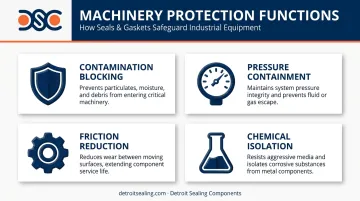
Properly specified seals and gaskets do more than stop leaks. They:
- Block contamination from entering sealed assemblies (bearings, gearboxes, hydraulic circuits)
- Contain pressurized fluids and gases to maintain system efficiency
- Reduce friction-related wear on mating surfaces
- Isolate chemically incompatible media from sensitive components
Each of these functions directly extends machinery service life. A bearing contaminated by dirt or moisture fails prematurely. A hydraulic system losing fluid through a leaking seal operates at reduced efficiency long before it fails outright. In both cases, the root cause traces back to a sealing component that wasn't matched to the actual operating conditions.
Common Types of Advanced Seals and Gaskets Used in Industrial Machinery
Seals for Dynamic Applications
O-Rings are the most widely used sealing element across industry. Parker defines them as torus-shaped rings — typically elastomeric, though PTFE and metal versions exist — that seal under compression in a machined groove. They appear in hydraulic cylinders, pneumatic actuators, fluid fittings, and thousands of other assemblies.
Material selection determines whether an O-ring survives its operating environment. The geometry is standardized; the compound is where performance is won or lost.
DSC stocks O-rings across the full range of international standards — AS568, ISO metric, JIS, BS, and others — with sizes ranging from 0.5mm ID to 1,600mm ID. X-rings, with their four-lobed cross section, are also available as a drop-in alternative that reduces spiral twist in rotary applications.
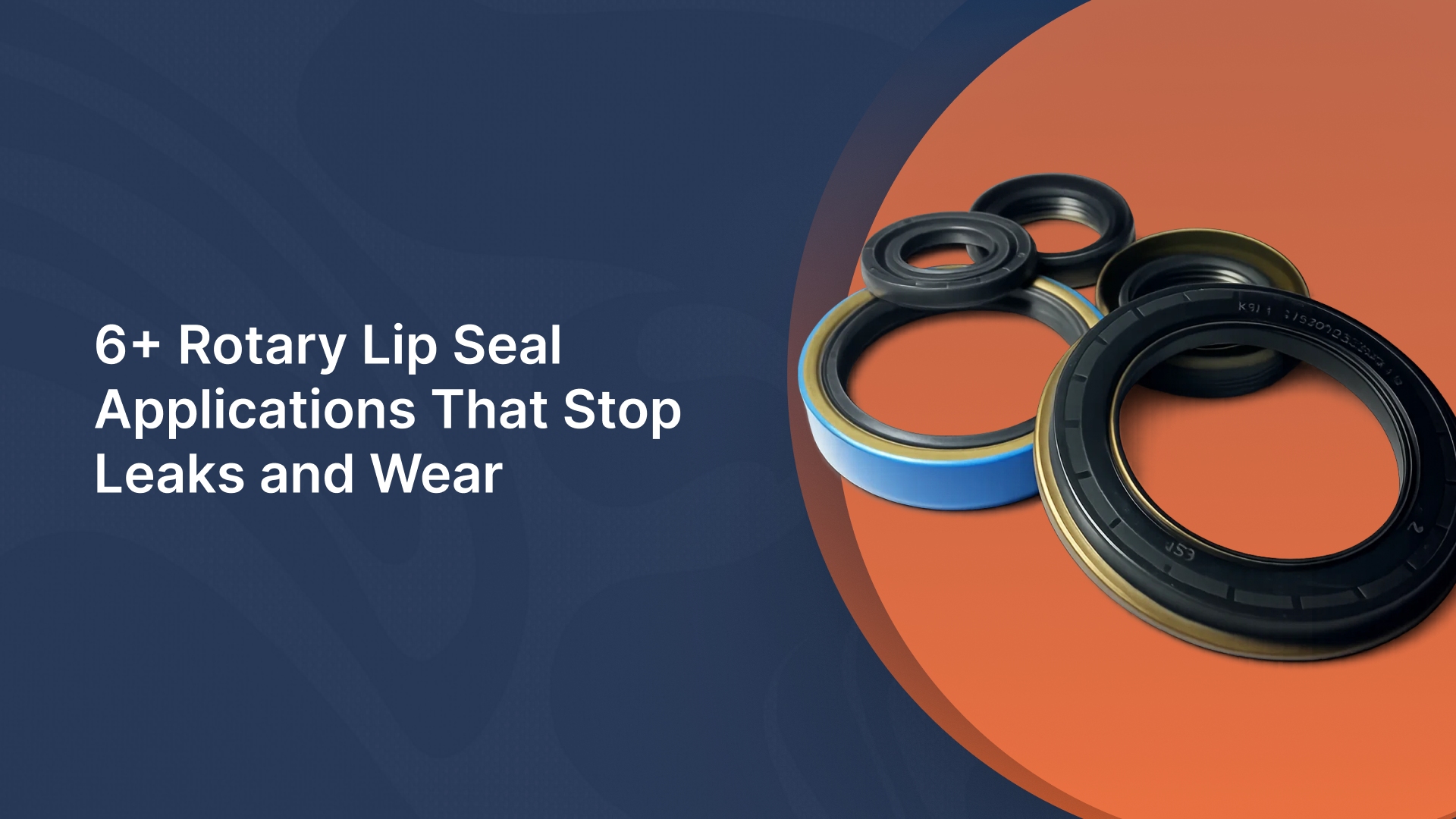
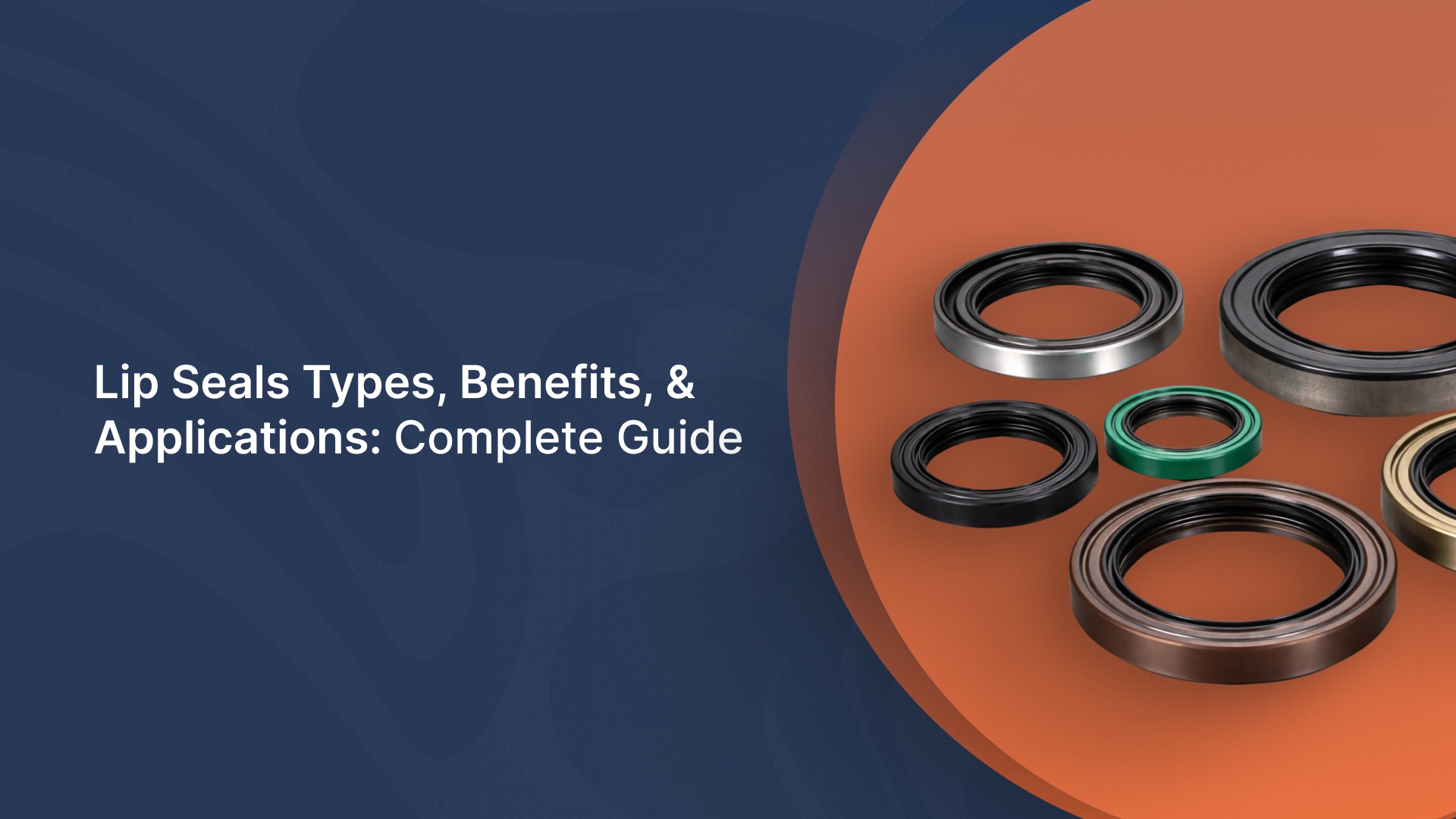
Lip Seals (Radial Shaft Seals) protect rotating shaft assemblies from lubricant loss and external contamination. Per ISO 6194-1, these incorporate elastomeric sealing elements in rubber-covered or metal-cased configurations. Common locations include gearboxes, pumps, and electric motors — anywhere a rotating shaft exits a housing.
DSC's V-Seals offer an alternative approach: an all-rubber face seal that mounts directly on the shaft and tolerates higher misalignment than traditional radial lip seals.
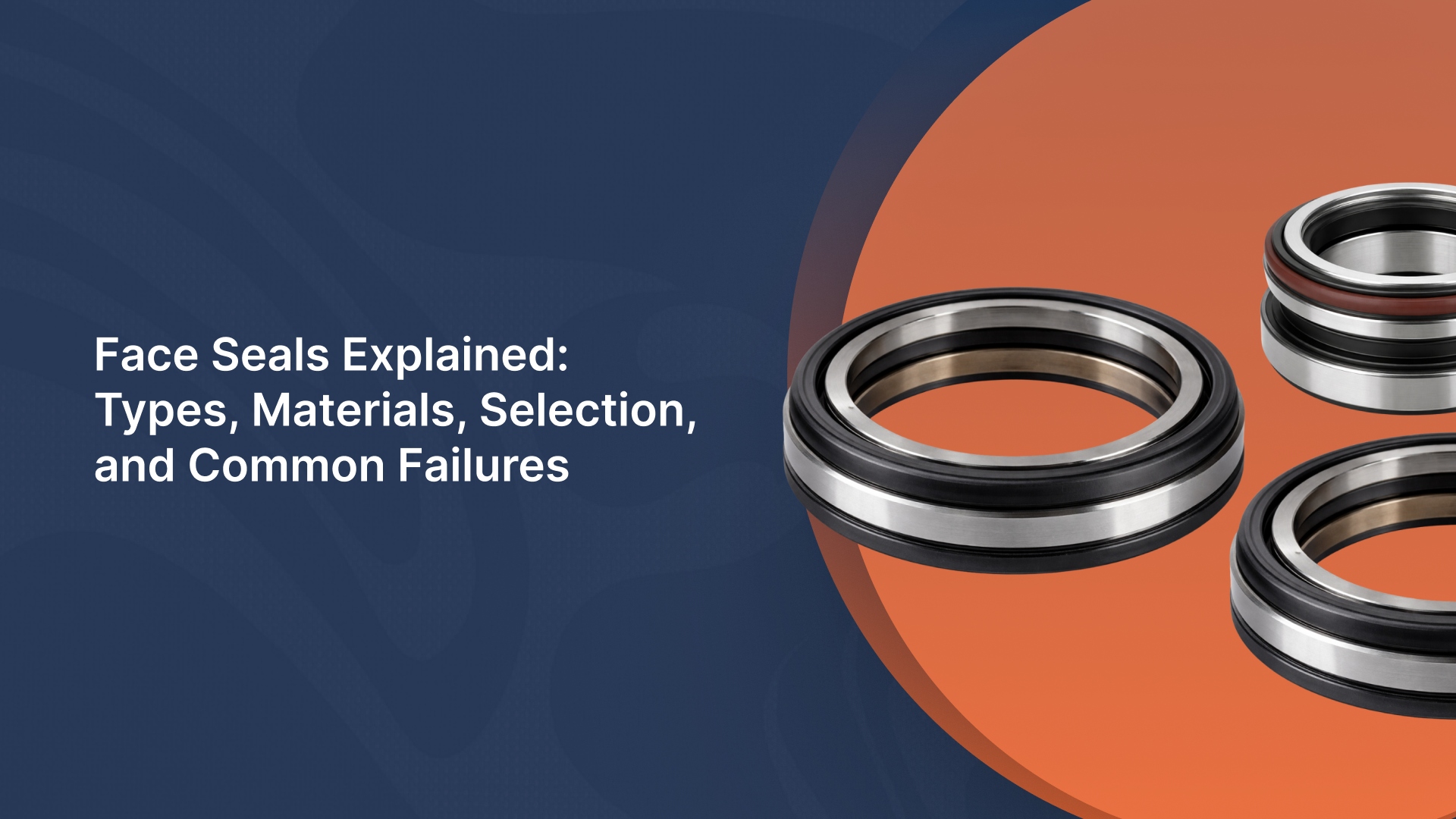
Mechanical Seals are used in pumps and rotating equipment to contain high-pressure fluids. Unlike elastomeric seals, mechanical seals rely on precision-lapped mating faces to create the sealing interface. The tradeoff is complexity and cost — but for demanding chemical or high-temperature environments, they're often the only viable option.
Hydraulic and Pneumatic Seals address the distinct demands of fluid power systems. DSC's hydraulic range covers wiper seals, rod and piston seals, and symmetrical profiles across standard cylinder bore sizes. Pneumatic seals prioritize low-friction performance and compact geometry for short-stroke configurations.
The key distinction: hydraulic seals handle higher pressures and fluid containment; pneumatic seals optimize for speed and minimal breakout force.
Gaskets for Static Applications
Sheet and Molded Gaskets are cut or molded to fit flanged connections, valve bodies, and heat exchanger faces. Material selection — rubber, PTFE, compressed fiber, flexible graphite — is based on the media being sealed and the temperature range involved. ASME B16.21 covers the dimensional and material requirements for nonmetallic flat gaskets.
Spiral Wound and Ring Joint Gaskets are the high-integrity options for oil and gas piping, high-pressure steam, and similar demanding services. Spiral wound gaskets combine metallic winding with soft filler, providing resilience under fluctuating bolt loads. Ring type joint (RTJ) gaskets are solid metallic rings designed for the highest-pressure, highest-temperature services where nonmetallic gaskets would extrude or degrade. Both types fall under ASME B16.20.
Material Matters: Choosing the Right Compound for Your Operating Environment
The compound is where most sealing failures begin. The wrong material exposed to incompatible chemistry, temperatures outside its rated range, or excessive compression set will fail regardless of how well the design was executed.
Here are the primary compound families and where they belong:
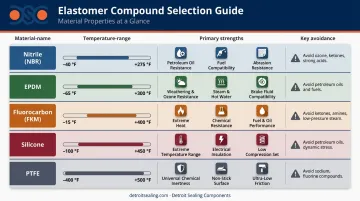
| Material | Temperature Range | Strength | Avoid |
|---|---|---|---|
| NBR (Nitrile) | -34°C to 121°C | Petroleum oils, hydraulic fluids, general industrial | Aromatic hydrocarbons, ketones |
| EPDM | -57°C to 121°C | Water, steam, ozone, glycol-based fluids | Petroleum-based oils and fuels |
| FKM (Viton) | -26°C to 205°C | Fuels, mineral oils, chlorinated solvents, high heat | Methanol, acetone |
| Silicone (VMQ) | -115°C to 232°C | Extreme temperature range, food contact, ozone | Mineral oil, aromatic hydrocarbons |
| PTFE | -73°C to 204°C | Near-universal chemical resistance | High-compression dynamic applications |
Each material covers a distinct operating window:
- NBR is the most widely used O-ring material in general industry, valued for petroleum-fluid resistance and balanced physical properties
- EPDM handles water, steam, and glycol applications where NBR would swell and degrade
- FKM is the go-to for high-temperature fuel and oil environments: aerospace, oil and gas, and automotive fuel systems
- Silicone covers the widest temperature span and is common in food-contact and medical applications with demanding thermal cycles
- PTFE applies where standard elastomers would degrade under chemical attack — its near-universal inertness makes it the last resort for aggressive media
DSC stocks hundreds of compounds across these and additional rubber families — including HNBR, FFKM, FVMQ, and polyurethane. Where standard formulations fall short, DSC's ISO 17025 accredited lab develops and tests custom compounds against specific temperature, pressure, and media requirements.
Key Factors to Consider When Selecting Seals and Gaskets for Machinery
The Four Primary Selection Parameters
Every seal and gasket selection should start with these four questions:
- What is the operating pressure? Include maximum transient pressure and cycling frequency. High pressure drives extrusion failure in O-rings and blowout risk in gaskets.
- What is the full temperature range? Consider not just operating temperature, but startup and shutdown extremes, plus thermal cycling frequency.
- What media does the seal contact? Include cleaning agents, secondary fluids, and process gases. Chemical incompatibility is a primary failure cause.
- What type of motion is involved? Static, rotary, and reciprocating applications each demand different design geometry and tribological properties.
These four factors narrow the material and geometry candidates significantly before any catalog is opened.
Surface Finish and Dimensional Tolerances
The right material in the wrong groove will still leak. The FSA/ESA Gasket Handbook provides clear guidance on required surface roughness by gasket type:
- Soft cut gaskets: Ra 3.2–12.5 μm
- Spiral wound and Kammprofile gaskets: Ra 3.2–6.3 μm
- Solid metallic gaskets: smoother than Ra 1.6 μm
For O-rings, Parker's design guidelines recommend a gland fill of approximately 75% to accommodate volume swell and thermal expansion. Too tight, and the O-ring extrudes under pressure. Too loose, and it doesn't seal under low-pressure conditions.
Installation matters equally. The FSA/ESA Gasket Handbook notes that 75% of leaking bolted flange connections result from non-gasket factors — improper bolt load, surface damage, or misalignment during assembly.
When Off-the-Shelf Isn't Enough
Standard components cover the majority of industrial applications. Custom solutions become necessary when applications involve:
Standard components cover the majority of industrial applications. Custom solutions become necessary when applications involve:
- Non-standard geometries that fall outside catalog dimensions
- Unusual pressure-temperature-media combinations that exceed standard material ratings
- Regulatory requirements in food and beverage, pharmaceutical, or semiconductor manufacturing
DSC's engineering team uses CAD and finite element analysis (FEA) to develop custom sealing profiles, identifying stress concentrations and predicting assembly forces before tooling is cut. Testing through DSC's ISO 17025 accredited lab validates performance under real application conditions, cutting qualification timelines for the most demanding programs.

Industry Applications of Advanced Sealing Solutions
Advanced sealing requirements show up differently by industry, but the underlying engineering logic is the same: match the compound and geometry to the actual operating environment.
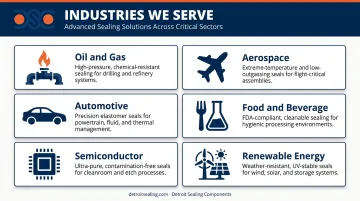
Oil and Gas demands seals that resist rapid gas decompression (RGD), handle H2S-containing environments, and maintain integrity at high pressures and temperatures. DSC's packer elements, S-seals, and FS-seals are manufactured from FKM, HNBR, FEPM, and FFKM with RGD-resistant formulations. The company adheres to NORSOK M-710, ISO 23936, and API 6A specifications for this sector.
Aerospace requires lightweight materials, extreme temperature performance, and strict material traceability. O-ring sizing follows SAE AS568 for aerospace applications. DSC supplies O-rings, backup rings, and hydraulic seals from FKM, FFKM, and fluorosilicone (FVMQ) compounds suited to these environments.
Automotive applications span conventional fuel and brake systems as well as emerging EV thermal management needs. NBR and FKM cover most legacy applications; EPDM and specialized compounds address glycol-based coolant circuits in electrified powertrains.
Food and Beverage requires FDA 21 CFR 177.2600-compliant materials for rubber articles in repeated-use food contact, along with NSF 61 and NSF 42 certification for drinking water applications. DSC's food-grade product range includes O-rings, gaskets, and bonded components in certified formulations.
Semiconductor manufacturing demands cleanroom-compatible components with minimal particle generation. DSC produces LSR components in a Class 1000 cleanroom environment for electronics and semiconductor applications where even trace particulate contamination can compromise yield.
Renewable Energy systems — wind turbine hydraulic circuits, solar inverter enclosures, energy storage housings — require seals engineered for prolonged outdoor exposure, wide temperature swings, and resistance to weather and UV degradation.
Machinery operating across multiple sectors, or under regulatory requirements, benefits from a single supplier capable of delivering both standard catalog components and custom-engineered solutions nationwide. DSC's Plymouth, Michigan location sits near major Midwest freight corridors, enabling reliable, fast delivery to customers across the US.
Frequently Asked Questions
What is the difference between a seal and a gasket?
Seals are used in dynamic applications — they prevent leakage between parts that move relative to each other, such as rotating shafts or reciprocating pistons. Gaskets seal the space between two stationary mating surfaces, like a flanged pipe connection or valve body. Both contain fluid or gas, but in different mechanical contexts.
How do I know when to replace seals and gaskets on machinery?
Several warning signs indicate seals or gaskets need attention:
- Visible leaks or fluid accumulation around sealed joints
- Increased fluid consumption without an obvious cause
- Contamination found in lubricant samples
- Unusual noise from bearings or gearboxes
- System pressure or temperature drifting outside normal parameters
Waiting for complete failure almost always costs more than proactive replacement.
What materials are best for high-temperature sealing applications?
FKM (Viton) handles high-temperature oil and fuel environments up to approximately 205°C. Silicone covers the widest thermal range, from -115°C to 232°C. PTFE suits chemically aggressive high-temperature scenarios. The right choice depends on what media the seal contacts, not temperature alone.
Can seals and gaskets be custom-made for non-standard machinery?
Yes. Custom solutions can be engineered from standard O-ring modifications to complex molded geometries using CAD and FEA. Suppliers with ISO 17025 accredited lab capabilities can develop and validate custom compounds for unusual operating conditions before full-scale production begins.
How do advanced seals and gaskets reduce machinery maintenance costs?
Properly specified seals eliminate unplanned leaks, extend intervals between maintenance events, reduce lubricant and fluid loss, and protect bearings and precision components from premature wear. The sealing component is rarely the most expensive part in the assembly — but its failure often is.
What is the most common cause of seal and gasket failure in industrial machinery?
Most seal and gasket failures trace back to a handful of root causes:
- Material incompatibility with the sealed media
- Operating beyond the component's rated temperature or pressure range
- Improper installation — over-compression, surface damage, or incorrect flange torque
- Using a general-purpose component where an application-specific solution was needed