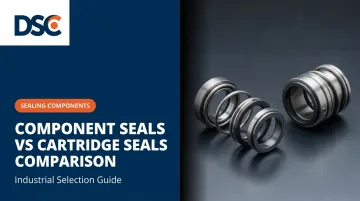
The core trade-off is clear: component seals cost less upfront but require skilled technicians and precise field assembly. Cartridge seals cost more initially but arrive factory-set, pressure-tested, and ready to install with minimal specialist knowledge. Knowing which trade-off fits your situation is what this guide covers.
Key Takeaways
- Component seals are field-assembled from discrete parts — lower purchase cost, but installation success depends heavily on technician skill
- Cartridge seals come pre-assembled and factory-tested — faster installation, fewer errors, and a higher price tag that reflects the reduced installation risk
- Component seals work well in compact equipment where cartridge units won't fit, or where experienced in-house fitters handle routine maintenance
- Cartridge seals are preferred for critical applications, hazardous media, or facilities without specialist seal fitters
- The right choice depends on your application's criticality, your team's experience, and what total lifecycle cost actually looks like for your operation
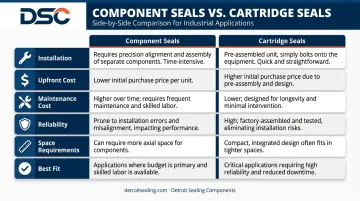
Component vs. Cartridge Seals: Quick Comparison
| Factor | Component Seals | Cartridge Seals |
|---|---|---|
| Installation | Field-assembled; requires precise axial setting and skilled technicians | Factory pre-assembled; bolts on as a single unit, no precision measurement required |
| Upfront Cost | Lower — individual parts can be stocked selectively | Higher — engineering and preassembly add to purchase price |
| Maintenance Cost | Economical per-part replacement, but higher labor risk adds hidden costs | Easier unit replacement; repairable cartridges can lower total replacement cost |
| Reliability | Depends on installer expertise and field conditions | Consistent — factory QA eliminates common assembly errors |
| Space Requirements | Compact; fits close-coupled or tightly integrated equipment | Requires more envelope space for the cartridge housing |
| Best Fit | Lower-duty services; experienced in-house teams; budget-constrained applications | Critical services; generalist maintenance teams; hazardous or high-pressure media |
What Is a Component Seal?
A component seal is a mechanical seal supplied as discrete parts: a rotating assembly (rotating face, spring or springs, and drive collar), a stationary seat, secondary seals such as O-rings or gaskets, and a gland plate for mounting. The technician assembles these elements directly onto the pump shaft, on-site, at installation.
How It Works
The primary seal forms between two lapped seal faces — one rotating with the shaft, one stationary in the gland — separated by a thin film of process liquid. Secondary sealing (preventing leakage around the shaft and gland) is handled by O-rings, bellows, or gaskets. Axial setting — the precise compression of the spring to maintain face contact — must be set manually during installation. It directly determines seal life.
Advantages
- Individual parts cost less upfront than a complete preassembled unit
- A small inventory of components can cover multiple seal configurations across equipment types
- No external housing — fits tight-clearance, close-coupled pumps where cartridge assemblies won't physically fit
- Faces, O-rings, and elastomeric elements can be swapped independently during repairs without replacing the full assembly
Disadvantages
- Installation outcome depends directly on technician skill and environmental cleanliness
- Seal faces are exposed during handling — susceptible to contamination or physical damage before installation
- Incorrect axial setting, dirty faces, or misaligned secondary seals lead to reduced seal life or immediate failure
- Field assembly conditions are inherently less controlled than factory environments
Component Seal Variations
AESSEAL's multi-spring component seals apply even face load across the sealing face using multiple compression springs — commonly specified in chemical and petrochemical services. Single-spring designs are simpler to assemble and self-cleaning, which makes them preferred in close-coupled pump applications where assembly simplicity and self-cleaning action matter.
Where Component Seals Fit
Component seals are well-matched to:
- General industrial pumps, mixers, and agricultural/irrigation equipment
- Close-coupled assemblies where physical space rules out a cartridge housing
- OEM assembly environments where controlled workshop conditions reduce installation risk
- Food and beverage applications requiring compact seal dimensions and specific material compliance
- Facilities with experienced, in-house maintenance technicians who perform seal work regularly
For facilities managing component seal inventories, material flexibility matters. DSC stocks individual sealing elements — O-rings, X-rings, backup rings, gaskets, and rubber-metal bonded parts — across hundreds of rubber compounds, including FKM, NBR, HNBR, EPDM, FFKM, and silicone. That breadth makes it practical to stock the right secondary seal compound for each application rather than defaulting to a one-size-fits-all elastomer.
What Is a Cartridge Seal?
A cartridge seal is a fully self-contained mechanical seal unit. The gland, sleeve, rotating assembly, stationary seat, springs, and all secondary seals are factory-assembled into a single housing. The entire unit mounts onto the pump shaft as one piece — no individual component setting required on-site.
The Preassembly Advantage
Both AESSEAL and Chesterton describe their cartridge seals as factory-set and pressure-tested before shipment. This means spring compression, face alignment, and axial positioning are verified under controlled conditions before the seal ever reaches the installation point. Built-in setting tabs or clips hold everything in position during transport and are removed only after the unit is mounted — eliminating the most error-prone steps of field assembly.
In practice, a generalist technician can install a cartridge seal correctly — the same task with a component seal typically requires a dedicated seal fitter. That installation simplicity shows up across several practical advantages:
Advantages
- Eliminates shaft measurements, axial setting calculations, and component sequencing at installation
- Protected seal faces — the enclosed housing prevents contamination during transport and handling
- The static secondary seal in most cartridge designs removes shaft sleeve wear caused by dynamic sealing
- Factory QA — pressure testing before delivery provides a verified performance baseline
- Worn components can be replaced within the existing housing, reducing repair cost versus full seal replacement
Disadvantages
- Higher initial purchase price compared to equivalent component seals
- Requires more physical space — the cartridge housing adds to the overall seal envelope
- Precise engineering data (shaft dimensions, seal chamber geometry, operating conditions) must be defined upfront before manufacture
- Not suitable for the most compact or tightly integrated equipment designs
Cartridge Seal Variations
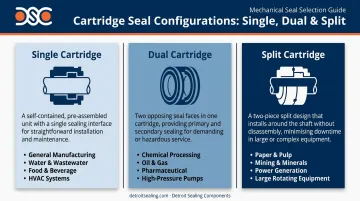
| Type | Description | Typical Application |
|---|---|---|
| Single cartridge | One seal face pair in a self-contained unit | General industrial pumps, mixers, agitators |
| Dual cartridge | Two seal faces with barrier fluid between them | Toxic, flammable, or difficult-to-seal media in oil & gas, chemical, pharmaceutical |
| Split cartridge | Housing splits axially for installation without shaft removal | Large pumps with fixed pipework; John Crane notes split seals suit shafts over 3 inches |
Where Cartridge Seals Fit
Cartridge seals are the standard choice across several demanding industries. In oil & gas, API 682 — which governs seal design, selection, and testing for centrifugal and rotary pumps in petroleum and chemical service — effectively mandates cartridge-style configurations for most applications.
Common deployment environments include:
- Water and wastewater treatment — Pumps & Systems notes non-split pusher seals for wastewater are almost exclusively cartridge designs
- Oil & gas upstream and midstream operations (per API 682)
- Chemical processing and pharmaceutical manufacturing, where hygiene standards require consistent, validated sealing
- Any facility where maintenance is performed by generalist technicians rather than dedicated seal fitters
Which Seal Type Should You Choose?
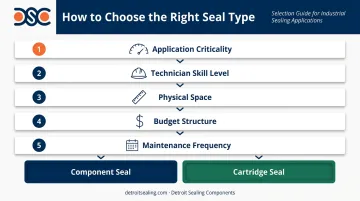
No single seal type suits every application. Five variables should guide your selection:
- Application criticality — what does unplanned downtime cost you?
- Technician skill level — do you have specialist seal fitters or general maintenance staff?
- Physical space — will the equipment accommodate a cartridge housing?
- Budget structure — upfront cost vs. total lifecycle cost across multiple maintenance cycles
- Maintenance frequency — how often does this seal get replaced?
Choose Component Seals When:
- Upfront cost is the primary constraint and experienced seal technicians are consistently available
- Equipment is compact or close-coupled and cannot physically accommodate a cartridge housing
- The service is lower-duty and seal replacements are infrequent
- Individual component replacement offers meaningful cost savings over a full assembly swap
- Material flexibility matters, such as switching elastomer compounds between cycles to address process changes
Choose Cartridge Seals When:
- Minimizing downtime is critical and installation speed matters
- In-house technicians are not specialized seal fitters
- The application involves high pressure, elevated temperature, or hazardous/toxic media where a failed installation cannot be risked
- Long-term reliability justifies the higher upfront cost; reduced labor time and fewer repeat failures typically close the price gap over multiple maintenance cycles
Industry-Specific Guidance
| Industry | Recommended Approach |
|---|---|
| Oil & Gas / Chemical Processing | Dual cartridge seals; API 682-compliant arrangements for single, dual-unpressurized, and dual-pressurized configurations |
| Food & Beverage / Pharmaceutical | Cartridge seals meeting EHEDG Guideline 25 hygienic design criteria; FDA-compliant elastomers (CFR 177.2600) |
| Water & Wastewater | Cartridge seals for pumps with shafts ≤3 inches; split cartridge seals for larger shafts; NSF/ANSI/CAN 61 compliance required for potable water across 49 U.S. states |
| General Industrial / Agricultural | Component seals where skilled technicians are available and tighter budgets apply |
| Aerospace / Semiconductor | Application-specific — often component seals engineered directly into equipment design; material compliance (FFKM, LSR, fluorosilicone) frequently critical |
Conclusion
Component seals and cartridge seals each earn their place. The right choice comes down to your application's criticality, the installer's experience level, and your total cost horizon. A component seal in the hands of an experienced technician, in the right equipment, is a reliable and economical choice. Put a cartridge seal in a critical service with a generalist doing the install, and the higher upfront cost pays for itself fast.
Whichever seal type you run, the elastomeric elements — O-rings, secondary seals, gaskets, and custom-molded components — are where material selection has the most direct impact on service life. DSC supplies those elements across hundreds of compounds, from standard NBR and EPDM to chemically resistant FKM and FFKM. For applications where off-the-shelf compounds fall short, DSC offers custom compound development backed by ISO 17025 lab testing.
If you're sourcing sealing components for mechanical seal maintenance or assembly, contact DSC to discuss the right compound and configuration for your application.
Frequently Asked Questions
What is the difference between cartridge and component mechanical seals?
Cartridge seals are factory pre-assembled, pressure-tested units that install as a single piece — faster, more consistent, and less dependent on technician skill. Component seals consist of individual parts assembled on-site by a technician, requiring precise axial setting and controlled handling conditions, but offering a lower upfront purchase cost.
What is a component seal?
A component seal is a mechanical seal made up of separate parts — rotating face, stationary seat, springs, O-rings, and a gland — assembled and adjusted on-site around the pump shaft. Performance depends directly on how accurately the technician sets axial compression and maintains face cleanliness during installation.
What are the three types of mechanical seals?
The three primary types are component seals (individually assembled parts), cartridge seals (factory pre-assembled units), and double/dual seals (two seal face pairs with a barrier fluid between them, used for hazardous, toxic, or high-pressure media in oil & gas, chemical, and pharmaceutical applications).
How much does it cost to replace a pump seal?
No universal figure applies — costs vary by seal type, shaft size, materials, and service conditions. Component seal parts generally cost less per unit, while cartridge seals carry a higher purchase price but reduce labor time and installation risk. For large or difficult-to-access pumps, downtime and labor costs can exceed the seal cost itself, which is where cartridge designs offer the clearest economic advantage.
Can cartridge seals be repaired and reused?
Yes. Cartridge seals are designed for repair — worn or damaged components can be replaced within the existing housing and the unit restored to like-new performance, often at lower cost than purchasing a new assembly.
Which seal type is better for hazardous or high-pressure applications?
Cartridge seals — particularly dual cartridge designs — are the standard choice for hazardous, high-pressure, or toxic media applications. Their factory-set, pressure-tested construction eliminates installation error risk, and the dual configuration provides an additional fluid barrier that prevents process media from reaching the environment if the primary seal fails.