Introduction
In most back pressure regulators (BPRs), the diaphragm is the only moving part. That single fact makes material selection one of the most consequential decisions in system design. Choose the wrong material, and you're looking at premature failure, unplanned downtime, and chemical contamination — often all at once.
Unplanned downtime costs Fortune Global 500 industrial companies nearly $1.5 trillion annually, roughly 11% of annual revenues. That figure spans all equipment failures — but a failed BPR diaphragm hits harder than most.
In Oil & Gas, Semiconductor, or Food & Beverage service, a single diaphragm failure can trigger recalibration, line shutdown, and contamination risk at the same time.
This guide covers how BPR diaphragms function, which material families are available, and the specific parameters that should drive your selection.
Key Takeaways
- The diaphragm is the sole moving component in most BPRs — its material determines precision, chemical safety, and service life
- Selection requires evaluating chemical compatibility, temperature and pressure ratings, and regulatory requirements together — not in isolation
- Three material families dominate: fluoropolymers (PTFE, PEEK), metals (Hastelloy, 316L SS), and elastomers (FKM, EPDM, Buna Nitrile)
- No single material is universally optimal — the right choice depends on your specific combination of process parameters
- Validate compatibility at actual operating temperature, not just ambient conditions, before you specify a material
What Is a Back Pressure Regulator Diaphragm?
BPR vs. Pressure Reducing Regulator
A back pressure regulator maintains upstream pressure at a defined set point by opening to release flow when inlet pressure exceeds that threshold. This is the inverse of a pressure reducing regulator, which manages downstream pressure. As Swagelok notes, a BPR regulates intake pressure rather than outlet pressure — a distinction that matters when specifying the right component for pump bypass, flow control, or overpressure protection.
The Diaphragm's Functional Role
The diaphragm acts as both the sealing element and the pressure sensor. One side receives reference pressure; process pressure acts on the other. When upstream pressure exceeds the setpoint, the diaphragm lifts off its orifice seat to release flow, then reseats once pressure returns to equilibrium. In dome-loaded BPR designs, this happens with fast, precise response because the diaphragm is the only moving part in the assembly.
That simplicity is both an advantage and a constraint. With no other component to absorb wear or compensate for material weakness, the diaphragm's properties directly determine performance across four dimensions:
- How precisely the regulator holds setpoint
- How sensitive it is to small pressure changes
- How long it operates before requiring replacement
Specifying the wrong material shortens diaphragm life and degrades regulator performance from the moment it's installed.
Common Diaphragm Material Options for Back Pressure Regulators
Three material families cover the vast majority of BPR applications. Each represents a different balance of chemical resistance, mechanical strength, thermal capability, and cost. DSC stocks compounds across rubber and fluoropolymer-based diaphragm materials, covering all three families below — so matching material to specification doesn't mean settling for whatever's in a short catalog.
Fluoropolymers: PTFE, PTFE-Glass Reinforced, Enhanced PTFE, PEEK
Fluoropolymers offer the broadest chemical compatibility of any diaphragm material family, making them the default starting point for corrosive media.
| Material | Temp Limit | Max Pressure | Notes |
|---|---|---|---|
| Standard PTFE | 100°C | 150 psig / 10 bar(g) | Low-pressure, low-flow only |
| PTFE-Glass (PGL) | 150°C | 2,500–3,000 psig / 172–206 bar(g) | Best combination of wide flow range + high pressure |
| Enhanced PTFE | 150°C | 150 psig / 10 bar(g) | USP Class VI listed; superior creep resistance |
| PEEK | <100°C | Verify with supplier | Wide flow range; high chemical resistance without extreme heat |
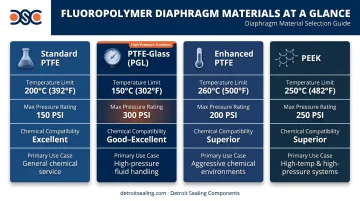
Source: Equilibar Diaphragm Selection data
Standard PTFE's grade A+ chemical resistance comes with a firm pressure ceiling: 150 psig. It is not a high-pressure diaphragm material. PTFE-Glass reinforced variants (PGL/ZPGL) close that gap substantially, and conductive ZPGL also carries ATEX compatibility.
Enhanced PTFE is the standard choice for food, pharmaceutical, and semiconductor applications requiring USP Class VI documentation.
Metals: Hastelloy and Stainless Steel 316L
Metal diaphragms serve applications where fluoropolymers fall short: hydrogen permeation risk, maximum temperature and pressure service, and ATEX-rated explosive atmospheres requiring conductive diaphragm materials.
- Hastelloy — Grade A+ chemical compatibility; excellent resistance to pitting, crevice corrosion, and sulfide stress cracking in sour environments; preferred for hydrogen service; not ideal for lowest flow ranges due to stiffness
- Stainless Steel 316L — Grade A compatibility; corrosion resistant to most chemicals; suitable for ATEX environments; a conductive diaphragm option alongside Hastelloy
When flow sensitivity and wide turndown ratios are the priority, elastomers are worth evaluating instead.
Elastomers: Viton/FKM, Buna Nitrile, EPDM, Polyimide, LDPE
Reinforced elastomers offer the best balance of sensitivity and robustness, particularly for vacuum service, cyclic pressure applications, and wide turndown ratios.
| Material | Temp Limit | Max Pressure | Best For |
|---|---|---|---|
| Viton / FKM | 150°C | 1,000 psig / 69 bar(g) | Aggressive chemistries, vacuum, cyclic service |
| Buna Nitrile / NBR | 100°C | 1,000 psig / 69 bar(g) | Moderate chemical exposure, cost-sensitive service |
| EPDM | Verify with supplier | Verify with supplier | Steam, water, ozone-exposed environments |
| Polyimide | 300°C | 5,000 psig / 344 bar(g) | High-temp hydrocarbons; avoid hot water, strong acids/bases |
| LDPE | Low temp | <100 psig | Ultra-low-pressure applications only |
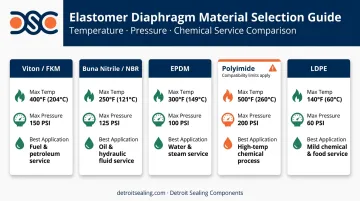
Source: Equilibar Diaphragm Selection data; Polyimide corroborated by DuPont Vespel S Line Design Handbook
Polyimide stands out for supercritical and high-temperature hydrocarbon service, with ratings of 300°C and 5,000 psig that no elastomer or fluoropolymer can match. That capability comes with hard limits.
Polyimide compatibility warnings (per DuPont):
- Concentrated mineral acids cause severe embrittlement
- Caustic solutions above pH 10 cause severe embrittlement
- Water and steam above 100°C may cause severe cracking
Check DuPont's published resistance charts before specifying Polyimide for any aqueous or high-pH service.
Key Factors for Selecting the Right BPR Diaphragm
Selection is a multi-variable problem. Misweighting any single factor — most commonly, prioritizing cost over chemical compatibility — is the primary cause of premature diaphragm failure in the field.
Chemical Compatibility
Chemical compatibility is the foundational criterion. The diaphragm material must resist degradation, swelling, and permeation during continuous contact with the process fluid at operating temperature — not just at ambient conditions. A material rated compatible at 20°C may fail rapidly at 80°C under the same chemistry.
Cross-reference compatibility using the Cole-Parmer Chemical Compatibility Database, which documents how variations in temperature, pressure, and concentration affect material performance. Always verify against your actual operating temperature, not just ambient ratings.
Standard PTFE illustrates this trap clearly: it carries an A+ chemical compatibility grade, yet its 100°C and 150 psig BPR pressure ceiling disqualifies it from most industrial pressure service despite those excellent chemistry ratings.
Temperature and Pressure Rating
Temperature and pressure ratings are interrelated, not independent. A diaphragm rated for a given pressure at room temperature will derate at elevated temperatures — selecting on pressure specification alone without accounting for operating temperature is a common engineering error.
Key reference points:
- Standard PTFE: 100°C / 150 psig
- PTFE-Glass / Enhanced PTFE: 150°C / up to 3,000 psig (PTFE-Glass) or 150 psig (Enhanced PTFE)
- Viton/FKM: 150°C / 1,000 psig
- Polyimide: 300°C / 5,000 psig
- Metal diaphragms (Hastelloy, 316L SS): Maximum temperature and pressure service
Always apply a temperature de-rating factor to burst strength when specifying for elevated temperature. The service factor calculation (see below) must use the temperature-adjusted burst value, not the room-temperature figure.
Suppleness, Stiffness, and Low-Flow Performance
Diaphragm suppleness determines how sensitively the regulator responds to small pressure changes. Softer, more supple materials — reinforced elastomers like Viton or Buna — offer lower cracking pressure, better low-flow cut-off, and high turndown ratios (100:1 or 1000:1). Stiffer materials — metals, thick PTFE — deliver better precision under high-pressure cycling but sacrifice low-flow sensitivity.
Two additional considerations:
- Wrinkling tendency in plain PTFE at low flows can degrade low-flow performance; reinforced variants reduce this
- Material hardness directly influences low-flow behavior — Hastelloy, for example, is explicitly noted as not ideal for lowest flow ranges
If your application requires wide flow range, suppleness must be a primary selection criterion, not a secondary consideration.
Service Factor and Robustness
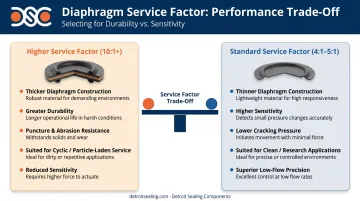
Service factor is the ratio of the diaphragm's expected short-term burst pressure (adjusted for temperature de-rating) to the maximum rated operating pressure.
Per Equilibar's OEM guidance:
- 4:1 to 5:1 — generally adequate for most research and clean-service applications
- 10:1 or higher — appropriate for high pulsating cycle loads, particle contamination, or abrasive media
The trade-off is direct: thicker diaphragms improve durability and puncture resistance but reduce sensitivity and low-flow precision. If your application imposes cyclic stress, abrasion, or contamination risk without strict low-flow requirements, a thick elastomeric diaphragm at a higher service factor is the correct specification — even if it means more frequent replacement scheduling.
Periodic diaphragm replacement is a normal part of BPR maintenance planning in demanding service.
Regulatory and Compliance Requirements
Certain industries narrow the material selection field through mandatory compliance requirements:
- Food, Beverage, Pharmaceutical, Medical — USP Class VI compliance required; Enhanced PTFE variants are the standard choice; FDA 21 CFR 177.1550 covers perfluorocarbon resins for food contact; 21 CFR 177.2600 covers repeated-use rubber articles
- ATEX-rated explosive atmospheres — EU ATEX Directive 2014/34/EU requires conductive diaphragm materials to prevent static charge buildup; approved options include conductive PTFE-Glass (ZPGL), Hastelloy, and Stainless Steel
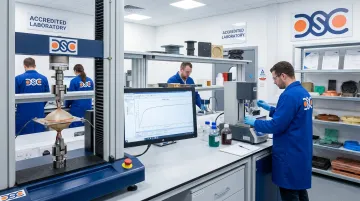
Using a non-compliant diaphragm in a food-grade or explosive atmosphere application creates direct regulatory and safety exposure. Verify compliance documentation from the material supplier for the specific material lot — material type designation alone is not sufficient. DSC stocks USP Class VI-certified materials and can provide compliance documentation for applicable applications through its ISO 17025 accredited lab.
Thickness Trade-Off: Durability vs. Sensitivity
Thickness is the mechanical variable that operationalizes the suppleness and service-factor trade-offs above — and it deserves its own explicit decision. Thicker diaphragms resist cutting, puncture, and abrasion: the right choice for slurry service, particle-laden flows, or highly cyclic pressure systems. Thinner, more supple diaphragms offer superior pressure sensitivity and lower cracking pressure: the right choice for precision flow control and low-pressure setpoint applications.
Define whether precision or durability is the primary operational priority before selecting thickness. Both choices can be correct — the error is treating thickness as a default rather than a deliberate specification call.
How DSC Can Help
For BPR diaphragm sourcing, one of the most common frustrations is catalog constraints — the right compound exists, but no standard supplier stocks it. DSC addresses this directly. As a distributor with access to hundreds of rubber and polymer compounds across all material types, engineers can specify what the application actually requires rather than settling for the closest available option.
DSC's ISO 17025 accredited lab supports custom material development and validation testing. When an application involves unusual chemical combinations, extreme temperatures, or conditions that fall outside published material ratings, DSC can develop and test a compound specifically for that requirement.
For more complex challenges, the lab applies Design of Experiments (DOE) methodology for root cause analysis — useful when failure mode isn't immediately obvious from standard datasheet comparisons.
What this covers for BPR diaphragm sourcing specifically:
- Stocks FKM, NBR, EPDM, PTFE-bonded options, and specialty compounds including USP Class VI-compliant materials
- Designs custom diaphragm geometries using CAD and FEA — covering stress/strain distribution, sealing force, and assembly force analysis
- Ships nationwide from Plymouth, MI, with proximity to major carriers reducing lead times on urgent orders
- Provides direct material selection support for novel chemical blends, extreme temperatures, or high-pressure service
For ATEX-compatible materials or specialty compounds like Polyimide, contact DSC's technical team directly — they can confirm availability and work through application-specific requirements with you.
Conclusion
Diaphragm selection is not a secondary specification. Because the diaphragm is the only moving part in most BPRs, the material chosen determines how long the regulator maintains accuracy, how frequently it needs replacement, and whether it can operate safely in the process environment. Getting it right upfront costs far less than diagnosing failure mid-process.
Build periodic diaphragm reviews into your maintenance planning — process conditions rarely stay static. The material that fit your initial installation may lose its edge as operating pressures shift, chemical formulations change, or temperature profiles drift. Re-evaluating with a materials specialist catches gradual performance degradation before it becomes an unplanned shutdown.
Frequently Asked Questions
How does a diaphragm pressure regulator work?
The diaphragm acts as a pressure-sensing seal with reference pressure on one side and process pressure on the other. When upstream pressure exceeds the setpoint, the diaphragm lifts off its orifice seat to release flow, then reseats once equilibrium is restored, maintaining tight pressure control with near-instantaneous response.
What is the purpose of a back pressure regulator?
A BPR maintains consistent upstream pressure by opening to release excess flow when inlet pressure exceeds a set threshold. Common applications include pressure relief, pump bypass, flow control, and overpressure protection in liquid and gas systems.
What diaphragm material is best for corrosive chemical applications?
PTFE-Glass reinforced (PGL) diaphragms are the most broadly used for corrosive service, offering high chemical resistance and a wide pressure-temperature range up to 150°C and 3,000 psig. For severe chemistries or high-pressure hydrogen service, Hastelloy metal diaphragms offer superior resistance to permeation and chemical attack.
How often should a back pressure regulator diaphragm be replaced?
Replacement frequency depends on service conditions and material match. Clean, non-cyclic service allows a well-specified diaphragm to last years, while abrasive, chemically aggressive, or highly cyclic applications require more frequent replacement. Any failure warrants a root-cause review before respecifying.
What is a service factor in BPR diaphragm selection?
Service factor is the ratio of the diaphragm's expected burst pressure (adjusted for temperature de-rating) to the maximum operating pressure. A 4:1 to 5:1 ratio is sufficient for standard applications; demanding cyclic or abrasive conditions may require 10:1 or higher per Equilibar's OEM guidance.
Can back pressure regulator diaphragms handle high-temperature applications?
Yes — material choice determines high-temperature capability. Polyimide diaphragms handle up to 300°C and 5,000 psig; Hastelloy and Stainless Steel 316L perform at maximum temperature service; standard PTFE is limited to approximately 100°C. Always apply a temperature de-rating factor to burst strength when specifying for elevated temperature service.