A small elastomer ring can determine whether a system runs reliably or fails without warning. O-rings are critical to sealing, pressure retention, and overall system integrity across hydraulics, pneumatics, pumps, and valves. When they work, no one notices. When they don’t, the consequences are immediate.
Incorrect elastomer selection is a common root cause of leakage, downtime, and safety incidents. Industry research shows unplanned downtime can cost hundreds of thousands of dollars per hour on average and over $2.3 million per hour in automotive manufacturing.
Many sealing failures are preventable; studies of hydraulic leaks attribute significant failures to basic O-ring issues like pinching or omission, not component wear alone.
The problem is the assumption that one material works everywhere. In reality, elastomers that look identical can behave very differently under heat, pressure, chemicals, steam, or dynamic motion. Selecting the right O-ring material isn’t a detail; it’s a reliability decision that protects uptime, safety, and cost.
Key Highlights
Choosing the right elastomer isn’t optional; it directly determines sealing reliability, system uptime, and safety. Wrong material selection is a major cause of leaks, failures, and costly downtime.
Temperature, chemicals, pressure, and environment are the core factors that decide whether an O-ring survives or fails prematurely. Each elastomer behaves differently under real-world conditions.
Material properties like elasticity, compression recovery, and chemical resistance vary widely across NBR, FKM, EPDM, Silicone, and Neoprene, making application-specific selection essential.
Durometer (hardness) is as critical as material, influencing sealing force, extrusion resistance, wear, and performance in static vs. dynamic applications.
Detroit Sealing Components supports accurate material and durometer selection, offering engineered O-rings and high-pressure solutions that prevent common sealing failures before they happen.
What Is an Elastomer O-Ring?
An elastomer O-ring is a circular sealing element made from a rubber-like polymer designed to prevent the passage of fluids or gases between two mating surfaces. Elastomers are polymers with elastic properties; they can stretch under load and return to their original shape when the load is removed. This ability makes them ideal for sealing applications where components experience pressure, vibration, or thermal expansion.
O-rings are widely used because they provide reliable sealing with a simple geometry, minimal space requirements, and low installation cost compared to more complex sealing solutions.
Key Properties That Make Elastomers Effective
Elastomer O-rings perform their sealing function due to three critical material properties:
Elasticity: Allows the O-ring to deform under compression and fill surface imperfections, creating a tight seal.
Compression recovery: Enables the material to rebound after being compressed, maintaining sealing force over repeated pressure and temperature cycles.
Chemical resistance: Determines how well the elastomer withstands exposure to oils, fuels, solvents, water, steam, or aggressive chemicals without swelling, cracking, or hardening.
The balance of these properties varies by elastomer type, which is why material selection is application-specific.
Key Factors That Determine the Right Elastomer O-Ring
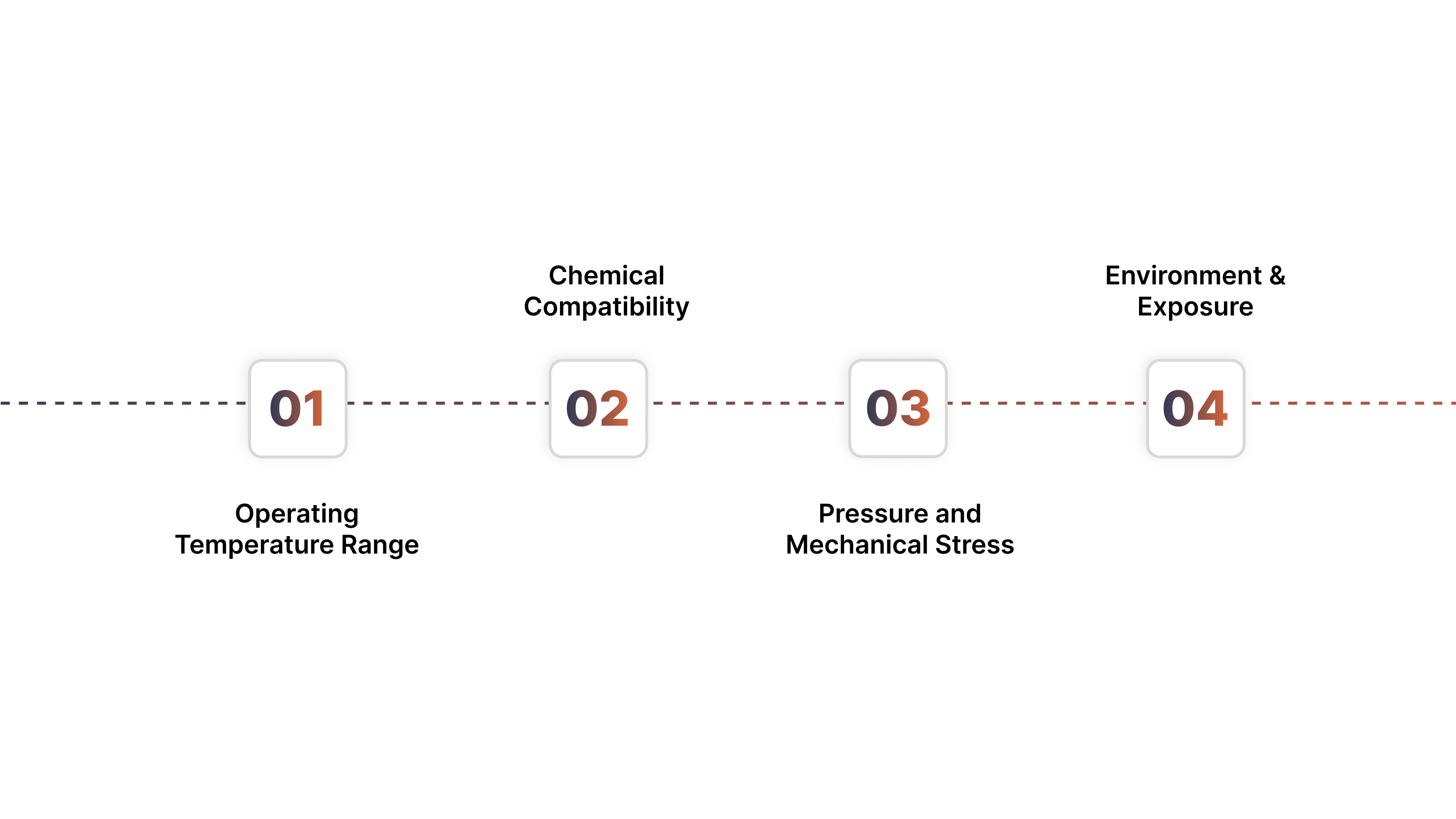
Selecting an elastomer O-ring isn’t about choosing a familiar material; it’s about matching material behavior to real operating conditions. The following factors drive whether an O-ring seals reliably over time or fails prematurely.
a. Operating Temperature Range
Temperature is often the primary failure driver for elastomer seals.
Low-temperature brittleness: At low temperatures, elastomers can lose flexibility and harden, preventing proper compression and sealing. Once the material drops below its glass transition range, cracking or leakage becomes likely.
High-temperature hardening: Elevated temperatures accelerate aging, causing elastomers to harden, lose elasticity, and take permanent compression set, reducing sealing force over time.
It’s also critical to distinguish between:
Continuous exposure: Sustained high or low temperatures that accelerate material degradation.
Intermittent exposure: Short temperature spikes that may be acceptable if the elastomer can recover between cycles.
A material that survives brief heat spikes may still fail rapidly under constant heat.
b. Chemical Compatibility
Chemical exposure determines whether an O-ring survives or slowly destroys itself.
Elastomers react differently to:
Oils and fuels (mineral, synthetic, bio-based)
Solvents and cleaning agents
Acids, bases, and process chemicals
Water, steam, and glycol-based fluids
Incompatible chemicals can cause:
Swelling: Softening and loss of dimensional stability, leading to extrusion or seal blowout
Shrinkage: Loss of sealing contact and leakage
Chemical degradation: Cracking, embrittlement, or surface erosion
Even cleaning agents and maintenance fluids, often overlooked, can be enough to compromise an otherwise suitable elastomer.
c. Pressure and Mechanical Stress
Pressure doesn’t just test sealing; it tests material strength.
Static sealing: O-rings remain stationary; material selection focuses on compression set resistance and chemical stability.
Dynamic sealing: O-rings experience movement (reciprocating or rotating), increasing wear, friction, and heat generation.
At higher pressures, extrusion risk becomes critical. Without sufficient hardness, backup rings, or proper groove design, the O-ring can be forced into clearance gaps, leading to rapid failure.
Pressure cycling further accelerates fatigue, making elastomer resilience and recovery essential.
d. Environment & Exposure
The surrounding environment can be as damaging as pressure or chemicals.
Key exposure factors include:
UV and ozone: Cause surface cracking and premature aging, especially in outdoor applications
Moisture and humidity: Can degrade certain elastomers over time
Steam exposure: Extremely aggressive, requiring materials specifically rated for hot water and steam service
Some applications add regulatory or cleanliness constraints:
Food and beverage: Requires FDA-compliant, non-toxic elastomers
Medical and pharmaceutical: Demands biocompatibility, low extractables, and sterilization resistance
Clean-room environments: Require low outgassing and particulate control
Ignoring environmental exposure often leads to seals that pass initial testing but fail in the field.
Selecting the right elastomer means balancing temperature limits, chemical exposure, pressure, and operating environment. Detroit Sealing Components offers O-rings in a wide range of elastomer materials, helping ensure the seal selected matches real-world conditions, not just theoretical limits.
5 Common Elastomer Materials and When to Use Them
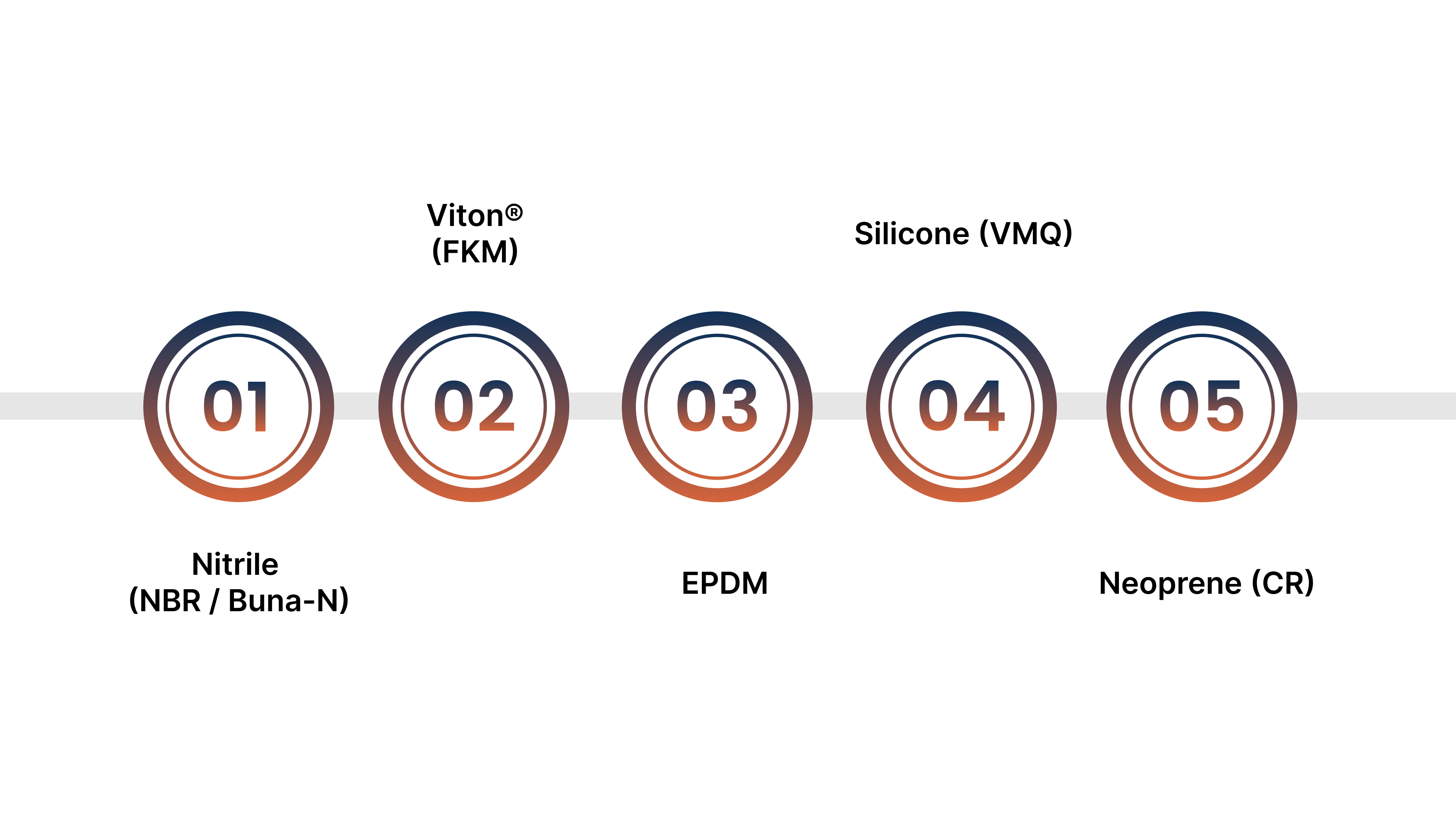
Not all elastomers behave the same under pressure, heat, and chemical exposure. Below is a practical breakdown of the most commonly used O-ring materials, what they do well, and where they fall short.
1. Nitrile (NBR / Buna-N)
Nitrile is the most commonly used O-ring material, valued for its strong oil resistance, good mechanical properties, and affordability across industrial applications.
Best for:
Petroleum-based oils and fuels
Hydraulic and pneumatic systems
Automotive and general industrial sealing
Nitrile is the most widely used O-ring material due to its good oil resistance, mechanical strength, and cost-effectiveness. It performs well in moderate temperature ranges and static or low-speed dynamic applications.
Limitations:
Poor resistance to ozone, UV, and weathering
Limited high-temperature capability compared to specialty elastomers
Use NBR when: oil compatibility and affordability matter more than extreme temperature or outdoor durability.
2. Viton® (FKM)
FKM is a high-performance elastomer designed for harsh environments involving elevated temperatures and aggressive chemicals.
Best for:
High-temperature environments
Aggressive chemicals and solvents
Fuels, oils, and aerospace applications
FKM elastomers offer excellent heat and chemical resistance, making them a go-to choice for demanding industrial and chemical-processing environments.
Trade-offs:
Higher material cost
Reduced flexibility at low temperatures, increasing cold-start leakage risk
Use FKM when: heat and chemical resistance are critical and low-temperature sealing is not the primary concern.
EPDM
EPDM is engineered for water-based and outdoor applications where environmental exposure and weather resistance are key concerns.
Best for:
Water and steam systems
Outdoor and weather-exposed applications
HVAC, braking systems, and potable water service
EPDM excels in resistance to ozone, UV, moisture, and steam, making it ideal for outdoor and water-based environments.
Limitations:
Incompatible with petroleum-based oils and fuels
Swells rapidly in hydrocarbon fluids
Use EPDM when: water, steam, or environmental exposure dominates, and oils are not present.
Silicone (VMQ)
Silicone O-rings are chosen for applications that demand extreme temperature stability and regulatory compliance.
Best for:
Extreme temperature ranges (both hot and cold)
Food-grade, medical, and pharmaceutical applications
Clean-room environments
Silicone O-rings remain flexible at very low temperatures and are available in highly pure, regulatory-compliant formulations.
Limitations:
Low abrasion and tear resistance
Not ideal for dynamic or high-pressure sealing
Use silicone when: temperature extremes and compliance requirements outweigh mechanical durability.
Neoprene (CR)
Neoprene provides balanced performance across mechanical strength, environmental resistance, and moderate chemical exposure.
Best for:
Weather and ozone resistance
Moderate chemical exposure
Refrigeration and general industrial use
Neoprene offers a balanced mix of mechanical strength, environmental resistance, and chemical compatibility, making it a versatile option for non-specialized applications.
Limitations:
Narrower temperature and chemical range than FKM or EPDM
Use neoprene when you need reliable, all-around performance without extreme operating conditions.
Durometer (Hardness): Why It Matters More Than You Think
Material choice gets most of the attention, but durometer often determines whether an O-ring actually seals or fails. Two O-rings made from the same elastomer can perform very differently simply because their hardness is wrong for the application.
1. What Shore Hardness Means
Durometer is a measure of an elastomer’s hardness, most commonly expressed on the Shore A scale for O-rings. It indicates how resistant the material is to indentation.
Lower Shore A number = softer, more flexible material
Higher Shore A number = harder, more resistant to deformation
Shore A does not measure strength or quality, it measures how the O-ring responds to compression and pressure in real-world sealing conditions.
2. Soft vs. Hard O-Rings: The Trade-Off
Choosing a durometer is always a balance between sealing ability and durability.
Aspect | Softer O-Rings (Lower Durometer) | Harder O-Rings (Higher Durometer) |
|---|---|---|
Sealing at low pressure | Seal easily, even with minimal system pressure | May struggle to seal at low pressure |
Surface imperfections | Better at filling scratches and minor surface irregularities | Less forgiving of surface finish |
Compression force | Require lower installation and compression force | Require higher installation force |
Extrusion resistance | More prone to extrusion at higher pressures | Strong resistance to extrusion and deformation |
Wear and abrasion | Wear faster, especially in dynamic applications | Better abrasion and wear resistance |
Dynamic performance | Not ideal for high-speed or high-load motion | Perform well in dynamic and high-pressure environments |
Installation tolerance | More forgiving of misalignment and tolerance variation | Require tighter tolerances and precise gland design |
Softer O-rings prioritize sealing performance at low pressure, while harder O-rings prioritize durability and pressure resistance. Selecting the right durometer depends on system pressure, motion, surface finish, and installation constraints.
Typical Durometer Ranges and Where They Work Best
Durometer selection directly affects sealing reliability, wear resistance, and pressure handling. Understanding where each hardness range performs best helps prevent leakage, extrusion, and premature seal failure.
50–60 Shore A: Used for low-pressure, static seals with rough mating surfaces or where maximum flexibility is needed.
70 Shore A: The industry standard for general-purpose static and dynamic sealing. Offers a strong balance of sealing force, durability, and ease of installation.
80–90 Shore A: Suitable for high-pressure systems, dynamic motion, and applications with extrusion risk, often paired with backup rings.
Static vs. Dynamic Applications
Whether an O-ring remains stationary or moves during operation significantly impacts material choice, hardness, and wear behavior. Matching the seal to static or dynamic conditions helps ensure long-term performance and leak prevention.
Factor | Static Applications | Dynamic Applications |
|---|---|---|
Seal movement | No relative motion between sealing surfaces once installed | Relative motion present (reciprocating or rotating) |
Primary sealing requirement | Maintain compression to block fluid or gas flow | Maintain sealing while accommodating continuous or intermittent motion |
Typical operating pressures | Low to high (depending on design) | Low to moderate; high pressure increases wear and extrusion risk |
Surface finish sensitivity | More forgiving of surface imperfections | Requires smoother surface finishes to minimize friction and wear |
Common failure modes | Compression set, chemical attack, thermal aging | Abrasion, extrusion, spiral failure, heat buildup |
Friction and heat generation | Minimal | Significant, must be managed through material selection and lubrication |
Material hardness preference | Softer to medium durometer (50–70 Shore A) | Medium to harder durometer (70–90 Shore A) |
Material selection focus | Chemical compatibility and long-term elasticity | Wear resistance, low friction, and tear strength |
Typical elastomers used | NBR, EPDM, Silicone | NBR, FKM, HNBR, specialized low-friction compounds |
Design considerations | Groove design for proper squeeze and compression set control | Groove geometry, surface finish, lubrication, and extrusion control |
Static seals fail primarily due to aging and chemical incompatibility, while dynamic seals fail due to wear, friction, and mechanical stress. When motion is introduced, material choice shifts from “will it seal?” to “will it survive movement without wearing out?
Matching elastomer, durometer, and seal design to static or dynamic conditions is critical for long-term reliability. Detroit Sealing Components supports both standard and custom O-ring sizing, including high-pressure solutions and back-up rings that help prevent extrusion and premature failure.
Industry-Specific O-Ring Selection Considerations
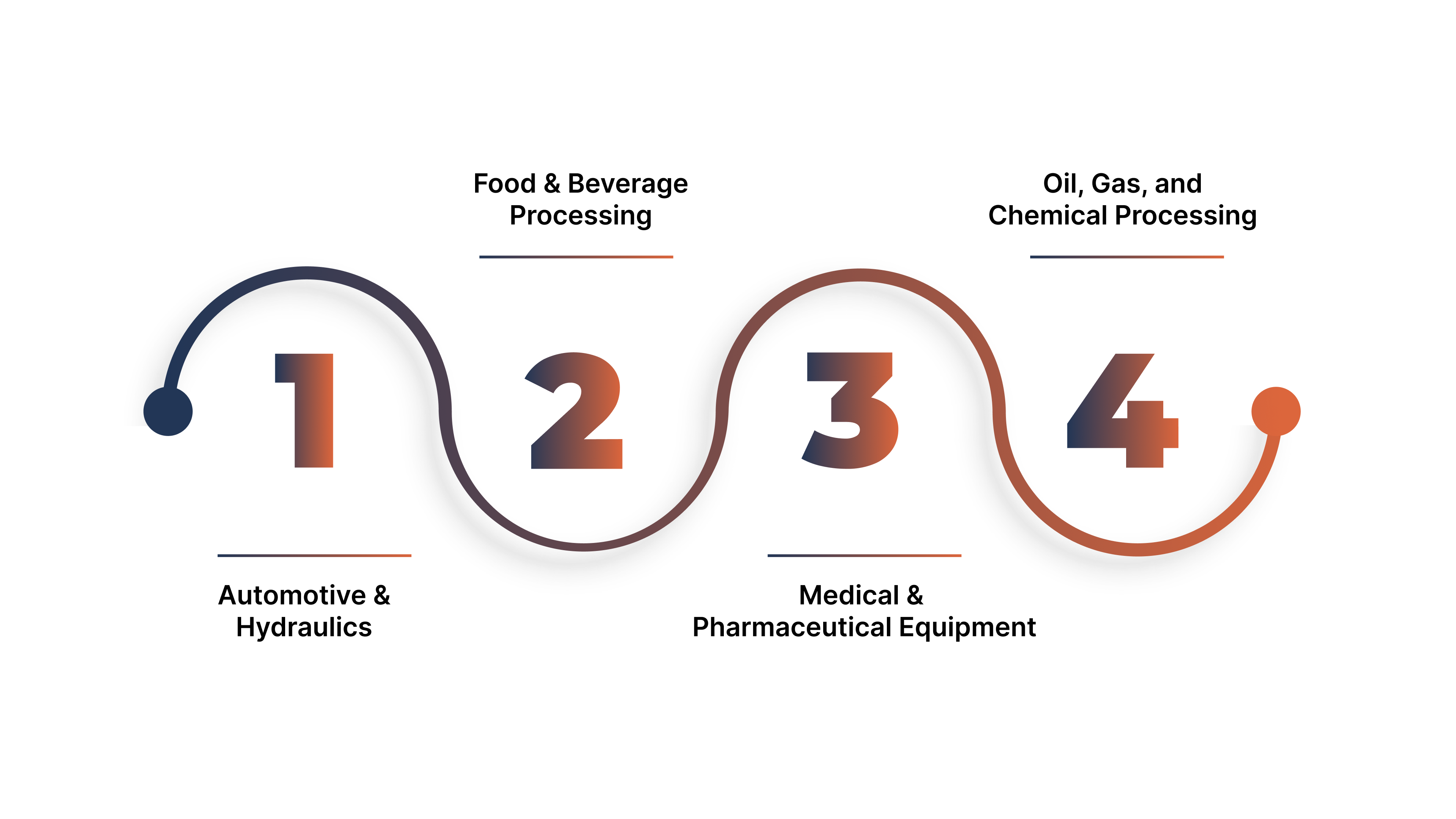
O-ring selection becomes far more complex when industry-specific operating conditions, regulations, and failure risks are factored in. What works in one sector can fail quickly or be non-compliant in another.
1. Automotive & Hydraulics
Automotive and hydraulic systems demand O-rings that can withstand pressure cycling, vibration, oils, fuels, and wide temperature swings. Seals are often exposed to dynamic motion, making wear resistance just as important as chemical compatibility.
Common materials: NBR, HNBR, FKM
Key priorities: Oil and fuel resistance, extrusion resistance, fatigue life
Typical challenges: Pressure spikes, thermal cycling, dynamic abrasion
Material choice must balance cost, durability, and performance, especially in high-volume or safety-critical components like braking and power steering systems.
2. Food & Beverage Processing
In food and beverage applications, sealing performance must align with strict hygiene and regulatory requirements. O-rings frequently contact hot water, steam, cleaning chemicals, and food products, all while requiring non-toxic formulations.
Common materials: EPDM, Silicone (FDA-compliant grades)
Key priorities: Resistance to steam and CIP/SIP cleaning, low extractables
Typical challenges: Frequent washdowns, temperature extremes, regulatory compliance
A chemically resistant seal that isn’t food-grade is not an option; compliance is as critical as performance.
3. Medical and Pharmaceutical Equipment
Medical and pharmaceutical systems operate under tight tolerances and zero-failure expectations. O-rings must remain stable under sterilization methods such as autoclaving, gamma radiation, or chemical disinfection.
Common materials: Silicone, FKM, specialty medical-grade elastomers
Key priorities: Biocompatibility, purity, and sterilization resistance
Typical challenges: Repeated sterilization cycles, low outgassing, particulate control
Here, material traceability and certification often matter as much as physical properties.
4. Oil, Gas, and Chemical Processing
These environments push elastomers to their limits with high pressures, extreme temperatures, and aggressive chemicals. Seal failure can result in environmental damage, safety hazards, and costly shutdowns.
Common materials: FKM, HNBR, perfluoroelastomers (FFKM)
Key priorities: Chemical resistance, high-temperature stability, extrusion control
Typical challenges: Sour gas, hydrocarbons, pressure cycling, corrosive media
Material selection in these industries is driven by long-term reliability under extreme conditions, not initial cost.
8. Common Elastomer O-Ring Selection Mistakes
Most O-ring failures trace back to avoidable selection errors rather than material defects. Recognizing these common mistakes helps prevent leaks, downtime, and premature seal replacement.
Choosing based only on price: Selecting the lowest-cost O-ring often leads to higher long-term expenses through premature failure, unplanned downtime, and repeated maintenance. Material cost is usually insignificant compared to the cost of a leak or shutdown.
Ignoring chemical compatibility charts: Assuming “rubber is rubber” causes swelling, shrinkage, or chemical degradation. Even short-term exposure to incompatible fluids or cleaning agents can permanently damage an O-ring.
Overlooking temperature spikes and pressure surges: Designs that consider only normal operating conditions miss the real failure drivers. Startup, shutdown, and upset conditions often exceed material limits and accelerate aging or extrusion.
Using the wrong durometer for dynamic seals: Soft O-rings may seal initially, but wear or extrude quickly under motion and pressure. Dynamic applications require the right balance of hardness, wear resistance, and groove design to ensure long service life.
How to Validate Your O-Ring Choice Before Installation
Even the right O-ring on paper can fail if it isn’t properly validated before use. Simple pre-installation checks help confirm that the material, dimensions, and quality meet real application demands.
1. Material Compatibility Testing
Verifying material compatibility reduces the risk of chemical and thermal failure in service.
Review chemical compatibility charts against all fluids involved, including cleaning and maintenance agents.
Confirm temperature limits for both continuous operation and short-term spikes.
When critical, perform soak or exposure testing to observe swelling, shrinkage, or hardness change.
2. Visual Inspection and Dimensional Checks
Physical defects or dimensional errors can cause immediate sealing failure.
Inspect for surface cracks, cuts, molding defects, or contamination
Verify O-ring size against standards to ensure proper squeeze and groove fit
Check roundness and cross-section consistency to prevent uneven sealing stress
3. Supplier Certifications and Standards
Documentation and traceability are essential for quality and compliance.
Confirm material certification to relevant standards such as ASTM and ISO.
For regulated industries, ensure compliance with FDA or other required approvals.
Verify batch traceability and quality control documentation from the supplier.
Turning O-Ring Selection Theory into Real-World Solutions
Choosing the right elastomer, durometer, and seal design only works if the product options and manufacturing capability actually support those decisions. This is where Detroit Sealing Components aligns directly with the O-ring selection principles discussed in this blog.
How Detroit Sealing Supports Proper O-Ring Selection
Their product range and capabilities are built around the same variables that drive sealing success:
Material flexibility: O-rings available in NBR, FKM, EPDM, Silicone, and specialty elastomers to match chemical, temperature, and environmental demands
Durometer control: Multiple Shore A hardness options to balance sealing force, wear resistance, and extrusion risk
Standard & custom sizing: AS568, metric, and custom O-rings to ensure proper groove fit and compression
High-pressure solutions: Back-up rings and engineered seals that address extrusion in demanding hydraulic applications
Instead of forcing a “close enough” seal into service, Detroit Sealing enables engineers to apply the right material, hardness, and seal design, the exact decision-making framework outlined throughout this blog. That alignment reduces leaks, extends seal life, and prevents the most common O-ring failures before installation.
Conclusion
Elastomer O-ring selection directly impacts system reliability, safety, and long-term cost. Factors like material compatibility, temperature range, pressure, motion, and durometer determine whether a seal performs as intended or fails prematurely.
When these variables are addressed upfront, O-rings deliver longer service life, fewer leaks, and reduced downtime. When they’re overlooked, even a low-cost seal can become an expensive failure point.
Need help selecting the right O-ring for your application?
The sealing experts at Detroit Sealing Components can help you choose the correct material, hardness, and configuration to ensure reliable performance. Contact Detroit Sealing today to get it right the first time.
FAQs
1. When should I consult a sealing expert?
If your application involves extreme conditions, regulatory requirements, dynamic motion, or recurring seal failures, consulting a sealing specialist can prevent costly trial-and-error and downtime.
2. What is the most common O-ring material used in industry?
Nitrile (NBR) is the most widely used due to its good resistance to petroleum oils, mechanical strength, and cost-effectiveness. However, it is not suitable for high temperatures or outdoor exposure.
3. Why does durometer matter for O-ring performance?
Durometer controls how easily an O-ring deforms under compression. Softer O-rings seal more easily at low pressure, while harder O-rings resist extrusion and wear in high-pressure or dynamic applications.
4. Can one O-ring material work for all applications?
No. Each elastomer has specific strengths and limitations. A material that performs well in oil may fail quickly in steam, chemicals, or outdoor environments.
5. What causes most O-ring failures?
Most failures result from incorrect material selection, wrong durometer, chemical incompatibility, or unaccounted temperature and pressure spikes, not from manufacturing defects.