Introduction
Standard fluoroelastomers handle most industrial sealing jobs. But in semiconductor plasma etch chambers, pharmaceutical sterile fill lines, and satellite systems, "good enough" is a failure mode.
These environments are so chemically aggressive and contamination-sensitive that conventional elastomers — including standard FKM — can actively introduce risk. A seal that degrades, outgasses, or leaches extractables into a drug product or onto a silicon wafer doesn't just fail mechanically; it compromises the entire process.
That risk has a measurable cost. Research published in ScienceDirect shows that particle contamination across just three critical semiconductor process steps can cause random yield loss of up to 6% — a figure that compounds fast in a high-volume fab.
This guide breaks down what "ultra-pure" FFKM actually means in practice, which industries depend on it, and the key specifications to evaluate when sourcing these seals for critical applications.
Key Takeaways
- Ultra-pure FFKM shares the same base polymer as standard FFKM but is manufactured in ISO Class 7 cleanrooms with tightly controlled extractables and particulation
- FFKM resists over 1,800 chemicals and operates up to ~325°C by grade — outperforming FKM in plasma, high-temperature, and purity-critical environments
- Serves semiconductor fab, pharmaceutical/biotech, food and beverage, aerospace, and high-purity chemical processing
- Require USP Class VI, FDA 21 CFR, ISO 10993, and ASTM E595 (outgassing) certifications — plus full lot traceability
- Total cost of ownership often favors ultra-pure FFKM despite its higher per-unit price
What Makes a Perfluoroelastomer Seal "Ultra-Pure"?
The Base Material
FFKM achieves its performance through a fully fluorinated polymer backbone — every carbon-hydrogen bond replaced by a carbon-fluorine bond. This gives it chemical resistance comparable to PTFE while retaining the elasticity and sealing force of a rubber compound.
Depending on the compound grade, FFKM operates across a range of approximately -40°C to +325°C and resists attack from more than 1,800 chemicals, solvents, and plasmas. No other elastomer matches that combination of temperature range and chemical resistance at the same time.
What "Ultra-Pure" Actually Means
"Ultra-pure" is a manufacturing classification, not just a material property. What separates it from standard FFKM is how the compound is processed, handled, and verified:
- Dedicated cleanroom production — Parker's Parofluor FFKM is packaged in ISO 14644-1 Class 7 cleanrooms; semiconductor-grade compounds from manufacturers like Greene Tweed are produced in controlled cells reserved for premium fluoropolymers
- Controlled metal ion content — trace metals on or in a seal can migrate onto silicon wafers or into drug streams; ultra-pure grades target sub-ppm ionic levels to meet semiconductor fab and pharma requirements
- Minimal particulation — ultra-pure grades are formulated and handled to reduce particle generation during installation and operation
- Lower outgassing — volatile residues from processing are driven out or excluded during manufacture
Ultra-Pure vs. Standard FFKM
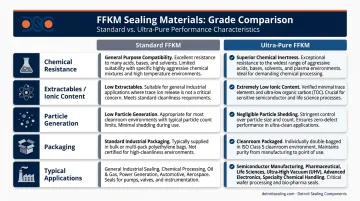
Standard FFKM carries excellent chemical resistance for demanding industrial use. What it doesn't guarantee is the extractable profile, particle count, or metal ion levels that semiconductor fabs, pharmaceutical cleanrooms, and food-contact environments require.
Ultra-pure grades are compounded, handled, and packaged specifically to meet those thresholds. The polymer chemistry is identical — what changes is the production environment, contamination controls, and the documentation proving compliance.
| Standard FFKM | Ultra-Pure FFKM | |
|---|---|---|
| Chemical resistance | Excellent | Excellent |
| Extractables / ionic content | Not controlled | Controlled to specified limits |
| Particle generation | Not specified | Minimized; tested |
| Packaging | Standard | Cleanroom-bagged, traceable |
| Typical applications | Industrial sealing | Semiconductor, pharma, food-contact |
Why Ultra-Purity Matters: Outgassing, Contamination, and Process Integrity
Outgassing
Every elastomer contains residual volatile substances — monomers, processing aids, plasticizers. Under vacuum, heat, or plasma conditions, these substances escape the polymer matrix and enter the process environment.
In a semiconductor plasma etch chamber, volatile molecular contamination from a seal can deposit on wafer surfaces, altering etch rates or gate oxide integrity. In a pharmaceutical sterile fill line, outgassed residues can compromise drug product quality or trigger regulatory noncompliance. Industry estimates place contamination-related yield losses as high as 6% — and seal-sourced outgassing compounds increase that risk further.
Ultra-pure FFKM grades are formulated to minimize these volatile residues. For aerospace and vacuum applications, ASTM E595 provides the standard test method — measuring Total Mass Loss (TML) and Collected Volatile Condensable Materials (CVCM) under 125°C, 24-hour vacuum conditions. ESA screening criteria require RML ≤1.0% and CVCM ≤0.1%.
Permeation
Beyond outgassing, gases and process fluids can diffuse through a seal's polymer matrix. FFKM's dense, fully fluorinated backbone restricts this diffusion far more effectively than silicone, NBR, or even FKM. This permeation resistance is critical in:
- High-vacuum semiconductor chambers
- High-purity gas distribution lines
- Solvent handling systems in pharmaceutical or chemical processing
The Cost of Choosing Wrong
A standard elastomer that degrades or outgasses in a critical process doesn't just need replacement. It can contaminate the product being manufactured, the equipment itself, and potentially trigger a compliance event. The downstream costs include:
- Unplanned downtime for decontamination and seal changeout
- Scrapped product batches
- Regulatory investigations or audit findings
- Reduced equipment lifespan from chemical attack
Ultra-pure FFKM addresses all three failure vectors simultaneously: low compression set, chemical inertness, and minimal outgassing. In high-stakes processes, that combination makes it the lower total-cost choice once downtime, scrapped batches, and compliance exposure are factored in.
FFKM vs. FKM for Ultra-Pure Sealing: A Practical Comparison
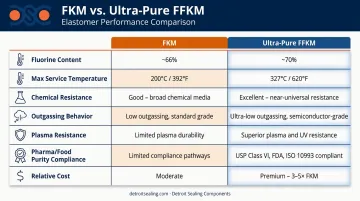
| Parameter | FKM (Viton) | Ultra-Pure FFKM |
|---|---|---|
| Fluorine content | 66–70% (by grade) | >70%, up to ~73.5% |
| Max continuous service temp | ~200°C | ~225–325°C (by grade) |
| Chemical resistance | Excellent — mineral oils, fuels, hydraulic fluids, aromatic solvents | Near-universal — ketones, amines, esters, concentrated acids, plasmas |
| Outgassing behavior | Higher volatile content | Engineered for minimal outgassing |
| Plasma resistance | Degrades under oxygen/fluorine plasma | Significantly better plasma resistance |
| Food/pharma purity compliance | Possible in some grades | Yes — with compound-specific verification |
| Relative cost | Baseline | 10–50x FKM per unit |
When FKM Is the Right Choice
FKM is the standard choice across automotive, oil and gas, and general industrial applications. It handles moderate temperatures and common industrial chemicals reliably — at a fraction of FFKM's cost.
It fits well when:
- Process fluids are petroleum-based oils, mineral hydraulic fluids, fuels, or lubricants
- Operating temperatures stay below ~200°C
- Contamination control is not a critical requirement
When Only Ultra-Pure FFKM Works
The following conditions push beyond FKM's capability:
- Plasma etch, CVD, or other semiconductor process environments
- Pharmaceutical or biotech contact with APIs, requiring USP Class VI or ISO 10993 compliance
- Temperatures consistently above 200°C
- Exposure to ketones, amines, strong oxidizers, or aggressive solvents outside FKM's resistance range
- Space and satellite applications requiring ASTM E595-verified low outgassing
In these environments, the per-unit cost difference is secondary to process integrity — a single contamination event routinely costs far more than the upgrade to FFKM.
Industry Applications of Ultra-Pure FFKM Seals
Semiconductor and Electronics Manufacturing
Chip fabrication depends on seals that contribute nothing to the process — no particles, no ions, no volatile residues. Ultra-pure FFKM is specified across the key process steps:
- Plasma etch and strip : O2, CF4, NF3, and fluorine-based plasmas rapidly degrade FKM, while FFKM shows dramatically lower weight loss under the same conditions
- Chemical vapor deposition (CVD and PECVD) — high temperatures combined with reactive precursor gases demand both thermal stability and chemical inertness
- Wet etch and aqueous processes — concentrated acids, bases, and hydrogen peroxide formulations that attack standard materials
- Electrochemical processes — ionic purity requirements exclude materials with mobile metal ion content
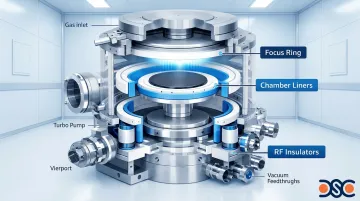
As chip geometries shrink below 3nm, the tolerance for any contamination source — including seal materials — approaches zero. Ultra-pure FFKM grades with controlled metal ion content are specified precisely because standard grades introduce trace metal contamination risks that standard industrial applications would never detect.
DSC serves the semiconductor market with access to hundreds of compounds across all rubber types. Its ISO 17025 accredited lab supports material verification for semiconductor-specific compound requirements, including documented metal ion content and outgassing data.
Pharmaceutical, Biotech, and Healthcare
Pharmaceutical manufacturing puts seals in direct or indirect contact with active pharmaceutical ingredients, aggressive clean-in-place (CIP) agents, steam sterilization cycles, and solvents. Every seal material in this chain is a potential contamination source.
Ultra-pure FFKM addresses the core sealing demands in:
- Bioreactors and fermenters — contact with growth media, buffers, and caustic CIP solutions
- Sterile fill lines — zero-extractables requirement for direct drug product contact
- Chromatography systems — solvent and buffer compatibility combined with purity requirements
USP Class VI testing (under USP <88>) validates biological safety through three in-vivo tests: Systemic Injection, Intracutaneous, and Implantation. Passing all three confirms that a material and its extractables don't produce adverse biological responses. ISO 10993 covers the broader biological evaluation framework for medical device contact.
DSC supplies USP Class VI certified seal materials for medical and pharmaceutical applications, with manufacturing in controlled cleanroom environments.
Food and Beverage Processing
Food processing equipment faces aggressive CIP chemistry — caustic soda, peracetic acid, steam — combined with strict requirements that seal materials leach nothing into food streams. PTFE handles the chemistry but lacks elasticity for dynamic sealing. Silicone handles the flexibility but struggles with aggressive CIP temperatures and solvents.
Ultra-pure FFKM compounds formulated to FDA 21 CFR 177.2600 and EU Regulation 1935/2004 meet both requirements. The EU framework prohibits constituents from transferring to food in quantities that endanger health, alter composition, or deteriorate organoleptic properties — a standard ultra-pure FFKM grades are formulated to meet.
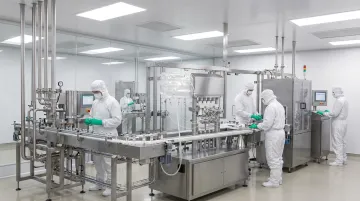
DSC's access to compounds across all rubber types means food and beverage customers can evaluate ultra-pure FFKM alongside other food-grade materials — EPDM, silicone, or food-grade FKM — to match the right compound to their specific process temperatures and chemical exposure.
Aerospace and Defense
Aerospace sealing covers extreme temperature cycling, aggressive fuel and hydraulic fluid exposure, and for space applications, the additional challenge of vacuum outgassing.
Key requirements by application:
- Jet engine and high-temperature seals : FFKM grades rated to -18°C to 324°C (such as Greene Tweed's Chemraz 676, formulated to AMS 7257E) cover the thermal range standard FKM cannot match
- Space and satellite systems : outgassed seal material can coat optics, contaminate sensors, or interfere with mission-critical systems. NASA and ESA outgassing screening under ASTM E595 applies to all candidate materials
For aerospace programs requiring documented outgassing or chemical resistance data, DSC's ISO 17025 accredited lab provides traceable test reports to support material qualification.
Chemical Processing and Oil & Gas
Chemical reactors, pump seals, and valve packings in aggressive process environments face combinations of strong acids, amines, ketones, esters, and high-pressure sour gas that rapidly consume standard elastomers.
Ultra-pure FFKM addresses these environments through:
- Near-universal chemical resistance across chemical families that exceed FKM's limits
- Explosive decompression resistance: select grades meet ISO 23936-2 / NORSOK M-710 RGD requirements for high-pressure gas service
- Low permeation under pressure, which is critical for high-pressure gas containment
For HPHT applications in oil and gas, DSC offers explosive decompression-resistant FFKM alongside FKM, HNBR, and FEPM in packer element applications designed for wellbore chemical exposure.
Key Considerations When Specifying Ultra-Pure FFKM Seals
Match the Compound to the Process
Not all FFKM compounds perform equally across all applications. Different formulations optimize for:
- Plasma resistance (semiconductor etch chambers)
- Low-temperature flexibility (cryogenic or arctic applications)
- Compression set resistance (static face seals held under long-term load)
- Steam and hot water resistance (pharmaceutical SIP cycles)
- Specific chemical family resistance (amine-heavy or ketone-heavy processes)
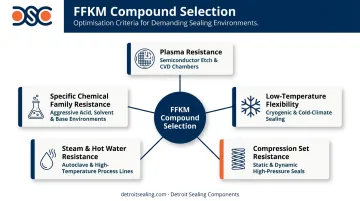
Defaulting to a "universal" FFKM grade and hoping it works across all conditions is a common and costly mistake. The compound must match the dominant process condition.
Seal Form Factor Matters
Ultra-pure FFKM is available as O-rings, custom-molded gaskets, diaphragms, and complex profiles. Choosing the correct geometry for the gland design is as important as choosing the correct material — an improperly sized seal generates particles through extrusion and wear, negating the purity advantage entirely.
Before committing to a form factor, simulation helps. DSC's CAD and finite element analysis capabilities model seal behavior under actual operating conditions, so form-factor mismatches get caught before production — not after.
Certifications and Traceability to Require
When sourcing ultra-pure FFKM seals, require documentation — not just claims:
- USP Class VI / ISO 10993 for pharmaceutical or medical device contact
- FDA 21 CFR 177.2600 for food contact
- EU 1935/2004 compliance for EU food-contact markets
- ASTM E595 test data for vacuum and aerospace applications
- Full lot traceability — compound formulation, production batch, and material certificates
DSC's ISO 17025 accredited lab supports material verification, and the company can assist customers in confirming compound performance against specification requirements.
The Total Cost of Ownership Argument
Ultra-pure FFKM seals carry a significant price premium , often 10–50x the per-unit cost of standard FKM. The ROI case requires looking beyond the purchase order:
- Fewer seal changeouts in corrosive or high-temperature service
- Reduced unplanned downtime for contamination decontamination
- Elimination of contamination-related product scrap or batch rework
- Compliance protection in regulated manufacturing environments
In any application where a single contamination event can scrap a production batch, damage equipment, or trigger a regulatory finding, the cost of the seal is rarely the number that matters most.
Frequently Asked Questions
Is FFKM better than Viton (FKM) for ultra-pure sealing applications?
For ultra-pure applications — plasma environments, pharmaceutical drug contact, temperatures above 200°C, or near-universal chemical resistance — FFKM is the superior choice. FKM remains a proven, cost-effective option for general-duty industrial sealing where contamination control is not critical and process conditions fall within its capability range.
Is FKM suitable for oil?
FKM performs very well with petroleum-based oils, fuels, mineral hydraulic fluids, and lubricants, making it a standard choice in automotive, oil and gas, and industrial equipment. It is not suitable for ultra-purity applications or environments requiring semiconductor and pharmaceutical cleanliness standards.
What is ultra-pure FFKM and how does it differ from standard FFKM?
Both grades use the same base fluorinated polymer. Ultra-pure FFKM is manufactured in ISO Class 7 (or better) cleanrooms with process controls that target lower particle counts, fewer extractable residues, and controlled metal ion content. This makes it suitable for semiconductor, pharmaceutical, and food-contact applications where standard FFKM falls short.
What industries require ultra-pure perfluoroelastomer seals?
The primary industries are semiconductor fabrication, pharmaceutical and biotech manufacturing, food and beverage processing, aerospace (particularly space systems), and high-purity chemical processing — any environment where contamination from the seal itself constitutes a failure mode.
What certifications should I look for when sourcing ultra-pure FFKM seals?
Key certifications include USP Class VI and ISO 10993 for pharmaceutical/medical use, FDA 21 CFR 177.2600 for food contact, ASTM E595 test data for vacuum and aerospace applications, and full lot traceability documentation. Always request actual test data and material certificates, not just compliance claims.
How do I know if my application needs ultra-pure FFKM vs. standard FFKM?
Choose ultra-pure grades when your process involves contamination-controlled manufacturing, plasma or aggressive chemical exposure, or compliance with extractables specifications. Standard FFKM is appropriate for demanding industrial environments where chemical and thermal resistance are the primary requirement — not purity.