Introduction
FKM and FFKM share one extra letter — and a significant performance gap. That gap determines whether a seal holds for months or years under demanding conditions.
Both are fluorinated elastomers trusted across industrial sealing, and both outperform standard rubber compounds in chemical and thermal resistance. The problem starts when engineers treat them as interchangeable.
Wrong material selection leads to seal failure, unplanned downtime, chemical contamination, and costly maintenance cycles. For industries like semiconductor manufacturing, oil & gas, aerospace, and pharma, those consequences are rarely acceptable.
This guide directly compares FKM and FFKM across the properties that actually drive selection decisions: chemical resistance, temperature range, compression set behavior, vacuum suitability, mechanical performance, and total cost of ownership. The result is a clear framework for choosing the right material and understanding when the cost premium is worth it.
Key Takeaways
- FKM offers excellent resistance to oils, fuels, and moderate chemicals, making it the cost-effective default for most industrial sealing up to 204°C
- FFKM is fully fluorinated, resisting over 1,800 chemicals and handling continuous service above 300°C, though at a notably higher price point
- FKM's documented failure zones include strong bases, amines, ketones, and superheated steam
- FFKM earns its premium when failure means contamination, safety incidents, or halted production lines
- Both materials are incompatible with molten or gaseous alkali metals
FKM vs FFKM: Quick Comparison
| Property | FKM | FFKM |
|---|---|---|
| Fluorine Content | ~66–70% by weight (grade-dependent) | ~75% — fully fluorinated backbone |
| Temperature Range | –20°C to 204°C (some grades to –46°C static) | –20°C to 320–327°C continuous |
| Chemical Resistance | Oils, fuels, hydraulic fluids, moderate acids | 1,800+ chemicals including plasma, amines, strong bases |
| Compression Set | ~66% after 1,000 hrs at 204°C (V0747-75 grade) | 10–21% depending on grade |
| Primary Use Cases | Automotive, oil & gas, general industrial | Semiconductor, pharma, aerospace, high-purity chemical |
| Relative Cost | Moderate-to-high vs. NBR/EPDM | Significantly higher — distributor spot pricing shows up to ~190x FKM unit cost |
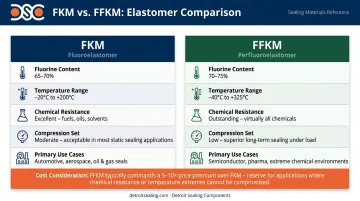
To put the cost row in context: a distributor comparison of equivalent AS568-107 geometry showed FKM V90 at $0.13 versus Simriz 498 FFKM at $24.53 per unit — roughly 189x at listed base tiers. Spot pricing, not a universal benchmark, but the gap is real and worth factoring into any material selection decision.
What Is FKM (Fluoroelastomer)?
FKM is a fluorocarbon-based synthetic rubber first commercialized in 1957 under the Viton™ trade name (now owned by Chemours) for aerospace sealing applications. Its partially fluorinated polymer backbone delivers chemical inertness and thermal stability that have made it a standard seal material across heavy industrial and process industries.
Core Performance Characteristics
- Chemical resistance: Oils, fuels, mineral grease, synthetic hydraulic fluids, aromatics, ozone, UV, and oxygen
- Compression set: Low enough for reliable performance in dynamic applications throughout the rated temperature range
- Density and mechanical integrity: High density contributes to sealing force retention in dynamic applications
- Temperature range: Typically –20°C to 204°C continuous; certain low-temperature grades (GLT/GFLT) rated to –45°C for static sealing
FKM Grades Are Not All the Same
FKM comes in multiple grades with meaningful performance differences:
| Grade | Fluorine Content | Key Advantage |
|---|---|---|
| A/E type | ~66% | General-purpose; most common |
| B type | ~68% | Higher fluid and acid resistance |
| F type | ~70% | Improved solvent resistance |
| GLT/GFLT | 65–68% | Low-temperature flexibility |
Specifying "FKM" without a grade is one of the most common causes of premature seal failure in chemical processing. The grade determines how the seal performs under specific fluid exposures and temperature swings — so the spec sheet needs to reflect that.
Where FKM Is Used
FKM seals are workhorses in O-rings, gaskets, shaft seals, and hydraulic cylinder seals across:
- Automotive: Fuel system seals, engine gaskets, transmission seals
- Oil & gas: Pipeline seals, refinery equipment, compressor seals
- Chemical processing: Moderate acid and solvent service up to 200°C
- General industrial: Pumps, valves, actuators, heat exchangers
What Is FFKM (Perfluoroelastomer)?
FFKM (perfluoroelastomer) achieves full fluorination of its polymer backbone, replacing every hydrogen atom with fluorine. Commercialized by DuPont in 1975 as Kalrez® perfluoroelastomer parts, the result is a molecular structure with chemical inertness approaching PTFE — but with the elasticity and compression recovery of a rubber compound.
No other elastomer class delivers both properties simultaneously, which is why FFKM is the go-to specification wherever seal failure carries serious consequences.
Core Performance Characteristics
- Chemical resistance: Over 1,800 chemicals including plasma, concentrated acids, strong alkalis, ketones, esters, amines, and oxidizing environments
- Temperature range: –20°C to 320–327°C continuous service, depending on grade
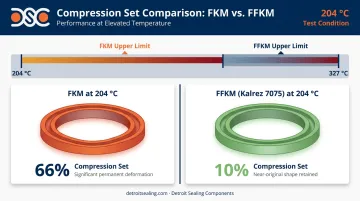
- Compression set: Significantly lower than FKM at equivalent temperatures — Kalrez Spectrum 7075 shows 10% compression set vs. FKM's ~66% at 204°C
- Compliance: Certain grades meet FDA 21 CFR 177.2600 and USP Class VI requirements for food and pharma contact
FFKM Grade Selection Matters Too
FFKM is not a single material — grades are formulated for different chemical and thermal mechanisms:
- Kalrez 7075: Max service 327°C — high-temperature duty
- Kalrez 6380: Hot aggressive amines at 225°C
- Kalrez 7375/7390: Hot water and steam sealing up to 300°C
- Semiconductor grades: Low-outgassing, plasma-resistant formulations for cleanroom environments
Where FFKM Is Indispensable
FFKM seals appear in applications where failure is simply not an acceptable outcome:
- Semiconductor fabs: Plasma etch chambers, CVD equipment, slit valve seals
- Pharmaceutical/bioprocessing: CIP/SIP valves, reactor linings, WFI systems
- Aerospace: Fuel system seals, hydraulic actuators, propulsion components
- High-purity chemical plants: Vacuum systems, analytical instruments, concentrated acid service
FKM vs FFKM Sealing Properties: Where the Differences Actually Matter
Chemical Resistance
This is the primary differentiator. FKM's partially fluorinated backbone has documented failure zones:
- Strong bases and caustics (high-pH exposure)
- Amines — A/B/F grades are not recommended for amine service
- Ketones — MEK and acetone are not compatible with standard FKM
- Superheated steam — FKM is explicitly not compatible
FFKM's fully fluorinated structure resists all of these. In mixed-chemical environments — CIP cleaning systems cycling between acidic and alkaline solutions, or semiconductor wet etch processes — that coverage gap isn't theoretical. It's the difference between a seal that holds and one that swells, cracks, or chemically degrades.
Temperature Performance and Compression Set
Parker documents FKM compound V0747-75 at 66% compression set after 1,000 hours at 204°C. At that level of permanent deformation, a seal has largely lost its sealing force — it won't recover when pressure drops and will leak on the next cycle.
By contrast, Kalrez Spectrum 7075 shows 10% compression set at equivalent conditions, with a service ceiling of 327°C. A seal that maintains elasticity at operating temperature is a seal that keeps sealing. Above roughly 204°C continuous, that data points to one conclusion: FKM compression set becomes a liability, and FFKM is the defensible choice for compression set-sensitive applications.
Vacuum and Clean Environment Suitability
Parker states that FFKM has the lowest outgassing and extractable levels of any rubber material — which is why it dominates semiconductor vacuum and cleanroom applications.
FKM has good vacuum resistance generally, but in plasma environments (chlorine, fluorine-based reactive gases), FKM degrades and can contaminate wafers or leave residue on process equipment surfaces.
FFKM grades specifically formulated for semiconductor service address plasma resistance, low outgassing, and metal-ion contamination concerns simultaneously. FKM cannot match that combination.
Mechanical Properties
Both materials can be compounded to similar hardness, tensile strength, and elongation targets. FFKM isn't inherently weaker. The trade-off is formulation-driven: semiconductor-grade FFKM compounds often use non-metallic fillers for purity, which reduces tear strength compared to carbon-filled FKM grades. For dynamic applications under high mechanical load, that distinction matters enough to evaluate at the compound level, not just the material family level.
Total Cost of Ownership
The unit cost gap between FKM and FFKM is real and large. But the cost decision hinges on failure consequences:
- A semiconductor fab running plasma etch at $40,000+ per hour of downtime doesn't evaluate seals on unit price
- A refinery CIP system that contaminates a batch due to a degraded seal faces recall costs that dwarf years of FFKM seal spending
- In standard industrial duty — pumps, actuators, moderate chemical service within FKM's limits — the cost-performance ratio of FKM is genuinely hard to beat
Select FKM when: Operating temperatures stay below 204°C, chemical exposure is oils, fuels, and moderate acids, and failure consequences are manageable.
Select FFKM when: The application involves aggressive or mixed chemicals, continuous high-temperature service above 204°C, plasma or vacuum environments, or industries where a failed seal means scrapped product, compliance failures, or safety risk.
Detroit Sealing Components stocks sealing components across FKM and FFKM material families for the full range of industrial applications. Their ISO 17025 accredited lab can test and validate compound performance against specific application conditions — particularly useful when the decision comes down to grade selection rather than material family alone.
Real-World Applications: When Each Material Is the Right Call
Semiconductor Manufacturing
Semiconductor fabs require FFKM O-rings in plasma etch and CVD chambers. Reactive gases like chlorine and fluorine-based compounds would rapidly degrade FKM seals — potentially contaminating wafers and triggering expensive equipment cleaning or replacement cycles. Greene Tweed's Chemraz FFKM portfolio covers deposition, plasma etching, and wet process segments specifically for this reason.
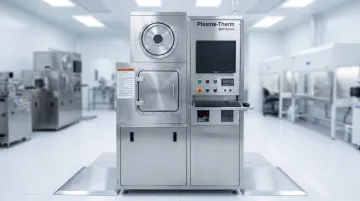
In the same facility's subfab — lower-risk support systems away from process chambers — FKM is commonly used for cost efficiency. Material selection is made application by application, not across the entire fab.
Oil & Gas and Chemical Processing
FKM has long been the workhorse in refinery equipment, pipeline seals, and chemical reactors handling hydrocarbons and moderate acids. Its temperature and chemical resistance covers the vast majority of these duties, and FFKM's cost premium is hard to justify where a named FKM grade is chemically compatible.
Sour gas (H₂S) environments and hot amine treatment systems — used to strip H₂S from process streams — are where FKM reaches its limits. Kalrez Spectrum 6380 is specifically formulated for hot aggressive amines in petrochemical service, and Greene Tweed's Chemraz 562 and 694 target sour gas and steam service up to 316°C.
Pharmaceutical and Food Processing
CIP/SIP systems cycle seals through steam sterilization combined with aggressive cleaning chemicals — conditions that degrade FKM through both chemical attack and thermal stress. FFKM grades meeting FDA 21 CFR 177.2600 and USP Class VI are specified here not just for performance, but for regulatory compliance.
DSC supplies USP Class VI certified sealing materials for healthcare and pharmaceutical applications, including FFKM formulations where those compliance requirements apply.
Aerospace
Aerospace fuel system seals, hydraulic actuators, and engine components face extreme temperature swings, high pressure, and aggressive jet fuels — all at once. When FKM's upper temperature limit is exceeded or chemical exposure breadth demands full fluorination, FFKM is the aerospace-qualified choice.
Key FFKM grades for this sector include:
- Chemraz 676 — rated –18°C to 324°C, tested per AMS 7257
- Kalrez 4079 — listed for aircraft O-rings and diaphragms, max service at 316°C
Frequently Asked Questions
What are the differences in sealing properties between FKM (Viton) and FFKM?
FKM offers excellent resistance to oils, fuels, and moderate chemicals with continuous service up to ~204°C. FFKM's fully fluorinated backbone extends chemical compatibility to nearly all aggressive media — including amines, ketones, and plasma — and pushes temperature resistance to 320–327°C. FFKM is the upgrade when FKM reaches its documented chemical or thermal limits.
How do FKM and FFKM compare for chemical resistance to acids and solvents?
FKM handles most hydrocarbons, aliphatic and aromatic fuels, mineral acids, and common solvents effectively. FFKM extends coverage to highly aggressive media — concentrated sulfuric acid, fuming nitric acid, strong amines, esters, and ketones — where FKM degrades. For mixed or unknown chemical environments, FFKM's near-universal inertness reduces the risk of unexpected compatibility failures.
Which materials are suitable for vacuum chambers and seals?
FFKM is preferred for vacuum and ultra-high-vacuum (UHV) applications due to its extremely low outgassing, chemical inertness, and plasma resistance. FKM can serve moderate vacuum applications but typically doesn't meet the purity or outgassing requirements of semiconductor-grade UHV environments. Both are incompatible with molten or gaseous alkali metals.
Is FFKM worth the higher cost over FKM?
In critical systems — semiconductor fabs, chemical processing, aerospace — FFKM's longer service life and fewer maintenance cycles deliver lower total cost of ownership despite the higher unit price. For standard industrial duty within FKM's documented limits, FKM offers the better cost-performance balance. The real question is what a seal failure costs your operation.
Can FKM be used in food and pharmaceutical applications?
Certain FKM grades carry FDA compliance, but FFKM is generally preferred where seals face repeated steam sterilization (CIP/SIP) and aggressive cleaning agents. Specific FFKM formulations meet FDA 21 CFR 177.2600 and USP Class VI standards for low-extractable, contamination-sensitive environments.
What is the difference between FKM and Viton?
Viton™ is a registered trade name (The Chemours Company FC, LLC) for a specific brand of FKM fluoroelastomer. FKM is the ASTM D1418 / ISO 1629 material designation for the broader fluoroelastomer family. Other manufacturers — including Syensqo (Tecnoflon) and Daikin (DAI-EL) — produce FKM compounds under different trade names with equivalent performance across most standard applications.