Introduction
Selecting the wrong FKM grade in an aerospace sealing application isn't just a procurement error—it's an engineering failure waiting to happen. In fuel or hydraulic systems, the consequences run from seal degradation and loss of compression preload to external leakage—a direct flight safety risk.
FKM is not a single material. It's a family of fluoroelastomers governed by ASTM D1418, each grade defined by a distinct monomer composition and fluorine content that determines where it works—and where it fails.
A Type A grade that performs reliably in a jet fuel system will swell aggressively in a synthetic hydraulic fluid application. A Type F grade with excellent chemical resistance will crack in cold-soak conditions where a GLT grade is required.
This guide covers what engineers need to make the right call:
- FKM grade taxonomy and monomer composition
- Performance across aerospace sub-applications (fuel, hydraulic, thermal)
- Key differentiating properties and qualification standards
- The most common grade selection errors—and how to avoid them
Key Takeaways
- FKM grades (Type A, B, F, GLT, GFLT) differ by fluorine content (64%–70%+) and monomer composition, not brand name alone
- Higher fluorine content improves chemical resistance to polar solvents and ester-based fluids but reduces low-temperature flexibility
- Low-temperature grades (GLT/GFLT) address cold-soak conditions, though specific TR-10 values vary by manufacturer and grade
- AMS 7259 and AMS 7276 are the governing aerospace qualification standards for FKM sealing rings; specifying "FKM" alone is not sufficient
- Grade mismatch drives the three primary early-failure mechanisms: fluid-induced swell, compression set loss, and thermal cracking
What FKM Grades Represent in Aerospace Sealing Systems
FKM is a designator under ASTM D1418 for a class of fluoroelastomers—not a single compound. ASTM D1418-21a classifies rubber by polymer-chain chemistry, and FKM appears within the M-class designation covering fluorine-containing rubbers. According to 3M's Dyneon product guide, FKM represents approximately 80% of all fluoroelastomers and is equivalent to FPM under ISO/DIN 1629.
In an aerospace sealing context, FKM functions as a compression-loaded barrier. The seal must maintain elastic recovery and dimensional stability across thermal cycling, fluid exposure, and pressure differentials—sometimes for hundreds of flight hours between inspection intervals. Seal failures in these systems are traceable directly to material decisions made at the design stage, which makes grade selection a safety-critical engineering task.
Grade as a Design Parameter
FKM grade is an engineering variable, not a commodity callout. The grade must be selected based on:
- Fluid media in the specific system (fuel, hydraulic fluid, engine oil)
- Temperature envelope across the full operational range, including ground cold-soak
- Qualification standard required for the application
- Cure system used in the compound formulation (bisphenol vs. peroxide)
Specifying "FKM" on an aerospace drawing without a compound reference or AMS standard leaves the grade uncontrolled. That gap is where non-conforming seals enter the supply chain.
Factors That Govern Grade Selection
Each primary aerospace fluid environment imposes different minimum fluorine content requirements on the seal compound:
| Fluid | Standard | Base Type |
|---|---|---|
| Jet-A / Jet A-1 | ASTM D1655 | Kerosene-type aviation turbine fuel |
| JP-8 | MIL-DTL-83133E | Kerosene type, NATO F-34, freeze point max -47°C |
| MIL-PRF-5606 | DLA ASSIST | Petroleum-base hydraulic fluid |
| MIL-PRF-83282 | DLA ASSIST | Synthetic hydrocarbon-base hydraulic fluid, -40 to +205°C |
| MIL-PRF-23699 | DLA ASSIST | Synthetic-base turbine engine oil (polyol ester base) |
| Phosphate ester hydraulic fluids | SAE AS1241D | Fire-resistant phosphate ester fluid—separate from MIL-PRF-83282 |
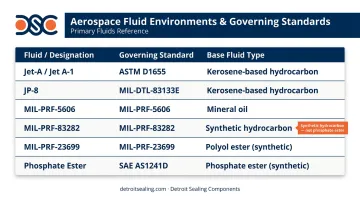
Note: MIL-PRF-83282 is frequently mislabeled as a "phosphate ester" fluid. It is a synthetic hydrocarbon-base fluid, and this distinction affects grade selection.
Temperature is the second major constraint. According to Chemours' Viton Selection Guide, FKM seals operate effectively up to 204°C continuously, with service limits extending to 232°C for 3,000 hours and 260°C for 1,000 hours.
The cold end is equally demanding. Standard Type A grades have a TR-10 of only -17°C—insufficient for altitude cold-soak or arctic ground operations where much lower flexibility thresholds apply.
The FKM Grade Spectrum: Performance Envelopes and Aerospace Relevance
The grade progression moves from general-purpose chemistry to increasingly specialized formulations, driven by higher fluorine content and added monomers. Higher fluorine improves fluid resistance; it also raises the low-temperature limit—a direct trade-off that shapes every grade selection decision in aerospace sealing.
Type A: The Baseline (VDF/HFP Dipolymer)
Type A FKM contains approximately 66% fluorine and a TR-10 of -17°C per Chemours data. It handles:
- Jet fuels (Jet-A, JP-8)
- Aliphatic hydrocarbons
- Petroleum-base hydraulic fluids (MIL-PRF-5606)
Its limitation in aerospace MRO is fluid selectivity. Type A is vulnerable to synthetic ester fluids, ketone-based cleaning agents, and methanol.
Chemours' swell data puts this in concrete terms: 90% volume change in methanol for Type A versus 5% for Type F. That gap explains why Type A cannot be used interchangeably across platform fluids.
Type A remains widely used in airframe fuel system seals and some hydraulic applications, but fluid compatibility validation is mandatory before qualifying it for any system involving synthetic fluids or blended fuel additives.
Type B and Type F: Terpolymers
Type B (VDF/HFP/TFE terpolymer, ~68% fluorine, TR-10 -13°C) offers better thermal stability and improved resistance to mixed aromatic fuels over Type A. For applications with blended fuel compositions or fuel additives, it's a meaningful upgrade.
Where Type B is incremental, Type F is a step change. Higher TFE content pushes fluorine to ~70%, and that shift delivers measurably better resistance to polar solvents. TR-10 rises to -6°C, but the fluid compatibility gain justifies the trade-off in most fixed installations. Type F is the appropriate starting point for:
- Synthetic hydrocarbon hydraulic fluids (MIL-PRF-83282)
- Polyol ester engine oils (MIL-PRF-23699)
- Phosphate ester hydraulic fluids (SAE AS1241D)
- Aggressive cleaning agents used in aerospace MRO
Fuel C swell data at 168 hours / 23°C confirms the gap: 4% volume change for Type A vs. 2% for Type F. On mixed-fluid platforms, that two-point difference compounds across seal life cycles.
Low-Temperature Grades: GLT and GFLT
Type F's -6°C TR-10 is the ceiling of standard FKM performance — adequate for ground-level installations, but not for cold-soak altitude or arctic dynamic seal applications. Low-temperature grades close that gap through modified monomer systems incorporating fluorinated vinyl ethers.
Per Chemours' Viton Selection Guide:
| Grade | Nominal Fluorine | TR-10 |
|---|---|---|
| GLT-S | 64% | -30°C |
| GFLT-S | 67% | -24°C |
Other manufacturers achieve lower thresholds. 3M's LTFE 6400ZC reaches -40°C TR-10, and Solvay's VPL low-temperature FKM grades extend to -45°C per their 2018 materials guide.
An important caveat: do not assume all GLT or GFLT grades reach -40°C. The Chemours data does not support that claim for the GLT-S and GFLT-S grades specifically. Verify TR-10 against the specific manufacturer's datasheet, not the grade family name.
Key Technical Properties That Differentiate FKM Grades for Aerospace
Fluorine content defines the chemistry, but aerospace performance is determined by three interrelated properties that must be evaluated together.
Compression Set and Elastic Recovery
Compression set (the permanent deformation remaining after a sealing load is released) governs reliability in static seals at engine flanges, fuel interfaces, and hydraulic actuators. Chemours data at 70 hours / 200°C shows:
- Type A grades: 12–20% compression set
- Type F and GF grades: 30–35% compression set
- GLT and GFLT grades: 30–40% compression set
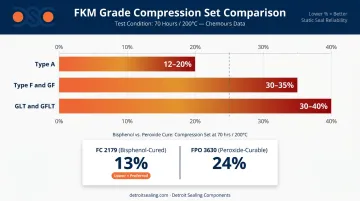
Cure system also matters. 3M's data shows bisphenol-cured FC 2179 at 13% versus peroxide-curable FPO 3630 at 24%, both at 70 hours / 200°C. For high-temperature static seals, engineers must obtain compound-level compression set data, not just grade-level figures.
Fluid Swell and Volume Change
Volume swell in service fluid directly affects groove fit and compression preload. If a seal swells beyond its groove volume, it can extrude under pressure or relax its sealing contact after thermal cycling. Published Chemours data (ASTM D471, 168 hours / 23°C):
| Fluid | Type A | Type F | GFLT-S |
|---|---|---|---|
| Fuel C | 4% | 2% | 2% |
| Methanol | 90% | 5% | 5% |
| MEK | >200% | >200% | >200% |
Note: Direct ASTM D471 swell data by grade for MIL-PRF-83282, MIL-PRF-23699, Jet-A, and JP-8 was not confirmed in current primary sources. Engineers should request fluid-specific swell data from the compound supplier before finalizing grade selection for these fluids.
Thermal Aging and Hardness Drift
Prolonged heat exposure causes hardness increase and elongation loss in all FKM grades. In aerospace, where seals must remain serviceable between inspection intervals spanning hundreds of flight hours, thermal aging stability is a life-limiting property.
Key considerations:
- Peroxide-cured grades generally show better long-term stability at high temperatures than bisphenol-cured equivalents
- Elongation-at-break retention after thermal aging (ASTM D573) is the primary screening metric; request grade-specific A vs. F type data from the compound supplier
- Excessive hardness drift reduces conformability and sealing contact at flange interfaces over time
How FKM Grades Are Specified and Qualified for Aerospace
Specification Standards and Documentation
The primary aerospace qualification standards for FKM molded sealing rings are:
- AMS 7259: High-temperature-fluid-resistant, very-low-compression-set FKM, Type 85–95 hardness range. Revised 2024-09-17.
- AMS 7276: Same performance scope, Type 70–80 hardness range. Published 2020-05-18.
Both standards define minimum property requirements including compression set, tensile strength, elongation, and fluid immersion performance. Procurement documents must reference the applicable AMS standard and a qualified compound—specifying only "FKM" leaves the grade and cure system uncontrolled.
AMS compliance is the baseline, not the ceiling. Engine OEM approval lists from manufacturers such as GE Aerospace, Pratt & Whitney, and Rolls-Royce impose additional requirements beyond those standards. These approvals are program-specific and non-transferable—a compound cleared for one engine program requires separate qualification before it can be used in another.
Testing and Validation
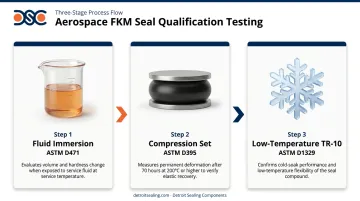
Meeting both AMS standards and OEM approval requirements depends on passing a defined set of qualification tests. For aerospace FKM seals, these typically include:
- Fluid immersion per ASTM D471 — in the specified service fluid at service temperature
- Compression set per ASTM D395 — at maximum service temperature (typically 70 hours / 200°C or higher)
- Low-temperature TR-10 per ASTM D1329 — to confirm cold-soak performance
Pre-qualification compound screening can identify unsuitable grades before a full OEM submission, saving time and cost during the qualification cycle. DSC's ISO 17025 accredited lab supports compound development and testing for customers working through aerospace qualification programs, offering a structured screening step that reduces the risk of rejection at formal submission.
Consequences of Using the Wrong FKM Grade
The principal failure mode of grade mismatch is straightforward: a seal that swells beyond its groove volume loses compression preload and either extrudes under pressure or fails to reseal after thermal cycling. In fuel and hydraulic systems, external leakage is a flight safety concern, not just a maintenance issue.
Thermal degradation follows a different but equally serious pathway. A grade with insufficient thermal resistance experiences accelerated hardening and elongation loss, eventually cracking and losing sealing contact. This is a time-dependent failure — the seal may pass initial inspection and degrade progressively between maintenance intervals.
The regulatory exposure compounds the technical risk. Using a non-qualified or incorrectly specified FKM grade in flight hardware creates a non-conformance under 14 CFR Part 21, which defines production approval as manufacturing in accordance with approved design. FAA AC 21-43 (10/16/2009) provides quality system guidance for production approval holders — an unapproved seal material substitution is not a minor procurement variation. It is a conformity issue that may require component removal, inspection, and corrective action.
Material traceability — compound identification, lot documentation, and material certifications — is a compliance requirement in this context. Without it, demonstrating conformance after a material substitution is effectively impossible.
Common Misinterpretations When Selecting FKM Grades for Aerospace
Three patterns show up repeatedly in aerospace FKM selection failures:
Treating "FKM" or "Viton" as a complete specification. "Viton" is a trademark of The Chemours Company FC, LLC; FKM is an ASTM D1418 family designation. Neither identifies a specific grade, fluorine content, cure system, or qualification status. An aerospace drawing that calls out only "FKM" leaves grade selection entirely uncontrolled.
Assuming cross-fluid compatibility within the same grade. A Type A seal qualified for jet fuel service does not meet the requirements of a synthetic hydraulic system on the same aircraft. The methanol and ester swell data referenced earlier makes this clear—these are not marginal differences. Cross-application without separate fluid compatibility validation is a documented source of in-service failures.
Over-relying on short-term lab immersion data. A 168-hour static immersion at ambient temperature does not replicate field conditions. Elevated temperature, pressure cycling, contamination, and thermal excursions produce cumulative degradation that short tests miss. Service margins must be applied, and test conditions should be as close to actual service conditions as practical.
Each of these failures traces back to the same root cause: selection decisions made at the material family level rather than the compound level. DSC's technical team, backed by an ISO 17025 accredited lab, works with aerospace engineers to identify compound-specific data—fluorine content, cure system, and qualified fluid compatibility—so grade selection decisions are grounded in actual performance evidence rather than generic material labels.
Frequently Asked Questions
What are the different grades of FKM?
The main FKM grades are Type A (VDF/HFP, ~66% fluorine), Type B (VDF/HFP/TFE, ~68%), Type F (higher TFE content, ~70%), and low-temperature variants GLT and GFLT, which incorporate fluorinated vinyl ether monomers to extend cold-soak flexibility. Each is suited to different fluid environments and temperature ranges; they are not interchangeable.
Is FFKM material better than Viton?
FFKM offers higher fluorine content, broader chemical resistance, and higher continuous temperature capability than standard FKM grades, but at substantially higher cost. For most aerospace fuel and hydraulic system seals, a correctly specified FKM grade provides adequate performance; FFKM is reserved for extreme chemical exposure environments where standard grades fall short.
Which is better, FKM or EPDM seal material?
FKM is the standard choice for aerospace fuel, oil, and hydraulic fluid sealing due to its resistance to hydrocarbons and ester-based fluids. EPDM is incompatible with petroleum-based fluids and is not appropriate for these applications.
What temperature range can FKM handle in aerospace sealing?
Standard FKM grades seal effectively to 204°C continuously, with extended service limits up to 232°C. On the cold end, Type A reaches only -17°C TR-10; low-temperature grades (GLT-S, GFLT-S) extend to -24°C to -30°C per Chemours data, while select grades from 3M and Solvay reach -40°C to -45°C. Verify against the specific compound datasheet, not generic FKM limits.
What aerospace standards govern FKM seal qualification?
AMS 7259 (Type 85–95) and AMS 7276 (Type 70–80) are the primary SAE standards for FKM molded sealing rings in aerospace applications. Engine OEM qualification requirements and platform-specific engineering drawings may impose additional property limits and test requirements beyond these standards, so AMS compliance alone does not guarantee OEM approval.