Introduction
Pick the wrong O-ring compound in a high-pressure amine service line, and you won't know it until the seal fails. By then, you're looking at unplanned downtime, potential safety exposure, and a maintenance crew pulling apart equipment that should have run for another year.
Aflas and Viton are both fluoroelastomers built for demanding environments—but they are not interchangeable. Engineers in oil and gas, chemical processing, and automotive sectors routinely face this exact choice, and the consequences of getting it wrong extend well beyond the cost of a replacement O-ring.
This guide gives you a practical decision framework covering:
- Chemical resistance profiles for each compound
- Temperature range limits and performance thresholds
- Static vs. dynamic sealing suitability
- Which compound belongs in which environment
Key Takeaways
- Aflas (FEPM/TFE-P) and Viton (FKM) serve different chemical environments—this is the single most important selection factor
- Viton excels with petroleum oils, fuels, aromatic hydrocarbons, and chlorinated solvents
- Better cold-temperature flexibility and compression set recovery give Viton the edge in dynamic sealing applications
- Aflas outperforms Viton against bases, amines, superheated steam, hot water, H₂S, and offers superior electrical insulation
- Aflas wins at the high end of the temperature range; Viton wins at the low end
- Match the material to your specific chemistry, sealing type, and operating conditions—no single compound fits every application
Aflas vs Viton O-Rings: Quick Comparison
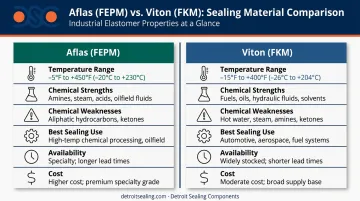
| Property | Aflas (FEPM/TFE-P) | Viton (FKM) |
|---|---|---|
| Composition | TFE/propylene copolymer (FEPM) | VDF/HFP fluorocarbon elastomer (FKM) |
| Temperature Range | ~-9°C to +232°C (Parker) | ~-26°C to +204°C continuous; ~-15°C low-temp dynamic limit |
| Chemical Strengths | Bases, amines, steam, H₂S, alkalis | Oils, fuels, aromatic hydrocarbons, chlorinated solvents |
| Chemical Weaknesses | Aromatic fuels, ketones, chlorinated hydrocarbons | Amines, alkalis, glycol brake fluids, superheated steam |
| Best Sealing Type | Static (flanges, valve seats) | Static and dynamic (shafts, pistons, cylinders) |
| Availability | Specialty compound; longer lead times | Widely stocked, multiple grades |
| Cost | Higher; quote-dependent by size and grade | Generally more cost-effective |
What Is an Aflas O-Ring?
Composition and Background
Aflas is a trademarked fluoroelastomer developed by Asahi Glass Co. (now AGC), first introduced in 1975. Its ASTM designation is FEPM, and it's composed of an alternating copolymer of tetrafluoroethylene (TFE) and propylene. That alternating polymer structure—not simply the fluorine content—is what gives Aflas its different chemical resistance profile compared to standard FKM.
AGC rates continuous service up to 200°C, with short-term exposure reaching 230–250°C. Parker's O-Ring Handbook places the normal FEPM service range at approximately -9°C to 232°C.
Where Aflas Excels
- Bases and alkalis — resists high-pH media that rapidly degrade standard FKM
- Amine-containing environments — including engine oils and fluids with amine additives
- Hot water and steam — Parker rates FEPM satisfactory for steam below 400°F (204°C)
- H₂S / sour gas — Parker rates FEPM satisfactory for listed H₂S conditions where FKM is rated unsatisfactory
- Electrical insulation — AGC reports volume resistivity of 3 × 10¹⁶ ohm-cm, a direct benefit of its fluorine content
Key Limitations
Aflas is not a universal replacement for Viton. Parker's handbook explicitly rates FEPM as incompatible with aromatic fuels, ketones, and chlorinated hydrocarbons. Its higher compression set at elevated temperatures also restricts it primarily to static sealing applications: flanges, valve body seals, and connector seals where the seal isn't repeatedly cycled.
Availability is another practical constraint. Aflas comes in a narrower range of standard sizes and grades than FKM, which can extend sourcing lead times on procurement-sensitive projects.
Aflas O-Ring Use Cases
Primary environments where Aflas is the specified choice:
- Oil and gas — downhole tools, packer elements, sour gas (H₂S) environments, amine-based corrosion inhibitor systems. AGC documents proven operating conditions of 204°C and 2,000–10,000 psi for downhole applications
- Power generation — geothermal plants, steam systems, hot water circuits
- Chemical processing — alkali environments, amine-based chemical handling, aggressive acid exposure
- Automotive — brake fluid systems, engine coolants, and transmission fluids with amine additives
Practical example: In oil and gas operations using amine gas treatment systems, standard FKM seals are chemically vulnerable to the amine solvents themselves. Aflas is commonly specified for these environments due to its base and amine-additive resistance. That said, the specific amine chemistry, temperature, and compound grade should always be verified before finalizing the specification.
What Is a Viton O-Ring?
Composition and Grades
Viton is a registered trademark of Chemours, referring to a family of FKM fluoroelastomers. Viton A-type fluoroelastomers are dipolymers of hexafluoropropylene (HFP) and vinylidene fluoride (VF2). It's one of the most widely used high-performance elastomers globally, and grade selection directly affects chemical compatibility and temperature range.
Chemours identifies four major Viton families, each with different resistance profiles tied to fluorine content:
| Grade | Best For | Notes |
|---|---|---|
| Viton A | Oils, fuels, standard hydrocarbons | Baseline grade; 20–25% volume swell in toluene at 40°C |
| Viton B | Improved acid resistance | Higher fluorine content than A-type |
| Viton F | Oxygenated fuels, concentrated acids | 8–12% volume swell in toluene; better fuel resistance |
| Viton ETP/ETP-S | Harshest chemical environments including amines and bases | Exception case for Viton's typical amine weakness |
Fluid resistance generally improves as fluorine level increases, while low-temperature flexibility tends to decrease—a trade-off engineers must account for in cold-start or cold-ambient applications.
Performance Profile
Viton's core strengths make it the default for hydrocarbon-heavy environments:
- Petroleum oils, mineral oil, and grease
- Gasoline, diesel, biodiesel blends, and aromatic fuels
- Chlorinated solvents and aromatic hydrocarbons
- Oxidizing acids
Compression set data from Chemours shows A-types at 12–20% after 70 hours at 200°C, making them significantly better than many alternatives for applications where seal recovery matters. This property drives Viton's advantage in dynamic sealing—rotating shafts, reciprocating pistons, hydraulic cylinders.
Known Weaknesses
Standard Viton grades (non-ETP) are incompatible with:
- Ammonia gas, amines, and alkalis
- Glycol-based brake fluids
- Superheated steam
- Low-molecular-weight organic acids (formic, acetic)
Aflas handles ammonia, amines, steam, and alkali environments that would degrade standard Viton—which is why it appears wherever those media are present.
Viton O-Ring Use Cases
- Automotive — Chemours confirms that automotive rubber parts made with Viton withstand extreme underhood temperatures and fuel/fume exposure; fuel injector seals, turbocharger hoses, transmission seals
- Aerospace — hydraulic system seals, fuel system components
- Oil and gas — valve seals, pump seals, and hydrocarbon-exposure environments where amine chemicals are not present
- Chemical processing — solvent handling, fuel transfer, reactor seals in non-amine, non-alkaline service
Aflas vs Viton: Which O-Ring Should You Choose?
Step 1: Define the Chemical Environment
The two materials serve largely complementary chemical niches:
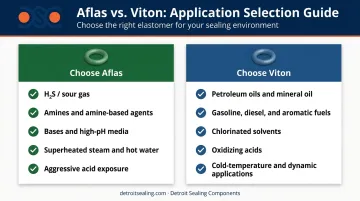
Choose Aflas if your application involves:
- H₂S or sour gas
- Amines or amine-based lubricants and treating agents
- Bases, alkalis, or high-pH media
- Superheated steam or hot water systems
- Aggressive acid exposure (outside aromatic/chlorinated categories)
Choose Viton if your application involves:
- Petroleum oils, mineral oil, grease
- Gasoline, diesel, biodiesel, or aromatic fuels
- Chlorinated solvents or aromatic hydrocarbons
- Oxidizing acids
- Applications requiring broader temperature flexibility, including cold environments
One caveat on amines: Parker's compatibility tables rate standard FEPM as "Doubtful" for mixed amines. AGC supports Aflas for amine-additive environments, but the specific amine chemistry, concentration, and temperature must be verified independently. Don't assume any generic Aflas compound passes amine service without compound-level testing.
Once you've confirmed the chemical fit, the next question is how the seal moves — or doesn't.
Step 2: Static or Dynamic Sealing?
- Static applications (flanges, valve seats, connector seals, gaskets) — both materials are candidates; Aflas's compression set limitation matters less when the seal isn't repeatedly cycled
- Dynamic applications (rotating shafts, reciprocating pistons, hydraulic cylinders) — Viton's superior compression set recovery makes it the stronger performer; Parker rates FKM static low-temperature resistance at approximately -26°C, with dynamic service down to -15°C to -18°C
Step 3: Factor in Cost and Availability
Viton is widely stocked across multiple grades and standard AS568 sizes, making it the practical default for most industrial applications where its chemical profile fits. Aflas carries a price premium and may involve longer lead times—but in environments where it's the correct material, extended seal life and reduced failure risk justify the cost differential.
When to Consult an Expert
If the chemical environment involves multiple aggressive media, borderline amine exposure, or operating conditions that sit between Aflas and Viton's performance ranges, material compatibility testing is the right next step—not a catalog assumption. DSC's ISO 17025 accredited lab supports compound selection, custom material development, and application-specific testing for exactly these situations.
Conclusion
Aflas and Viton each occupy a distinct performance niche. Viton is the workhorse for hydrocarbon-heavy and dynamic sealing environments. Aflas is the specialist for amine-rich, alkaline, H₂S, or steam-heavy environments and static sealing applications. The right compound depends entirely on the specific chemicals, temperatures, and mechanical demands of your application — and getting that match wrong carries real cost.
Correct compound selection reduces unplanned downtime, extends maintenance intervals, and protects system integrity in demanding processes. For straightforward applications, the framework above will point you in the right direction. For complex or multi-chemical environments, DSC's technical team — backed by an ISO 17025 accredited lab and access to hundreds of rubber compounds — can help you validate the right choice before you commit.
Frequently Asked Questions
What is an Aflas O-ring?
Aflas is a fluoroelastomer (FEPM) — an alternating copolymer of tetrafluoroethylene and propylene developed by AGC in 1975. It resists bases, amines, steam, and H₂S where standard FKM fails, and offers high electrical insulation properties.
Is FEP the same as Viton?
No. FEP (fluorinated ethylene propylene) is a thermoplastic fluoropolymer, while Viton is an FKM fluoroelastomer — related materials with fundamentally different structures. FEP-encapsulated O-rings, which use an FEP shell over an elastomeric core, are a separate product category entirely.
Can Aflas O-rings replace Viton in all applications?
No. Aflas has lower resistance to aromatic fuels, ketones, and chlorinated hydrocarbons, and its higher compression set makes it unsuitable for most dynamic sealing applications where Viton performs reliably. It's a specialist material for specific chemical environments, not a universal substitute.
What is the temperature range of Aflas vs Viton O-rings?
Per Parker's O-Ring Handbook, Aflas (FEPM) operates from approximately -9°C to 232°C, while standard FKM operates from approximately -26°C to 204°C in continuous service. Aflas has a higher max temperature ceiling; Viton handles colder operating conditions better, particularly for dynamic sealing.
Which O-ring material is better for oil and gas applications?
It depends on the media. Viton is preferred for hydrocarbon-exposure environments without amine or alkali contact. Aflas is the standard for sour gas (H₂S), amine-based treating systems, and downhole environments with aggressive chemical exposure — Parker rates FEPM satisfactory for H₂S conditions where FKM is rated unsatisfactory.
Are Aflas O-rings more expensive than Viton?
Aflas costs more due to its specialized polymer structure and lower production volume; exact pricing varies by size, grade, and order volume. When correctly specified, the premium is offset by longer seal life and a lower risk of costly failures.