The problem is that O-rings are often treated as commodity purchases. When a standard Nitrile seal fails in a solvent-heavy environment, the instinct is to replace it with the same material — faster. But in demanding applications, repeating that cycle means repeating the failure.
This article covers what makes Viton (FKM) O-rings the right engineering choice for harsh industrial environments — not just the material science, but how those properties translate into fewer replacements, lower maintenance costs, and more reliable systems.
Key Takeaways
- Viton (FKM) O-rings use fluoroelastomer chemistry to resist chemicals, heat, and environmental degradation that destroy standard elastomers
- Three core advantages: broad chemical resistance, continuous service to 204°C, and low compression set for extended seal life
- Nitrile (NBR) and EPDM have well-known failure modes — aromatic solvents, high-temp petroleum oils, and long-cycle fatigue are where they fall short
- Viton costs more per unit — but typically delivers lower total cost of ownership in demanding environments
- Used across Oil & Gas, Automotive, Aerospace, Chemical Processing, Food & Beverage, and Healthcare
What Are Viton O-Rings?
Viton is a registered trademark of The Chemours Company for a family of fluoroelastomers classified under ASTM D1418 as FKM. Introduced in 1957 to meet aerospace sealing demands, it has since become the standard reference for high-performance elastomer seals across industrial sectors.
"Viton" and "FKM" are used interchangeably — both describe fluorinated polymer compounds with identical chemistry.
What sets FKM apart from standard elastomers like Nitrile (NBR) or EPDM is the carbon-fluorine bond structure. C-F bonds carry significantly higher dissociation energy than the C-H bonds found in standard rubbers, which is why Viton resists chemical attack, thermal degradation, and ozone exposure that would compromise NBR or EPDM.
That performance profile makes FKM the material of choice for both static and dynamic sealing in demanding environments:
- Hydraulic and pneumatic systems
- Fuel handling and delivery systems
- Chemical process valves and pumps
- Automotive under-hood and powertrain applications
- Aerospace fluid and hydraulic circuits
Specifying Viton is the correct engineering call when the environment involves aggressive media, sustained heat, or long service intervals where a seal failure carries real operational or safety consequences.
Key Advantages of Viton O-Rings
Superior Chemical Resistance
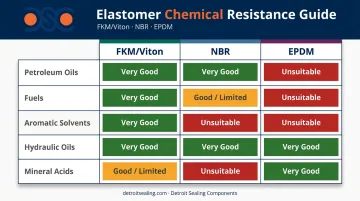
Viton resists a broad range of aggressive media that cause standard elastomers to swell, distort, or degrade. According to Trelleborg's chemical compatibility data, FKM is rated suitable or very good for:
| Medium | FKM/Viton | NBR | EPDM |
|---|---|---|---|
| Petroleum oils | Very good | Very good | Unsuitable |
| Fuels | Very good | Good | Unsuitable |
| Aromatic solvents | Very good | Unsuitable | Unsuitable |
| Hydraulic oils | Very good | Very good | Unsuitable |
| Mineral acids | Very good | Limited/unsuitable | Good (varies) |
NBR fails in aromatic fuels and solvents — a common media type in fuel handling and chemical processing. EPDM cannot be used in any petroleum oil or hydraulic fluid service. FKM covers the full matrix.
Chemical attack causes swelling, dimensional change, or surface degradation. An O-ring that swells extrudes from its groove; one that softens loses sealing force. Either path leads to leaks. In pressurized or hazardous systems, fluid containment failures carry costs well beyond the O-ring itself:
- Unplanned downtime during emergency repairs
- Contaminated process fluid requiring disposal or rework
- Potential safety incidents in pressurized or volatile service
A Viton O-ring that holds its dimensions in the process media simply stays in service longer. That directly reduces replacement frequency and the labor cost associated with scheduled or emergency seal changes.
Certain Viton grades meet FDA 21 CFR 177.2600 for rubber articles intended for repeated use in food contact applications. For food, beverage, and pharmaceutical operations, chemical compatibility intersects with compliance. A compound that isn't FDA-listed isn't a viable option regardless of its mechanical properties. Detroit Sealing Components supplies FDA-compliant FKM materials across multiple product lines for customers in these regulated sectors.
This advantage is most critical in chemical processing, Oil & Gas, food and pharmaceutical manufacturing, fuel handling, and any application with regular exposure to solvents, aromatic hydrocarbons, or petroleum-based media.
Extreme Temperature Performance
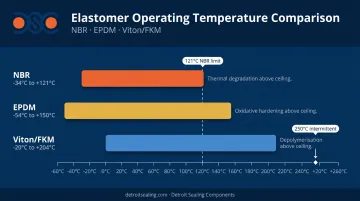
Standard elastomers have well-defined thermal ceilings. According to Parker's O-Ring Handbook, the upper service limits are:
- NBR: approximately -34°C to +121°C
- EPDM: approximately -54°C to +150°C
- Viton/FKM: approximately -20°C to +204°C continuous, with some grades rated for intermittent exposure to 250°C
That gap between Viton and NBR — over 80°C at the upper end — is the difference between a seal that holds and one that hardens, loses compression force, and begins leaking.
At elevated temperatures, most elastomers oxidize or soften. The high-energy C-F bonds in FKM remain stable under sustained heat, allowing the O-ring to maintain its sealing geometry and mechanical properties where other materials fail progressively.
Thermal failure follows predictable patterns:
- Hardening that eliminates compression force against the mating surface
- Surface cracking that creates leak paths through the seal cross-section
- Permanent deformation (compression set) that prevents recovery when pressure cycles
In automotive under-hood applications, Oil & Gas wellhead equipment, and industrial sterilization systems, this failure mode can be sudden rather than gradual. A seal that fails mid-cycle often damages adjacent components before the system shuts down.
For cold-side applications, specialized GLT and GFLT grade families extend low-temperature flexibility down to approximately -40°C. These grades cover applications requiring both chemical resistance and cold-weather performance, such as outdoor equipment or refrigeration systems.
Primary use cases: automotive powertrain, Oil & Gas downhole equipment, aerospace hydraulic systems, steam sterilization, and processes subject to frequent thermal cycling.
Extended Service Life and Low Compression Set
Compression set is the tendency of an elastomer to permanently deform after sustained compression. An O-ring with high compression set loses its ability to exert sealing force over time, even if it looks intact. This is one of the most common causes of gradual leak development in aging sealing systems.
Chemours compression set data under ASTM D395 Method B shows Viton performing at:
- 9–16% after 70 hours at 23°C
- 10–30% after 70 hours at 200°C (grade-dependent)
For context, NBR tested at 100°C and EPDM tested at 125°C both show representative compression set values around 20–25% — at significantly lower test temperatures. FKM's low compression set at 200°C means it retains sealing force in conditions where those materials would already be outside their operating envelope.
That performance directly affects maintenance economics. The true cost of an O-ring replacement includes:
- Labor to access and disassemble the sealed assembly
- System downtime during the replacement window
- Process fluid loss or contamination associated with the failure
- Collateral inspection or repair of adjacent components
For industries where maintenance windows are expensive or infrequent — subsea equipment, aerospace systems, continuous process manufacturing — extending seal life from months to years per interval has a compounding effect on total maintenance cost.
Viton also resists UV radiation, ozone, and weathering, which matters for O-rings in exposed outdoor installations or held in long-term storage prior to installation.
The KPIs most directly affected: mean time between replacements, system availability rate, annual maintenance labor hours, and total cost of ownership per seal position.
What Happens When the Wrong O-Ring Material Is Specified
The failure patterns are predictable, and they follow directly from compatibility data.
NBR + aromatic fuels → swelling and groove extrusion: Nitrile is rated unsuitable for aromatic exposure. The rubber swells, loses dimensional control, and can extrude from the groove under pressure — creating a leak path or losing the seal entirely.
EPDM + petroleum hydraulic fluid → mechanical degradation: EPDM is incompatible with petroleum-based oils and fuels. Contact causes swelling and structural breakdown, regardless of groove design or installation quality.
Standard elastomers above rated temperature → compression loss: At temperatures above their ceiling, both NBR and EPDM harden, crack, or lose compression force. The seal doesn't fail suddenly — it degrades gradually, often allowing small leaks before a maintenance inspection catches them.
The operational consequences extend beyond the O-ring:
- Unplanned production stops during high-output periods
- Emergency maintenance callouts at premium labor rates
- Contamination of process fluid or product batches
- Collateral damage to pumps, valves, and actuators that operate with a leaking or extruded seal
The price difference between a standard Nitrile O-ring and a Viton equivalent is typically small relative to the cost of any one of these events. A single unplanned shutdown or contaminated batch will far outpace the per-unit premium on the correct material.
How to Get the Most Value from Viton O-Rings
Specifying "Viton" isn't enough — the grade has to match the application. Chemours identifies five primary families with distinct performance profiles:
| Grade | Fluorine Content | Best For |
|---|---|---|
| A-Type | 66% | General chemical and fuel exposure; good compression set |
| B-Type | 68% | Enhanced fluid resistance vs. A-Type |
| F-Type | 70% | Aromatic fuels and harsh solvents; highest fluid resistance |
| GLT-S | 64% | Low-temperature flexibility; chemical resistance |
| GFLT-S | 66.5% | Low-temperature + improved fluid resistance vs. GLT-S |
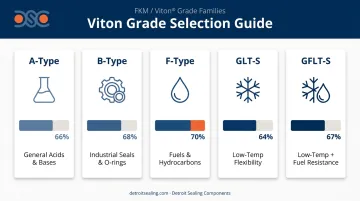
Higher fluorine content improves chemical resistance but can affect compression set performance and cold-side flexibility. Matching the grade to the specific media and temperature range is what delivers the performance improvement — a generic FKM specification sacrifices the gains that grade selection is designed to provide.
Beyond grade selection, groove design matters. Correct groove dimensions, surface finish, and hardware tolerances for the compound's durometer and cross-section determine whether even the right material performs as expected. A Viton O-ring in an undersized groove or on a rough surface finish won't seal reliably regardless of its chemistry.
Getting both grade and groove geometry right is where specification work pays off. Detroit Sealing Components stocks FKM compounds in 75 and 90 durometer across standard O-ring series including AS 568, BS 4518, metric, and several others. For applications where a standard grade needs validation against specific process media, DSC's ISO 17025 accredited lab supports custom material development and bench testing under customer-specified conditions — a practical step before committing a compound to production scale.
Conclusion
Viton O-rings earn their place in demanding applications through chemistry, not marketing. The carbon-fluorine bond structure delivers chemical inertness, thermal stability, and dimensional retention that standard elastomers genuinely cannot match in extreme environments.
The economics support the specification. The higher unit cost is offset by:
- Longer service intervals between scheduled replacements
- Fewer emergency changeouts during unplanned downtime
- Reduced risk of collateral equipment damage when a seal fails in a critical system
Material selection isn't a one-time decision. As operating conditions shift, process media changes, or new equipment enters service, the sealing specification should be revisited. The right O-ring for today's process may be the wrong one after a reformulation or pressure change — which is why periodic review matters as much as the initial specification.
Detroit Sealing Components works with engineers across industries to evaluate compound compatibility, validate performance requirements, and source Viton grades suited to specific operating conditions. If a process change has you questioning your current seal spec, that's the right time to reassess.
Frequently Asked Questions
What are the benefits of Viton O-rings?
Viton O-rings offer three core advantages: broad chemical resistance across fuels, oils, aromatic solvents, and mineral acids; continuous temperature performance up to 204°C; and low compression set that maintains sealing force over extended service intervals. Together, these properties reduce replacement frequency and total maintenance cost in chemically aggressive or high-heat service.
Viton O-rings vs. Nitrile O-rings: which is better?
Nitrile (NBR) works well for moderate petroleum oil and fuel exposure up to approximately 121°C, but Viton outperforms it in chemical diversity, temperature ceiling, and long-term dimensional stability. For heat, solvents, or extended service cycles, Viton is the better fit.
How long does a Viton O-ring last?
Service life depends on temperature, media, and pressure, but Viton consistently outlasts standard elastomers in aggressive service conditions. In stable environments with compatible media, Viton seals can remain in service for years between replacements — particularly in low-compression-set applications.
What temperature range can Viton O-rings handle?
Standard Viton grades perform reliably from approximately -20°C to 204°C continuously, with some grades tolerating intermittent exposure to 250°C. Specialized GLT and GFLT grades extend cold-side performance to approximately -40°C for applications requiring both low-temperature flexibility and chemical resistance.
Are Viton O-rings worth the higher cost?
For chemical exposure, elevated heat, or long maintenance intervals — yes. The higher unit price is offset by fewer replacements, less downtime, and reduced risk of collateral equipment damage, bringing total cost of ownership below that of standard elastomers.
What industries use Viton O-rings most commonly?
Oil & Gas, Automotive, Aerospace, Chemical Processing, Food & Beverage (FDA-grade formulations), Healthcare, and Semiconductor manufacturing all rely on Viton. Each sector faces some combination of chemical exposure, temperature extremes, or regulatory requirements that standard elastomers cannot meet.