Both materials are fluorinated elastomers, but that's roughly where the similarity ends. One is engineered for near-universal chemical resistance and extreme temperatures. The other delivers excellent performance across a broad range of industrial conditions at a fraction of the cost. Picking the right one means understanding what each material is actually built to handle — not just which one sounds more capable.
Key Takeaways
- Kalrez (FFKM): Perfluoroelastomer with resistance to over 1,800 chemicals and a temperature ceiling up to 327°C
- Viton (FKM): Fluoroelastomer with strong resistance to oils, fuels, and acids, rated to ~200°C
- Cost trade-off: Kalrez costs significantly more upfront but can reduce total operating costs in extreme environments through longer service life and fewer failures
- Grade matters: Both materials come in multiple grades — selecting the right one requires knowing your chemical exposure, temperature ceiling, and purity requirements
- How to choose: Weigh operating temperature, chemical aggressiveness, and total cost of ownership — not unit price alone
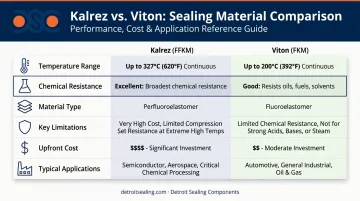
Kalrez vs Viton: Quick Comparison
| Factor | Kalrez (FFKM) | Viton (FKM) |
|---|---|---|
| Material Type | Perfluoroelastomer | Fluoroelastomer |
| Manufacturer | DuPont | Chemours |
| Temperature Range | -20°C to 327°C (grade-dependent) | -20°C to ~200°C |
| Chemical Resistance | Resistant to 1,800+ chemicals including solvents, amines, plasma | Excellent vs. oils, fuels, hydrocarbons, many acids |
| Limitations | Molten/gaseous alkali metals; grade-specific | Ketones, amines, high-temperature steam |
| Upfront Cost | 10–50x Viton unit price (grade-dependent) | Low-to-moderate unit cost |
| Typical Applications | Semiconductor fabs, pharma, aggressive chemical processing, downhole tools | Automotive fuel systems, aerospace, general industrial, chemical processing |
Cost and Total Ownership
Kalrez costs significantly more per unit than Viton, but DuPont's TCO analysis shows net savings of 4% to 98% depending on the application — once seal replacement frequency, installation labor, downtime, and contamination risk are included.
One documented example: in concentrated sulfuric acid service at CDR Pompe, FKM O-rings failed within 2 months. Kalrez Spectrum 6375 remained operational for more than 20 months. At that replacement ratio, the unit cost premium reverses well before the first year is out.
What Is Kalrez?
Kalrez is DuPont's perfluoroelastomer (FFKM): a fully fluorinated polymer that resists chemical attack at a molecular level. The fully fluorinated backbone puts it closer to PTFE (Teflon) in chemical inertness than any other elastomer — while still delivering the flexibility seals require. DuPont's published data covers resistance to more than 1,800 chemicals, solvents, and plasmas.
Because that chemical resistance is structural — not a surface treatment or additive — Kalrez seals maintain their dimensional integrity, compression set, and sealing force across conditions that degrade conventional elastomers. That translates to longer maintenance intervals and fewer unplanned shutdowns. Which grade delivers those benefits, though, depends entirely on the application.
Kalrez Grades: Not One Material
Key grades include:
- Kalrez 6375 — broad chemical resistance for chemical processing; rated to 275°C / -20°C lower limit
- Kalrez 7075 — maximum thermal resistance at 327°C; lower limit -18°C
- Kalrez 7275 — targeted at aggressive chemicals including concentrated nitric acid and organosilanes; rated to 300°C
- Kalrez 6380 — engineered specifically for hot, aggressive amines up to 225°C
- Kalrez 9100 — semiconductor grade for PECVD, ALD, HDPCVD, and conductor etch; rated to 300°C with ultra-low particle generation
- Kalrez 6221/6230 — pharmaceutical and life sciences grades with FDA Food Contact Notification 101 compliance
- Kalrez 0090 — downhole oil and gas grade with RGD resistance for sour H2S streams
- Kalrez 0040 — low-temperature specialty grade rated to -42°C
Where Kalrez Is the Right Call
Kalrez earns its place in environments where Viton simply won't survive:
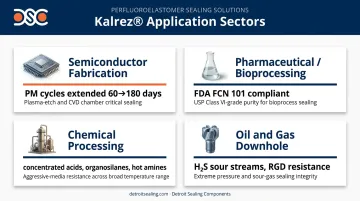
- Semiconductor fabrication: Kalrez 9100 is designed specifically for plasma etch, ALD, and PECVD processes. DuPont's case data documents PM-cycle extensions from 60 to 180 days in HDPCVD service — in fabs, that kind of interval reduction has real dollar value.
- Pharmaceutical and bioprocessing: Kalrez 6221 and 6230 meet FDA FCN 101 compliance for food-contact and life sciences applications where purity and extractables are non-negotiable.
- Concentrated acids, organosilanes, and hot amines rapidly degrade standard FKM. Grades 6375, 7275, and 6380 are built specifically for those environments.
- Oil and gas downhole: Kalrez 0090 handles high-pressure sour streams containing H2S with RGD (Rapid Gas Decompression) resistance, where seal failure means well integrity risk.
What Is Viton?
Viton is Chemours' fluoroelastomer brand : a partially fluorinated polymer based on vinylidene fluoride (VF2) and hexafluoropropylene (HFP) copolymers. First introduced in 1957 for aerospace applications, it has since become the default high-performance sealing material across most industrial sectors. One important distinction: Viton is a registered Chemours trademark, and not all FKM compounds are Viton.
Its partially fluorinated structure gives it strong resistance to hydrocarbons, oils, fuels, and many acids, while keeping it more processable and flexible than FFKM. Chemours' data puts continuous high-temperature service limits at 3,000 hours at 232°C and 1,000 hours at 260°C for appropriate grades, useful benchmarks when specifying seals for high-temperature service.
Viton Grades: A Spectrum, Not a Single Material
| Grade | Fluorine Content | Best For |
|---|---|---|
| Viton A | ~66% | Oils, hydrocarbons, broad general resistance |
| Viton B | ~68.5% | Better acid resistance than A-type |
| Viton F | ~69.5% | Enhanced resistance to oxygenated fuels and concentrated acids |
| Viton Extreme (ETP) | Variable | High-pH environments, MEK and low-molecular-weight carbonyls — beyond standard FKM |
Viton Extreme ETP fills a specific gap: standard FKM grades are attacked by high-pH materials and low-molecular-weight ketones like MEK, but ETP is engineered to handle both. When chemical exposure is the constraint rather than temperature, ETP can resolve the problem at a fraction of FFKM cost.
Where Viton Dominates
Viton is the default sealing material across a wide range of demanding industrial environments — for good reason:
- Automotive: Fuel injector O-rings, turbocharger seals, and underhood components subject to heat and fuel exposure
- Aerospace: Hydraulic system O-rings, gaskets, and hoses rated for high temperatures and aggressive aerospace fluids
- Chemical processing: Pumps and valves handling oils, mineral acids, aliphatic and aromatic hydrocarbons
- Food and beverage / pharmaceutical: Specialty FDA-compliant grades for process equipment where material safety matters
- General industrial: Wherever the chemical and thermal envelope falls within Viton's rated range — which covers the majority of industrial applications
The global fluoroelastomer market was valued at $1.69 billion in 2024 with a projected CAGR of 5.7% through 2030 — a scale that reflects Viton's position as the baseline for industrial sealing before more demanding conditions push the specification toward FFKM.
Kalrez vs Viton: Which Should You Choose?
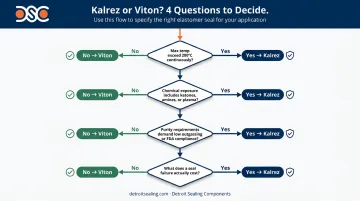
Four questions narrow the decision quickly:
- Does your maximum operating temperature exceed 200°C continuously? Standard Viton grades begin to degrade above this threshold. If yes, evaluate Kalrez grade options.
- Does your chemical environment include ketones, aggressive amines, plasma, or ultra-concentrated oxidizers? These push beyond standard FKM limits. Viton Extreme may cover some of this range; Kalrez covers the rest.
- Do purity requirements demand low outgassing, ultra-low particle generation, or FDA/USP compliance? Semiconductor fabs and pharmaceutical manufacturing often need Kalrez-grade cleanliness.
- What does a seal failure actually cost? Factor in replacement labor, process downtime, contamination cleanup, and any safety implications — not just the O-ring price.
Selection Guidelines by Application
Choose Kalrez when:
- Operating temperature exceeds 200°C on a sustained basis
- Chemical exposure includes materials outside Viton's compatibility range (amines, certain solvents, plasma environments)
- Contamination control is non-negotiable — semiconductor, pharma, or food-contact processes
- Seal failure carries significant safety, downtime, or contamination costs that justify the upfront premium
Choose Viton when:
- Operating conditions fall within the ~200°C / standard FKM chemical resistance range
- The application involves fuels, oils, hydraulic fluids, or common industrial acids
- Budget constraints are a real factor and the performance envelope doesn't require FFKM
- Standard grades meet purity requirements
Consider Viton Extreme (ETP) when:
- Chemical aggressiveness exceeds standard FKM but maximum temperature stays below FFKM territory
- The specific challenge is ketones, high-pH environments, or low-molecular-weight carbonyls
- Cost is a constraint and a middle-ground solution may perform adequately
For dual-exposure scenarios or unusual compound combinations, DSC's technical team and ISO 17025 accredited lab can validate material selection and test compounds under actual service conditions before you commit to production quantities.
Conclusion
Kalrez and Viton aren't in competition — they're designed for different operating realities. An engineer who knows their maximum temperature, chemical exposure profile, and acceptable failure risk already has most of the information needed to make the right call.
Choosing Kalrez in an environment where Viton would fail prevents costly downtime, contamination events, and repeated maintenance cycles. Defaulting to Kalrez where Viton performs adequately wastes budget without adding reliability. Cost-effectiveness means matching the material to the actual demand — and that match starts with knowing exactly what each environment asks of a seal.
Frequently Asked Questions
Frequently Asked Questions
How do Kalrez O-rings compare to Viton O-rings?
Kalrez (FFKM) resists 1,800+ chemicals and handles continuous service up to 327°C, while Viton (FKM) is rated for approximately 200°C with narrower chemical compatibility. Kalrez costs significantly more per unit but typically delivers longer service life in extreme environments, reducing total operating costs in high-failure-risk applications.
What chemicals are Kalrez O-rings incompatible with?
Kalrez should not be exposed to molten or gaseous alkali metals such as sodium and potassium. Compatibility also varies by grade — Kalrez 6380 is engineered for hot amines, while other grades are not. Use DuPont's grade-specific compatibility tools for any non-standard chemical environment.
Why are Kalrez O-rings more expensive?
Kalrez is produced using specialized fully fluorinated polymer chemistry that is inherently difficult and costly to manufacture at scale. The price premium also reflects extended service life — in aggressive environments, the per-unit cost of Kalrez typically runs lower than the cumulative cost of repeated FKM seal replacements.
Who makes Kalrez O-rings?
Kalrez is a registered trademark and product of DuPont, available through authorized distributors. Other manufacturers offer FFKM O-rings under different brand names — Chemraz by Greene Tweed (rated to 315°C) and Parker's ULTRA FFKM line offer comparable performance profiles for critical applications.
Can Viton O-rings be used in high-temperature applications above 200°C?
Standard Viton grades begin to degrade above approximately 200°C, making them unsuitable for sustained high-temperature service in processes like plasma etch or ALD. Viton Extreme (ETP) expands chemical resistance but does not extend the temperature ceiling — for applications above 200°C continuous service, Kalrez is the appropriate material.
What is the difference between Viton A, Viton B, and Viton Extreme?
Viton A (~66% fluorine) handles oils and hydrocarbons broadly and is the most widely used grade. Viton B (~68.5% fluorine) offers improved acid resistance. Viton Extreme (ETP) is engineered for aggressive chemical environments including high-pH media and ketones like MEK — it delivers substantially broader chemical resistance than standard FKM grades at a fraction of FFKM cost.