FKM (fluorine rubber) and silicone are both high-performance elastomers. On spec sheets, they can look interchangeable. In practice, they fail in completely different conditions — and understanding where each material breaks down is what separates a reliable sealing system from a costly maintenance problem.
This guide covers the key differences in material properties, performance data, and real application context to help you make the right call.
Key Takeaways
- FKM offers superior chemical resistance, continuous temperature performance up to ~230°C, and excellent compression set — best for fuel systems, oil & gas, and chemical processing
- Silicone excels in low-temperature flexibility (down to ~-60°C), biocompatibility, and weathering resistance — best for static seals in food-grade, medical, and general industrial settings
- FKM costs more upfront, but longer service life in harsh environments typically lowers total cost of ownership
- Never use silicone where prolonged contact with fuels, petroleum oils, or hydrocarbon solvents is expected
- Choose based on chemical exposure, temperature range, application type, and budget assessed as a whole
Fluorine Rubber vs. Silicone O-Rings: Quick Comparison
| Property | FKM (Fluorine Rubber) | Silicone (VMQ) |
|---|---|---|
| Composition | Fluorocarbon backbone; high C-F bond strength | Silicon-oxygen backbone with organic side groups |
| Temp Range (typical) | -26°C to 204°C continuous; some grades to 230°C | -54°C to 204°C; special compounds to -115°C / 260°C |
| Chemical Resistance | Excellent — fuels, oils, hydraulic fluids, solvents, acids | Limited — good for UV/ozone/moisture; poor against hydrocarbons |
| Application Type | Static and dynamic sealing | Static sealing only (low tear and abrasion resistance) |
| Compression Set | Excellent — retains seal integrity under sustained heat and pressure | Good — acceptable for static, low-stress applications |
| Cost | Higher — complex production, limited fluorocarbon supply | Lower — more accessible for general applications |
| Regulatory Compliance | FDA/USP grades available for food and pharma | FDA 21 CFR 177.2600 compliant grades widely available |
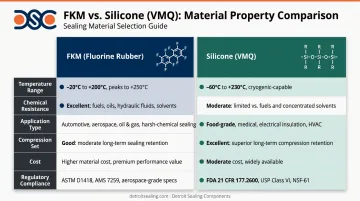
In summary: FKM wins on chemical and thermal toughness; silicone wins on low-temperature range, biocompatibility, and price.
What Is Fluorine Rubber (FKM)?
FKM is a synthetic fluoroelastomer — designated as fluorocarbon rubber under ASTM D1418 and ISO 1629. Its defining structural feature is a carbon-fluorine backbone. The C-F bond is one of the strongest in organic chemistry, and that molecular stability is what gives FKM its exceptional resistance to heat, aggressive chemicals, and degradation.
Core Performance Properties
According to the Parker O-Ring Handbook (ORD-5700), FKM handles:
- Continuous heat resistance up to 204°C, with specific material options up to 230°C
- Cold flexibility down to approximately -26°C (standard grades; specialized grades go lower)
- Full compatibility with mineral oils, gasoline, aromatic hydrocarbons, chlorinated hydrocarbons, HFD hydraulic fluids, and aliphatic hydrocarbons
- High vacuum service
FKM's low compression set is a critical practical advantage. Parker's testing of compound V0747-75 recorded a 66% compression set after 1,000 hours at 204°C — translating directly to fewer seal replacements and longer maintenance intervals in fuel, pressure, and chemical-contact applications.
FKM Grades and Subtypes
FKM is available in varying fluorine content levels — typically 66%, 68%, or 70% — with higher fluorine content yielding better chemical resistance at the cost of reduced low-temperature flexibility. For the most extreme chemical environments, FFKM (perfluoroelastomer) steps up further, handling temperatures to 320°C. For most demanding industrial applications, standard FKM grades are the practical choice.
Where FKM Is Used
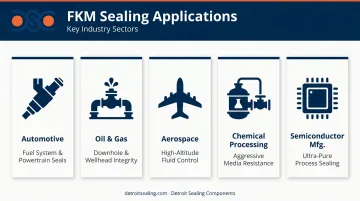
FKM is the standard specification in applications where seals contact aggressive media:
- Automotive: Fuel rails, injectors, fuel return lines — including ethanol-blended fuels (E10 through E85)
- Oil & gas: Pipeline seals, wellhead components, sour gas environments (qualified under ISO 23936-2 for elastomers in oil and gas production)
- Aerospace: Hydraulic systems and fuel lines (covered by SAE AMS7276 for high-temperature, fluid-resistant fluorocarbon sealing rings)
- Chemical processing: Pumps, valves, reactors exposed to solvents and concentrated acids
- Semiconductor manufacturing: Where chemical purity and resistance are both critical
DSC stocks FKM O-rings in hardness ranges from 55 to 90 Shore A across AS568, metric, and other international series. For applications with specific chemical exposures or temperature requirements, DSC's technical team can help identify the right compound grade.
What Is Silicone (VMQ)?
Silicone rubber — designated VMQ under ASTM D1418 — is built on an inorganic silicon-oxygen backbone rather than a carbon-carbon chain. That structural difference drives its distinctive performance: a broad usable temperature range, good UV and ozone resistance, and inherent biocompatibility that makes it viable in food and medical applications.
Core Performance Properties
Per Parker ORD-5700, silicone offers:
- Heat resistance to 204°C (special compounds to 260°C)
- Excellent cold flexibility to -54°C, with specialized compounds reaching -115°C
- Good resistance to UV, ozone, weathering, and animal/vegetable oils
- FDA 21 CFR 177.2600 compliance in food-grade grades (Parker lists multiple VMQ compounds — S0802-40, S0317-60, and others — meeting FDA requirements)
- USP Class VI and biocompatibility for medical and pharma applications
Where Silicone Falls Short
Parker explicitly lists silicone as incompatible with several common industrial media:
- Hydrocarbon-based fuels and aromatic hydrocarbons
- Low molecular weight chlorinated hydrocarbons
- Acids, alkalis, and steam above 121°C
Mechanically, tensile strength runs only 500–900 psi with poor tear resistance. That combination makes silicone unsuitable for dynamic sealing applications where wear and abrasion are ongoing concerns.
Silicone Subtypes Worth Knowing
Those limitations help explain why silicone has several variants targeting specific gaps:
- Standard VMQ: General-purpose silicone; the most commonly specified grade
- FVMQ (Fluorosilicone): Fluorine groups added to the polymer chain give this variant fuel and oil resistance while preserving silicone's temperature range — distinct from both VMQ and FKM, and priced accordingly
- LSR (Liquid Silicone Rubber): A processing variant used for injection-molded precision parts, particularly in medical and pharmaceutical applications
Where Silicone Is Used
Silicone is the right material when chemical exposure is benign but other performance demands apply:
- Food processing: FDA-compliant grades make it the default for seals in contact with food products
- Medical and pharmaceutical devices: USP Class VI and ISO 10993 compliance; biocompatibility and sterilization resistance
- HVAC and outdoor equipment: UV/ozone resistance suits long-term weathering exposure
- Consumer appliances and electrical enclosures: Good electrical insulation and vibration damping
DSC stocks VMQ silicone O-rings from 45 to 90 Shore A, including FDA-compliant and USP Class VI grades for food and medical applications.
FKM vs. Silicone: Which Should You Choose?
Four factors drive this decision, and they need to be evaluated together, not in isolation.
1. Chemical Environment (Usually the Deciding Factor)
| If the seal contacts... | Choose... |
|---|---|
| Fuels, petroleum oils, hydraulic fluids, solvents | FKM — silicone will swell and lose sealing integrity |
| Aromatic or chlorinated hydrocarbons | FKM |
| Water, steam below 121°C, dilute acids, food products | Silicone may be appropriate |
| UV, ozone, moisture, ambient air | Silicone |
If hydrocarbons are present, FKM is the answer — this single factor typically resolves the choice before the others even come into play.
2. Temperature Range
Both materials overlap significantly in the 0°C–200°C range. The differences matter at the extremes:
- Below -30°C: Standard FKM becomes rigid. Silicone (and FVMQ) retain flexibility much further down
- Above 200°C: FKM maintains shape and compression set more reliably under sustained heat
3. Application Type: Static vs. Dynamic
FKM is rated for both static and dynamic applications. Parker sets dynamic-service minimums at 1,000 psi tensile strength and maximum 10% volume swell — FKM meets both. Silicone's tensile strength tops out at 900 psi with poor tear resistance, making dynamic sealing a poor fit.
Rule of thumb: If the seal moves, use FKM.
4. Cost and Service Life
Silicone costs less upfront. But in the wrong environment — any environment involving fuels or oils — silicone degrades quickly and requires frequent replacement. FKM's higher initial cost is routinely offset by fewer replacement cycles and reduced maintenance in demanding applications.
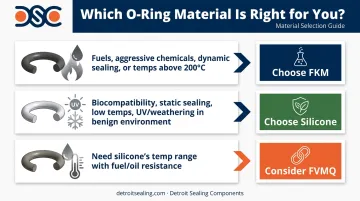
Situational Recommendations
- Choose FKM when the application involves fuels, aggressive chemicals, temperatures above 200°C, or any dynamic sealing requirement
- Choose silicone when you need biocompatibility, low-cost static sealing, wide low-temperature performance, or UV/weathering resistance in a chemically benign environment
- Consider FVMQ when you need silicone's low-temperature range with meaningful fuel or oil resistance — contact DSC's technical team when application parameters don't fit cleanly into either column
DSC's ISO 17025 accredited lab can test and validate compound performance for application-specific conditions, including custom compound development when standard grades don't meet the requirements.
Frequently Asked Questions
What is the difference between fluorine rubber (FKM) and silicone O-rings?
FKM's carbon-fluorine backbone gives it superior chemical resistance and heat stability — particularly against fuels, oils, and aggressive solvents. Silicone's silicon-oxygen backbone delivers broader low-temperature flexibility and biocompatibility. The critical difference is fuel and hydrocarbon resistance: FKM handles them, silicone doesn't.
Are silicone O-rings better than other rubber O-rings?
Silicone outperforms many rubbers in UV, ozone, and weathering resistance, and it's the default for food-grade and medical static sealing. However, it underperforms nitrile, EPDM, and FKM in tensile strength, abrasion resistance, and chemical resistance to fuels and oils — making it a poor choice for dynamic or chemically aggressive environments.
Is fluorosilicone the same as silicone?
No. Fluorosilicone (FVMQ) is a modified silicone with fluorine groups added to the polymer chain, giving it improved fuel and oil resistance while retaining silicone's broad temperature range. It bridges the gap between standard VMQ and FKM, but it's a distinct (and typically more expensive) material.
Can silicone O-rings be used in fuel or oil systems?
They should not be. Silicone swells significantly when exposed to hydrocarbons, losing its interference fit and sealing ability. This leads to leakage and potential system failure. FKM is the standard specification for fuel system seals for this reason.
What temperature range can FKM O-rings handle?
Standard FKM grades handle continuous service from approximately -26°C to 204°C, with select materials reaching 230°C. Short-term peaks beyond this are possible at higher temperatures, but compression set performance degrades. The low-temperature limit varies by compound — specialized grades extend to around -46°C.
Which O-ring material is better for food-grade or medical applications?
Silicone is generally the first choice: FDA 21 CFR 177.2600 compliant grades are widely available, biocompatibility is inherent to the material, and it handles sterilization well. FKM can also be specified for food and pharma applications using appropriate compound grades, but silicone is the default where chemical contact is benign.
Conclusion
FKM and silicone each solve different problems. FKM is the material for aggressive chemical environments, high-temperature service, and dynamic applications where seal integrity directly affects system safety. Silicone fits static sealing in food-grade, medical, and weathering-exposed applications where the chemical environment is benign.
Selecting the wrong material doesn't just mean a failed seal. It means unplanned downtime, replacement costs, and in critical systems, genuine safety exposure. The right choice translates directly to longer maintenance intervals and lower total cost of ownership.
For straightforward applications, the data in this guide points to a clear answer. Borderline temperatures, mixed chemical exposures, or conflicting performance demands are where material expertise changes the outcome. Detroit Sealing Components stocks FKM and silicone O-rings across hundreds of compounds and sizes, with an ISO 17025 accredited lab to back up material recommendations when the application demands it. Contact DSC's technical team with your operating temperature range, media exposure, and application type to get a compound recommendation matched to your specific conditions.