Introduction
Pneumatic cylinders are the workhorses of industrial automation. Found in automotive assembly lines, food packaging equipment, semiconductor fabrication, and oil & gas processing, these compressed-air-powered actuators convert pressure into precise linear or rotary motion — with consistent force, minimal contamination risk, and long service life.
But not all pneumatic cylinders work the same way, and choosing the wrong type creates real problems: inconsistent stroke force, excessive air consumption, and accelerated wear. In safety-critical applications, the wrong selection can create genuine risk.
According to a 2024 Global Industry Analysts report, the global pneumatic cylinders market was valued at $15.4 billion in 2023 and is projected to reach $20.2 billion by 2030 — driven by expanding automation across automotive, food processing, and semiconductor manufacturing.
This article breaks down the primary cylinder types, the specific benefits each delivers, common selection mistakes, and what factors actually matter when selecting the right actuator for your application.
Key Takeaways
- Pneumatic cylinders convert compressed air into mechanical motion — cleaner and quieter than hydraulics for most medium-force tasks
- The four primary categories are single-acting, double-acting, rodless, and specialty (rotary, tandem, telescopic)
- Selection depends on force direction, stroke length, available space, duty cycle, and fail-safe requirements
- Sealing components determine cylinder performance and service life; material compatibility with the operating environment is critical to longevity
- Match the cylinder type to your application requirements and you'll see better output, lower maintenance costs, and fewer unplanned stoppages
What Is a Pneumatic Cylinder?
A pneumatic cylinder is a mechanical actuator that converts compressed air energy into linear (or rotary) motion. Inside a sealed cylindrical bore, pressurized air pushes against a piston — that force transmits through a piston rod to move a load.
Core Components
Every cylinder relies on the same fundamental parts:
- Cylinder bore — the tube that contains and guides the piston
- Piston — the pressure-receiving element that generates force
- Piston rod — transfers piston motion to the external load
- End caps — seal both ends of the bore and house the air ports
- Seals and O-rings — maintain airtight separation between chambers and prevent external leakage
- Ports — where compressed air enters and exits
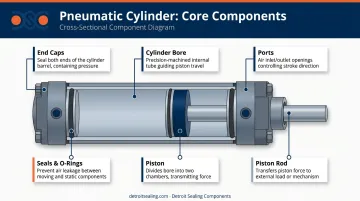
The integrity of sealing elements determines almost everything about long-term performance. Degraded or improperly specified seals cause air leakage between chambers, pressure loss, and accelerated wear.
DSC supplies wiper seals, rod seals, piston seals, and symmetrical seals engineered for pneumatic cylinder and valve applications — including the UC36 piston seal, designed for short-stroke configurations where installation space is tight.
Pneumatic vs. Hydraulic
The fundamental difference is the working medium: air versus fluid. This distinction matters practically:
- Air leaks don't contaminate surrounding equipment or products
- Pneumatic systems require no fluid storage tanks or disposal management
- Operation is quieter at typical industrial pressures
- Pneumatic cylinders are preferred in food & beverage, semiconductor, and healthcare environments where any contamination is unacceptable
ISO pneumatic cylinder standards are built around the 1,000 kPa / 10 bar pressure series — significantly lower than typical hydraulic operating pressures. That's why pneumatic systems suit medium-force, high-cycle applications rather than heavy pressing or lifting.
Types of Pneumatic Cylinders
Pneumatic cylinders are not one-size-fits-all. The right type depends on force direction, stroke length, available space, duty cycle, and the specific motion task.
Single-Acting Cylinders
How they work: Compressed air drives the piston in one direction only — typically extension. An internal spring (or gravity and the external load) returns the piston to its home position. A single air port connects to one side of the piston.
Best suited for: Applications where powered force is needed in only one direction:
- Part ejection and sorting
- Clamping and fixturing
- Braking systems
- Applications requiring a guaranteed return position if air pressure is lost
Key strengths:
- Lower cost and simpler valve/piping requirements
- Reduced air consumption (air only consumed on one stroke)
- Spring return provides a defined home position when pressure drops
Limitations to know:
- The spring occupies internal space, limiting achievable stroke length (SMC single-acting families range from 5 mm to 250 mm stroke depending on bore)
- Spring resistance reduces net output force throughout the stroke
- Spring fatigue over time can cause stroke inconsistency
- Not suitable for tasks requiring powered force in both directions
Single-acting cylinders make the most sense when the application genuinely needs force in one direction only. Using a double-acting cylinder in that scenario adds cost, air consumption, and valve complexity without any functional gain.
Double-Acting Cylinders
How they work: Two air ports — one for extension, one for retraction. Air pressure alone drives motion in both directions; there is no spring. This is the most versatile cylinder configuration for industrial automation.
Best suited for:
- Automated valve and gate control
- Pick-and-place systems and robotics
- Material handling and conveyor actuation
- High-cycle packaging equipment
- Any application requiring powered, controlled motion in both stroke directions
Key strengths:
- Full bidirectional force control throughout the stroke
- Longer achievable stroke lengths than spring-return designs
- Faster cycle speeds and greater design flexibility
- Available across a wide bore range (6 mm to 300 mm per SMC selection data)
- Many designs comply with ISO 15552 (32–320 mm bores), ensuring dimensional interchangeability across manufacturers
One important physics note: Extension force is always higher than retraction force in single-rod cylinders. The force formulas are F1 = η × A1 × P (extension) and F2 = η × A2 × P (retraction), where A2 is reduced by the rod's cross-sectional area. Size the cylinder based on whichever stroke direction is force-critical.
Limitations:
- Higher air consumption than single-acting designs
- More complex valve and piping requirements
- Piston position becomes indeterminate on sudden air loss — applications with fail-safe position requirements need additional locking mechanisms or sensors
Rodless Cylinders
How they work: Instead of an external piston rod, an internal piston connects to an external carriage or platform via a mechanical band, cable, or magnetic coupling. The carriage travels along the cylinder body, moving the load without any protruding rod.
The key space advantage: Parker's rodless cylinder catalog states rodless designs require nearly half the installation space of traditional rod-type cylinders for equivalent stroke — with standard strokes reaching 5,500 mm on some series.
Best suited for:
- Long-stroke conveyor and transfer applications
- Automated assembly lines with tight installation envelopes
- Pick-and-place machines and web cutting systems
- Applications where conventional cylinder-plus-stroke length would exceed available space
Three main variants:
| Variant | Mechanism | Best For |
|---|---|---|
| Band/mechanical | Corrosion-resistant steel inner seal band + dust cover | General industrial long-stroke use |
| Cable type | Cable connects piston to external carriage | Moderate-stroke, lighter loads |
| Magnetically coupled | Magnetic fields link internal piston to external carriage | Cleanroom, food-grade, contamination-sensitive environments |
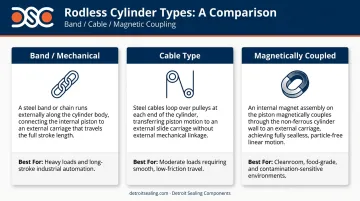
For cleanroom applications, Parker's OSP-P cleanroom series is certified to DIN EN ISO 14644-1 at ISO Class 4 (0.14 m/s) and ISO Class 5 (0.5 m/s). SMC also lists magnetically coupled rodless cylinders specifically rated for clean-room use. For these environments, DSC's wiper seals (UA6, UA7, UA25, UB1 series) provide the contamination barrier that keeps particulates from entering the cylinder tube — a direct requirement for maintaining cleanroom classification.
Limitations:
- More complex to maintain than rod-type cylinders
- Band and cable variants can develop positioning inaccuracy with wear
- Magnetically coupled types risk de-coupling under excessive moment or side loads
- Not well-suited for high side-load applications
Specialty Cylinders
Three additional cylinder types address specific performance requirements that standard designs cannot meet:
Rotary actuators convert compressed air into angular torque via rack-and-pinion or vane mechanisms. SMC rack-and-pinion units achieve arc lengths of 90, 180, 190, or 270 degrees depending on configuration. Parker single-vane rotary actuators cover 60 to 190 degrees. Choose rotary when the application requires angular positioning — valve actuation, indexing tables, robotic joints — not linear travel.
Tandem cylinders place two double-acting cylinders in series on a single rod, delivering approximately double the force for a given bore size. Choose tandem when maximum force is needed but bore size cannot be increased due to space constraints — heavy clamping and pressing are typical applications.
Telescopic cylinders use nested tube stages that extend sequentially, achieving very long strokes from a compact retracted length — useful in aerial lifts and extended-reach industrial equipment.
Specify specialty cylinders only after confirming that single-acting, double-acting, or rodless designs fall short. The added cost, installation complexity, and maintenance burden are worth taking on when the application leaves no other option — not as a default starting point.
How to Choose the Right Pneumatic Cylinder
Start with application requirements, not brand familiarity or what's in stock. Force direction and stroke length alone will filter most options immediately.
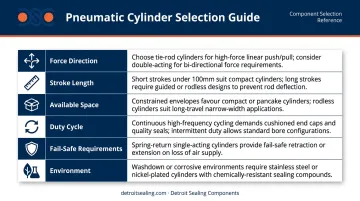
Selection Factors
| Factor | What to Consider |
|---|---|
| Force direction | One-way only → single-acting; bidirectional → double-acting or rodless |
| Stroke length | Short-to-medium → rod cylinders; long strokes → rodless |
| Available space | Tight envelope → ISO 21287 compact (20–100 mm bore); long stroke in tight length → rodless |
| Duty cycle | High-speed, high-frequency → double-acting |
| Fail-safe requirements | Guaranteed return position on air loss → single-acting spring return |
| Environment | Cleanroom/food → magnetically coupled rodless or stainless; oil & gas/aerospace → FKM or FFKM seals |
ISO Standards Matter for Interchangeability
Once you've narrowed your cylinder type, specifying an ISO-compliant model simplifies procurement, replacement, and cross-manufacturer sourcing:
- ISO 15552 — detachable-mounting cylinders, 32–320 mm bore, 10 bar series
- ISO 6432 — single-rod cylinders, 8–25 mm bore
- ISO 21287 — compact cylinders, 20–100 mm bore
Seal Material Is a Selection Variable, Not an Afterthought
Internal seals must match the operating environment — not just the pressure and bore. Application environment determines the compound:
- Oil & gas: FKM (-26°C to 250°C) or FFKM for aggressive chemicals and rapid gas decompression (RGD) per NORSOK M-710 and ISO 23936
- Food & beverage: FDA-compliant (CFR 177.2600) and NSF 61-certified compounds
- Pharmaceutical: USP Class VI materials as the baseline requirement
When standard catalog compounds fall short, DSC's ISO 17025 accredited laboratory develops and validates custom elastomer formulations matched to your specific operating conditions.
Common Mistakes to Avoid
Over-specifying the cylinder type. Reaching for a tandem or double-acting cylinder when a single-acting design would handle the job drives up cost and air consumption — and creates maintenance overhead that wasn't necessary.
Ignoring fail-safe requirements. A double-acting cylinder stops with the piston in an indeterminate position when air pressure drops. In applications where the load must return to a safe position on power loss, that outcome is a design flaw, not an acceptable trade-off.
Treating seal selection as a procurement afterthought. A cylinder correctly sized for force and stroke will still fail prematurely if internal seals are incompatible with operating temperature, chemical exposure, or washdown conditions. Food, pharmaceutical, and semiconductor environments routinely require material certifications — and degraded seals don't just leak. They reduce force output and disrupt stroke consistency throughout the cylinder's service life.
Frequently Asked Questions
Frequently Asked Questions
How do you choose the right pneumatic cylinder?
Start by identifying required force direction, stroke length, available installation space, duty cycle, and fail-safe requirements. Match those parameters to the appropriate cylinder type, then check ISO standard compliance (15552, 6432, or 21287) for interchangeability.
What are the different types of pneumatic cylinders?
The primary types are single-acting, double-acting, and rodless cylinders. Specialty types include rotary actuators, tandem cylinders, and telescopic cylinders, each suited to different force, space, and motion requirements.
What are the five basic components of a pneumatic system?
The five fundamentals are the compressor, air treatment unit (filter/regulator/lubricator), directional control valve, actuator (cylinder), and connecting tubing and fittings. Seals within each component are critical to maintaining system integrity and preventing air loss.
What is the difference between single-acting and double-acting cylinders?
Single-acting cylinders use compressed air for one stroke direction and a spring for return — simpler, less air-intensive, and inherently fail-safe. Double-acting cylinders use air for both strokes, delivering greater force and faster cycling at the cost of higher air consumption.
What are the advantages of pneumatic over hydraulic cylinders?
Pneumatic cylinders are cleaner, quieter, and lower cost to operate than hydraulic systems — air leaks pose no contamination risk and there's no fluid storage required. That makes them the preferred choice in food, pharmaceutical, and semiconductor applications where contamination cannot be tolerated.
How do seals affect pneumatic cylinder performance?
Internal seals maintain pressure separation between chambers and prevent air loss — degraded or incompatible seals cause pressure drop, inconsistent stroke force, and accelerated wear. Seal material must match the operating temperature, pressure, and chemical environment for reliable long-term performance.