The challenge is that most cylinder failures don't happen suddenly. They develop gradually through worn seals, contaminated air supply, or misalignment — problems that are entirely preventable with the right maintenance approach.
This guide covers the key warning signs of cylinder failure, a step-by-step repair process, preventive maintenance practices, and a practical maintenance schedule to help you extend cylinder life and reduce unplanned stoppages.
Key Takeaways
- Worn seals, poor lubrication, contamination, and side loading cause most pneumatic cylinder failures — and all are preventable with proper maintenance
- Watch for audible leaks, slow actuation, erratic operation, and visible corrosion as early warning signs
- Most cylinders can be repaired by replacing seals and addressing hard component wear; severe structural damage warrants full replacement
- A tiered maintenance schedule — daily through annual — is the most reliable way to avoid unplanned downtime
- Match seal materials to your operating environment; that single choice determines how long each repair holds
Why Pneumatic Cylinder Maintenance Matters
Pneumatic cylinders operate under continuous mechanical stress, pressure cycling, and environmental exposure. In high-cycle production environments, that constant load accumulates quickly. When a cylinder fails without warning, the costs compound fast.
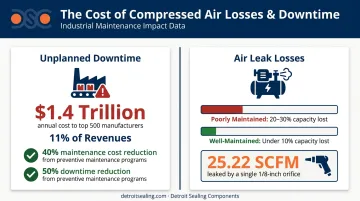
Siemens' 2024 manufacturing research found that unplanned downtime costs the world's 500 largest manufacturers roughly $1.4 trillion annually — about 11% of revenues. Predictive and preventive maintenance programs can reduce maintenance costs by 40% and cut unplanned downtime by 50%, based on the same research.
Air leaks — a direct result of neglected seals and fittings — are a measurable efficiency loss. According to DOE/NREL compressed air protocols, poorly maintained compressed air systems can lose 20–30% of capacity through leaks, while well-maintained systems stay below 10%.
That gap has real consequences at the component level. A single 1/8-inch orifice at 100 psig leaks 25.22 SCFM, enough to reduce cylinder output pressure and drive up compressor energy consumption.
The Safety Dimension
Failed cylinders don't just cause downtime. They create physical hazards. OSHA documented a 2018 incident at Tower Automotive where a maintenance employee tightened a loose pneumatic cylinder seal without first bleeding system pressure, resulting in crushing hand injuries and fractures to both hands. That incident is a clear reminder: pneumatic maintenance has safety consequences, not just operational ones. In regulated industries like food processing and aerospace, a cylinder failure can also trigger compliance issues that extend well beyond the plant floor.
The sections below cover exactly how to stay ahead of both — from routine inspection routines to seal replacement and leak detection.
Warning Signs Your Pneumatic Cylinder Needs Repair or Maintenance
Catching failure symptoms early prevents a minor seal replacement from becoming a full cylinder rebuild. Treat these signs as actionable alerts.
Performance or Output Changes
Watch actuation behavior first — it's the most direct window into cylinder health.
- Sluggish or failed actuation — Points to low supply pressure, undersized control lines, or a faulty metering valve. SMC's maintenance guidelines flag changes in piston speed or cycle time as early indicators of developing problems.
- Elevated actuation pressure — Mechanical binding or misalignment forces the system to compensate, accelerating wear on seals and rods.
Unusual Sounds or Erratic Operation
Noise and irregular motion are easy to dismiss — but both signal active component degradation.
- Hissing or audible leaks — Indicates leakage at a rod seal, worn piston, or deteriorated fitting. Even minor leaks measurably reduce output pressure and efficiency.
- Rhythmic variation or mid-cycle hesitation — Signals a system imbalance that affects cycle accuracy and accelerates component wear. Machinery Lubrication links erratic cylinder behavior directly to side-load mounting, contamination, lubrication loss, and operating-limit violations.
Visible Wear, Corrosion, or Structural Damage
Surface condition on the rod, tube, and end caps tells you how much life remains.
- Rust, pitting, or erosion on the rod, body, or end caps — Humidity, temperature extremes, and chemical exposure accelerate surface degradation that compromises structural integrity.
- Scored tube interior or worn rod surface — Requires immediate attention. Scoring violates the surface roughness requirements (Rmax 1.0–4.0 µm) that Trelleborg specifies for seal mating surfaces, causing seal bypass and pressure loss.
Recurring Downtime or Intermittent Operation
Repeat failures point to a root cause, not just a worn part.
- Intermittent startup or mid-cycle stoppages — Frequently linked to overloading. Operating beyond rated capacity causes erratic behavior and accelerates rod end wear.
- Recurring failures in the same component — Usually signal misalignment, incorrect cylinder specification, or chronic contamination. Replacing the seal again without addressing the root cause restarts the failure cycle.
How to Repair a Pneumatic Cylinder: Step-by-Step
Most pneumatic cylinder repairs center on seal replacement and hard component inspection. Whether it's worth the effort depends on cylinder size, damage extent, and parts availability — but the process is consistent either way.
Step 1: Depressurize and Power Down
All compressed air must be fully exhausted and the power supply shut off before any disassembly begins. SMC's maintenance documentation instructs users to cut power and exhaust compressed air before any maintenance or removal. The OSHA incident referenced earlier illustrates exactly what happens when this step is skipped.
Step 2: Disassemble and Inspect All Components
Per Bimba and SMC OEM repair procedures:
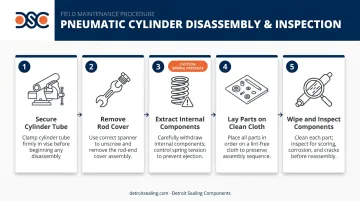
- Secure the cylinder tube in a vise
- Remove the rod cover with a spanner
- Extract internal components carefully — note that single-acting cylinders contain springs that can pressurize contents during disassembly
- Lay all components on a clean cloth to prevent particles from scratching seals during inspection
- Wipe grease from each part and inspect the piston rod, cylinder tube interior, bushing, and piston for scoring, corrosion, uneven wear, or cracks
Step 3: Replace Seals with Correctly Specified Components
Replace all seals in the kit whenever the cylinder is opened — rod seal, piston seal, tube gaskets, and O-rings — even if only one appears visibly worn. Seal kits for common tie-rod cylinders range from $7.47 to $131 depending on bore size and series (based on SMC and NITRA kit pricing from Grainger and AutomationDirect).
Seal material selection determines how long your repair lasts:
| Material | Best For | Temperature Range |
|---|---|---|
| NBR | General pneumatic applications | -40°C to 100°C |
| FKM (Viton-type) | High-temperature and chemical exposure | -26°C to 250°C |
| EPDM | Water, steam, and certain chemical resistance | -55°C to 125°C |
| PTFE/Turcon | Dry-running, low-friction applications | -50°C to 200°C |
For sourcing these seal types, Detroit Sealing Components stocks pneumatic-specific profiles including wiper seals (UA6, UA7, UA25, UB1), rod seals (UB3), piston seals (UC3, UC7, UC36), symmetrical rod and piston seals (UF5, UF6), and damper seals (UE1) — available in NBR, FKM, EPDM, HNBR, and other compounds matched to your operating environment. When standard materials fall short, their ISO 17025 accredited lab can custom develop and test compounds for specific application requirements.
Step 4: Address Hard Component Damage
When the issue goes beyond seals:
- Scored or corroded piston rod — Replace if damage is significant. Even minor scoring will shred the new rod seal on every stroke, so don't attempt to reuse a damaged rod.
- Worn barrel — Minor scoring may be honed back to spec; severe damage may require replacement. Trelleborg's seal guidance confirms that scores and machining marks are not permitted on seal mating surfaces.
- Worn bushings — Always replace. Bushings are sacrificial components designed to protect the head; worn bushings transfer load stress directly to the seals.
Step 5: Lubricate, Reassemble, and Test
Lubricate these components with manufacturer-recommended grease before reassembly:
- Rod seal and rod seal groove
- Piston seal inner and outer surfaces, and piston seal groove
- Piston rod surface
- Cylinder tube inner surface
- Tube gaskets
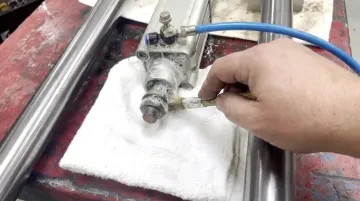
After reassembly, apply low operating pressure and check for leaks using soapy water around the rod seal, end seals, and cushion pockets. Bubbles indicate reassembly issues requiring re-inspection before returning the cylinder to service. SMC also requires evenly tightened tie-rod nuts to specified torque before final pressurization.
Pneumatic Cylinder Preventive Maintenance Tips
Most cylinder failures trace back to installation errors, neglected lubrication, or contamination that accumulates over time. These practices address the root causes.
Proper Installation and Alignment
Side loading — lateral force on the piston rod rather than along the cylinder axis — is one of the most frequent causes of accelerated seal wear and tube scoring. SMC's maintenance documentation explicitly warns that failing to align the rod axis with the load direction can damage the inner tube surface, bushings, and seals.
- Verify mounting hardware is torqued correctly on tie rods
- Maintain parallelism between the load path and cylinder axis
- Where side loading cannot be fully eliminated, use guided cylinder configurations
Lubrication and Seal Material Selection
Check lubrication levels on all dynamic components — rod seals, piston surfaces, tube inner surface — on a schedule matched to operating conditions. High-heat environments, chemical exposure, and washdown applications all increase lubrication frequency requirements.
Seal material selection is equally critical — a compound mismatched to the operating environment will fail before the next planned service interval:
- NBR for standard general-purpose pneumatic applications
- FKM for chemical exposure or temperatures above 100°C
- EPDM for washdown environments and water resistance
- PTFE-based seals for dry-running or ultra-low-friction requirements
Selecting the right compound requires knowing your operating temperature range, media exposure, and regulatory requirements. DSC's technical team can specify the correct material across hundreds of rubber compounds, including FDA-compliant grades for food processing and materials qualified for aerospace applications.
Filter and Air Quality Management
Contamination is a primary driver of internal cylinder damage. ISO 8573-1:2010 classifies compressed air contaminants by solid particles, water, and oil content; maintaining the right purity class for your application prevents premature seal and surface wear.
Steps to maintain air quality:
- Change air filters on the schedule specified by your FRL unit manufacturer
- Inspect fittings routinely for rust or corrosion — corroded fittings introduce particulates directly into the cylinder
- Disassemble cylinders only in clean environments, on clean cloth, to prevent contamination during service
Routine External Inspection
- Clean external cylinder surfaces regularly to make leaks and damage visible before they escalate
- Inspect rod surfaces for nicks or scoring that will damage the rod seal on each stroke
- Check fittings and end caps for corrosion indicators
- For cable cylinders, verify the nylon jacket is intact — damage accelerates seal wear
Pneumatic Cylinder Maintenance Schedule
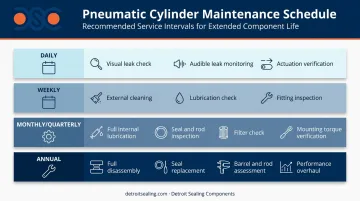
After any repair, the right maintenance schedule is what prevents the next failure. No single interval applies universally — cycle frequency, operating environment, load conditions, and manufacturer specs all shape the right cadence. Use this as a baseline and adjust for your application.
| Frequency | Tasks |
|---|---|
| Daily | Visual leak check; listen for audible air leaks; verify smooth actuation |
| Weekly | External cleaning; check lubrication on accessible components; inspect fittings for rust or wear |
| Monthly/Quarterly | Full lubrication of all internal components; inspect seals and rod surface condition; check filter condition; verify mounting hardware torque |
| Annual | Full disassembly inspection; replace all seals if approaching rated cycle counts; assess barrel and rod condition; overhaul if performance has degraded |
Usage profile adjustments:
- High-cycle automated environments (automotive assembly, packaging lines): Compress intervals at every tier — don't wait for monthly checks to catch weekly-grade problems
- Harsh environments (food processing washdowns, chemical exposure, outdoor use): Increase lubrication and filter check frequency regardless of cycle count
- Intermittent-use cylinders: Exercise them regularly even during low-demand periods; seals dry out and lose elasticity without regular movement
Frequently Asked Questions
How much does it cost to repair a pneumatic cylinder?
Seal replacement kits for common cylinder series run from roughly $7 to $131 depending on bore size and brand. Total repair cost increases significantly when barrel honing, rod replacement, or bushing work is required, plus labor. For larger industrial cylinders, professional repair shop labor can add considerably to parts cost.
Can a pneumatic cylinder be repaired?
Most pneumatic cylinders can be repaired through seal replacement and hard component servicing. Cylinders with severely scored barrels beyond honing tolerance, bent rods, or cracked end caps are generally more cost-effective to replace than repair entirely.
How long do pneumatic cylinder seals last?
Seal lifespan is driven by cycle count, operating pressure, lubrication, and seal material compatibility. Some cylinder models are rated up to 100 million full cycles — but only under correct specification and consistent maintenance. Mismatched materials or poor lubrication cut that figure significantly.
What is the lifespan of a pneumatic cylinder?
A well-maintained cylinder in light-duty service can last indefinitely with periodic seal replacement. Heavy-duty industrial cylinders are measured in millions of cycles, with maintenance quality being the single biggest variable.
How to tell if a pneumatic cylinder is bad?
Key indicators include audible air leaks, slow or failed actuation, erratic or non-smooth operation, intermittent startup, and visible corrosion or scoring on the rod or cylinder body. Any of these warrant immediate inspection to prevent further damage.
What is the most common cause of pneumatic cylinder failure?
Seal wear and degradation, typically accelerated by insufficient lubrication, contaminated air supply, or side loading from improper installation. Each of these is preventable — consistent maintenance routines and correctly specified seal materials address all three.