Introduction
Specifying the wrong seal type is a more common mistake than most engineers would admit. Both oil seals and O-rings are elastomeric sealing components — but their designs, motion tolerances, and application profiles differ enough that swapping one for the other leads directly to premature failure, leaks, and unplanned downtime.
According to SKF, improper installation and selection are the most common reasons for premature seal failure. Siemens reports that unplanned downtime costs the world's 500 largest companies 11% of annual revenues — which means seal selection is a direct cost control decision.
This article breaks down what each seal is, how they work, where each belongs, and how to choose correctly based on motion type, media, and operating conditions.
Key Takeaways
- Oil seals (shaft seals, radial lip seals) are built for rotating shafts — they use a spring-loaded lip to contain oil or grease against continuous rotary motion.
- O-rings are circular elastomeric rings that compress in a machined groove to seal liquids or gases in static, reciprocating, or oscillating applications.
- The core difference is motion type: oil seals track a rotating shaft, while O-rings rely on groove compression to seal.
- Use an oil seal for rotating shaft assemblies; use an O-ring for static joints, hydraulic ports, flanges, and low-speed reciprocating applications.
- Material selection matters for both — match the compound to your fluid and temperature for long-term seal integrity.
Oil Seal vs O-Ring: Quick Comparison
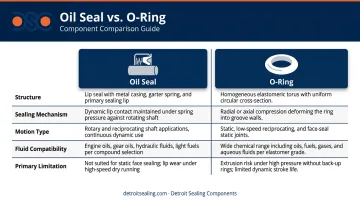
The table below breaks down the key differences at a glance — structure, motion type, fluid compatibility, and where each seal falls short.
| Feature | Oil Seal | O-Ring |
|---|---|---|
| Structure | Metal case + elastomeric lip + garter spring | Circular torus, round cross-section |
| Sealing Mechanism | Lip contacts rotating shaft surface | Compressed in a precision-machined groove |
| Motion Type | Continuous rotary or reciprocating | Static, reciprocating, oscillating — not continuous rotary |
| Fluid Compatibility | Oil and grease (lubricants) | Water, oils, fuels, gases, chemicals — depends on compound |
| Dimensional Standards | DIN 3760, ISO 6194-1 | AS568 (inch), ISO 3601 (metric) |
| Primary Limitation | Requires precise shaft finish and hardness | Not suited for continuous rotary shaft applications |
What Is an Oil Seal?
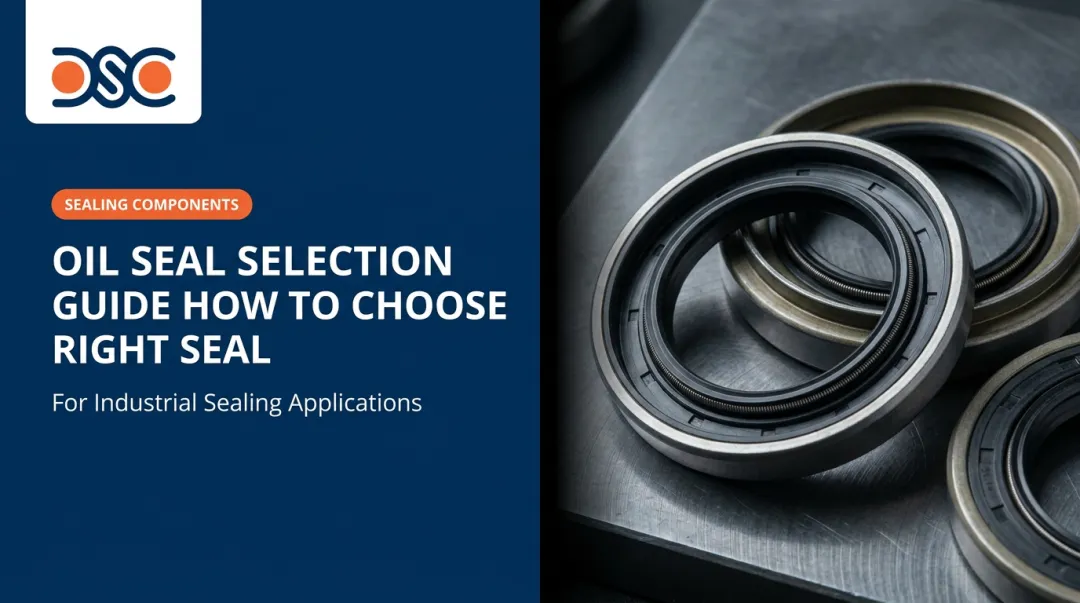
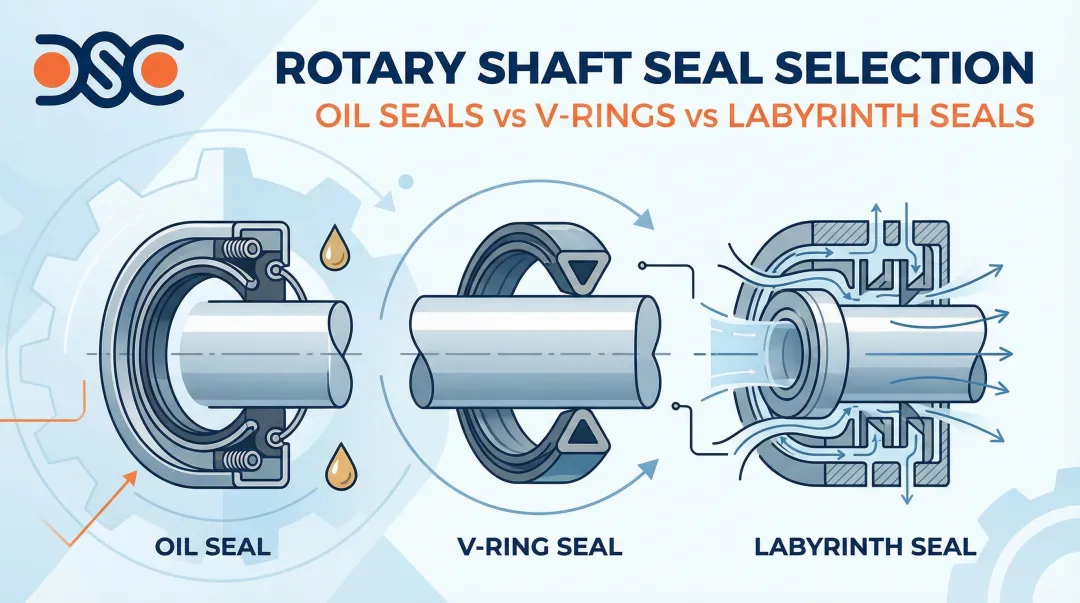
As defined by SKF, a radial shaft seal sits between rotating and stationary components, using a flexible elastomeric lip pressed against the shaft surface by a garter spring to maintain contact. The outer casing — typically sheet steel or elastomer — is pressed into the housing bore to create a static fit.
How the Garter Spring Works
The garter spring applies consistent radial load against the shaft, keeping the sealing lip in contact even as the shaft rotates and as the lip wears over time. This self-compensating design accommodates minor shaft runout and small misalignments, making it fundamentally different from static seals like O-rings.
Single-lip designs contain lubricant. Double-lip designs add a second lip that faces outward to exclude external contaminants like dirt, water, and airborne debris — useful in agricultural and off-highway equipment where ingress contamination is a constant threat.
Oil Seal Lip Materials
| Material | Best For |
|---|---|
| NBR (Nitrile) | Standard petroleum oils and greases; cost-effective |
| FKM (Viton) | High temperatures, aggressive chemicals |
| Silicone (VMQ) | Wide temperature range applications |
| PTFE | Low friction, chemical resistance; requires harder shaft (58–62 HRC) |
SKF specifies that the shaft counterface typically requires a minimum of 30 HRC hardness and a surface roughness of Ra 0.2 to 0.5 μm. A scored or poorly finished shaft will fail the seal regardless of lip material.
Where Oil Seals Are Used
Oil seals appear wherever a rotating shaft passes through a stationary housing and lubrication must stay contained:
- Automotive crankshaft, camshaft, and wheel hub seals
- Gearbox and speed reducer output shafts
- Hydraulic pump drive shafts
- Electric motor shaft ends
- Agricultural axle seals (tractors, combines)
- Industrial conveyor drive shafts and compressors
These applications span virtually every industry on the list above — and DSC stocks oil seals across this full range, from automotive and oil & gas to agriculture and general industry.
What Is an O-Ring?
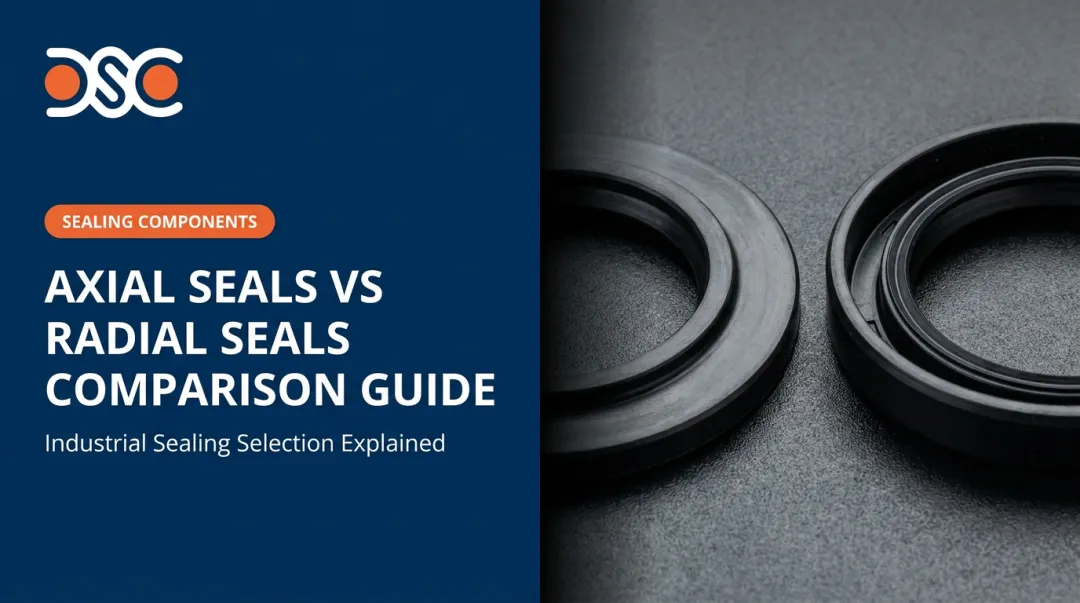
An O-ring is a precision-molded, torus-shaped elastomeric seal with a circular cross-section. It sits in a machined groove (gland) and is compressed between two mating surfaces — a flange face, port fitting, or cylinder bore — to create a fluid-tight or gas-tight barrier.
They're the most commonly specified sealing element in industrial design — simple, inexpensive, and compatible with an enormous range of fluids and gases when matched to the right elastomer compound.
Static vs. Dynamic O-Ring Applications
Static applications are the most common and most reliable:
- Pipe flanges and face seals
- Valve bodies and port plugs
- Pump housing covers
- Threaded fittings and connectors
In static applications, the O-ring compresses once and doesn't move. Properly designed and installed, these can outlast the equipment they're sealing.
Dynamic applications (reciprocating rod seals, piston seals) are more demanding. Friction requires careful groove design, appropriate Shore hardness, and adequate lubrication to prevent extrusion or abrasion. Parker's engineering guidelines note that O-rings with cross-sections larger than 0.139 inches are not recommended for rotary seal applications — friction and surface area become limiting factors quickly.
O-Ring Material Families
DSC carries O-rings across hundreds of compounds, including:
- NBR (Nitrile) — General purpose; oil and fuel resistant. 70 and 90 durometer. Rated –40°C to 100°C.
- FKM (Fluorocarbon/Viton) — High temperature and chemical resistance. 75 and 90 durometer. Rated –26°C to 250°C.
- EPDM — Excellent for water, steam, and brake fluids; poor for petroleum oils.
- Silicone (VMQ) — Wide temperature range; food and medical grade available.
- FFKM (Perfluoroelastomer) — Ultra-pure and chemically inert; used in semiconductor processing environments.
- HNBR, XNBR, ACM — Specialized compounds for aggressive petroleum-based fluid environments.
For food and beverage applications, FDA 21 CFR 177.2600 governs rubber articles intended for repeated food contact. DSC stocks FDA-compliant EPDM and silicone compounds certified to this standard. NSF 61 and NSF 42 compliant materials are also available where required.
O-Ring Sizing
DSC's inventory conforms to multiple international standards: AS568 (SAE inch-series), ISO 3601 (metric), JIS B2401, BS 4518, and others. Sizes range from 0.5mm ID to 1,600mm ID, covering both metric and imperial applications across all industries.
Which Should You Choose?
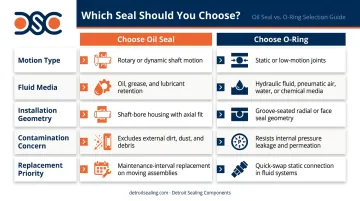
The decision comes down to five factors evaluated together — not individually.
Decision Framework
| Factor | Choose Oil Seal | Choose O-Ring |
|---|---|---|
| Motion type | Continuous rotary shaft | Static, reciprocating, oscillating |
| Fluid media | Oil or grease lubricants | Water, fuels, gases, chemicals, food media |
| Installation geometry | Shaft penetrating a housing bore | Grooved face seal, port, or flange |
| Contamination concern | Yes — lip excludes external contaminants | Limited — depends on application design |
| Replacement priority | Rotating equipment maintenance | Cost and ease of replacement matter |
When the Oil Seal Is the Right Choice
Use an oil seal when:
- A shaft continuously rotates through a stationary housing
- The media is petroleum-based oil or grease
- Self-compensating lip contact is needed for shaft runout or minor misalignment
- Contamination exclusion (dirt, water intrusion) is required alongside lubricant retention
Typical applications: gearbox output shafts, engine crankshafts, pump drive shafts, agricultural axle ends.
When the O-Ring Is the Right Choice
Use an O-ring when:
- The joint is static or involves reciprocating (not continuous rotary) motion
- You need to seal a wide range of fluids, gases, or chemically aggressive media
- Installation involves flanged ports, face seals, or threaded fittings
- Cost, replacement ease, and media flexibility are priorities
Typical applications: hydraulic cylinder end caps, valve body ports, pipe flange connections, pneumatic manifold fittings, food processing line connections.
Can You Substitute One for the Other?
In rotating shaft applications, the two are not interchangeable.
An appropriately compounded O-ring can seal oil effectively in static applications — a port plug or sump face seal, for example. But in a continuously rotating shaft application, an O-ring cannot replicate what an oil seal does. It lacks the spring-loaded lip geometry, it doesn't track shaft runout, and friction destroys it quickly.
Conversely, an oil seal is over-engineered and geometrically inappropriate for a standard static pipe joint where an O-ring would work reliably and cost less.
For most applications, one or the other is clearly correct. Where unusual geometry, aggressive chemical compatibility, or extreme temperature requirements push beyond standard catalog options, custom-molded sealing profiles are worth considering. DSC supports custom design through computer-aided design and finite element analysis, with compound development and material compatibility testing performed in its ISO 17025 accredited lab — before any full production commitment.
Conclusion
Oil seals and O-rings are not interchangeable — they're complementary tools for different sealing problems. Oil seals handle dynamic rotary containment of lubricants; O-rings handle versatile, wide-media sealing in static and reciprocating applications. Choosing based on motion type and fluid media, rather than size or availability, prevents premature failures and keeps maintenance costs under control.
Before ordering a replacement or specifying a new design, confirm the four parameters that drive the right seal selection:
- Shaft speed and motion type
- Fluid media and chemical compatibility
- Operating temperature range
- System pressure
When those parameters push beyond standard catalog options — an aggressive chemical environment, a food-grade requirement, an unusual bore geometry — DSC's technical team can match you to the right compound from hundreds of available rubber types, with ISO 17025 lab-backed validation when the application demands it.
Frequently Asked Questions
Is an O-ring the same as an oil seal?
No. An oil seal is a multi-component assembly — metal case, elastomeric sealing lip, and garter spring — engineered specifically for rotating shaft applications. An O-ring is a simple circular elastomeric ring used in machined grooves for static and reciprocating sealing across many fluid types.
What is the difference between an O-ring and an oil seal?
Oil seals use a spring-loaded lip that tracks a rotating shaft and retain lubricant. O-rings compress between mating surfaces for static or reciprocating seals, and can be compounded for water, fuels, gases, chemicals, or food-grade media.
What is another name for an oil seal?
Oil seals are also called shaft seals, rotary seals, radial lip seals, or grease seals. Each term describes the same dynamic sealing device used where a rotating shaft passes through a stationary housing.
Can an O-ring be used instead of an oil seal?
In static oil-containing applications, such as a port plug or face seal, a properly compounded O-ring can work. In continuous rotary applications, it will fail rapidly — rotational friction destroys O-ring sealing surfaces quickly without the spring-loaded lip contact that oil seals provide.
What materials are oil seals typically made from?
The most common lip materials are NBR for standard oil and grease service, FKM (Viton) for high-temperature or chemically aggressive environments, silicone for wide temperature ranges, and PTFE for low-friction or chemical resistance needs. PTFE-lipped designs require harder shaft counterfaces (58–62 HRC).
Which lasts longer — an oil seal or an O-ring?
Neither inherently outlasts the other — service life comes down to correct selection and installation. A well-specified oil seal can run for tens of thousands of hours; a properly seated O-ring can outlast the surrounding equipment. Both fail prematurely when misapplied or installed incorrectly.