Introduction
A water treatment facility in California faced regulatory scrutiny when routine testing revealed trace contaminants in their distribution system. The culprit? Non-certified seals in critical pumping equipment leaching chemicals into the drinking water supply. The facility faced immediate shutdown orders, costly retrofits, and litigation exposure—all because the seals lacked proper NSF 61 certification.
NSF 61 certification is mandatory for water system components across most of North America — currently enforced in 49 U.S. states and 11 Canadian provinces under NSF/ANSI/CAN 61 standards.
For water system engineers, specifying non-certified seals isn't just a compliance gap. It creates direct legal liability and measurable public health risk.
This article covers NSF 61 certification requirements for sealing components, material selection by water chemistry, and what to look for in a compliant supplier.
TLDR: Key Takeaways About NSF 61 Certified Seals
- NSF 61 is mandatory in 49 U.S. states and 11 Canadian provinces—non-compliance triggers regulatory violations and project shutdowns
- Certification prevents harmful leaching by limiting contaminants like lead, heavy metals, and VOCs through rigorous extraction testing
- Certification applies to complete seal assemblies, not just base materials; compound formulation and manufacturing location both affect listing status
- Common certified materials include EPDM, specific FKM grades, and silicone, but compound formulation determines certification
- Always verify supplier documentation, NSF listing numbers, and batch traceability before specifying seals
What is NSF 61 Certification?
NSF/ANSI/CAN 61: Drinking Water System Components – Health Effects is the American National Standard governing health requirements for drinking water infrastructure. It sets maximum allowable contaminant levels that can leach from materials — including seals and gaskets — into potable water over time.
Its regulatory reach is broad, which is why specification compliance matters from the component level up.
Regulatory Landscape
The regulatory adoption of NSF 61 is extensive:
- United States: 49 states require NSF 61 compliance for centralized water treatment plants
- Canada: 11 provinces and territories mandate NSF/ANSI/CAN 61 compliance
- Enforcement: U.S. EPA, state primacy agencies, and Canadian provincial authorities enforce compliance
Washington State regulations explicitly mandate that all materials in "substantial contact" with potable water supplies must conform to NSF 61. California prohibits the use of any gasket or joining material in drinking water contact that hasn't been tested and certified to the standard.
Maximum Allowable Contaminant Levels
NSF 61 establishes pass/fail criteria based on toxicological data:
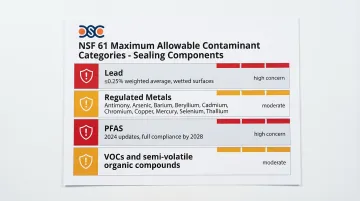
- Lead: Weighted average ≤0.25% for wetted surfaces
- Regulated metals: Antimony, arsenic, barium, beryllium, cadmium, chromium, copper, mercury, selenium, and thallium
- PFAS: 2024 updates integrate testing for per- and polyfluoroalkyl substances, with full compliance required by 2028
- VOCs: Volatile organic compounds and semi-volatile organic compounds
Certification Terminology
Three terms appear across specifications — and they don't mean the same thing:
- NSF 61 certified: The complete, assembled product has been tested and carries a verifiable listing number in the NSF database
- NSF 61 compliant materials: The raw materials meet composition standards, but the finished assembly hasn't been independently tested
- NSF 61 approved: Used interchangeably with "certified" in most contexts, though not a formal NSF designation
Always specify "NSF 61 certified" products with a verifiable listing number. "Compliant materials" offers no assurance that the assembled component performs to the standard.
Why NSF 61 Certification Matters for Water System Engineers
Legal Liability and Regulatory Consequences
Using non-certified components creates immediate legal exposure:
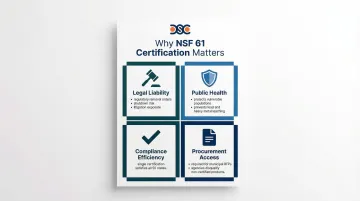
- State agencies can order immediate removal of non-certified products from active systems
- Facilities may face operational shutdowns until full compliance is restored
- Contractors risk paying out of pocket to remove and replace non-compliant components
- Contamination events tied to unverified materials expose project teams to litigation
Public Health Responsibility
Even trace contaminants accumulate over time, particularly affecting vulnerable populations including children and the elderly. NSF 61 certification ensures that seals, gaskets, and O-rings don't contribute lead, heavy metals, or chemical compounds to drinking water supplies.
Streamlined Compliance
Protecting public health starts with documentation that holds up at the regulatory level. Certified seals come with test records that simplify approval across multiple jurisdictions — rather than running independent tests for each jurisdiction, engineers can rely on NSF certification to satisfy requirements across all 50 states.
Competitive Bidding Requirements
That compliance documentation also has direct procurement consequences. Municipal RFPs explicitly require NSF 61 certification — Pinellas County, Florida specifications mandate that gaskets "comply with and be labeled as approved by the National Sanitation Foundation (NSF) for use in potable water lines meeting NSF 61." The City of San Diego requires suppliers to provide "certification product is certified as suitable for contact with drinking water by an accredited certification organization in accordance with NSF/ANSI 61 and 372."
Agencies disqualify non-certified products regardless of cost advantages.
Risk Mitigation Through Ongoing Oversight
Certification provides ongoing third-party audits of manufacturing facilities, ensuring consistent material quality and reducing the risk of undisclosed substitutions. NSF conducts these audits at approved manufacturing locations on a regular schedule.
NSF 61 Requirements for Sealing Components
Meeting NSF 61 certification isn't just about choosing the right elastomer. Every component in a seal assembly — and every step in its production — must satisfy specific material, testing, manufacturing, and documentation requirements. Here's what engineers need to understand before specifying certified seals.
Material Composition Requirements
All components of a seal assembly must meet leaching limits:
- Elastomers (base polymers)
- Metals (if used in bonded assemblies)
- Lubricants (applied during manufacturing or installation)
- Coatings and process aids
Extraction Testing Protocol
Certification involves rigorous testing to simulate worst-case leaching conditions:
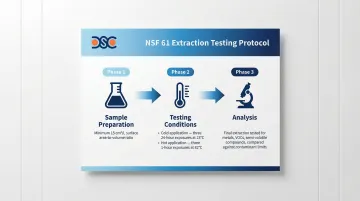
Sample Preparation:
- Minimum surface area-to-volume (SA/V) ratio of 15 cm²/L (8.8 in²/gal)
- If field application uses higher ratios, testing must match that ratio
Testing Conditions:
- Cold application: Three sequential 24-hour exposures at 23°C (73°F); third extraction analyzed
- Hot application: Three sequential 1-hour exposures at 82°C (180°F)
Analysis:
- Final extraction water analyzed for metals, VOCs, and semi-volatile organic compounds
- Results compared against maximum allowable contaminant levels
Manufacturing Location Requirements
Certification is facility-specific:
- Production must occur at NSF-approved facilities
- Facilities undergo multiple third-party audits
- Quality management systems must be documented
- Process parameters (molding, curing) must be verified not to affect leachate levels
Traceability and Documentation
Each batch must include:
- Material certifications with traceable batch numbers
- Date of manufacture or batch identification
- NSF listing numbers
- General arrangement (GA) drawings for custom seals
- Proper NSF 61 labeling on packaging
Design Change Limitations
Those documentation requirements exist for good reason: any modification to materials, dimensions, or manufacturing processes requires re-testing and re-approval. Standardized designs are preferred because they hold certification without triggering a full re-evaluation cycle — a significant time and cost factor for procurement teams.
Lubricant and Assembly Considerations
Any lubricants, adhesives, or process aids used during seal installation must also meet NSF 61 standards. Using non-certified lubricants during installation voids the seal's compliance status, even if the seal itself is fully listed.
Selecting NSF 61 Certified Seals: Key Considerations for Engineers
Assess Application-Specific Requirements
Before specifying seals, evaluate:
- Water chemistry: pH levels, chlorine vs. chloramine treatment, temperature ranges
- Pressure ranges: Static vs. dynamic sealing requirements
- Service life expectations: Replacement intervals and maintenance schedules
- Environmental conditions: Exposure to ozone, UV, or extreme temperatures
Verify Complete Assembly Certification
Confirm that suppliers provide:
- NSF 61 certification for the entire seal assembly (not just components)
- Documentation with NSF listing numbers
- Manufacturing location approvals
- Batch traceability processes
Search the NSF International online database to verify listings by material type, trade designation, and manufacturing facility.
Evaluate Supplier Capabilities for Custom Applications
For non-standard sizes or unique geometries, partner with suppliers who have:
- ISO 17025 accredited labs and ISO 9001:2015 certified quality system for material testing
- Custom compound development capabilities
- Experience with NSF 61 certification processes
- Engineering support for design optimization
Consider Material Compatibility with Local Water Chemistry
Different municipal systems use varying treatment approaches:
- Chlorine vs. chloramine: EPDM offers superior chloramine resistance
- pH adjustments: Select elastomers that resist degradation at specific pH ranges
- Temperature extremes: Hot water applications require higher-rated materials
Review Supplier Quality Systems
Request evidence of:
- Approved manufacturing locations with NSF facility audits
- Batch traceability processes with documented quality controls
- Frequency of third-party audits
- Affidavits of compliance for delivered batches
Partner with Experienced Suppliers
Detroit Sealing Components (DSC) is one example of what this partnership can look like in practice. You can specify standard O-rings from established series (AS 568, BS 4518, METRIC) or work with their team to develop custom molded seals for non-standard geometries. DSC's materials carry certifications across NSF 61, WRAS, W270, NSF 42, UBA (KTW), AS/NZS 4020, and ACS standards, with access to hundreds of compounds across all rubber types.
Key supplier capabilities to confirm before committing:
- Multi-standard certification coverage (not just NSF 61 in isolation)
- Access to a broad compound library across rubber types
- ISO 17025 accredited and an ISO 9001:2015 certified quality system testing for custom material development
- Engineering consultation on material selection for your specific water chemistry
Common NSF 61 Certified Seal Materials and Their Applications
EPDM (Ethylene Propylene Diene Monomer)
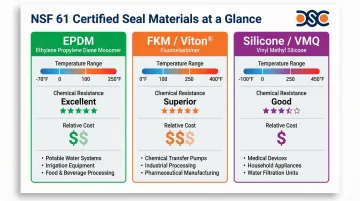
EPDM offers excellent chlorine and chloramine resistance across a wide temperature range (-40°F to 250°F), making it the go-to choice for most municipal water applications. It also holds up well against ozone and weathering, and it's cost-effective at scale.
Common applications:
- Municipal water distribution systems
- Water treatment plant pumps and valve seals
- Hot water recirculation systems
Certification note: Specific compounds like American Biltrite's AB-576 carry NSF 61 certification for potable water. Not all EPDM formulations qualify—always verify the exact compound, not just the base material.
FKM (Fluoroelastomer/Viton®)
FKM handles what EPDM can't. With a temperature ceiling of 400°F (204°C) and broad-spectrum chemical resistance, it's built for demanding conditions where standard elastomers break down. The trade-off is cost—FKM runs significantly higher than EPDM.
Common applications:
- Hot water systems above 180°F
- Chemical feed pumps handling aggressive disinfectants
- Ozone treatment systems and high-pressure dynamic seals
Certification note: NSF 61 certification applies only to specific FKM compounds. The Viton® brand name alone doesn't confirm compliance—verify the exact formulation with the supplier.
Silicone (VMQ)
Silicone covers the widest temperature range of the three materials (-65°F to 450°F), and its biocompatible, inert nature makes it well-suited for potable water contact. That said, its mechanical strength is lower than EPDM or FKM—it's best reserved for static, low-pressure applications.
Common applications:
- Low-pressure static seals and diaphragms
- Temperature-sensitive gasket applications
- Food and beverage processing (dual NSF 51/61 certification available)
Certification note: Certified silicone compounds exist, but must be verified against specific compound names and production facilities—certification doesn't transfer across manufacturing sites.
Material Comparison Table
The table below summarizes key differences to help engineers quickly narrow material selection for a given application:
| Material | Temperature Range | Chemical Resistance | Cost | Best Applications |
|---|---|---|---|---|
| EPDM | -40°F to 250°F | Excellent chlorine/chloramine | $ | Municipal water, treatment plants, valve seals |
| FKM (Viton®) | -15°F to 400°F | Superior broad-spectrum | $$$ | Hot water, chemical feed, ozone systems |
| Silicone (VMQ) | -65°F to 450°F | Good water, limited chemical | $$ | Low-pressure static, gaskets, diaphragms |
Frequently Asked Questions
What does NSF 61 compliant mean?
NSF 61 compliance means a product meets the health effects standard for drinking water system components by limiting contaminant leaching to safe levels, as verified through independent testing. Certified products are listed in the NSF database with specific listing numbers.
Are Viton and EPDM seals NSF 61 approved?
Specific formulations of Viton (FKM) and EPDM can be NSF 61 certified, but certification applies to the complete seal assembly, not just the base polymer. Engineers must verify certification for the exact product being specified, including the compound formulation and manufacturing location.
What is NSF 61 compliant material?
NSF 61 compliant materials meet the standard as raw inputs but haven't been tested as complete assemblies. Engineers should specify "NSF 61 certified products" — fully tested assemblies — rather than compliant materials alone for regulatory coverage.
What does the NSF seal of approval certify?
NSF certification verifies a product has been independently tested to meet health and safety standards, undergoes regular manufacturing facility audits, and is listed in the NSF database for public verification.
How does NSF 61 differ from NSF 42, 51, 53, and 600?
NSF 61 covers drinking water system components (pipes, seals, valves), while NSF 42/53 cover drinking water treatment units — filters for aesthetic and health effects — NSF 51 covers food equipment materials, and NSF 600 provides toxicological criteria for water additives.
How do I verify a seal supplier's NSF 61 certification?
Request NSF listing numbers from the supplier, then verify them in the official NSF database at nsf.org. Check the trade designation, manufacturing location approvals, maximum SA/V ratios, and water contact temperature ratings. Confirm batch traceability documentation is available for delivered products.