Selecting between NBR, HNBR, and AFLAS is not a straightforward upgrade path. Each material was engineered for a different combination of temperature, chemical exposure, and pressure conditions. Choosing the wrong one can cause premature degradation, extrusion under load, or internal rupture from rapid gas decompression (RGD).
This guide compares all three materials across the parameters that matter to well intervention engineers—temperature limits, sour service performance, RGD resistance, and fluid chemistry compatibility—then maps each to specific intervention scenarios so you can arrive at a defensible selection decision.
Key Takeaways
- NBR suits low-temperature (≤120°C), non-sour, oil-based workover environments—treat it as a cost baseline, not a default
- HNBR covers most sour service workovers up to ~150–175°C with strong RGD resistance when peroxide-cured
- AFLAS (FEPM) is the specialist pick for amine-rich fluids, steam injection wells, and high-density zinc or calcium bromide brines beyond HNBR's range
- Selection turns on four factors: downhole temperature ceiling, H₂S/CO₂ partial pressure, workover fluid chemistry, and cost-per-job risk tolerance
NBR vs HNBR vs AFLAS: Quick Comparison
All three are elastomers used in downhole packer elements, but their performance differences become significant as temperatures, pressures, and fluid exposures increase. Use this table as a quick screening reference before detailed material qualification.
| Parameter | NBR | HNBR | AFLAS (FEPM) |
|---|---|---|---|
| Max continuous operating temp | ~108–120°C | ~165–175°C | ~200–230°C (250°C peak) |
| H₂S resistance | Poor | Good to very good | Excellent |
| RGD resistance | Poor | Good (peroxide-cured) | Good to very good |
| Amine/steam resistance | Poor | Limited | Excellent |
| Oil resistance | Good | Good | Moderate |
| Relative cost index (NBR = 1) | 1 | 2–4× | 5–10× |
| Primary intervention suitability | Low-temp, non-sour workover | Sour service, HPHT re-entries | HPHT sour + amine/steam/brine |
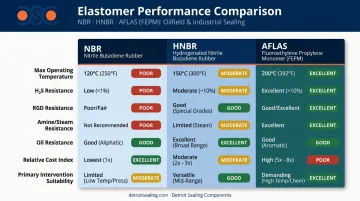
Temperature data sourced from MatWeb, ARLANXEO Therban documentation, and AGC AFLAS technical brochures. RGD and sour service qualification references: NORSOK M-710 and ISO 23936-2.
Understanding the Three Packer Element Materials
NBR (Nitrile Butadiene Rubber)
NBR is a copolymer of acrylonitrile (ACN) and butadiene, with ACN content ranging from 18% to 50%. Higher ACN content improves oil resistance and heat resistance but reduces low-temperature flexibility. That trade-off directly determines suitability for a given wellbore fluid environment.
For well intervention, NBR's advantages are straightforward:
- Baseline cost (cost index of 1)
- Tensile strength of 6.89–24.1 MPa depending on formulation and temperature
- Reliable compatibility with oil-based workover fluids in moderate-temperature, lower-pressure environments
The limitations are equally clear. A 2022 study published in the Journal of Applied Polymer Science tested NBR and HNBR packer elements under sour conditions at 121°C, 52.5 MPa, and 5% H₂S—NBR specimens were significantly less resistant than HNBR across every measured parameter.
The unsaturated polymer backbone is the root cause. NBR is vulnerable to H₂S attack, ozone degradation, and thermal breakdown above roughly 120°C. RGD performance is a separate concern: gas permeating under high pressure expands rapidly during depressurization, producing internal blistering and cracking. Together, these characteristics disqualify NBR from most HPHT or sour service intervention scenarios.
HNBR (Hydrogenated Nitrile Butadiene Rubber)
HNBR starts as NBR, then undergoes selective hydrogenation of the butadiene segments, substantially reducing the C=C double bonds in the polymer backbone. That structural change produces a material that performs differently in downhole service across temperature, chemical resistance, and mechanical load.
Key performance data for well intervention:
- Continuous service temperature: 165–175°C (ARLANXEO Therban data and ARDL downhole nitrile study)
- Tensile strength: 15–38 MPa, mechanically superior to NBR and capable of handling higher differential pressure
- Fewer RGD fractures than NBR in comparative testing
- Qualified formulations available under NORSOK M-710, ISO 23936-2, and API 6A
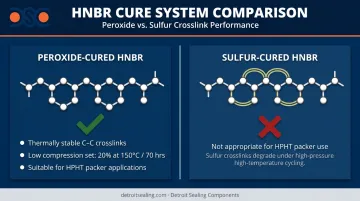
Cure system matters. Peroxide-cured HNBR creates thermally stable C-C crosslinks that minimize compression set at operating temperature. ARLANXEO reports Therban compression set values of 20% after 70 hours at 150°C, a critical property for maintaining long-term sealing force across the intervention lifecycle. Sulfur-cured grades are not appropriate for HPHT packer applications.
HNBR's abrasion resistance also makes a practical difference. Running in through perforated casing or rough wellbores during re-entry operations can degrade softer elements before they reach setting depth. HNBR handles that exposure better than NBR under those conditions.
At 2–4× the cost of NBR, HNBR provides the best performance-to-cost ratio for the majority of well intervention operations.
AFLAS (Tetrafluoroethylene/Propylene – FEPM)
AFLAS is a copolymer of tetrafluoroethylene (TFE) and propylene, with fluorine content of 57% for standard grades (AFLAS 100/150) and 60% for AFLAS 200P. Its fluorinated and hydrocarbon combined backbone produces a chemical resistance profile that standard FKM types do not replicate.
Temperature capability: 200°C continuous service, 250°C peak. For steam injection well interventions or deep HPHT sour gas producers, no other cost-practical elastomer provides that operating margin.
The chemical resistance data is decisive for amine-containing workover fluids. Testing reported by Seal Eastern found AFLAS 100H changed 4.2% in strain energy density after 168 hours in 40% dimethylamine, compared to 49.3% change for FKM Type 5 under identical conditions. At that magnitude of divergence, FKM is not a viable substitute where amine exposure is confirmed.
AFLAS also carries important trade-offs to check before specifying it:
- Glass transition temperature (Tg) around -3°C (AFLAS 100/150), limiting use in cold environments
- 41% volume change in toluene, 40% in benzene, so aromatic solvent exposure must be ruled out
- Cost index of 5–10× NBR, appropriate only when the intervention environment specifically justifies it
Critical Selection Criteria for Well Intervention
Temperature: The First-Pass Filter
Maximum downhole temperature eliminates materials before any other analysis:
- NBR: Conservative screening threshold of ≤120°C
- HNBR: 165–175°C depending on compound grade and cure system
- AFLAS: 200°C continuous, 250°C peak
Stimulation operations matter here specifically. Temperature excursions during hydraulic fracturing or acid stimulation can briefly exceed the steady-state production temperature—the element rating must cover the full operational envelope, not just the normal producing temperature.
H₂S and CO₂ Partial Pressure
NBR degrades under meaningful H₂S concentrations. A 2022 JAPS study makes this quantifiable: at 121°C and 5% H₂S, the performance gap versus HNBR is not recoverable through compound adjustments. HNBR is widely qualified for sour gas service under NORSOK M-710—the standard that governs critical rubber sealing materials in oil and gas production.
AFLAS is the preferred selection when H₂S is combined with amines—a common combination when H₂S scavengers are present in workover fluids. Standard FKM types degrade under those conditions; AFLAS does not.
RGD Resistance
During rapid wellbore depressurization—emergency well control, production testing, or swab operations—gas absorbed into the elastomer under pressure expands internally as pressure drops. Internal blistering, cracking, or element rupture follows.
| Material | RGD Performance |
|---|---|
| NBR | Poor |
| HNBR (peroxide-cured) | Good |
| AFLAS | Good to very good |
Element geometry also matters. Larger cross-section seals absorb more gas and face higher RGD risk during rapid decompression—specifying the right material without also reviewing element geometry leaves the element underspecified.
Workover Fluid Chemistry
Fluid chemistry can override temperature as the primary selection driver:
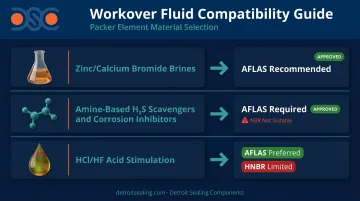
- Zinc bromide / calcium bromide brines: AFLAS shows superior resistance; NBR and HNBR should be qualified against specific brine concentration and temperature before deployment
- Amine-based H₂S scavengers and corrosion inhibitors: AFLAS is the right choice; standard FKM grades and HNBR approach performance limits in these environments
- HCl/HF acid stimulation: AFLAS handles high acid concentrations well; HNBR has documented limitations with high HCl concentrations in acid-flowback environments
Cost vs. Consequence
Once fluid chemistry and temperature narrow the field, cost follows as the final check—and the economics rarely favor cutting corners on material grade. The cost argument for NBR breaks down quickly when you account for intervention failure economics.
A 2021 ScienceDirect study on packer failures in the Tahe Oilfield recorded 30 failures in 1,152 well completion tests over five years. Each failure required re-running the tubing string, additional well-control operations, and unplanned rig time.
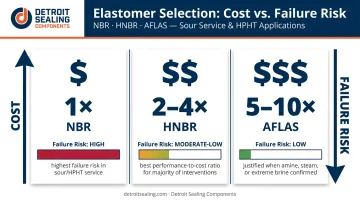
- NBR: Lowest material cost, highest failure risk in anything beyond basic low-temperature workover
- HNBR: Best performance-to-cost ratio for the majority of intervention scenarios; the 2–4× premium over NBR is recovered quickly against any re-run
- AFLAS: 5–10× premium is justified specifically when amine chemistry, steam, or extreme brine exposure is confirmed
Which Material Should You Choose for Well Intervention?
Choose NBR When:
- Operating below 120°C
- Non-sour environment with no meaningful H₂S concentration
- Oil-based workover fluid with no amine additives
- No significant gas pressure (RGD risk is minimal)
- Cost minimization is the primary driver—shallow water injection maintenance, low-pressure bridge plug applications
Choose HNBR When:
- Temperatures fall in the 120–175°C range (the majority of sour service workovers and HPHT re-entries)
- H₂S is present at any meaningful concentration
- Workover fluid involves completion brines without high amine content
- High-pressure re-entry where abrasion resistance during run-in matters
- RGD resistance is required but steam and amines are absent
HNBR should be the default specification for most well intervention operations. It covers the broadest practical range of intervention conditions with a cost premium that's easily justified against NPT risk.
Choose AFLAS When:
- Amine-based workover fluids are in use—any H₂S scavenger or amine-containing corrosion inhibitor pushes HNBR and FKM toward their performance limits
- Steam injection well interventions expect simultaneous steam and sour gas exposure
- High-density zinc bromide or calcium bromide completion brines are present, particularly in HPHT liner-top packer or frac plug applications where HNBR shows inadequate brine resistance
For engineers sourcing packer element compounds, validating material performance against specific well fluid chemistries before deployment substantially reduces misapplication risk. That means working with a distributor that can match compound selection to actual fluid chemistry—not just generic material grades.
DSC's access to hundreds of elastomer compounds across all rubber types, paired with ISO 17025 accredited lab testing, supports material compatibility confirmation for specific fluid systems—including immersion testing and compression set validation before deployment.
Real-World Application: Selecting HNBR Over NBR in a Sour Gas Workover
Consider a workover operation on a sour gas producer: moderate H₂S concentration, bottomhole temperatures around 135–145°C, with the initial packer element specified as NBR based on unit cost. During element setting, H₂S-induced embrittlement reduces sealing force before the packer reaches its set position. The element fails to hold.
The result: a re-run, rig time consumed, and non-productive time that far exceeds the cost differential between NBR and HNBR.
This failure sequence is consistent with what the 2022 JAPS study on H₂S effects on NBR and HNBR packer elements documents under controlled sour conditions: at 121°C and 5% H₂S, NBR specimens degraded significantly faster than HNBR, with measurable loss of mechanical properties that would translate directly to lost sealing force at operating conditions.
The corrective specification is a peroxide-cured HNBR compound with appropriate ACN content to maintain oil resistance. Two properties drive the upgrade:
- Saturated backbone resists H₂S-induced chain scission that attacks NBR's unsaturated sites
- Peroxide crosslinks deliver lower compression set at operating temperature, maintaining sealing force throughout the intervention
On re-run, production testing confirmed a successful set with sustained seal integrity.
When H₂S is present above 120°C, NBR failure costs—rig time, re-run, lost production—exceed the HNBR price difference before the element has been downhole 24 hours. For interventions adding amine chemistry or steam injection, the same cost logic applies to the step up from HNBR to AFLAS.
Conclusion
No single material wins across all well intervention scenarios. The decision hierarchy is clear:
- NBR for low-risk, low-temperature, non-sour workover where cost is the primary constraint
- HNBR for the practical majority of sour service and HPHT workover operations—it covers more of the real intervention envelope than any other mid-range material
- AFLAS when amine chemistry, steam, or extreme brine exposure disqualifies both NBR and standard fluoroelastomers
The downstream consequences of getting this wrong are not abstract. Compression set drives long-term seal reliability. RGD resistance determines whether the element survives rapid depressurization during well control or production testing. Chemical compatibility determines whether the element reaches its rated service life or degrades within hours of fluid contact.
Each of those failure modes adds NPT, fishing risk, and well integrity exposure that compounds across the intervention lifecycle.
Match the material to the specific well conditions. When the selection requires custom compounding or material validation against non-standard fluid exposure, DSC's ISO 17025 accredited lab provides the testing infrastructure to confirm compatibility before the element goes downhole.
Frequently Asked Questions
What common materials are used for seals and packing in oil and gas, and why?
The most common downhole packer element materials are NBR, HNBR, FKM, AFLAS (FEPM), and FFKM. Selection depends on temperature rating, chemical resistance to H₂S and CO₂, fluid compatibility, and cost — no single material covers all scenarios.
Is FKM better than NBR?
FKM offers significantly higher temperature resistance and broader chemical resistance than NBR, making it the better choice for HPHT applications. However, it has real limitations in amine-rich environments — that's where AFLAS outperforms both.
What are the components of a production packer?
A production packer consists of rubber sealing element(s), a metallic mandrel, slips for anchoring against the casing, anti-extrusion backup rings, and a setting mechanism—hydraulic piston, mechanical dogs, or wireline-initiated. The rubber element is the primary sealing component, and its material selection governs the packer's chemical and thermal performance limits.
Where does the seal element on a liner top packer seal?
The seal element on a liner top packer seals against the inside diameter of the casing above the liner hanger, creating an annular hydraulic barrier between the casing and liner. This prevents fluid migration from the formation into the annulus above the liner top during and after cementing.
When should HNBR be chosen over AFLAS for well intervention packer elements?
HNBR is the right call when temperatures stay below 150°C and the well involves no amines, steam, or high-density bromide brines. In those conditions, its superior abrasion resistance, NORSOK M-710 sour gas qualification, and lower cost (2–4× vs. 5–10× the NBR baseline) make it the practical default.