Introduction
Buna-N holds roughly 45% of the global O-ring market, according to Persistence Market Research — a position earned through a specific combination of oil resistance, mechanical durability, and cost-effectiveness that no single alternative replicates. Yet that market dominance creates a dangerous assumption: that Buna-N is a safe default for any sealing application.
It isn't. Use it outside its rated limits — mismatched fluid chemistry, temperature extremes, or the wrong durometer for the load — and seal failure follows. The consequences range from minor leaks to unplanned downtime and system damage.
That's what this guide addresses. It covers what Buna-N actually is chemically, how it seals, its real operating ranges, core technical properties, where it fits and where it doesn't, and how it compares to Viton, EPDM, and neoprene when you need a substitute.
Key Takeaways
- Buna-N (NBR) is a synthetic copolymer of acrylonitrile and butadiene, engineered primarily for petroleum oil, fuel, and hydraulic fluid resistance
- Standard operating temperature: −40°F to 257°F (−40°C to 125°C)
- ACN content and compound formulation shift that temperature range up or down
- Strengths: oil/fuel resistance, tensile strength, abrasion resistance, low compression set
- Weaknesses: poor resistance to ozone, UV, aromatic hydrocarbons, ketones, and esters
- Buna-N, nitrile rubber, and NBR all refer to the same material
What Is Buna-N and How Does It Function as a Seal?
Chemistry: ACN Content Is the Key Variable
Apple Rubber defines Buna-N as a copolymer of butadiene and acrylonitrile (ACN), with the ASTM D1418 designation NBR. According to Trelleborg's O-ring engineering data, ACN content typically ranges from 18% to 50%, and this single variable governs the entire performance balance:
- Higher ACN (40–50%): stronger resistance to petroleum oils and non-polar hydrocarbons, reduced cold-weather flexibility
- Lower ACN (18–30%): better low-temperature performance, slightly reduced oil resistance
- Mid-range ACN (30–40%): general-purpose balance for most industrial sealing environments
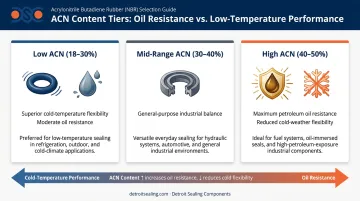
This is why specifying "NBR" on a drawing isn't enough. The ACN grade determines whether the compound actually performs in your fluid and temperature environment.
ACN content isn't the only lever. Freudenberg's elastomer technical data notes that cross-link density, filler dispersion, and cure chemistry also shift the performance profile — peroxide-cured NBR, for instance, delivers improved thermal resistance over sulfur-cured formulations. These compound-level variables determine how the material holds up once it's under load.
How the Sealing Mechanism Works
Those material properties only matter in context of what the O-ring actually does. Buna-N O-rings are not adhesive barriers — per Trelleborg's design engineering documentation, they seal through two sequential mechanical mechanisms:
- Initial squeeze: The O-ring is compressed radially or axially within its groove, creating a contact pressure that closes the leak path
- Pressure activation: As system pressure rises, it pushes the O-ring harder against the groove wall and mating surface — the seal becomes more effective under load, not less
What sustains this mechanism over time is the elastomer's compression set resistance — its ability to return to shape after compressive load is removed. An O-ring with high compression set loses contact pressure permanently, which means it loses sealing contact before any visible leak appears.
Specifying Buna-N Correctly
Selecting Buna-N means validating the full compound specification — not just the elastomer family. Before finalizing an NBR grade, confirm:
- ACN content matched to your operating fluid and minimum service temperature
- Cure system (peroxide vs. sulfur) aligned to thermal exposure requirements
- Compression set rating appropriate for the duty cycle and seal replacement interval
General industry familiarity with "NBR" is a starting point, not a specification.
Buna-N O-Ring Operating Ranges
Buna-N's performance envelope is defined by four interdependent parameters: temperature, chemical exposure, mechanical load, and compound formulation. Published catalog values are nominal starting points, not universal guarantees.
Temperature Range
| Condition | Temperature Range |
|---|---|
| Standard Buna-N (Apple Rubber) | −40°F to 257°F (−40°C to 125°C) |
| Special low-temp compounds | Down to −67°F (−55°C) |
| Short-period upper limit (Trelleborg) | Up to 248°F (120°C) for special compounds |
| Dry heat upper limit (Apple special) | Up to 275°F (135°C) |
Any temperature above 212°F (100°C) should be treated as compound-specific, not a general NBR capability. High-ACN formulations resist oil better at elevated temperatures; low-ACN formulations maintain flexibility at lower temperatures. Neither is universal.
Chemical Resistance
Buna-N performs reliably with:
- Petroleum-based oils and fuels
- Mineral greases and lubricants
- Petroleum-based hydraulic fluids (HLP, HLVP types)
- Water and dilute water-based solutions
- Silicone greases and oils
- Alcohols
Buna-N is incompatible with:
- Ketones (MEK, acetone)
- Esters
- Chlorinated solvents and hydrocarbons
- Aromatic hydrocarbons (benzene, toluene)
- Strong oxidizing acids
Always verify compatibility against a compound-specific chemical resistance chart for the exact fluid and concentration. Trelleborg's compatibility guidance explicitly notes that lab compatibility data may not match field conditions at elevated temperatures.
Pressure, Durometer, and Dynamic Load
Pressure ratings depend on groove geometry, cross-section, back-up ring configuration, and hardness. Per Trelleborg's engineering data:
| Application Type | Typical Pressure Limit |
|---|---|
| Static, no back-up ring (ID > 50mm) | Up to 5 MPa (~725 PSI) |
| Static, no back-up ring (ID < 50mm) | Up to 10 MPa (~1,450 PSI) |
| Static, with back-up rings | Up to 40 MPa (~5,800 PSI) |
| Dynamic reciprocating, no back-up ring | Up to 5 MPa (~725 PSI) |
Buna-N is available in Shore A durometers from approximately 40 to 90:
- 40–60 Shore A: Conforms well to irregular surfaces, lower sealing loads, softer contact
- 70 Shore A: General-purpose industrial standard; Trelleborg's reference compound data uses this grade
- 80–90 Shore A: Preferred for dynamic applications, high-pressure service, and extrusion resistance
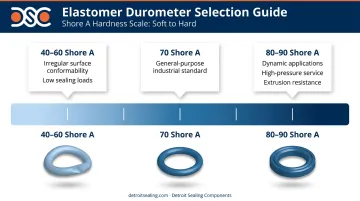
DSC stocks NBR O-rings in both 70 and 90 durometer as standard grades, with additional durometer options available across hundreds of compounds.
Key Technical Properties of Buna-N O-Rings
Oil and Fuel Resistance
This is Buna-N's defining property. The polar acrylonitrile groups in the polymer chain resist swelling from non-polar hydrocarbon fluids; higher ACN content means stronger resistance. Trelleborg's standard 70 Shore A NBR shows a volume change of up to +15% after 72 hours in IRM 903 reference oil at 100°C, which is acceptable for most service conditions.
This resistance does not extend to aromatic fuels, oxygenated fuel blends, or fluids containing ketones and esters. Modern gasoline blends with high ethanol or aromatic content require compound-specific fuel immersion testing before you specify a compound.
Tensile Strength and Elongation
Per Trelleborg's published compound data:
- 50 Shore A NBR: Tensile strength ≥8 MPa (~1,160 PSI), elongation ≥200%
- 70 Shore A NBR: Tensile strength ≥14 MPa (~2,031 PSI), elongation ≥200%
- 90 Shore A NBR: Elongation drops to ≥100% as hardness increases
These properties enable O-rings to withstand installation stress and dynamic deformation without tearing. Both values decline with age, elevated temperature exposure, or chemical swell. Monitoring service conditions throughout the seal's life is the practical response to that reality.
Compression Set Resistance
Compression set is the permanent deformation that remains after a compressive load is removed. ASTM D395 measures this by applying a defined compressive force for a set duration, then recording how much thickness the sample fails to recover.
Trelleborg's standard 70 Shore A NBR achieves less than 25% compression set after 24 hours at 100°C at 25% deformation. What that means in practice:
- Under 25%: The O-ring retains sufficient contact pressure — acceptable sealing longevity
- Over 30–35%: Contact pressure degrades; the seal begins losing effectiveness under pressure cycling
- Over 50%: Functional seal failure is likely without visible extrusion or cracking
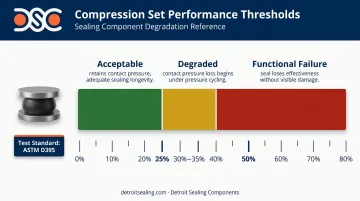
The danger with high compression set is that the O-ring looks undamaged. It has simply lost enough contact force against the groove wall that it no longer seals reliably.
Abrasion Resistance
Both Apple Rubber and Freudenberg characterize NBR as having high abrasion resistance, which is why it's the standard material for dynamic radial shaft seals and reciprocating piston applications. That performance degrades if the compound softens through chemical swell or operates above its temperature rating. A swollen NBR O-ring under a dynamic load wears faster than rated.
Aging and Environmental Stability
Within its rated temperature range, Buna-N maintains physical properties through normal service life. Trelleborg data shows heat aging effects after 72 hours at 100°C: hardness change of up to +8 Shore A and tensile/elongation change of up to −25%. Significant, but manageable within rated conditions.
The failure modes that catch engineers off guard are atmospheric, not thermal:
- Ozone exposure causes surface cracking perpendicular to tensile stress. Freudenberg's elastomer documentation identifies this as a well-documented failure mode tied to NBR's unsaturated double bonds
- UV radiation accelerates surface hardening and embrittlement
- These are storage and installation failures, not operating condition failures. Exposure near electric motors, arc welding equipment, or outdoor environments is typically the cause
Where Buna-N O-Rings Excel: Industry Applications
Buna-N dominates wherever petroleum-based fluid contact and moderate temperature cycles define the environment — spanning automotive lines, heavy equipment hydraulics, food processing, and drinking water infrastructure.
Automotive and Transportation
- Fuel injectors, fuel system seals, oil seals
- Hydraulic systems (note: standard NBR is not rated for DOT 3/4 glycol-based brake fluids — Freudenberg rates it unsuitable for those media)
- Transmission seals, coolant-adjacent static gaskets
Oil and Gas / Industrial
- Pump seals, valve packing, downhole tool seals
- Hydraulic power unit seals in heavy equipment
- General industrial static sealing in petroleum-fluid environments
Agriculture and Construction
- Hydraulic circuit seals in excavators, loaders, and irrigation systems
- High-cycle reciprocating applications where abrasion resistance is required
Water, Food, and Sanitary Systems
- Potable water-grade NBR formulations certified to NSF 61 and NSF 42
- FDA-compliant NBR (per 21 CFR 177.2600) for food contact applications
- DSC stocks certified compounds meeting WRAS, W270, NSF 61/42, and ACS standards for drinking water service
DSC supplies Buna-N O-rings across all of these verticals, with hundreds of NBR compound formulations available — including 70 and 90 Shore A grades stocked as standard. When a catalog compound won't meet the application's demands, DSC's ISO 17025 accredited lab supports custom compound development and material testing.
Buna-N Limitations and Out-of-Range Consequences
Chemical Incompatibilities
Exposure to aromatic hydrocarbons, ketones, esters, or chlorinated solvents causes Buna-N to swell, soften, and permanently distort. The failure progression:
- Volume swell increases as fluid absorbs into the polymer matrix
- Tensile strength and hardness drop as the compound softens
- The O-ring extrudes into gaps it would normally seal against
- Under pressure cycling, the distorted seal fails (often without visible cracking)
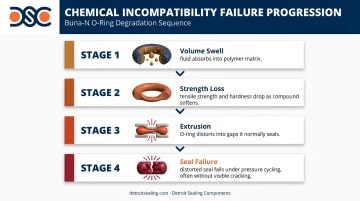
This failure mode can develop slowly over weeks or months, making it hard to diagnose in the field.
Thermal Boundary Failures
Temperature excursions in either direction produce distinct failure modes:
- Too cold: Buna-N loses elasticity and becomes brittle, contact pressure drops, and thermal shock can crack the material. Low-ACN formulations push this threshold lower but don't eliminate it.
- Too hot: Accelerated compression set hardens the material permanently, reducing contact pressure until the seal fails.
- Combined thermal and chemical stress: Intermittent high-temperature excursions paired with chemical exposure degrade properties faster than either condition alone — swell and thermal stress compound each other.
Ozone and UV Degradation
Ozone causes surface cracking perpendicular to tensile stress — the characteristic failure pattern documented in ASTM D1171 testing. This damage is not related to operating temperature or fluid exposure. It affects:
- O-rings stored near electric motors or ozone-generating equipment
- Seals installed in outdoor environments
- Any application where UV exposure is present
SMC's technical documentation on pneumatic equipment specifically identifies NBR as the elastomer most susceptible to ozone cracking in that environment. The only mitigations are proper storage — cool, dark, sealed packaging kept away from ozone sources — and substituting a more ozone-resistant material for outdoor applications.
Buna-N vs. Other Elastomers: When to Substitute
Buna-N vs. Viton (FKM)
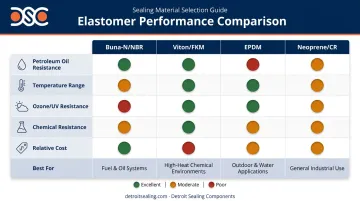
| Property | Buna-N (NBR) | Viton (FKM) |
|---|---|---|
| Max continuous temperature | ~257°F (125°C) | ~392°F (200°C) |
| Petroleum oil resistance | Excellent | Excellent |
| Aromatic hydrocarbons | Poor | Good |
| Chlorinated solvents | Poor | Good |
| Cost | Lower | Significantly higher |
Choose Buna-N for petroleum oil and fuel environments at moderate temperatures. Upgrade to Viton when the chemical environment includes aromatics, chlorinated solvents, or strong acids, or when temperatures consistently exceed 257°F. DSC stocks FKM O-rings in AS568 sizes for direct substitution.
Buna-N vs. EPDM
These two materials serve almost opposite fluid environments:
- EPDM: Hot water, steam, ozone resistance, outdoor weathering — unsuitable for petroleum oils
- Buna-N: Petroleum oils, fuels, mineral hydraulic fluids — unsuitable for ozone or weathering exposure
The critical distinction in water system applications: water alone is compatible with both materials, but any petroleum fluid contamination in the system will cause EPDM to swell and fail. Specify by the full fluid environment, not just the primary fluid.
Buna-N vs. Neoprene (CR)
Each material has a clear home environment:
- Neoprene: Better ozone and UV resistance — preferred for outdoor installations and weathering-exposed applications
- Buna-N: Superior petroleum oil resistance and mechanical properties — the right choice for oil-service environments
For applications that fall outside these standard comparisons, DSC maintains access to hundreds of compounds across all elastomer families and ISO 17025 accredited lab testing to validate the right material for the specific operating conditions.
Conclusion
Buna-N earns its market position through a combination of properties no single alternative matches at its price point — but that position comes with defined boundaries. Its operating range, ACN content, durometer, and compound formulation are engineering decisions that must be matched to the fluid environment, temperature duty cycle, and mechanical load of each application.
Catalog ratings are a starting point, not a guarantee. Compound selection, durometer choice, and compatibility verification against the actual fluid and temperature profile are what close the gap between a published spec and a seal that holds in service. When an application pushes past those boundaries — whether through elevated temperatures, aggressive chemical exposure, or dynamic load — the correct response is a material change, not a higher safety factor on the same compound. Knowing which alternative to reach for, and why, is where sealing expertise matters most.
Frequently Asked Questions
How long do Buna-N O-rings last?
Service life depends on fluid exposure, temperature cycling, and mechanical duty. Static applications within rated conditions can last many years; dynamic applications wear faster. Storage life under proper conditions (cool, dark, ozone-free) is typically up to 15 years per industry standards.
Are Buna-N O-rings good for gasoline?
Standard Buna-N performs well with conventional petroleum-based gasoline. Modern fuel blends containing high ethanol content, aromatic additives, or oxygenates can cause swell or degradation — run compound-specific compatibility testing before using blended or specialty fuels.
What is better, Viton or Buna-N?
Neither is universally better. Buna-N is the correct choice for petroleum oil and fuel service at moderate temperatures and offers better cost economics. Viton is superior for extreme temperatures, aggressive chemical environments, and applications requiring longer service intervals in harsh conditions.
Is Buna-N the same as nitrile rubber?
Yes — Buna-N, nitrile rubber, and NBR all refer to the same material: nitrile butadiene rubber. "Buna-N" is a legacy trade name, while NBR is the standardized engineering designation per ASTM D1418.
What is the difference between Buna-N and neoprene?
Buna-N offers superior resistance to petroleum oils and fuels. Neoprene provides better ozone, UV, and weathering resistance. Use neoprene for outdoor installations or ozone-rich environments; use Buna-N wherever petroleum-based fluid contact is present.
Why is it called Buna-N?
"Buna" combines Butadiene and Natrium (the Latin/German word for sodium), the original polymerization catalyst. The "N" identifies the acrylonitrile comonomer responsible for oil resistance. The acrylonitrile-butadiene copolymer was patented in 1934 by Konrad and Tschunkur at IG Farben in Germany.