Introduction
FKM O-rings show up on nearly every aggressive hydraulic specification list, and their reputation is earned. Chemical resistance, thermal stability, and low compression set at elevated temperatures make them a strong fit for demanding environments.
The problem is that "FKM" on a drawing tells an engineer almost nothing. Without knowing the compound grade, cure system, fluorine content, Shore hardness, and whether anyone confirmed compatibility with the actual formulated fluid in service, the spec is incomplete.
Misspecified FKM seals don't wear out gradually. They extrude, swell, or take a permanent set — often before the first scheduled maintenance interval. Understanding exactly where FKM excels, where it fails, and how to specify it correctly is what separates a reliable hydraulic system from an expensive one.
This article covers FKM compound grades, operating range limits, key performance properties, real-world failure modes, and the specification decisions that determine whether your hydraulic O-ring holds up under service conditions.
Key Takeaways
- FKM operates continuously from -20°C to +200°C with chemical resistance to most mineral-oil hydraulic fluids
- Compound grade matters more than material family — standard grades fail in phosphate ester (HFD) and amine-containing fluids
- 70 Shore A suits moderate pressure; high-pressure dynamic service requires 80–90 Shore A or back-up rings
- Extrusion, chemical swelling, compression set loss, and explosive decompression signal specification errors, not worn-out seals
- FKM selection requires grade, hardness, and validated fluid compatibility — not just a brand name
What FKM O-Rings Represent in Aggressive Hydraulic Systems
FKM (the ISO/ASTM designation for fluorocarbon rubber) describes a family of fluoroelastomers characterized by fluorine content ranging from 66% to 70% by weight. Higher fluorine content correlates with broader chemical resistance, though it also reduces low-temperature flexibility. Viton® is a trade name owned by Chemours for one product line within the FKM family. All Viton® products are FKM, but FKM encompasses far more than Viton®.
In a hydraulic system, an O-ring functions as the primary pressure boundary between components (cylinder bores, piston assemblies, valve bodies, fittings) under both static and dynamic conditions. A static seal sitting in a face groove carries a fundamentally different loading history than a reciprocating rod seal cycling thousands of times per hour under variable pressure.
What many specifications miss: published chemical resistance charts describe potential performance under controlled laboratory conditions. They don't capture the combined loading of actual system temperature, cyclic pressure, surface velocity, and real fluid chemistry — real-world fluids often carry additives, contamination, and oxidative degradation products that were never part of the lab test.
Key implication: Lab-rated compatibility and field performance are not the same thing. Compound selection must account for the fluid as it exists in service, not as it appears on a clean specification sheet.
FKM Compound Grades and Hydraulic Fluid Compatibility
Chemours identifies four major Viton® families (A, B, F, and ETP) with different fluorine content and cure systems. For hydraulic specification purposes, the critical distinction is between:
- Standard FKM grades : suited to mineral-based oils (HL/HLP type) and petroleum-based synthetic fluids at high temperatures
- Base-resistant / GBL grades : necessary for phosphate ester hydraulic fluids (HFD type), primary amines, and strongly alkaline media
The stakes here are not theoretical. Trelleborg's chemical compatibility data rates primary amines as U — unsuitable for standard FKM, while base-resistant FKM (Resifluor 500) is rated A — very good suitability for the same fluid. The same source rates Skydrol 500 (a phosphate ester) as U for standard FKM. Complete material incompatibility, not a marginal performance gap.
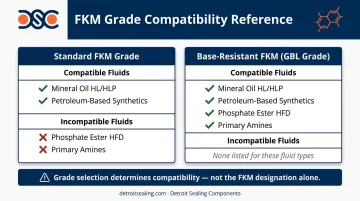
Grade selection is the first specification decision. Hardness, geometry, and compression set are all irrelevant if the compound degrades in the operating fluid.
Operating Range of FKM O-Rings in Hydraulic Applications
FKM's effective operating envelope is defined by temperature, pressure, and fluid compatibility acting simultaneously. Exceeding any one limit compresses what's tolerable on the others.
Temperature Range
According to Trelleborg's 2024 O-ring catalog, standard FKM operates continuously from -20°C to +200°C, with peak short-period tolerance to +230°C. Specialty low-temperature grades extend the lower limit to -40°C, though these formulations typically trade off some chemical resistance to achieve it.
The hydraulic-specific concern: Trelleborg explicitly notes that catalog temperature limits represent maximum laboratory values. In aggressive hydraulic service with hot synthetic or contaminated fluid, effective service life at sustained temperatures above 150°C shortens considerably — always validate against compound-specific datasheets rather than relying on catalog maximums alone.
Cold-start risk often goes unaddressed. Standard FKM becomes less flexible at low temperatures than NBR. In outdoor mobile equipment or unheated industrial facilities, a standard FKM compound may fail to seal during startup transients even if it performs correctly at normal operating temperature.
Pressure, Hardness, and Extrusion Gap
Trelleborg's 2024 data provides concrete pressure thresholds for FKM O-rings:
| Configuration | Max Pressure |
|---|---|
| Static, no back-up ring, ID < 50 mm | 10 MPa (1,450 psi) |
| Static, no back-up ring, ID > 50 mm | 5 MPa (725 psi) |
| Dynamic reciprocating, no back-up ring | 5 MPa (725 psi) |
| Static, with back-up rings | Up to 40 MPa (5,800 psi) |
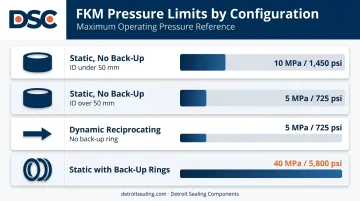
These thresholds assume correct gland geometry and appropriate compound hardness. Standard 70 Shore A FKM is suitable for moderate-pressure applications within these limits.
High-pressure dynamic sealing (common in industrial presses, mobile hydraulic cylinders, and aerospace actuators) requires 80–90 Shore A compounds or back-up rings to prevent extrusion.
Extrusion occurs when the diametral clearance between mating components is too large for the operating pressure and material hardness. Parker describes the result as a chewed or chipped appearance on the low-pressure side of the O-ring. DSC stocks FKM back-up rings in 90 Shore A, sized for the complete AS568 series, specifically to address this failure mode in high-pressure assemblies.
Fluid Compatibility Reference
Fluid type is the third variable in the operating envelope — and one that trips up even experienced engineers. The table below maps common ISO 6743 hydraulic fluid classes to standard and base-resistant FKM grades.
| Hydraulic Fluid Type | Standard FKM | Base-Resistant FKM |
|---|---|---|
| Mineral oil (HL/HLP) | ✓ Compatible | ✓ Compatible |
| Petroleum-based synthetic | ✓ Generally compatible | ✓ Compatible |
| Phosphate ester (HFD) | ✗ Unsuitable | ✓ Required |
| Amine-containing fluids | ✗ Unsuitable | ✓ Required |
| Water-glycol (HFC) | ⚠ Verify by exact fluid | ⚠ Verify by exact fluid |
| Biodegradable ester (HEES) | ⚠ Verify by exact fluid | ⚠ Verify by exact fluid |
Note: PAO, HFC, HETG, and HEES ratings require exact-fluid confirmation. Do not extrapolate from "oil-resistant" to cover all ISO 6743 hydraulic fluid classes.
Key Performance Properties of FKM in Hydraulic Environments
FKM's hydraulic suitability comes from four interconnected properties. None can be evaluated in isolation when specifying for a real system.
Chemical Resistance
FKM's resistance derives from high-energy carbon-fluorine (C-F) bonds in its polymer backbone — stable against most hydrocarbon-based hydraulic fluids, acids, and oxidizing agents. Standard FKM grades retain C-H bonds that remain vulnerable to strong amines and alkaline media, which is why grade selection governs compatibility rather than the FKM designation alone.
Fluorine content percentage matters: Chemours confirms that fluid resistance generally improves as fluorine content increases, while low-temperature performance decreases. This trade-off becomes critical when an application combines aggressive fluid chemistry with cold-start requirements.
Compression Set Resistance
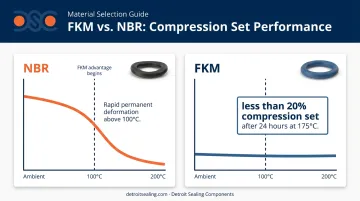
Compression set is the permanent deformation an O-ring retains after sustained compression. As compression set accumulates, sealing force diminishes — the ring loses its ability to recover against groove walls and mating surfaces, and the system leaks.
Trelleborg's verified data: standard FKM demonstrates less than 20% compression set after 24 hours at 175°C. Parker's material guide rates FKM compression set as excellent. FKM's advantage over NBR becomes decisive at sustained temperatures above roughly 100°C, where NBR takes a permanent set significantly faster.
Mechanical Properties and Hardness Selection
Trelleborg's data for standard FKM compounds:
- Tensile strength: minimum 10 MPa
- Elongation at break: 125% at 70/75 Shore A; 100% at 90 Shore A
- Available hardness: 70, 75, 80, 90 Shore A
Harder compounds (80–90 Shore A) improve extrusion resistance at high pressure but reduce sealing contact conformity on imperfect surfaces. Softer compounds (70 Shore A) conform better but extrude at lower pressures. This is a system-specific engineering trade-off, not a default choice.
For dynamic applications, that trade-off extends further:
- PTFE-blended FKM (identified by Parker for reduced-friction dynamic service) outperforms standard compounds on abrasion resistance in high-velocity applications
- Hardness range 55–90 Shore A is accessible across DSC's compound inventory, covering configurations beyond standard catalog defaults
- ISO 17025 lab validation is available for compound selection against specific fluid chemistry, pressure, and temperature conditions when off-the-shelf specs aren't sufficient
Failure Modes and Misspecification Risks
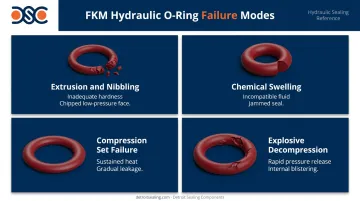
Most hydraulic FKM failures are specification failures, not material failures. The mechanisms are distinct and each points to a specific specification error.
Primary Failure Modes
- Extrusion and nibbling — inadequate hardness or missing back-up rings allow the O-ring to flow into the clearance gap under pressure; appears as chipping or tearing on the low-pressure face
- Chemical swelling — incompatible fluid causes the elastomer to swell, jamming seals in grooves or impeding mechanical movement; most common with phosphate ester in standard-grade FKM
- Compression set failure — sustained compression at elevated temperature causes permanent deformation and loss of sealing force, resulting in gradual leakage at operating temperature
- Explosive decompression (RGD) — rapid pressure release in gas-charged high-pressure systems causes absorbed gas to expand inside the elastomer, producing internal blistering or cracking; requires specifically certified RGD-resistant FKM grades
Common Misspecification Errors
- Treating all FKM as equivalent — applying a standard bisphenol-cured compound in phosphate ester HFD systems because the drawing specifies "FKM"
- Specifying temperature rating only — confirming FKM handles the temperature without verifying fluid compatibility at that temperature
- Using static hardness conventions for dynamic applications — 70 Shore A specified for a reciprocating rod seal operating above 5 MPa without back-up rings
- Ignoring fluid additive packages — confirming compatibility against base stock while the fully formulated fluid contains amine-based additives incompatible with standard FKM
- Overlooking cold-start conditions — specifying for operating temperature without accounting for startup transients in outdoor or unheated environments
System-Level Consequences
Hydraulic seal failure isn't a maintenance inconvenience. Per ISO 4413:2010, unintended actuator movement from pressure loss represents a direct personnel hazard.
Secondary consequences compound quickly:
- Environmental contamination from hydraulic fluid release
- Equipment damage from uncontrolled actuator motion
- Fire risk and rapid mechanical failure in phosphate ester or high-pressure gas systems
The specification decision happens before installation. Once the system is pressurized, a mismatched compound cannot be corrected — only replaced, at the cost of downtime, fluid loss, and potential safety exposure.
Conclusion
FKM is a high-performance sealing material — but "high-performance" only applies when the compound grade, hardness, groove geometry, and fluid compatibility are simultaneously correct for the application. Material family membership alone doesn't guarantee anything.
The specification decisions that determine hydraulic FKM performance — grade selection for fluid type, hardness for operating pressure, gland geometry for dynamic duty, low-temperature grade for cold-start environments — require compound-level knowledge. Browsing a catalog gets you a material family. It doesn't get you the right seal.
Detroit Sealing Components (DSC) applies that compound-level expertise to hydraulic FKM specification. DSC's resources for getting the specification right include:
- Hundreds of FKM compound formulations across grade and hardness ranges
- 80–90 Shore A options and FKM back-up rings for high-pressure assemblies
- ISO 17025 accredited lab for compound validation against specific hydraulic fluid chemistry and operating conditions
The goal is a verified specification before the seal goes into service — not a failure investigation after.
Frequently Asked Questions
Frequently Asked Questions
Are FKM (Viton) O-rings suitable for aggressive hydraulic systems?
FKM O-rings are well-suited for aggressive hydraulic environments due to their chemical resistance and high-temperature stability. Correct performance depends on selecting the right compound grade (standard for mineral oil, base-resistant for phosphate ester or amine fluids) and the appropriate hardness for system pressure.
Is FKM the same as Viton?
Viton® is a trade name owned by Chemours for one fluoroelastomer product line. FKM is the generic ISO/ASTM designation for the entire fluorocarbon rubber family. All Viton® products are FKM, but FKM includes compounds from many other manufacturers and formulations not covered by the Viton® brand.
What hydraulic fluids are not compatible with standard FKM O-rings?
Standard FKM grades are unsuitable for phosphate ester hydraulic fluids (HFD type), primary amine-containing fluids, and certain ketone-based fluids — base-resistant FKM formulations are required in those environments. Water-glycol (HFC) and biodegradable ester (HEES) fluids require case-by-case verification against the specific fluid.
What durometer hardness is recommended for FKM O-rings in high-pressure hydraulic systems?
70 Shore A suits moderate-pressure static applications within standard gland clearances. High-pressure dynamic sealing (typically above 5 MPa without back-up rings) requires 80–90 Shore A compounds or paired back-up rings to prevent extrusion — the right choice depends on operating pressure, clearance gap, and static vs. dynamic duty.
How does FKM compare to NBR for hydraulic O-ring applications?
NBR is more cost-effective and handles low temperatures better, making it appropriate for standard mineral oil hydraulic systems with moderate temperature requirements. FKM is superior for high-temperature service above roughly 100°C, aggressive or synthetic fluid environments, and applications where low compression set over extended service intervals matters.
What causes FKM O-ring failure in hydraulic systems?
Common failure causes include:
- Extrusion from insufficient hardness or missing back-up rings
- Chemical incompatibility with the hydraulic fluid (especially phosphate ester in standard-grade FKM)
- Compression set accumulation in high-temperature dynamic sealing
- Installation damage from incorrectly sized grooves or improper assembly technique