Introduction
Engineers and procurement managers selecting rubber gasket materials often default to neoprene or silicone — materials they know. EPDM (ethylene-propylene diene monomer) gets overlooked, even when it's the better fit.
That oversight is costly. Using the wrong gasket material in a water treatment line, outdoor enclosure, or steam system leads to premature seal failure, unplanned downtime, and replacement costs that compound quickly.
This article covers what EPDM is, how it's made, its verified mechanical and chemical properties, the grades and forms available, where it excels, and where it fails. If you're specifying gaskets for outdoor, water-contact, or heat-exposed environments, the properties covered here will determine whether EPDM belongs on your shortlist.
Key Takeaways
- EPDM is a synthetic rubber with a saturated backbone, giving it excellent resistance to water, steam, ozone, UV, and weathering
- Tensile strength ranges from 5.0–12 MPa depending on compound — suitable for most gasket applications
- EPDM operates from approximately -57°C to +150°C, with steam service up to 204°C (400°F)
- Available in solid, closed-cell, and open-cell forms with hardness from 40–90 Shore A
- Petroleum fuels, mineral oils, and hydrocarbon-based lubricants cause rapid swelling and degradation — avoid EPDM in these media
What Is EPDM and How Is It Made?
EPDM stands for ethylene-propylene diene monomer — a synthetic rubber produced by polymerizing ethylene, propylene, and a small amount of a non-conjugated diene monomer. According to ScienceDirect, commercial EPDM contains 45–75% ethylene by content, with propylene making up most of the remainder.
The Role of the Diene Component
The diene is what separates EPDM from its simpler cousin, EPM. Common diene monomers include:
- 5-ethylidene-2-norbornene (ENB) — the most widely used; offers fast cure rates
- Dicyclopentadiene (DCPD) — lower cost, commonly used in roofing and automotive seals
- 5-vinyl-2-norbornene (VNB) — used in specialty grades requiring improved compression set
EPM is an ethylene-propylene copolymer with no diene component. EPDM adds that diene, which creates pendant unsaturation in the polymer chain — the site where sulfur or peroxide vulcanization occurs. Without it, achieving the crosslinked network that gives EPDM its elasticity and strength isn't possible.
Why the Saturated Backbone Matters
The main polymer chain in EPDM is fully saturated — meaning no double bonds along the backbone itself. This is the structural reason EPDM resists heat, ozone, UV radiation, and oxidation so effectively. Ozone and oxygen attack double bonds. With none exposed in the backbone, EPDM simply doesn't give them a target.
How Cure Chemistry Affects Final Properties
During vulcanization, two cure systems are used:
- Sulfur cure — better initial tensile and tear properties
- Peroxide cure — superior heat aging resistance and lower compression set
Controlling the ethylene-to-propylene ratio, diene content, and cure system during manufacturing determines the final compound's hardness, flexibility, and chemical resistance. That's why EPDM grades vary widely — from softer, flexible formulations suited to food and water applications to harder, heat-resistant compounds used in automotive and industrial sealing.
Key Material Properties of EPDM Gaskets
Key Material Properties of EPDM Gaskets
Mechanical Performance
How does EPDM compare to common alternative elastomers? The table below shows tensile and elongation benchmarks across compound types:
| Material | Tensile Strength | Elongation |
|---|---|---|
| EPDM (solid sheet/profile) | 5.0–12 MPa | 250–300% minimum |
| Nitrile (NBR, 60 Shore A) | ~8.5 MPa | ~400% |
| Neoprene/CR blend (60 Shore A) | ~5.9 MPa | ~300% |
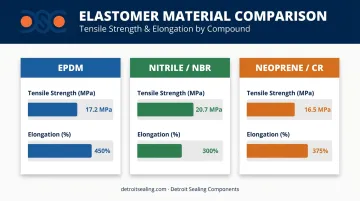
EPDM's tensile range varies meaningfully by compound. Standard high-grade solid sheet typically achieves 7.0 MPa minimum, while UL 94 V-0 flame-retardant EPDM is specified at 5.0 MPa minimum — a trade-off for the flame-retardant additives required.
Thermal Range
- Solid EPDM: approximately -57°C to +150°C continuous service (Parker O-Ring Handbook)
- Steam service: up to 204°C (400°F) — making EPDM one of the few elastomers rated for live steam service
- At low temperatures, EPDM retains flexibility where other elastomers become brittle, due to its saturated polymer backbone
Chemical Resistance
EPDM's non-polar structure makes it highly compatible with polar media:
- Water and steam (rated excellent across Parker, Trelleborg, and IPEX guides)
- Dilute acids and alkalis
- Brake fluids (DOT rated)
- Ketones — acetone, MEK
- Phosphate esters
- Silicone oils
- Alcohols
Compression Set and Electrical Properties
- Parker's E1157-60 EPDM compound achieves 8.7% compression set after 70 hours at 125°C — reliable sealing under repeated loading cycles, critical for flange gaskets and door seals
- Electrical resistance exceeds 10⁹ ohm-cm, making EPDM a practical choice for electrical enclosure gaskets
EPDM Gasket Grades and Forms
Physical Forms
Three distinct forms serve different sealing needs:
Solid EPDM
- Density: approximately 1.30 g/cm³
- Hardness: commonly 70 Shore A ± 5 for standard sheet
- Use for: flange gaskets, abrasion or shock load applications, high-compression environments
Closed-Cell Foam EPDM
- Density range: 75–200 kg/m³ depending on grade
- Hardness measured in Shore OO (not Shore C)
- Structure is air and water-tight
- Use for: weatherstripping, door and window seals where moisture ingress must be blocked
Open-Cell Sponge EPDM
- Density range: 70–110 kg/m³, overlapping with lower-density closed-cell grades
- More compressible and porous than closed-cell
- Use for: dry sealing applications requiring high compressibility at low closure forces
Key Grades
| Grade | Key Characteristic | When to Specify |
|---|---|---|
| Standard/commercial | Sulfur-cured, general purpose | Cost-sensitive, moderate temperature applications |
| Peroxide-cured | Superior heat aging, lower compression set | Steam systems, elevated temperature service |
| UL 94 V-0 | Flame-retardant, 65 Shore A | Electrical enclosures, mass transit, rail |
| FDA 21 CFR 177.2600 | Food-contact compliant | Food processing, beverage equipment |
| NSF/ANSI 61 | Potable water certified | Pipe flanges, drinking water distribution |
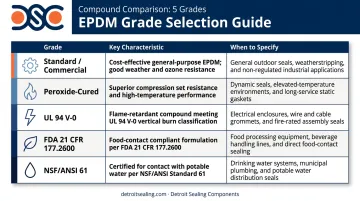
Important: These compliance designations are compound-specific. Not all EPDM is FDA-compliant, and not all EPDM meets NSF/ANSI 61 — the specific compound must carry the certification.
DSC's EPDM Portfolio
Selecting the right grade often comes down to matching compound properties to regulatory and service requirements. Detroit Sealing Components stocks EPDM from 40–90 Shore A across all major grades and forms listed above.
For non-standard requirements, DSC's ISO 17025 accredited lab supports:
- Custom compound development for unusual chemical exposure profiles
- Regulatory compliance documentation (FDA, NSF, UL)
- Material qualification testing for mixed service conditions
Industries and Applications of EPDM Gaskets
EPDM's outdoor durability, water resistance, and chemical compatibility make it a practical choice across a broad range of industries:
Primary Industries
Automotive
- Door and window seals (a core EPDM application globally)
- Cooling system hoses and seals
- Brake fluid system components
Water and Sanitary
- Pipe flange gaskets in potable water systems (NSF/ANSI 61 certified compounds)
- Pump and valve seals in water treatment
- Plumbing seals where continuous water contact is expected
HVAC and Building
- Weatherstripping and expansion joint seals
- Facade and curtain wall sealing profiles
- Window and door frame gaskets
Renewable Energy
- Solar collector panel seals — Trelleborg specifically lists this application
- Wind turbine enclosure gaskets exposed to continuous outdoor weathering
Additional Sectors
- Food and beverage: FDA-grade EPDM for processing equipment where incidental food contact occurs
- Electrical/electronics: Enclosure gaskets using EPDM's EPDM's >10⁹ ohm-cm electrical resistance
- Agriculture and construction: Equipment seals exposed to outdoor elements, UV, and temperature cycling
- General industrial: Flange gaskets, valve seats, and pump seals in water-based systems
That breadth of use translates directly into market momentum: the EPDM market is projected to grow from $5.10 billion in 2026 to $6.26 billion by 2031 — a 23% increase driven by steady demand from water infrastructure, automotive, and renewable energy sectors.
What EPDM Gaskets Are Not Compatible With
This is where material selection failures happen most often.
The Hydrocarbon Problem
EPDM should never be used in contact with:
- Mineral oils
- Petroleum fuels (gasoline, diesel)
- Synthetic di-ester lubricants
- Most hydrocarbon-based fluids
The cause is chemical polarity. EPDM's non-polar polymer structure attracts non-polar hydrocarbons, which diffuse into the rubber matrix and cause swelling and physical degradation. Parker, Trelleborg, and IPEX all rate EPDM as unsuitable for mineral oil and petroleum fuel service.
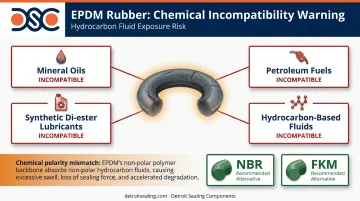
The alternative: NBR (nitrile rubber) for mineral oil and petroleum applications. FKM/Viton for high-temperature fuel service.
Other Limitations
- Standard EPDM has poor inherent flame resistance; UL 94 V-0 performance requires specific additive packages
- Food processing applications need FDA 21 CFR 177.2600 compliant formulations — standard EPDM does not qualify
- Above 150°C continuous dry heat, performance degrades; silicone is the better choice for sustained high-temperature dry environments
- High dielectric strength applications require purpose-specified EPDM compounds, not standard grades
The most common field failure pattern: Standard EPDM installed in oil- or fuel-wetted systems. Always identify the exact fluid, concentration, and temperature before specifying a gasket material.
How to Choose the Right EPDM Gasket
Evaluate these variables in sequence:
1. Media Compatibility First
Identify every fluid the gasket will contact. If any are petroleum-based, EPDM is disqualified — stop here and evaluate NBR or FKM.
If the media are water-based, steam, dilute aqueous chemicals, brake fluids, or ketones, proceed to the next variable.
2. Temperature Range
Use compound-specific data, not polymer family maximums:
- Standard solid EPDM sheet: up to 120–150°C continuous
- Peroxide-cured EPDM: better performance at the upper range
- Steam applications: confirm compound is rated for steam service (up to 204°C)
3. Match Form to Function
| Requirement | Correct Form | Example |
|---|---|---|
| Abrasion or high compression loads | Solid EPDM | Pipe flange gasket |
| Moisture-tight seal, moderate compression | Closed-cell foam | Window frame weatherstripping |
| Low-pressure, high-compressibility dry seal | Open-cell sponge | HVAC access panel gasket |
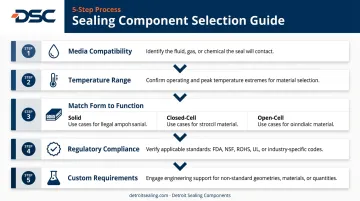
4. Regulatory Compliance
Determine early whether the application requires:
- FDA 21 CFR 177.2600 — food contact
- NSF/ANSI 61 — potable water
- UL 94 V-0 — electrical or transit applications
Request compliance documentation for the specific compound, not a general EPDM grade claim.
5. Custom Requirements
Standard compounds have limits. Custom formulation becomes necessary when the application involves:
- Simultaneous exposure to multiple media types
- Temperature ranges outside published compound specs
- Regulatory requirements that no off-the-shelf grade satisfies
DSC's ISO 17025 accredited lab develops and qualifies custom EPDM formulations for these cases, matching the compound to the specific service conditions rather than the other way around.
Frequently Asked Questions
What is EPDM material in gaskets?
EPDM (ethylene-propylene diene monomer) is a synthetic rubber gasket material produced by polymerizing ethylene, propylene, and a diene component. It's known for outstanding resistance to water, steam, UV, ozone, and weathering across a wide temperature range — properties that make it suitable for a broader range of outdoor and fluid-sealing environments than most synthetic rubbers.
Is EPDM a good gasket material?
EPDM is an excellent gasket material for outdoor, water-based, steam, and weathering applications, with tensile strength of 5.0–12 MPa depending on compound — stronger than neoprene at equivalent hardness. It is not suitable for oil, fuel, or hydrocarbon fluid contact.
How long does an EPDM gasket last?
Trelleborg's documentation supports a storage life of up to 10 years (extendable by 5 years) under controlled conditions. Installed service life depends on the compound, media, temperature, compression load, and UV/ozone exposure — request service-life data from your compound supplier for specific application conditions.
What is the density of an EPDM seal?
Solid EPDM sheet is approximately 1.30 g/cm³ (1,300 kg/m³). Closed-cell foam EPDM ranges from 75–200 kg/m³ by grade, while open-cell sponge EPDM is typically 70–110 kg/m³ — the two cellular forms overlap at lower densities and are not always distinctly separated by grade.
How thick is EPDM gasket material?
EPDM sheet stock is available from approximately 1 mm to 25 mm (roughly 1/16" to 1"), with the correct thickness determined by flange gap, bolt load, and required compression. Custom thicknesses outside this range are available for specific applications.