Introduction
A single non-compliant O-ring seal can cascade into catastrophic system failure. The NASA Rogers Commission investigation found that Challenger's SRB field joint O-rings were classified as Criticality 1 — meaning primary seal failure meant loss of crew and vehicle. Temperature-dependent resiliency was a key factor: at 75°F the ring lost contact for 2.4 seconds, but at 50°F it failed to reestablish contact within 10 minutes.
For engineers and procurement teams specifying aerospace O-rings, that failure mode is exactly what the applicable standards are designed to prevent. Each specification — dimensional, material, gland design — exists to keep hydraulic, fuel, and pneumatic systems intact under the conditions where failure is not recoverable.
This guide covers the five standard categories:
- Dimensional sizing (AS568, ISO 3601)
- Material compounds (ASTM D2000, AMS)
- Defense specifications (MIL-Spec, MS, AN, NAS)
- Gland design (AS4716, AS5857, AS6235)
- Quality certifications (AS9100, ISO 9001)
TL;DR: Key Aerospace and Defense O-Ring Standards at a Glance
- AS568 is the primary US dimensional standard, using dash numbers to identify O-ring inside diameter and cross-section
- ISO 3601 is the international sizing equivalent — used when drawings reference metric or non-US OEM specs
- ASTM D2000 classifies rubber compounds by heat and oil resistance
- AMS specs qualify specific compounds for aerospace applications
- MIL-Spec (MS, AN, NAS) governs defense procurement; always source by NSN for verified compliance
- AS9100 is the top-tier quality management certification for aerospace suppliers
- AS4716, AS5857, AS6235 define the gland geometry that determines how an O-ring seals
Dimensional Sizing Standards: AS568 and ISO 3601
AS568F — published by SAE International — is the primary sizing reference for aerospace O-rings in the US. It specifies inside diameters, cross-section widths, tolerances, and dash number identification codes. Coverage includes O-rings for sealing applications and straight-thread tube-fitting boss gaskets.
Every aerospace drawing that calls out a dash number is referencing this standard. DSC stocks the complete AS568 series — sizes from 0.5mm ID up to 1600mm ID — for aerospace sealing applications.
How AS568 Dash Numbers Are Organized
The dash numbering system groups O-rings by cross-section, with each hundred-series block identifying a specific cross-section width:
| Dash Number Range | Nominal Cross-Section | Typical Use |
|---|---|---|
| -001 to -050 | 0.040 in | Miniature assemblies, instruments |
| -102 to -178 | 0.070 in | Small-bore hydraulic and pneumatic |
| -201 to -284 | 0.103 in | General aerospace hydraulic |
| -309 to -395 | 0.139 in | Medium-pressure sealing |
| -425 to -475 | 0.210 in | Large-diameter static seals |
| -900 series | Varies | Straight-thread tube-fitting boss gaskets |
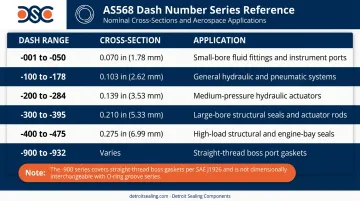
Each dash number identifies exactly one nominal size. There is no overlap.
AS568 vs. ISO 3601: Which Standard Applies?
ISO 3601-1:2012 covers the same territory — inside diameters, cross-sections, tolerances, and designation codes — but for international fluid power applications. ISO 3601-3 adds quality acceptance criteria for those same dimensions.
Use ISO 3601 when:
- The engineering drawing explicitly references ISO dimensions
- The program involves EU or non-US OEM specifications
- The supply chain includes metric-system manufacturers
Critical rule: Tolerances and some size callouts differ between AS568 and ISO 3601. Confirm which standard the drawing references before ordering. Using the wrong standard's tolerances on a flight-critical seal is not a minor documentation error.
Material and Compound Standards for Aerospace O-Rings
ASTM D2000 and AMS: Two Different Layers
ASTM D2000 classifies vulcanized rubber by type (heat-aging resistance) and class (oil-swell resistance). A D2000 call-out on a drawing tells the supplier what base material and performance level is required — but it doesn't specify the exact compound or verify that it has passed aerospace-specific testing.
That's where AMS (Aerospace Material Specifications) come in. Managed by SAE International, AMS specs qualify specific compounds for aerospace use. They go beyond material classification to confirm that the compound has passed required performance testing for aviation components.
For flight-critical seals, ASTM D2000 alone is insufficient. You need the AMS designation.
Common Elastomers in Aerospace O-Rings
| Elastomer | AMS Reference | Primary Aerospace Use |
|---|---|---|
| FKM (Viton) | AMSR83485/1 | High-temp hydraulic and fuel systems, approximately -15°F to 400°F |
| FVMQ (Fluorosilicone) | AS9967B / AMS7273 | Fuel systems requiring both fuel resistance and low-temp flexibility |
| EPDM | AS7217 / AMS7361 | Phosphate-ester hydraulic fluids (e.g., Skydrol), static seals to -75°F |
| HNBR | — | Engine accessories requiring better heat and abrasion resistance than standard nitrile |
| FFKM | AMS7257F | Mission-critical seals with broadest chemical and temperature resistance |
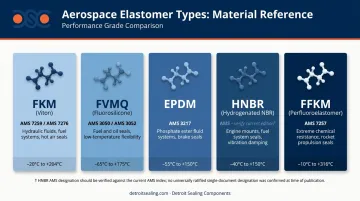
Note on HNBR: No current SAE AMS O-ring specification for HNBR has been confirmed. Verify any HNBR AMS callout against the applicable standard before specifying.
Selecting the Right Compound
Three factors drive compound selection:
- Chemical compatibility: Jet fuel, synthetic lubricants, and Skydrol each demand different elastomer families. FKM degrades rapidly in phosphate-ester fluids; EPDM fails in petroleum-based fluids.
- Temperature range: The compound must maintain elasticity from arctic ground conditions to turbine-adjacent heat — across the full operating envelope of the application.
- Dynamic vs. static duty: Dynamic seals face abrasion and extrusion forces that static seals don't. HNBR's improved abrasion resistance makes it preferable to standard NBR in moving applications.
When standard off-the-shelf compounds fall short of specific AMS or application requirements, DSC's access to hundreds of compounds across all rubber types — FKM, FVMQ, EPDM, HNBR, and FFKM — and an ISO 17025 accredited lab for custom material development provides a direct path to a compliant solution.
MIL-Spec, MS, AN, and NAS Standards for Defense Applications
"MIL-Spec" is not a single document. It's a framework of specifications maintained by the U.S. Department of Defense that governs dimensional precision, material quality, and performance verification for defense-grade components. Both the manufacturer and the part itself must comply — and understanding how the designation systems work is the first step to sourcing correctly.
Understanding MS, AN, and NAS Designations
MS (Military Standard) is the primary current designation system:
- MS29513 — originally covered hydrocarbon fuel-resistant O-rings; now superseded by SAE-AS29513
- MS28775 — covers hydraulic O-rings rated to +275°F; now superseded by SAE-AS28775
Many procurement documents still reference the MS numbers. Always check DLA ASSIST for current supersession status before releasing a purchase order against a legacy MS part number.
AN (Air Force-Navy) designations are older foundational dimensional specs. They remain embedded in legacy aircraft documentation and are still cited references for parts in those systems.
NAS (National Aerospace Standard) designations — developed by the Aerospace Industries Association — complement MS specs and address high-performance material requirements. NAS status should be confirmed through the AIA or DLA before citing in new procurement documents.
NSNs and Certificates of Conformance
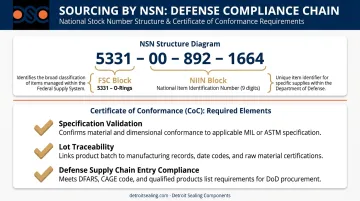
The National Stock Number (NSN) is a 13-digit code assigned through the federal supply system. Its structure:
- 4-digit Federal Supply Classification (FSC) — O-rings fall under FSC 5331
- 9-digit National Item Identification Number (NIIN)
Sourcing by NSN is the highest assurance of MIL-Spec compliance. An NSN links the O-ring directly to its specified dimensions, compound, and performance criteria.
Certificate of Conformance (CoC) is the documentation layer required for defense supply chain entry. A valid CoC:
- Validates the part meets its specification
- Provides lot traceability back to the manufacturer
- Enables compliant entry into the defense supply chain
Per FAR 52.246-15, contractors must ship a CoC with supplies when the contract requires inspection at source. CoC requirements are contract-driven — make them explicit in every defense O-ring purchase order, not assumed.
SAE Gland Design Standards: AS4716, AS5857, and AS6235
AS568 tells you what O-ring to order. The gland standards tell you how to design the groove it sits in. Correct gland geometry controls compression ratio, prevents extrusion, and determines whether a seal will survive its operating life or fail in compression set.
The Three Primary SAE Gland Standards
AS4716 — General Static and Dynamic Applications
AS4716 covers gland design for AS568 O-rings at pressures exceeding 1,500 psi (using one or two anti-extrusion backup rings) and below 1,500 psi without backup rings. It is the baseline gland standard for most aerospace hydraulic and pneumatic systems and covers both static and dynamic sealing configurations.
AS5857A — Static External (Overboard) Sealing
AS5857A (revised 2022) provides increased squeeze compared to AS4716, specifically for improved sealing at low temperatures and when seal swell is minimal. It is intended exclusively for static external applications — seals that face atmosphere or overboard. Do not specify AS5857A for dynamic sealing duty.
AS6235A — Face Seal Gland Designs
AS6235A covers face seal gland design for static applications in aerospace hydraulic and pneumatic systems, for both internal and external pressure configurations. AS6235A is listed as a historical SAE document — verify the current revision status before referencing it in a new design release.
Choosing the right standard:
- Dynamic or general hydraulic/pneumatic → AS4716
- Static external/overboard, low-temperature concern → AS5857A
- Face seal configuration → AS6235A
- Large-diameter custom-compression seals (nominal 3/8 in cross-section) → AS4832
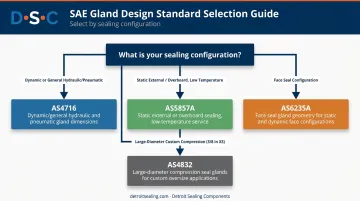
Always match the gland standard to the specific AS568 dash size and confirm that gland dimensions suit the system's pressure, temperature, and motion requirements before finalizing the design.
Quality Management Certifications and Compliance Requirements
AS9100 and ISO 9001
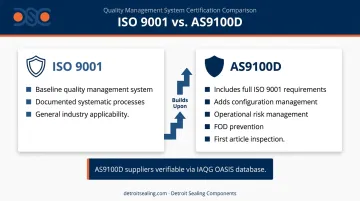
AS9100D — published by SAE International in 2016 — incorporates ISO 9001:2015 in full and adds aviation, space, and defense-specific requirements including configuration management, operational risk management, FOD prevention, and first article inspection. Suppliers certified to AS9100D are listed in the IAQG OASIS database, which procurement teams can use to verify certification status.
AS9100D certification is a strong supply-chain preference and often a customer flow-down requirement for aerospace programs. No universal legal mandate applies to every O-ring supplier, but AS9100D is the threshold qualification most aerospace and defense prime contractors require from their supply chains.
ISO 9001 represents the baseline quality management system. Suppliers certified to ISO 9001 have demonstrated systematic, documented quality processes — but without the aerospace-specific additions of AS9100D. For aerospace O-ring procurement, ISO 9001 alone doesn't satisfy the configuration management, risk, and traceability requirements that AS9100D addresses directly.
Shelf Life and Environmental Compliance
Certification standards address supplier quality systems — but storage and handling compliance is equally critical once parts enter your inventory.
ARP5316 (and the related AS5316) governs storage of aerospace elastomeric seals, covering data recording, packaging, and storage requirements prior to assembly. Elastomeric seals have a defined maximum usable life from their cure date. Installing an O-ring past its shelf life is a safety violation regardless of how the seal looks visually.
Procurement teams must verify cure dates and lot traceability, particularly for MIL-Spec inventory.
RoHS and REACH apply selectively to defense programs:
- REACH applies to the defense sector in EU Member States, though Article 2(3) allows defense exemptions for specific substances — these exemptions must be documented
- RoHS applies to electrical and electronic equipment; standalone rubber O-rings generally fall outside RoHS scope, though they may be caught by contract-level material declaration flow-downs
For programs with EU or international scope, request REACH/RoHS declarations from your supplier and document any applicable exemptions in your procurement records.
Frequently Asked Questions
What standards apply to aerospace and defense O-rings?
Aerospace O-ring standards are layered: AS568 for US dimensional sizing, ISO 3601 for international equivalency, ASTM D2000 for rubber compound classification, AMS for aerospace-qualified materials, MIL-Spec (MS, AN, NAS) for defense procurement, and AS4716/AS5857/AS6235 for gland groove design. Most applications require compliance across several of these simultaneously.
What is the difference between AS568 and ISO 3601?
AS568 is the SAE US-centric standard using dash number identification; ISO 3601 is the international equivalent using ISO designation codes. Tolerances and some size callouts differ between the two — always confirm which standard appears on the engineering drawing before ordering.
What materials are approved for aerospace O-rings?
Common aerospace-approved elastomers include FKM/Viton (high-temperature hydraulics and fuel), FVMQ/Fluorosilicone (wide-range fuel systems), EPDM (phosphate-ester fluids), HNBR (engine accessories), and FFKM (extreme chemical and thermal environments). All flight-critical materials require AMS and/or MIL-Spec qualification.
What is a MIL-Spec O-ring and when is it required?
A MIL-Spec O-ring meets US Department of Defense specifications — such as MS or AN designations — for dimensions, material, and performance. It is required for any defense procurement contract specifying component traceability and verified compliance. MIL-Spec O-rings are identified by NSN and must be accompanied by a Certificate of Conformance.
What is the difference between AS9100 and ISO 9001 for aerospace suppliers?
ISO 9001 is the baseline quality management system standard. AS9100D builds on ISO 9001 and adds aerospace-specific requirements including configuration management, risk management, and first article inspection. AS9100D is the preferred — and often required — certification for suppliers entering the aerospace and defense supply chain.
How do I choose the right gland design standard?
AS4716 covers static and dynamic applications across standard and high-pressure ranges. AS5857A applies to static external seals requiring increased squeeze at low temperatures, while AS6235A governs face seal gland configurations. Match the gland standard to the O-ring's AS568 dash size and confirm compatibility with the system's pressure, temperature, and motion type.