Introduction
A single failed seal can halt an entire production line. This plays out daily across oil refineries, food processing plants, hydraulic systems, and semiconductor fabs. Sealing components govern fluid containment, contamination prevention, and pressure integrity — and a failure in any one of those functions can cascade through an entire operation.
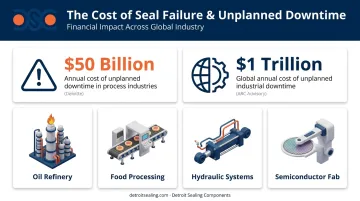
Unplanned downtime costs process industries an estimated $50 billion annually, according to Deloitte. Despite that exposure, sealing components are still selected as commodity line items in too many maintenance programs — without matching material, geometry, or pressure ratings to the actual application.
This guide covers the major types of industrial sealing components, the materials that determine their performance, and how to match the right seal to the right application. The same principles apply whether you're maintaining hydraulic cylinders on a construction site or managing fugitive emission compliance in a chemical plant.
Key Takeaways
- Industrial sealing components prevent fluid leakage, contamination ingress, and pressure loss across virtually every type of machinery
- Primary types — O-rings, gaskets, mechanical seals, lip seals, and hydraulic/pneumatic seals — each suit different motion types and pressures
- Material selection (NBR, FKM, EPDM, PTFE) is as critical as seal geometry; the wrong compound fails prematurely
- Static seals handle stationary joints; dynamic seals handle rotating or reciprocating surfaces, which changes both material and profile requirements
- Early failure signs include visible leakage, pressure drops, contaminated lubricant, and unusual noise
Why Sealing Components Are Critical to Industrial Equipment
Seals serve three non-negotiable functions in any industrial system: containing process fluids or gases, excluding external contaminants, and maintaining system pressure. When any one of these functions fails, the consequences compound fast:
- A lubricant leak accelerates bearing damage
- Contamination ingress degrades hydraulic fluid quality
- Pressure loss cuts actuator force or reduces throughput
ARC Advisory Group estimates unplanned downtime across process industries costs roughly $1 trillion annually when totaled across global operations. At the plant level, even a few hours of unplanned downtime translates directly into lost production, emergency labor costs, and secondary equipment damage.
Compliance Is Also at Stake
In chemical processing and oil & gas, seal failure isn't just a maintenance problem — it's a regulatory one. EPA 40 CFR Part 60 Subpart VVa sets VOC leak thresholds for pumps, compressors, valves, and connectors in synthetic organic chemical manufacturing, with limits as low as 500 ppm for valves in gas/vapor service. Exceeding those thresholds triggers mandatory monitoring and repair protocols.
In food and beverage, FDA 21 CFR 177.2600 governs rubber articles for repeated food contact. NSF/ANSI 61 covers sealing materials in potable water systems. Specifying the wrong seal material creates both an equipment problem and a compliance failure simultaneously.
Long-Term Equipment Impact
Effective seals also protect the equipment around them. They reduce metal-to-metal contact on shafts and bearings, preserve lubricant integrity, and slow wear on rotating components. Over an asset's lifecycle, that translates to fewer bearing replacements, lower lubricant consumption, and extended mean time between failures.
The Most Common Types of Industrial Sealing Components
O-Rings
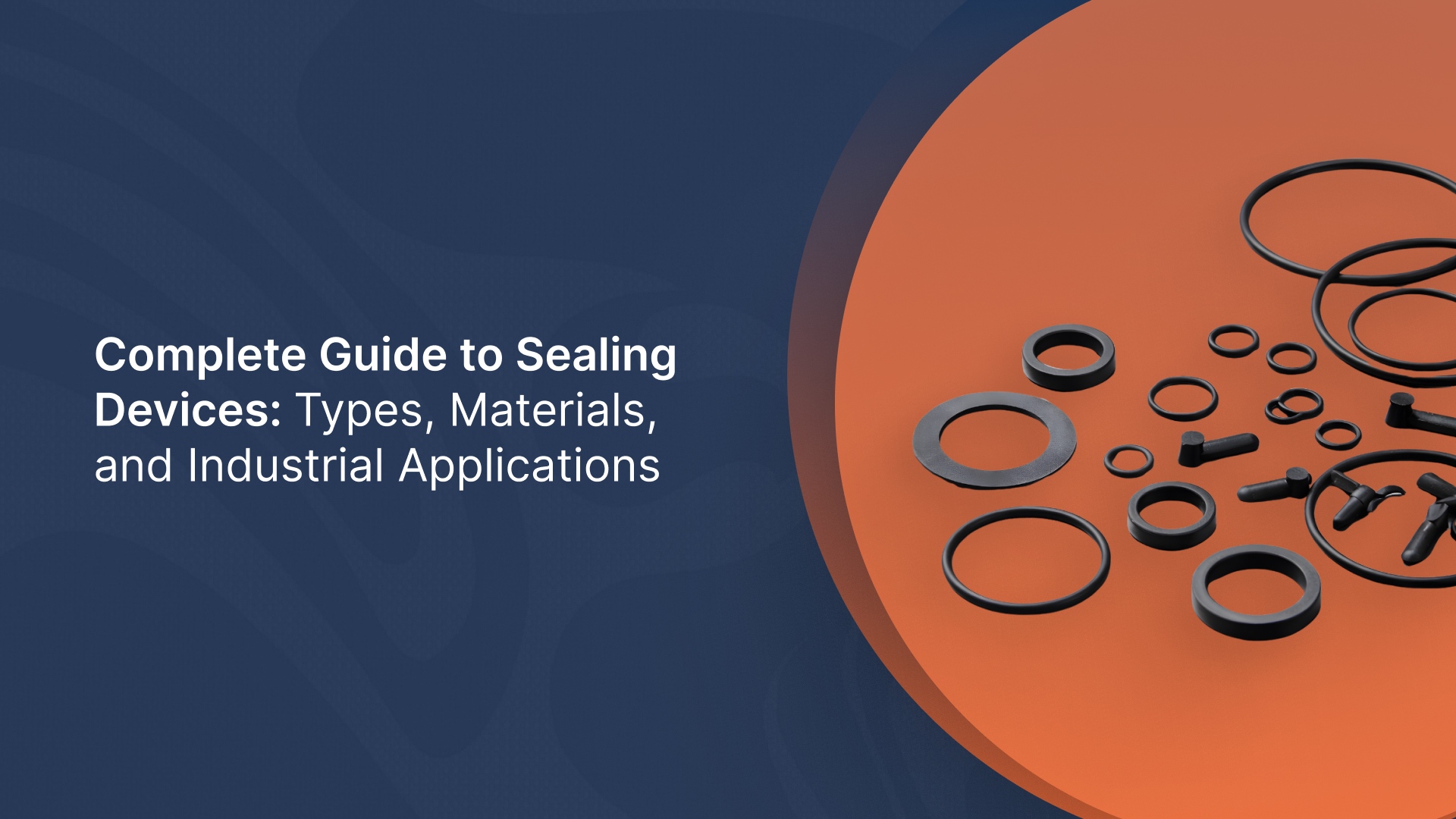
O-rings are toroidal elastomeric rings that create a seal under compression. They work in both static and dynamic applications, are dimensionally standardized under SAE AS568F (inch-series) and ISO 3601 (metric/fluid power), and are available across a wide range of materials and sizes.
DSC stocks the full range of international O-ring standards — AS 568, BS 4518, JIS B2401, metric, and others — with sizes from 0.5mm ID × 0.4mm CS up to 1,600mm ID × 50mm CS, covering the vast majority of industrial requirements without custom tooling.
Gaskets
Gaskets are flat sealing elements used between two mating surfaces — flanges, covers, and pipe joints — where bolt compression creates the seal. DSC's gasket range focuses primarily on molded rubber geometries, produced through compression, transfer, and injection molding to achieve precise cross-sections and material consistency. With over 8,000 tooled articles in inventory and custom design capability using CAD and finite element analysis, DSC can match or develop gasket profiles for static applications across a broad range of industries.
Mechanical Seals
Mechanical seals are precision devices used on rotating shafts in pumps, compressors, and mixers. A typical assembly includes:
- A rotating primary face attached to the shaft
- A stationary face mounted in the equipment housing
- Secondary seals (O-rings or gaskets) preventing leakage behind the faces
- Springs or bellows that maintain face contact pressure
- Drive mechanisms to transmit shaft rotation
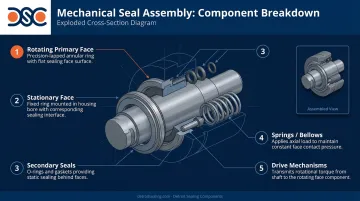
The lapped sealing faces create a near-leak-proof barrier even at high speeds and pressures. API Standard 682, issued by the American Petroleum Institute, defines requirements for shaft sealing systems used in petroleum, natural gas, and chemical industry pumps.
Lip Seals (Rotary Shaft Seals)
Lip seals — also called oil seals or rotary shaft seals — use a flexible sealing lip that contacts a rotating shaft to retain lubricant and exclude contaminants. They're common in gearboxes, axles, electric motors, and other rotating equipment where a simple, compact seal is needed to keep lubricant in and contaminants out.
Hydraulic and Pneumatic Seals
These seals handle linear motion applications and fall into two categories:
Hydraulic seals — designed for pressurized liquid service in cylinders and actuators. Common types include:
- Wiper seals (exclude contaminants on the rod retract stroke)
- Rod seals (prevent fluid leakage past the cylinder rod)
- Piston seals (separate pressure zones within the cylinder bore)
- Symmetrical seals (function as either rod or piston seal)
Pneumatic seals — designed for compressed air or gas service at lower pressures, with an emphasis on low-friction performance and tight tolerances for speed and precision.
DSC carries a full hydraulic and pneumatic seal range including wiper, rod, piston, symmetrical, and damper seal profiles across multiple configuration standards, tooled for common cylinder sizes to reduce lead times.
Key Materials Used in Industrial Sealing Components — and How to Choose
Material selection determines how long a seal lasts. The wrong compound will swell, harden, crack, or chemically degrade before its design life is reached — regardless of how well the geometry is specified. Temperature range and fluid compatibility are the primary screening criteria.
NBR (Nitrile Butadiene Rubber)
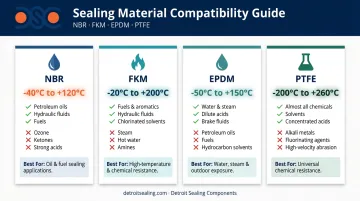
The most widely used general-purpose sealing compound. Per the Parker O-Ring Handbook, NBR performs from -34°C to 121°C and is compatible with petroleum oils, mineral oil, diesel fuel, and aliphatic hydrocarbons.
Avoid NBR with: strong acids, polar solvents (ketones, acetone), high-aromatic fuels, ozone, and outdoor weathering exposure.
FKM (Fluorocarbon / Viton®)
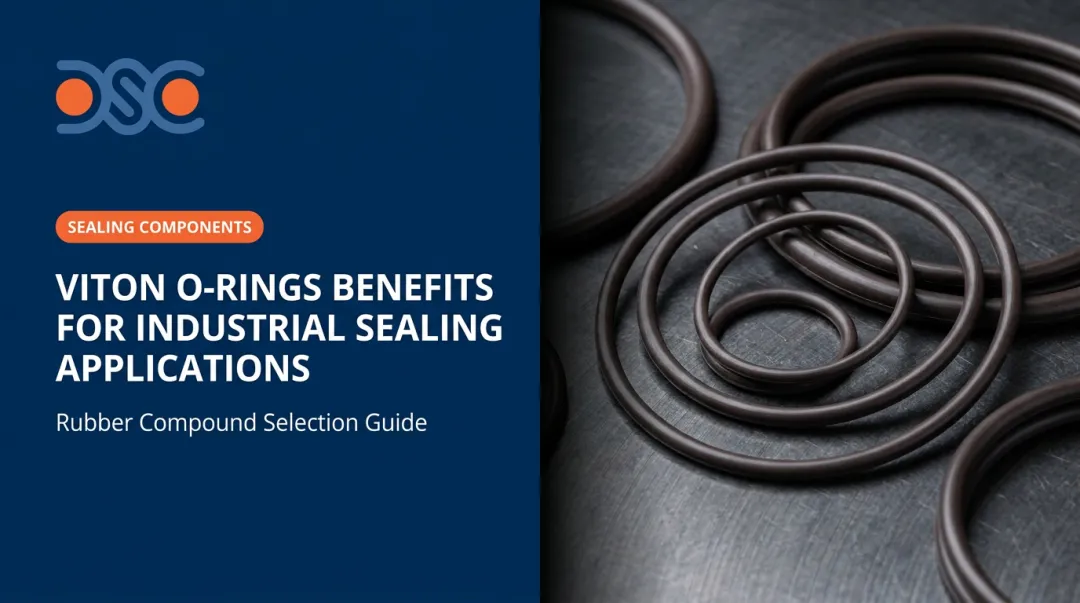
The standard choice for aggressive chemical environments and elevated temperatures. Parker rates FKM at -26°C to 205°C, with resistance to mineral oils, synthetic hydraulic fluids, fuels, and aromatics. Common in oil & gas, aerospace, and chemical processing.
The tradeoff: FKM costs more than NBR, and low-temperature performance is limited. For applications below -26°C, HNBR or specialty compounds should be considered.
EPDM
Preferred for water, steam, and brake fluid applications. Parker confirms EPDM handles hot water and steam up to 149°C and provides excellent ozone and weathering resistance.
Critical limitation: EPDM is incompatible with mineral oils and petroleum-based lubricants. It's the right choice for HVAC, water treatment, and food-grade water-contact applications — and the wrong choice anywhere petroleum lubricants are present.
PTFE
Near-universal chemical resistance, combined with a wide temperature range (-73°C to over 204°C), makes PTFE the material of choice for extreme chemical environments, pharmaceutical applications, and semiconductor processing. It's typically used as a coating, seat material, or in spring-energized seal designs rather than as a standalone elastomer, because it lacks the elasticity of rubber compounds.
Beyond the Standard Four
Standard compounds cover most applications — but unusual chemical combinations, dual-media exposure, or regulatory certifications often require broader material access.
DSC stocks compounds across all major elastomer families, including:
- HNBR and FFKM for high-performance chemical and temperature demands
- Silicone (VMQ) and fluorosilicone (FVMQ) for extreme temperature ranges
- Liquid silicone rubber (LSR) for precision medical and food-contact parts
- Polyurethane (AU/EU) for high-wear dynamic sealing
- Chloroprene (CR) for weather and ozone resistance
When no standard compound fits, DSC's ISO 17025 accredited lab can custom develop and bench-test new formulations under actual service conditions before production begins.
Static vs. Dynamic Seals: Understanding the Difference
Get the static/dynamic classification wrong upfront, and every downstream material and geometry decision compounds the error.
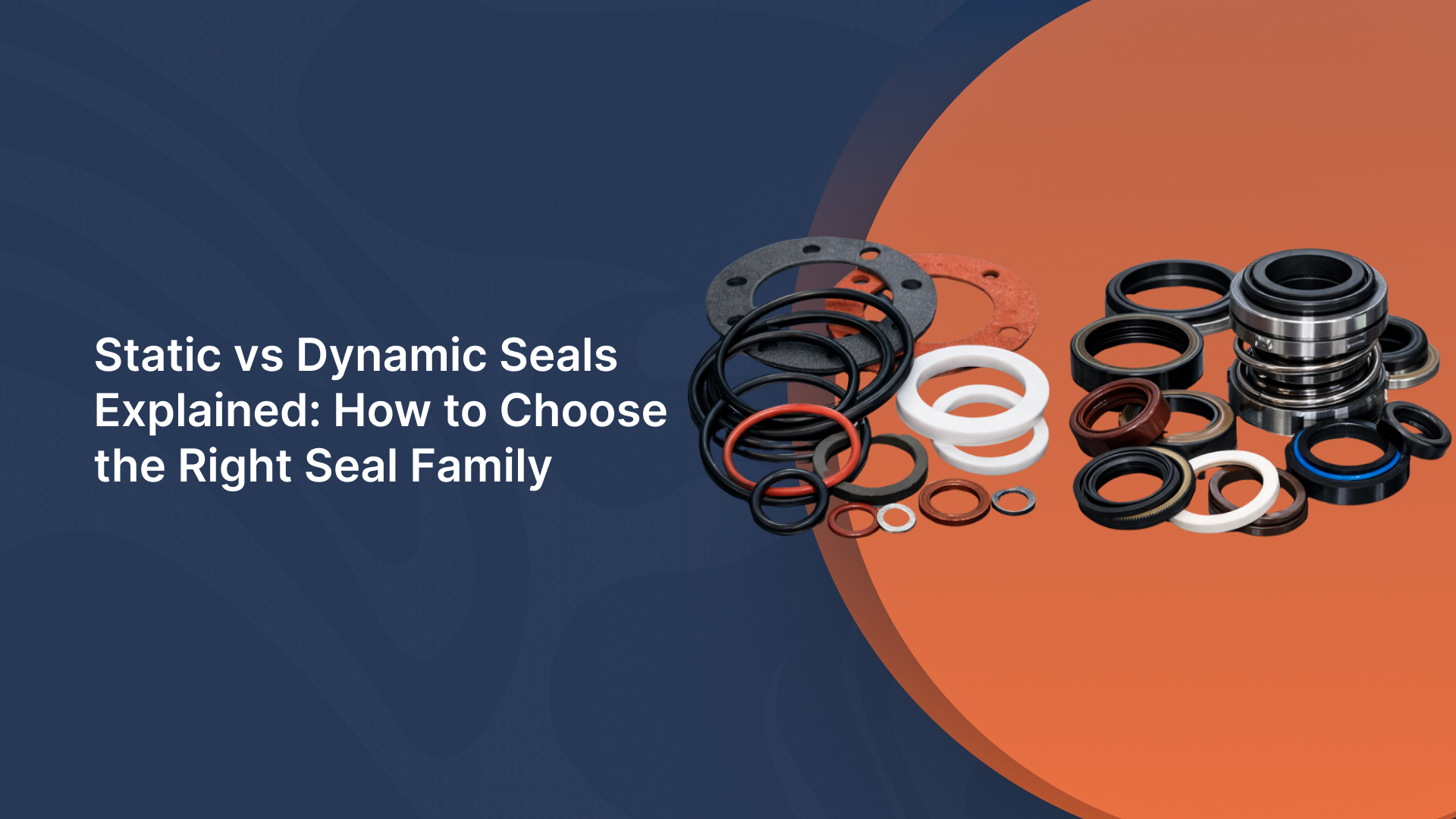
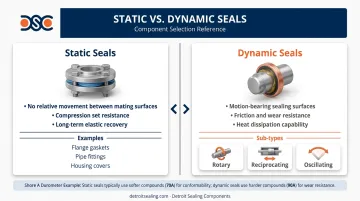
Static seals operate between two surfaces with no relative movement — flange gaskets, pipe fittings, housing covers. The design challenge is maintaining clamping load over time and resisting chemical attack without compression set causing the seal to lose contact force. Extrusion resistance and long-term elastic recovery matter most.
Dynamic seals operate where one surface moves relative to another:
- Rotary — lip seals, mechanical seals on rotating shafts
- Reciprocating — hydraulic rod and piston seals
- Oscillating — limited angular motion applications
For dynamic service, friction, heat generation, and wear resistance become primary considerations — on top of chemical compatibility. That shift in priority matters: a soft, highly elastic compound ideal in a static flange groove may fail rapidly in a reciprocating rod seal application due to abrasion or extrusion.
Consider a common O-ring scenario: in a static face seal groove, a softer durometer (70 Shore A) works well for maximum sealing contact. That same cross-section in a dynamic reciprocating groove typically needs a harder compound (90 Shore A) or a different profile entirely — a U-cup or lip seal — to resist extrusion and wear.
Signs of Seal Failure and When to Replace Industrial Seals
Visible Indicators
The most direct warning signs are straightforward to spot during routine inspection:
- Fluid leakage around shafts, rods, or flanged joints
- Oil staining on equipment housings or floors
- Contaminated lubricant (discoloration, particulate, water emulsion)
- Unusual noise from bearings — often caused by lubricant loss or abrasive contamination ingress
Less Obvious Symptoms
These are frequently misattributed to pump wear, valve problems, or instrumentation errors before the seal is inspected:
- Gradual pressure drop in hydraulic or pneumatic circuits
- Increased energy consumption as leakage reduces system efficiency
- Product contamination in process streams
- Recurring bearing replacements in the same equipment position
Replacement Strategy
Reactive replacement after failure is always more expensive than planned replacement. The cost isn't just emergency part sourcing — a failed hydraulic rod seal typically allows contamination ingress that degrades the entire hydraulic fluid volume and accelerates cylinder bore wear.
Deloitte research shows predictive maintenance can reduce breakdowns by 70% and lower maintenance costs by 25%. For seal management, that means setting preventive replacement intervals based on OEM service hours, operating cycles, or condition monitoring — not waiting for visible failure.
When a seal does need replacement, getting the specification right is equally critical. DSC provides technical consultation and cross-referencing support to match replacements by material, geometry, and compound certification, including upgraded specifications where the original design had documented limitations.
Frequently Asked Questions
What are the three components of a seal?
Most seals have three components: a primary sealing element (the elastomeric lip or face contacting the mating surface), a secondary sealing element (an O-ring or gasket behind the primary seal), and an energizing element (a spring or clamping force maintaining contact pressure). Together, these determine seal performance under pressure and temperature variation.
What are hermetic components?
Hermetic components create a completely airtight or gas-tight barrier with zero allowable leakage. They're used in aerospace, medical devices, and semiconductor equipment where even trace leakage is unacceptable, and are achieved through metal-to-glass seals, welded closures, or precision elastomeric seals in controlled configurations.
What are the components of a carbon seal?
A carbon seal includes a carbon-graphite ring as the primary sealing face, a harder ceramic or steel mating ring, secondary O-rings or gaskets, and a spring loading mechanism. They're common in aerospace engines and high-speed rotating equipment for their low friction and thermal stability.
What is the difference between a static and a dynamic seal?
Static seals function between two surfaces with no relative movement, such as gaskets in flanged joints. Dynamic seals accommodate motion — either rotary (lip seals, mechanical seals) or reciprocating (hydraulic piston and rod seals). Dynamic seals are engineered with friction resistance, wear life, and heat dissipation as primary design considerations.
How do I know which seal material is right for my application?
Start with four criteria: the fluid or gas being sealed, operating temperature range, system pressure, and whether the seal is static or dynamic. From there, a sealing specialist like DSC can confirm material compatibility and identify any regulatory certifications your industry requires.
How often should industrial seals be replaced?
Replacement intervals depend on temperature, pressure, cycle frequency, and chemical exposure. Most programs establish preventive schedules based on OEM guidelines or defined service hours. Any visible leakage, contaminated lubricant, or unexplained pressure drop warrants immediate inspection — regardless of where the seal sits on the replacement schedule.