Introduction
Pick the wrong seal for a dynamic application and you'll know it quickly—through leaks, accelerated wear, or an unscheduled shutdown. O-rings and X-rings (Quad rings) look nearly identical in a parts bin, but their behavior under reciprocating or rotary motion is a different story.
Choosing the wrong seal type carries real consequences: premature failure, increased downtime, higher maintenance costs, and potential safety hazards in critical applications. According to industry research, unplanned industrial downtime costs between $10,000 and $500,000 per hour, with seal failures ranking among the primary contributors to equipment stoppages. In high-value sectors like aerospace, a single assembly line stoppage can exceed $20,000 per hour in losses.
This guide breaks down exactly where each seal type excels, where it falls short, and how to match the right geometry to your application's pressure, motion, and lubrication conditions.
Key Takeaways
- O-rings have circular cross-sections suited for static applications where low cost is the priority
- X-rings use a four-lobed cross-section that delivers superior performance in dynamic applications with 20-40% reduced friction
- X-rings resist twisting, rolling, and spiral failure in reciprocating and rotary motion applications
- Selection depends on motion characteristics, pressure requirements, and lifecycle cost analysis, not just upfront price
X-Rings vs O-Rings: Quick Comparison
| Aspect | O-Rings | X-Rings |
|---|---|---|
| Cross-Section Design | Circular (toroidal) profile with uniform geometry | Four-lobed X-shaped profile creating multiple contact points |
| Sealing Surfaces | Single primary contact line per side | Two sealing surfaces per side for improved integrity |
| Friction Characteristics | Higher surface contact; friction coefficient ~0.18 at 100 psi | 20-40% lower friction; coefficient ~0.10 at 100 psi |
| Dynamic Stability | Prone to twisting and rolling in reciprocating motion | Resists spiral failure through stable four-point contact |
| Lubrication Retention | Limited lubricant retention in standard grooves | V-shaped grooves between lobes retain lubricant |
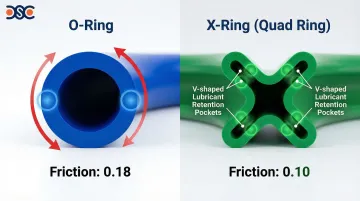
Cross-section geometry is where the two seals diverge most visibly. O-rings use a simple circular profile that compresses uniformly in a groove, creating a seal through radial compression. X-rings use a four-lobed geometry — forming an "X" in cross-section — that changes how the seal contacts groove walls and mating surfaces.
That geometry directly affects sealing surface count. The circular O-ring creates one main contact point on each side of the groove. X-rings provide two primary sealing surfaces per side, for four total sealing lips. That redundancy matters when pressure fluctuates or motion briefly compromises a single contact point.
Friction is where X-rings show the clearest measurable advantage. Lab testing at 100 psi shows O-rings at a friction coefficient of roughly 0.18; X-rings come in around 0.10 — a 44% improvement. In practice, that means lower breakout force, reduced operating temperatures, and less energy consumed in pneumatic and hydraulic systems.
Those friction reductions also contribute to better dynamic stability. O-rings in reciprocating applications frequently experience spiral failure: the seal rolls and twists in the groove, producing spiral-shaped cuts and eventual leakage. X-rings resist this failure mode through stable four-point contact, holding position even under high-speed reciprocating motion.
What is an O-Ring?
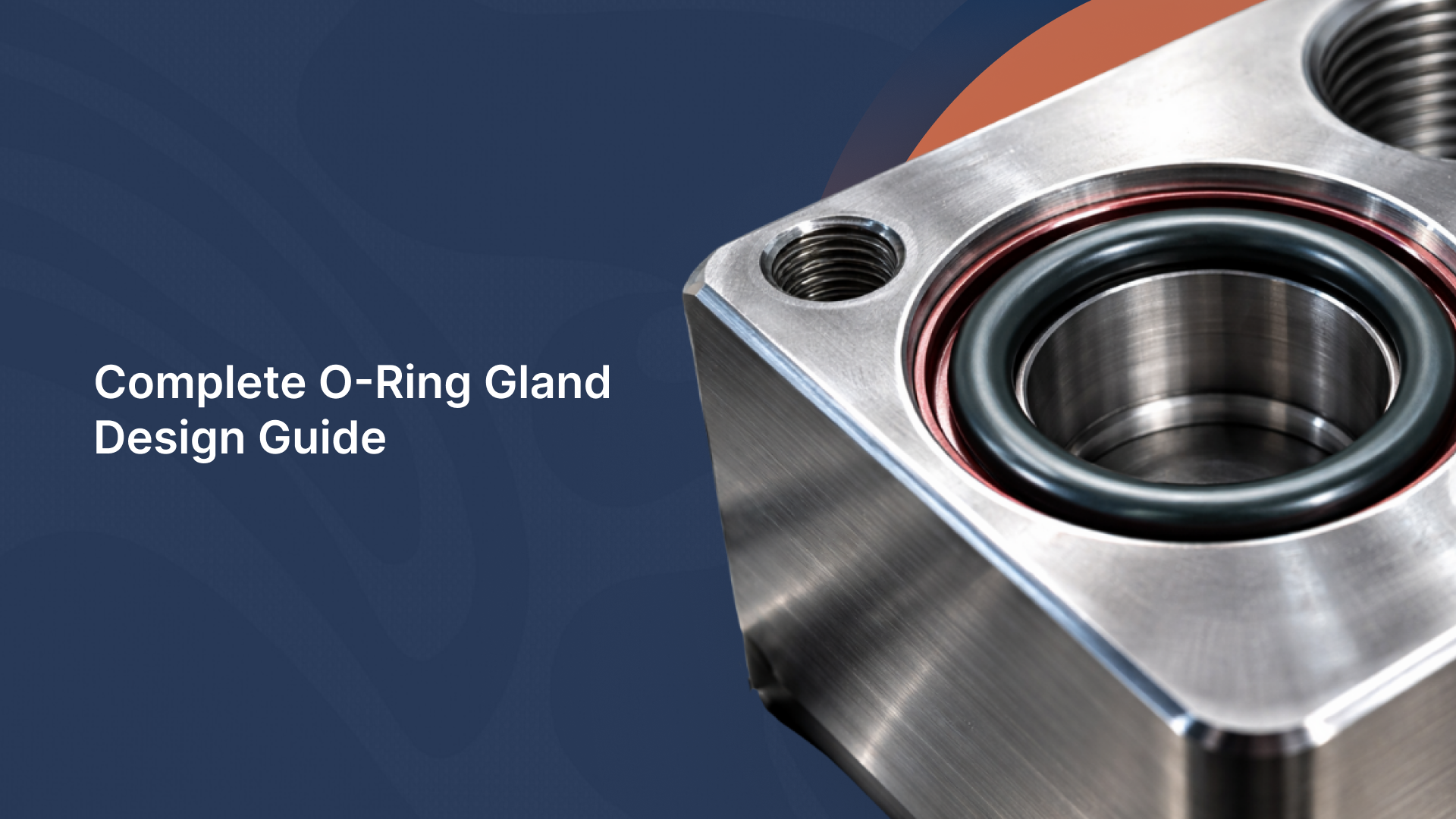
O-rings are circular elastomeric seals with a round (toroidal) cross-section that create a seal through radial compression when installed in a groove. As the seal compresses between the groove walls and the mating surface, it deforms to fill the available space, blocking fluid or gas passage.
Core benefits include:
- Drop into standard grooves with no orientation requirements
- Available in NBR, FKM, EPDM, silicone, and dozens of specialized compounds
- Lower manufacturing costs make them the go-to choice for static sealing
- Over 80 years of field performance across industrial applications
O-rings excel in static sealing applications including flanges, pipe connections, hydraulic fittings, and covers. They handle low-speed dynamic applications where motion is minimal or intermittent, though performance degrades as speeds and cycle counts climb.
Use Cases of O-Rings
O-rings dominate applications where sealing surfaces remain stationary or experience only occasional movement. Static gland seals in equipment housings, face seal applications in pumps, and low-pressure hydraulic systems represent ideal use cases where O-rings deliver reliable performance at minimal cost.
Industries where O-rings excel:
- Plumbing and water treatment systems requiring cost-effective static sealing
- Equipment covers, access panels, and static connections in general manufacturing
- FDA-compliant static seals in food and beverage processing equipment
- Shop air systems and basic automation in low-pressure pneumatics
For these applications, the simplicity and availability of O-rings make them the logical first choice.
What is an X-Ring (Quad Ring)?
X-rings (also called Quad rings) feature a four-lobed cross-section that forms an "X" shape when viewed from the end. This geometry creates four sealing lips that contact the groove walls, producing measurably different performance characteristics compared to O-rings.
Core benefits with operational impact:
- Runs 20-40% lower friction than O-rings in reciprocating applications, cutting heat generation and energy draw
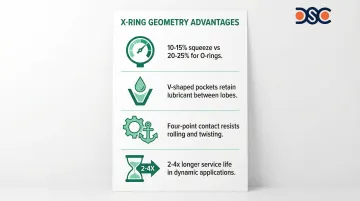
- Retains lubricant in V-shaped pockets between lobes, extending service intervals
- Resists spiral failure — four-point contact prevents the rolling and twisting that compromises O-rings under motion
- Lasts 2-4 times longer than O-rings in dynamic applications
The X-profile creates lubricant-retaining pockets while four lips hold seal integrity under the twisting forces that would roll or damage an O-ring. The geometry also requires less squeeze to seal effectively — 10-15% versus 20-25% for O-rings — which directly lowers contact stress and running friction.
Use Cases of X-Rings
X-rings excel where seals experience regular motion, high speeds, or long stroke lengths. Reciprocating hydraulic cylinders, rotary shaft seals, high-pressure pneumatic systems, and any application with continuous or frequent motion benefit from X-ring geometry.
Industries and equipment preferring X-rings:
- Oil and gas - Drilling equipment and downhole tools with reciprocating motion
- Automotive - Shock absorbers and hydraulic systems requiring long service life
- Aerospace - Actuators where reliability and reduced friction are critical
- Heavy machinery - Hydraulic systems in construction and agricultural equipment
- Semiconductor manufacturing - Precision positioning equipment where stick-slip must be eliminated
Detroit Sealing Components offers X-rings tooled in all AS568 gland sizes for both FKM and NBR materials, with custom sizing available for alternate housing dimensions.
X-Rings vs O-Rings: What is Better?
The answer comes down to motion. O-rings win on cost and simplicity for static setups; X-rings earn their keep once regular movement enters the picture.
Static vs. Dynamic Rule
O-rings are typically sufficient and more cost-effective for static applications or those with minimal motion. Their simple geometry, lower cost, and wide availability make them the default choice when seals remain stationary or move only occasionally.
X-rings should be considered when seals experience regular motion, high speeds, or long stroke lengths. The friction reduction and stability advantages justify the higher upfront cost in dynamic, high-cycle systems.
Pressure and Extrusion Considerations
Both seal types generally require backup rings for pressures exceeding 1,500 psi. However, X-rings resist extrusion better due to their geometry. In dynamic reciprocating applications, X-rings are rated up to 50 bar (725 psi) without backup rings and 300 bar (4,350 psi) with backup rings.
For systems operating above 3,000 psi or experiencing pressure spikes, X-rings provide superior extrusion resistance, particularly where reciprocating motion accelerates extrusion risk.
Friction and Wear Factors
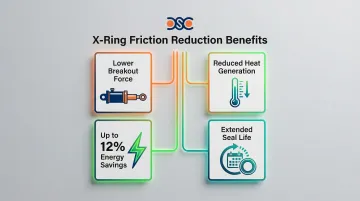
In applications where friction reduction is critical—energy efficiency concerns, heat generation issues, or high cycle counts—X-rings provide clear advantages. The 20-40% friction reduction translates to:
- Lower breakout force in hydraulic and pneumatic cylinders
- Reduced heat generation during operation
- Decreased energy consumption (up to 12% in pneumatic systems)
- Extended seal life through reduced wear
Lifecycle Cost Analysis
Those wear and energy benefits compound into significant cost differences over time. X-rings cost 20-40% more upfront, but a 3-5 year total cost of ownership calculation frequently flips the economics in dynamic applications.
Cost factors to consider:
- X-rings last 2-4 times longer, cutting replacement frequency and maintenance labor
- Fewer seal failures reduce unplanned downtime and production losses
- Lower friction trims energy costs in high-cycle pneumatic and hydraulic systems
In one documented case, a pneumatic cylinder application showed a 24-month total cost of ownership of $181 for X-rings versus $16,494 for O-rings when accounting for replacement labor and downtime costs.
Real World Examples and Case Studies
Pneumatic Cylinder Optimization: Eliminating Spiral Failure
A precision assembly line using rodless pneumatic cylinders faced recurring seal failures that disrupted production and compromised positioning accuracy. The facility experienced O-ring failures every six months due to spiral failure—the seal would roll and twist in the groove during reciprocating motion, creating spiral-shaped cuts and eventual leakage.
The Challenge
- O-ring seals failed every 6 months in reciprocating cylinders
- Positioning errors occurred as seals degraded, with accuracy drifting from specification
- Each seal failure required a production line shutdown for emergency maintenance
- Downtime and scrap costs were mounting
Switching to X-Rings
The engineering team identified spiral failure as the root cause. Testing confirmed that reciprocating motion caused O-rings to twist in the groove, progressively damaging the seal. After consulting with their distributor, they specified X-rings as a direct drop-in replacement—same NBR compound, same groove dimensions, just the four-lobed geometry.
Measurable Improvements:
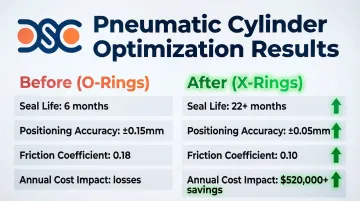
According to documented results from this application, the switch to X-rings delivered:
- Seal life extended from 6 months to 22+ months - nearly 4x improvement
- Positioning accuracy improved from ±0.15mm to ±0.05mm - 67% better precision
- Annual savings exceeded $520,000 through reduced scrap and maintenance costs
- Friction coefficient dropped 44% (from 0.18 to 0.10 at 100 psi)
Results like these aren't unusual—but they depend on matching the right compound and verifying groove dimensions before switching. When dynamic applications show symptoms like frequent failures, spiral-shaped seal damage, high friction, or positioning inconsistencies, X-rings are worth evaluating as a direct replacement.
Experiencing similar failures? Detroit Sealing Components stocks O-rings and X-rings in hundreds of compounds, and its ISO 17025 accredited lab and ISO 9001:2015 certified quality system can develop custom materials tested to your specific operating conditions. Reach their technical team at 313-418-0730 to talk through your application.
Conclusion
The choice between O-rings and X-rings comes down to what your application actually demands. O-rings excel in static or low-motion applications where cost-effectiveness matters. X-rings are built for dynamic systems where motion, pressure cycling, and seal longevity are non-negotiable.
Choosing the appropriate seal type impacts equipment reliability, maintenance costs, energy efficiency, and production uptime. In dynamic applications, the 20-40% friction reduction and 2-4x service life extension of X-rings often justify their higher upfront cost through reduced downtime and lower total cost of ownership. For static applications, O-rings remain a proven, cost-effective solution.
Getting the geometry right requires matching seal cross-section to groove dimensions, pressure range, and motion type. Detroit Sealing Components works with engineers across automotive, oil and gas, and industrial sectors to nail that match — verifying groove compatibility and recommending materials from hundreds of available compounds, backed by ISO 17025 accredited lab testing and ISO 9001:2015 certified quality system.
Frequently Asked Questions
Which is better: X-ring or O-ring?
Neither is universally better—O-rings are more cost-effective for static applications and low-motion sealing, while X-rings outperform in dynamic applications with reciprocating or rotary motion. The right choice depends on whether your application involves regular motion and high cycle counts.
When should you use an X-ring?
X-rings make sense when your application involves:
- Reciprocating or rotary motion with high cycle counts
- High-pressure systems prone to extrusion (above 3,000 psi)
- Energy-efficiency requirements where reduced friction matters
- Long service life goals where the 20-40% higher upfront cost is offset by 2-4x longer seal life
What is the difference between an O-ring and an X-ring?
O-rings have a circular cross-section with a single sealing contact point per side, while X-rings feature a four-lobed X-shaped cross-section with two sealing surfaces per side. This geometric difference translates to 20-40% lower friction, superior stability under motion, and resistance to spiral failure in dynamic applications.
What is a quad ring (X-ring) and how does it differ from an O-ring?
Quad ring is simply the common trade name for an X-ring. The four-lobed profile creates recessed pockets between the lobes that retain lubricant throughout the stroke cycle—a feature a round O-ring profile can't replicate. This also prevents the seal from rolling or twisting under motion, which is a leading cause of early O-ring failure in dynamic installations.
Can X-rings replace O-rings in existing grooves?
X-rings are manufactured to AS568 size standards, so they often fit existing O-ring grooves. However, optimal performance requires 10-15% squeeze—lower than a typical O-ring installation—so verify groove depth before retrofitting. Consult groove design specs or a sealing engineer to avoid over-squeeze, which increases friction and shortens seal life.