In oil and gas, "something going wrong" means hydrocarbon leaks, unplanned shutdowns, regulatory violations, and serious risk to personnel. The HSE has documented that a hydrocarbon leak and fire occurred because a seal-ring of incorrect material was fitted in a proprietary clamp connector — a reminder that material selection isn't a paperwork exercise.
This article covers the four main gasket types used across upstream, midstream, and downstream oil and gas operations, what makes each one distinct, how to match the right type to an application, and the mistakes that cause most flange joint failures.
Key Takeaways
- The four most common gasket types in oil and gas are spiral wound, ring type joint (RTJ), Kammprofile, and non-metallic — each suited to different pressure, temperature, and media conditions
- Metallic and composite gaskets are required for high-pressure, high-temperature service; non-metallic gaskets are limited to low-pressure applications
- Key selection factors: pressure class, temperature range, fluid media, and flange face type
- RTJ gaskets are single-use only — reusing them is a documented safety risk
- Applicable standards: ASME B16.20 (metallic), ASME B16.21 (non-metallic), and API 6A (wellhead/high-pressure)
What Is a Gasket and Why Does It Matter in Oil and Gas?
A gasket is a compressible sealing element installed between two mating surfaces — typically flanges — to prevent fluid or gas from escaping the joint when bolt load is applied. The engineering behind that simple function is anything but straightforward.
Flange faces are never perfectly smooth, which means a gasket has to do more than just sit between two surfaces. Under compression, it fills microscopic surface irregularities that would otherwise allow pressurized media to escape — particularly during thermal expansion and contraction cycles that constantly stress the joint.
In oil and gas, gaskets are not off-the-shelf components. They must be specified by:
- Flange type, size, and pressure class
- Operating temperature range (including thermal cycling)
- Media type and chemical composition
- Applicable standards: ASME B16.5, B16.20, B16.21, API 6A
The consequences of gasket failure go well beyond a maintenance call. A single failed joint can trigger pressure loss, contamination, or a full system shutdown. Potential outcomes include:
- Product loss and process contamination
- Toxic or flammable media releases
- Unplanned shutdowns and production downtime
- Environmental damage and regulatory violations under OSHA PSM 29 CFR 1910.119
That's why the right gasket for the application — not just any gasket that fits the flange — is a critical engineering decision.
Types of Gaskets in the Oil and Gas Industry
Gaskets are broadly classified by material — non-metallic, metallic, or composite — and by configuration, such as full face, raised face, or ring type joint. The right choice depends on the specific combination of pressure class, temperature, media, and flange design.
Four types dominate oil and gas specifications. Each sub-section below covers construction, operating limits, and the conditions where that gasket type is the right call.
Spiral Wound Gaskets
Spiral wound gaskets are the most widely specified gasket for ASME B16.5 pipe flanges across all pressure ratings.
They're constructed by winding alternating layers of a metal strip — typically 316 stainless steel — and a soft filler material (graphite or PTFE) in a spiral pattern. A carbon steel outer ring controls compression.
An inner ring prevents inward buckling under high bolt loads. It's required for PTFE-filled designs on raised-face and flat-face flanges, and strongly recommended for pressure Class 900 and above or temperatures above 300°C / 572°F.
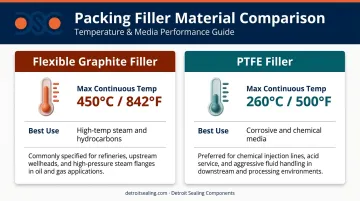
Filler material determines the operating envelope:
| Filler | Max Continuous Temp | Best For |
|---|---|---|
| Flexible graphite | 450°C / 842°F | High-temp steam, hydrocarbons |
| PTFE | 260°C / 500°F | Corrosive/chemical media |
Per Flexitallic's spiral wound gasket specifications, these gaskets cover ASME pressure Class 150 through Class 2500. The outer ring carries a color-coded identification system per ASME B16.20 — for example, 316L stainless steel winding uses a green guide ring, graphite filler uses a gray stripe, and PTFE filler uses a white stripe.
Strengths:
- Excellent compressibility and thermal cycling recovery
- Tolerates imperfect flange surface finishes
- Multiple filler options matched to specific media
Limitations:
- Requires correct bolt torque — under- or over-torquing causes failure
- Large-diameter installations require care during placement
- Always install new; never reuse
Ring Type Joint (RTJ) Gaskets
RTJ gaskets are solid metallic gaskets that create a seal through metal-to-metal line contact as bolt load is applied. They come in three sub-types:
- Style R — oval or octagonal cross-section for standard RTJ flange service; manufactured to ASME B16.20 and API 6A
- Style RX — pressure-energized design that increases sealing load as internal pressure rises; resistant to shock loads and drilling vibration
- Style BX — for extreme pressure up to 20,000 psi on API 6BX flanges only; not interchangeable with other RTJ styles
Common materials include soft iron, low-carbon steel, 304/316 stainless steel, Monel, Inconel, Hastelloy, duplex, and super duplex — chosen based on media and temperature requirements.
Primary applications: wellheads, blowout preventers, high-pressure pipeline connections, valves, and refinery assemblies where extreme pressure demands a metal-to-metal seal.
Strengths:
- Exceptional blowout resistance
- Reliable under extreme pressure fluctuation and thermal shock
- BX verified to 20,000 psi for API 6BX service
Critical limitation: RTJ gaskets undergo plastic deformation during sealing. Per Durlon's RTJ technical guidance: "Never use more than one gasket in one flange joint and never reuse a gasket." A used RTJ gasket will not form a reliable seal on reinstallation — this is a non-negotiable safety rule, not a recommendation.
RTJ flanges also require precisely machined grooves — any groove damage means the flange must be remachined or replaced before a new gasket is installed.
Kammprofile Gaskets
Kammprofile gaskets — also called camprofile or grooved metal gaskets — are composite gaskets built around a solid metal core, typically stainless steel, with a serrated (grooved) surface profile. Both faces are covered with a soft sealing layer: flexible graphite, PTFE, or mica.
The grooved profile concentrates sealing stress at multiple contact points. The soft facing fills surface imperfections and absorbs radial shear — the relative movement between flanges during thermal expansion and contraction.
That radial shear resistance is where Kammprofile earns its place: Lamons notes that their CorruKamm design provides greater recovery for thermal cycling than a spiral wound gasket in heat exchanger service.
Primary applications: heat exchangers, reactor vessels, high-pressure steam systems, and any cyclic pressure/temperature application where repeated thermal movement creates high radial shear forces. Kammprofile gaskets are manufactured under ASME B16.20's grooved metal gasket category.
Strengths:
- Superior resistance to radial shear from thermal cycling
- Reusable metal core reduces long-term costs
- Lower blowout risk than spiral wound gaskets in large-bore applications
- Core can be fabricated from exotic alloys for corrosive service
Limitations:
- Higher initial cost than spiral wound gaskets
- Grooved core requires precise machining for optimal performance
- Temperature limits depend on the specific facing material selected — always verify against the product data sheet
Non-Metallic Gaskets
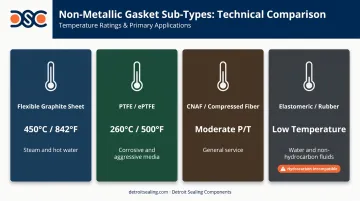
Non-metallic gaskets are cut from sheet material and made entirely from non-metallic compounds: compressed non-asbestos fiber (CNAF), PTFE or ePTFE, flexible graphite sheet, and elastomers. They're governed by ASME B16.21 for pipe flange applications and are primarily used with flat-face or full-face flanges in low-to-moderate pressure service.
Sub-types by material:
- Flexible graphite sheet — highest temperature capability among non-metallic types; Klinger Graphite Laminate PSM is rated up to 450°C / 842°F for steam and hot water service; typically reinforced with a stainless steel insert
- PTFE/ePTFE — excellent chemical resistance for corrosive or aggressive media; limited to around 260°C / 500°F continuous service
- CNAF — suitable for moderate pressure and temperature conditions; suitability should be verified against pressure-temperature graphs for the specific product
- Elastomeric (rubber) — appropriate for water and low-temperature, non-hydrocarbon service only
The pressure ceiling for non-metallic gaskets is meaningful. Garlock's gasketing guidance states that while a 150# raised-face flange can accommodate various gasket types, a 600# raised-face flange is best suited for a metal gasket.
Non-metallic gaskets must not be used in high-pressure oil and gas pipeline service.
Strengths:
- Low cost and straightforward installation
- Good chemical resistance, especially PTFE grades
- Wide material options for specific chemical compatibility
Limitations:
- Cannot match metallic or composite gaskets for mechanical strength or pressure resistance
- Performance in field conditions often falls below laboratory maximums
- Must never be applied beyond their rated pressure and temperature limits
How to Choose the Right Gasket for Oil and Gas Applications
Gasket selection must be driven by the actual operating envelope — worst-case pressure, temperature, media, and mechanical conditions — not by familiarity or convenience.
Start with Pressure and Temperature
Pressure class is the primary filter. As a practical baseline:
- Class 150 flanges — various gasket types are viable, including non-metallic
- Class 600 and above — metal or composite gaskets are required
- Wellhead / API 6A service — RTJ gaskets (RX or BX type) are the standard
Garlock recommends considering fluid temperature first when selecting gasket material, upgrading if operating temperatures approach the material's continuous service limit. Thermal cycling adds stress that favors high-recovery gaskets — spiral wound for most pipeline flanges, Kammprofile where radial shear is a concern.
Match Material to Media
Chemical compatibility is non-negotiable:
- Aggressive chemicals → PTFE-filled spiral wound or PTFE sheet gaskets
- High-temperature steam or hydrocarbons → graphite filler or graphite laminate
- Corrosive or offshore environments → stainless steel or exotic alloy metallic components
- Sour gas service (H₂S) → verify alloy selection against NACE requirements
Match Gasket to Flange Configuration
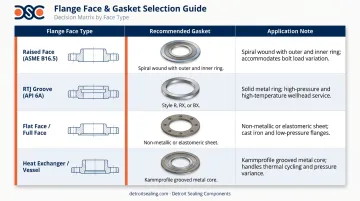
| Flange Face Type | Appropriate Gasket |
|---|---|
| Raised face (ASME B16.5) | Spiral wound with outer + inner ring |
| RTJ groove (API 6A) | Style R, RX, or BX (match to groove type) |
| Flat face / full face | Non-metallic or full-face elastomeric |
| Heat exchanger / vessel | Kammprofile |
Flange surface finish matters too. Garlock recommends 30–55 serrations per inch in a concentric or spiral pattern for optimal gasket seating. Large nicks, gouges, or pitting mean the gasket will not seal reliably regardless of type.
Reference the Governing Standard
Always specify against the applicable standard — ASME B16.20 for metallic gaskets, ASME B16.21 for non-metallic, and API 6A for wellhead and high-pressure RTJ service.
For non-standard or challenging applications, Detroit Sealing Components (DSC) stocks FKM, HNBR, FFKM, and PTFE-based compounds across all rubber types, and operates an ISO 17025 accredited lab for custom material development and testing.
DSC's engineers work directly with procurement and engineering teams on material specification, and can bench-test custom designs against customer conditions before full production.
Common Mistakes to Avoid
Even the right gasket fails when it's installed incorrectly, reused past its service life, or chosen out of habit rather than engineering judgment. These three mistakes account for a disproportionate share of flange leaks in oil and gas operations.
Reusing metallic gaskets. RTJ gaskets deform plastically during sealing and cannot form a reliable seal on reinstallation. Flexitallic's installation guidance is equally firm: always use a new spiral wound gasket. Replace every metallic gasket each time a joint is opened — no exceptions.
Selecting by habit rather than application. Defaulting to spiral wound gaskets because they're familiar, even when a large-diameter heat exchanger with heavy thermal cycling calls for Kammprofile, is an engineering shortcut that causes recurring maintenance problems. Always verify the selection against actual operating conditions.
Ignoring bolt load and flange surface condition. Garlock's technical data shows that underloaded gaskets produce higher leak rates and lower blowout resistance. Overcompression crushes non-metallic gaskets. Even a correctly specified gasket will leak in a poorly assembled joint — incorrect torque sequence, wrong bolt lubricant, or a scratched flange face each undermine the seal. Getting the gasket right is only half the job.
Frequently Asked Questions
What are the types of gaskets in the oil and gas industry?
The four main types are spiral wound gaskets, ring type joint (RTJ) gaskets, Kammprofile gaskets, and non-metallic gaskets (PTFE, flexible graphite, compressed fiber, elastomeric). Pressure class and operating temperature are typically the first two factors used to narrow down the correct type.
What is the ASME B16.20 gasket standard?
ASME B16.20 governs metallic gaskets for pipe flanges — covering spiral wound, ring joint, and Kammprofile types. It specifies dimensional requirements, materials, and a color-coding system that identifies the winding metal and filler in spiral wound gaskets.
What is the most commonly used gasket in oil and gas pipelines?
Spiral wound gaskets with inner and outer rings are the most widely specified for ASME B16.5 flanges in oil and gas. Their load recovery properties make them particularly reliable in services prone to thermal cycling or vibration — conditions common across pipeline and processing applications.
What is the difference between a spiral wound gasket and an RTJ gasket?
Spiral wound gaskets are composite (metal strip plus filler) and suit raised-face flanges across a wide pressure range. RTJ gaskets are solid metal, create a metal-to-metal seal, are specified for high-pressure service like wellheads, and must be replaced after each use .
When should gaskets be replaced in oil and gas systems?
Every time a flanged joint is opened. Metallic gaskets — particularly RTJ types — deform permanently under compression and cannot reseal reliably. Non-metallic and composite gaskets should also be replaced if any deformation, chemical attack, or physical damage is visible upon removal.
Can non-metallic gaskets be used in high-pressure oil and gas applications?
Generally, no. Most non-metallic gaskets are limited to lower-pressure service — industry guidance typically specifies metallic or composite gaskets for anything above Class 600 raised-face flanges. Flexible graphite offers better temperature range (up to 450°C), but still doesn't meet the mechanical demands of high-pressure pipeline service.