Gaskets and O-rings both stop leaks, but they’re designed for different joint geometries: flat-face compression vs controlled squeeze in a groove. Mix them up, and you’ll often get repeat issues like re-torque leaks, blowouts under pressure spikes, or premature wear in motion.
This page helps you choose the right seal fast using the three factors that drive most failures: geometry, pressure behavior, and motion.
Key takeaways
If there’s no groove, don’t force an O-ring; use a gasket or redesign the joint.
If you see extrusion/nibbling or blowouts, the problem is usually support/clearance + pressure spikes, not “bad rubber.”
If there’s motion, treat it as a dynamic sealing problem (often needs a purpose-built seal).
If leaks return after re-torque, suspect compression control/flange condition, not just material.
When in doubt, choose based on joint geometry first, then media/temp/pressure.
How to choose between a gasket and an O-ring
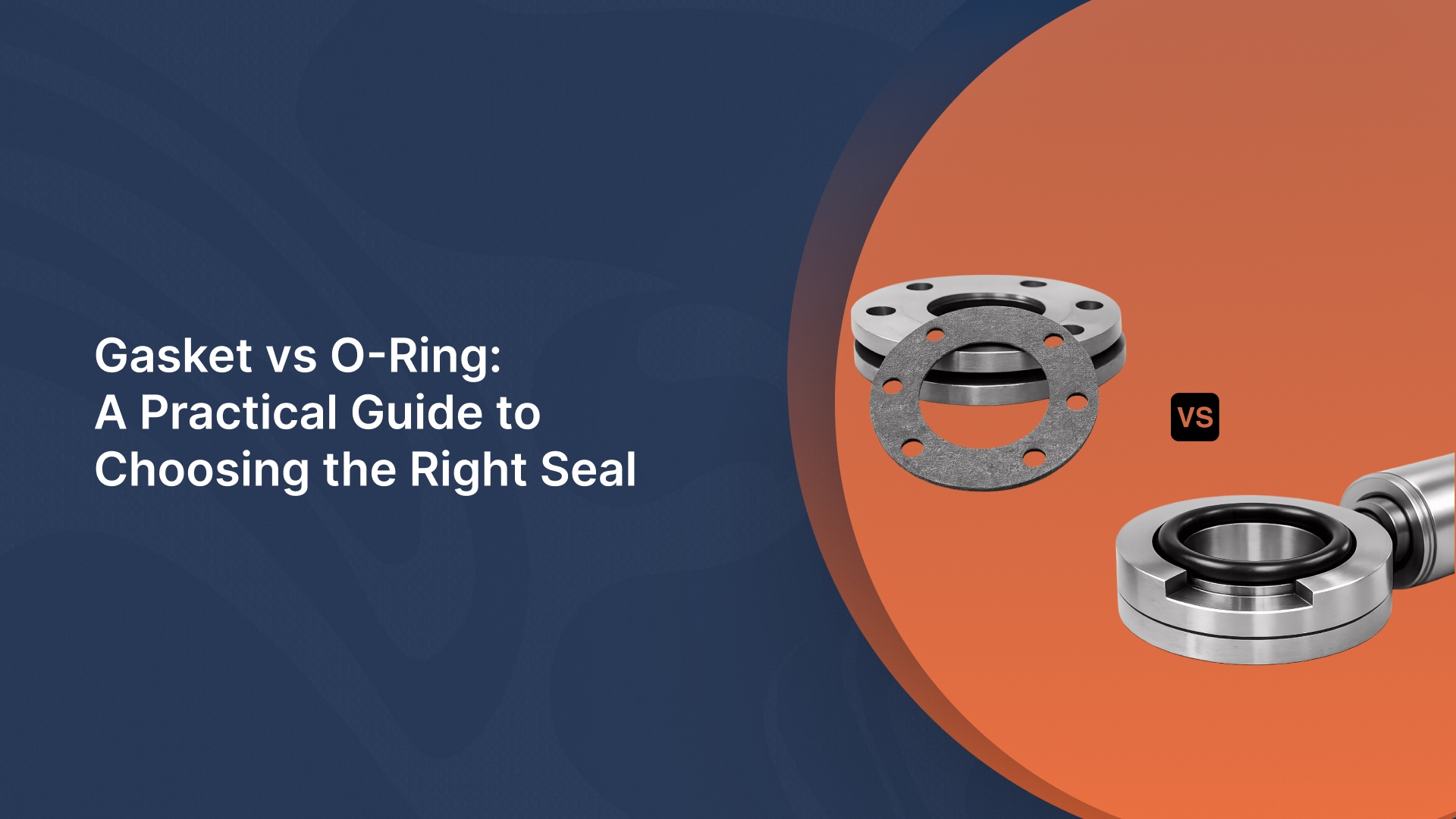
Quick difference: A gasket is a flat seal compressed between two mating faces (flange/cover). An O-ring is a round cross-section seal that sits in a machined groove (gland), so the groove controls the squeeze. Because the geometry is different, you usually can’t swap one for the other unless the joint was designed for it.
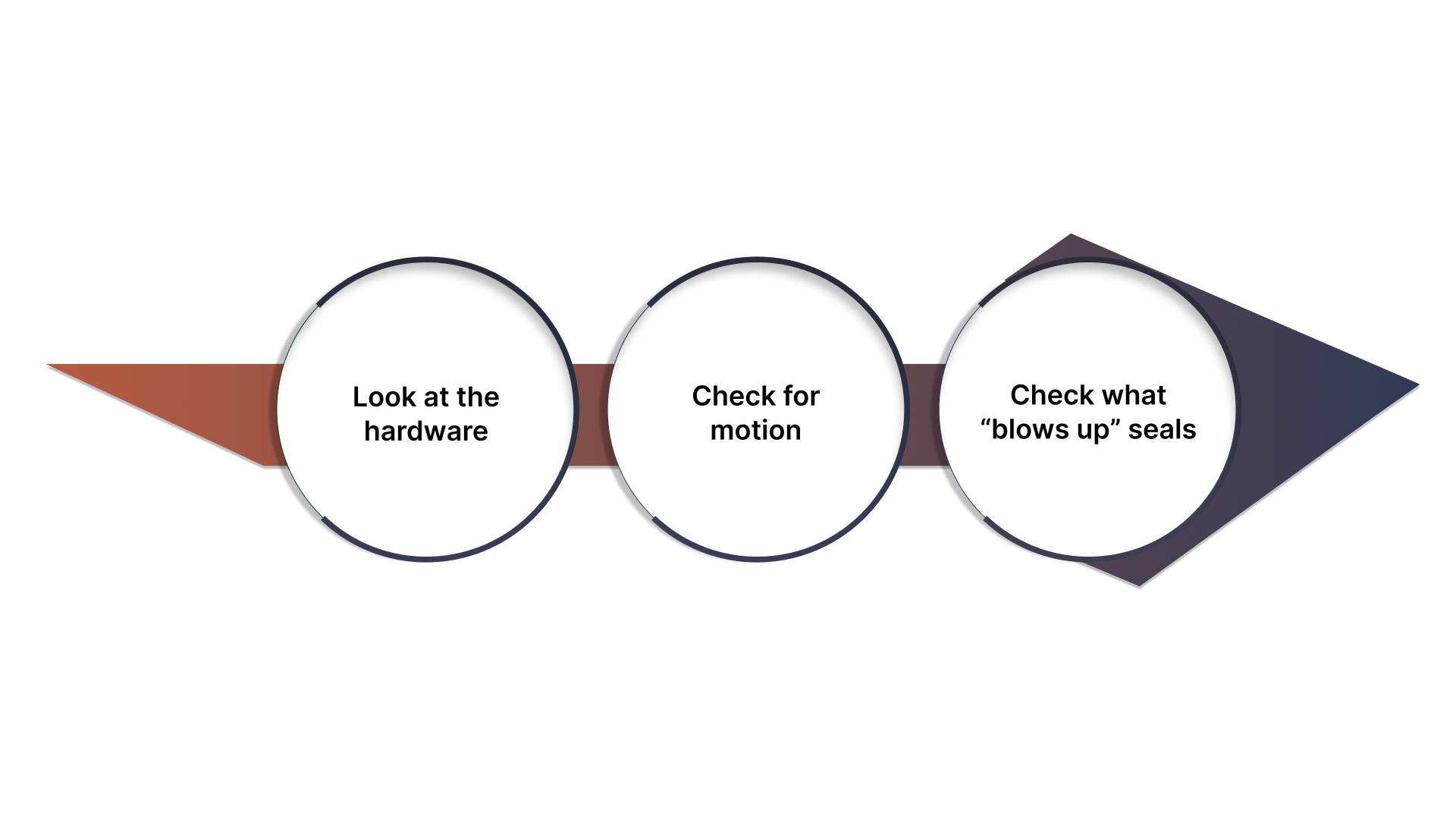
Step 1: Look at the hardware (geometry decides first):
Machined groove (gland) for a round seal → O-ring
No groove, two flat faces pulled together → Gasket
Step 2: Check for motion (overrides the default):
Any sliding/rotating interface (rod, piston, shaft, spool) → treat it as a dynamic sealing problem (often needs a purpose-built seal, not a flat gasket—and not always a plain O-ring)
Step 3: Check what “blows up” seals (pressure + support):
Pressure spikes or a visible gap/clearance → plan for extrusion control (O-ring + back-up ring) or a hydraulic seal set
If you’re unsure which bucket you’re in, the table below maps real-world situations to the safest choice and what to verify.
Gasket vs O-ring decision table
Situation | Best choice | Why it wins | What to verify |
|---|---|---|---|
Flat flange/cover joint (manifold, housing split line) | Gasket | Seals by compression across a flat face; handles irregularities better than forcing a round seal | Flange flatness, bolt pattern/torque, gasket thickness, surface finish |
Groove (gland) designed for a seal | O-ring | Controlled squeeze in a groove gives a repeatable seal with minimal footprint | Groove dimensions (squeeze + stretch), surface finish, correct size (ID + CS) |
Frequent open/close service (access covers, maintenance panels) | O-ring (if a gland exists) / Gasket (if flat faces) | O-rings are reusable when the gland controls compression; gaskets are often replaced each open/close | Reusability expectations, set/compression over time, surface damage from repeated service |
High pressure with spikes or visible clearance risk | O-ring + back-up ring (or hydraulic seal set) | Back-up rings/hydraulic seals prevent extrusion/blowout that a plain O-ring can’t tolerate in gaps | Clearance gap/extrusion risk, pressure direction, spike magnitude, gland design |
Dynamic sliding/reciprocating motion (rod/piston) | Hydraulic/dynamic seal (not a flat gasket) | Purpose-built for wear control + leakage control under motion; gaskets aren’t designed for sliding interfaces | Surface finish, lubrication, contamination level, speed/cycle rate, seal set design |
Dynamic rotary motion (shaft) | Dynamic rotary seal + excluder (wiper/V-seal) as needed | Rotary interfaces need wear + heat, + runout management; an O-ring is rarely the best primary rotary seal | Shaft finish/runout, speed, heat generation, lubricant, misalignment |
Misalignment / uneven bolt load risk (warped flanges, distortion) | Gasket | A gasket can tolerate some unevenness better than a groove-dependent O-ring setup | Flange condition/flatness, torque method, gasket compressibility, creep/relaxation |
Contamination exclusion needed (dust, grit, slurry splash) | Wiper/V-seal + primary seal | Excluders keep debris out; neither a gasket nor an O-ring alone solves contamination-driven wear | Where contamination enters, shaft/rod finish, seal placement, washdown exposure |
“Leak after re-torque” keeps happening | Re-evaluate joint compression/control first (often gasket-side issue) | Repeat leaks after re-torque usually point to compression loss, flange condition, or joint design, not just material | Bolt load retention, flange flatness, gasket thickness/compressibility, thermal cycling |
If you’re buying, send this, the fastest way to avoid wrong parts
O-ring: ID + cross-section, media + temperature (include cleaners), pressure + spikes, static vs dynamic, groove/gland details or drawing (if available)
Gasket: flange/drawing or bolt pattern, thickness, media + temperature (include cleaners), pressure/bolt load (if known)
Where seal swaps go wrong (and why leaks repeat)
Most “gasket vs O-ring” problems are geometry and load-control mistakes. These are the swaps that reliably create immediate leaks or repeat failures:
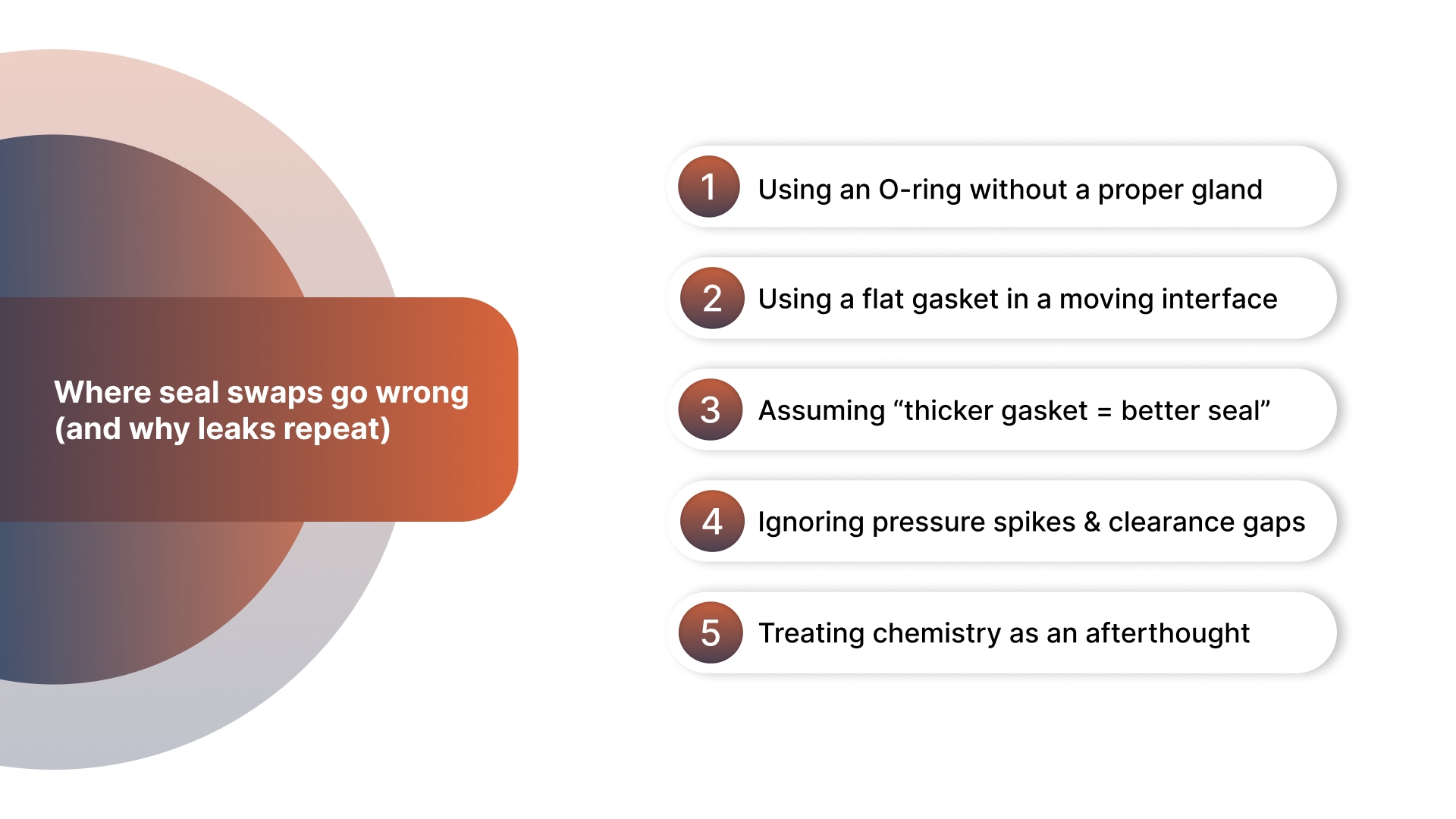
Using an O-ring without a proper gland: An O-ring only works when a groove controls its squeeze. Without that squeeze control, you get inconsistent sealing, pinching, and early leakage.
Using a flat gasket in a moving interface: Gaskets are built for static compression. Put them in sliding/rotary duty, and they become a wear surface; leaks, tearing, and rapid relaxation follow.
Assuming “thicker gasket = better seal”: Thickness changes how bolt load is distributed and how compression relaxes over time. Too thick can reduce effective clamp load, promote creep/relaxation, and make re-torque leaks more likely.
Ignoring pressure spikes and clearance gaps: That’s how you get extrusion/blowout. If the seal edge isn’t supported (or the gap opens under load), even a “right material” seal can fail fast.
Treating chemistry as an afterthought: The real exposure includes process media plus additives and cleaners/CIP. If compatibility isn’t confirmed, swelling/softening/cracking can look like “bad sealing” when it’s really the wrong compound.
Bottom line: If you’re swapping seal types to fix a leak, start by checking gland/geometry, compression control, pressure behavior, and full chemical exposure; that’s where most “wrong seal choice” failures come from.
If those checkpoints still don’t make the choice obvious, the fastest next step is to match the joint to the right seal family (not just “a seal”), and that’s where having one source for gaskets, O-rings, and the next-step options comes in.
Detroit Sealing Components products for gaskets and O-rings
Once you factor in groove vs flat face, pressure spikes, motion, and contamination, “gasket vs O-ring” often becomes a seal-style decision.
Detroit Sealing Components (DSC) is relevant here because its catalog covers both options, plus the common next-step components used when a plain gasket or standard O-ring isn’t the right fix.
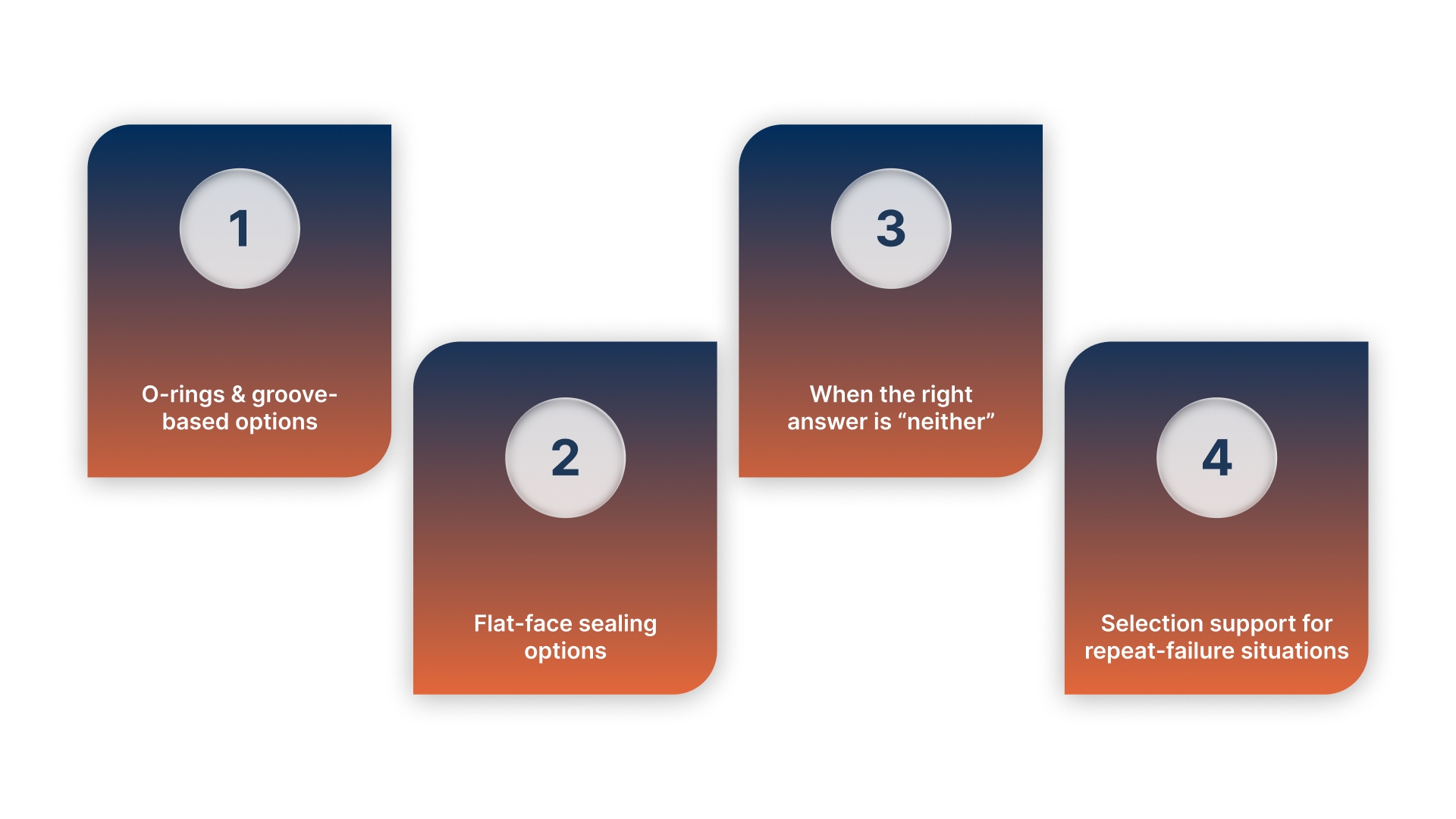
O-rings and groove-based options: DSC lists O-rings along with related groove-style components like X-rings and back-up rings (useful when dynamic stability or extrusion control is the real issue).
Flat-face sealing options: DSC also offers gaskets & packings, including molded options (compression/transfer/injection molded) and a large library of tooled articles, which matters when the joint is flange/cover-based or when geometry isn’t a standard O-ring gland.
When the right answer is “neither”: Our catalog includes hydraulic seals and V-seals/wipers, which are often the correct move for high-cycle motion or contamination exclusion scenarios that make simple swaps fail.
Selection support for repeat-failure situations: DSC references engineering capabilities like FEA and validation/testing approaches, which are most relevant when you’re troubleshooting repeated leaks rather than just picking a part from a chart.
If you need a quick confirmation on gaskets vs. O-rings, we’ll point you to the right seal style and product family. Get in Touch!
Conclusion
The safest way to avoid repeat leaks is to treat seal selection like a quick systems check: match the seal to the joint layout, then confirm what typically breaks seals, load retention, clearance under pressure, movement at the interface, contamination, and every fluid/cleaner the seal will see.
When those inputs are clear, the “gasket vs O-ring” question usually answers itself, and if it doesn’t, it’s often a sign you need a different seal family rather than another swap.
FAQs
Can I use a gasket instead of an O-ring?
Sometimes—but only if the joint is designed for it. If the hardware uses a groove (gland) to control the squeeze, substituting a flat gasket usually won’t seal consistently. If it’s two flat faces with clamp load, a gasket is typically the correct choice.
Do I need a groove for an O-ring?
For most reliable seals, yes. An O-ring is meant to sit in a machined gland, so the groove controls the squeeze and prevents the ring from shifting or pinching.
Which is better for high pressure?
Neither is “automatically better.” High pressure depends on support and clearance. O-rings often need extrusion control (like a back-up ring) when pressure spikes or gaps exist; flat gaskets depend heavily on bolt load retention and flange condition.
Which is better for flanges?
Most flange/flat-face joints are a gasket job because gaskets seal by compression across the face and can tolerate minor surface variation better than trying to force an O-ring solution.
What causes extrusion/blowout?
Usually, pressure spikes + an unsupported gap/clearance that lets the seal material push into the opening. The fix is typically improved support/containment (and for O-rings, often adding a backup ring).
What if there’s motion?
If the sealing interface slides or rotates (rod, piston, shaft), treat it as a dynamic sealing problem. A flat gasket isn’t designed for wear, and a plain O-ring may not last depending on speed, lubrication, surface finish, and pressure often a purpose-built dynamic seal is the right choice.
Can I use an O-ring on a flange?
Only if the flange is designed with an appropriate groove (gland) to control the squeeze. On a typical flat-face flange with no groove, a gasket is usually the correct approach.