TPU sits at a genuine crossroads between elastomer and engineering plastic — elastic enough to seat and conform like rubber, tough enough to outlast most rubbers in abrasive dynamic service, and processable on standard thermoplastic equipment. That combination has made it the default material for hydraulic U-cup seals and a growing presence across automotive, agriculture, oil and gas, and industrial machinery.
This guide covers what TPU is chemically, which properties make it perform in sealing applications, how it stacks up against NBR, EPDM, and FKM, where it belongs (and where it doesn't), and how to select the right TPU seal for your specific application.
Key Takeaways
- TPU offers 2–3× the abrasion resistance of NBR, making it the dominant material for dynamic hydraulic seals
- Standard operating range is approximately -35°C to 100°C (-31°F to 212°F); specialty grades extend to 135°C
- TPU is compatible with mineral oils, lubricants, and aliphatic hydrocarbons; ketones, esters, aromatics, and steam will degrade performance
- Common seal types include U-cups, rod seals, piston seals, wiper seals, and O-rings in 80A–95A Shore hardness
- Not a universal replacement for EPDM (steam/glycol applications) or FKM (extreme chemical/thermal service)
What Is TPU? Bridging the Gap Between Rubber and Plastic
Chemistry and Structure
According to BASF's Elastollan documentation, TPU is a linear polymer produced through polyaddition of polyols, diisocyanates, and short-chain diols. The result is a block copolymer thermoplastic elastomer (TPE) with alternating hard and soft segments at the molecular level.
- Hard segments contribute structural rigidity, chemical resistance, and load-bearing capacity
- Soft segments provide elasticity, flexibility, and low-temperature performance
Adjusting the ratio of these segments — and choosing polyether versus polyester chemistry — directly controls the final material properties. This tunability is a real advantage: engineers can dial in Shore hardness, temperature range, and fluid compatibility to match specific sealing demands rather than accepting a fixed material profile.
Why It's Different From Both Rubber and Plastic
TPU occupies a position that neither standard thermosets nor rigid plastics can reach on their own. Thermoset rubbers like NBR or EPDM vulcanize permanently and can't be remelted. Engineering plastics are processable, but too stiff for dynamic sealing. TPU handles both: it flows for injection molding and extrusion, then performs like a resilient elastomer in service.
As Lubrizol's ESTANE TPU documentation confirms, this is intrinsic to the material class — not a processing workaround. In practice, it means standard O-ring, U-cup, and profile seal geometries can be produced on the same molding equipment used for other thermoplastic components, including extrusion, injection molding, and blow molding.
Sealing Hardness Range
Parker's Ultrathan TPU sealing compounds span a wide hardness range, covering most dynamic and static sealing applications:
| Grade Range | Typical Application |
|---|---|
| 80–86 Shore A | Compliant gaskets, low seating force static seals |
| 87A, 92A, 94A | Hydraulic rod and piston seals (most common) |
| Up to 58 Shore D | High-pressure applications requiring extrusion resistance |
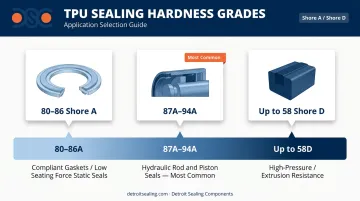
This breadth is one of TPU's practical advantages — a single material family covers sealing demands that would otherwise require switching between material classes entirely.
Key Properties That Make TPU High-Performance for Sealing
Abrasion Resistance
Abrasion resistance is TPU's most cited advantage in dynamic sealing applications. Parker's Fluid Power Seal Design Guide (EPS 5370) states that polyurethane delivers 2 to 3 times the abrasion resistance of NBR. SKF independently confirms that TPU is the most commonly specified material for hydraulic U-cup seals, citing wear resistance and gap-extrusion resistance as the primary reasons.
For dynamic sealing (rod seals, piston seals, rotary shaft seals) this advantage directly translates to longer service intervals and reduced replacement frequency.
Mechanical Strength and Tear Resistance
Parker Ultrathan compound data shows tensile strength ranging from 15 MPa to 55 MPa and tear strength from 30 N/mm to 150 N/mm depending on the specific formulation. At those values, TPU far outperforms softer elastomers like EPDM or silicone — which is why TPU seals hold up under repeated pressure spikes without tearing or extruding through clearance gaps.
Freudenberg Dichtomatik confirms the same pattern, citing abrasion, extrusion, compressive, and tear-propagation resistance as key advantages over classic elastomers.
Oil, Grease, and Hydrocarbon Resistance
TPU performs reliably with:
- Mineral-oil hydraulic media (DIN 51524 H, HL, and HLP grades)
- Mineral-oil lubricating oils and greases
- Silicone oils and greases
- Aliphatic hydrocarbons (with minor swelling noted by Covestro)
This makes TPU a practical sealing choice wherever hydraulic equipment operates with petroleum-based fluids — construction machinery, industrial presses, mobile hydraulics.
Temperature Range and Low-Temperature Flexibility
Standard TPU compounds maintain sealing integrity from approximately -35°C to 100°C (-31°F to 212°F), based on Parker's eHandbook data and Freudenberg's Dichtomatik materials documentation. Specialty grades — such as Parker's Resilon 4300 — extend this to -54°C to 135°C in defined petroleum fluids.
In cold-climate applications, where natural rubber loses elasticity and sealing force, TPU maintains flexibility well below freezing — supporting consistent seal contact through temperature cycles.
Weather, Ozone, and UV Resistance
Unlike NBR — which Freudenberg rates as having low resistance to weather, ozone, and UV — TPU offers inherent resistance to ozone degradation and weathering.
Parker Ultrathan identifies specific TPU compounds formulated for maximum UV and ozone resistance. These grades are relevant for outdoor equipment, agricultural machinery, and renewable energy installations where seals face extended atmospheric exposure.
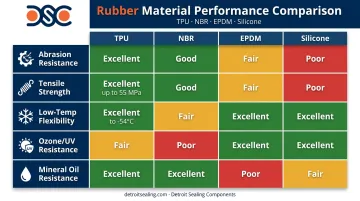
TPU vs. Common Elastomers: Key Property Comparison
| Property | TPU | NBR | EPDM | Silicone |
|---|---|---|---|---|
| Abrasion Resistance | Excellent | Good | Fair | Poor |
| Tensile Strength | Up to 55 MPa | ~15 MPa | ~10 MPa | ~8 MPa |
| Low-Temp Flexibility | To -54°C (specialty) | To -40°C | To -50°C | To -60°C |
| Ozone/UV Resistance | Good | Poor | Excellent | Excellent |
| Mineral Oil Resistance | Good | Excellent | Poor | Poor |
Common Types of TPU Seals and Their Applications
Hydraulic and Pneumatic Seals
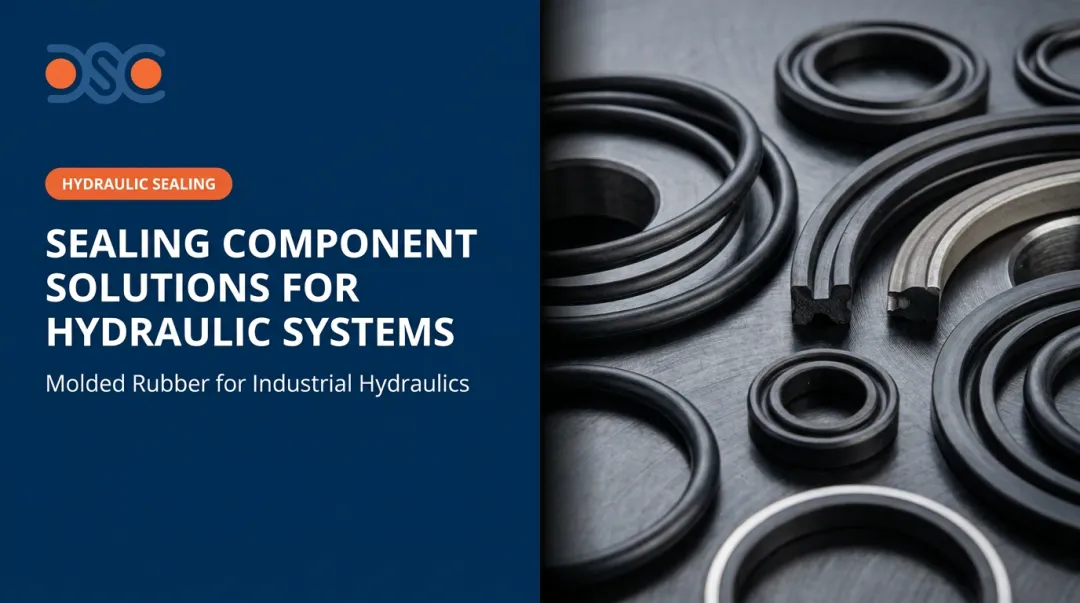
TPU is the dominant material for hydraulic U-cup seals, a position confirmed by SKF's technical documentation. The combination of wear resistance, gap-extrusion resistance, and dimensional stability under pressure makes it well-suited for:
- Rod seals — sliding contact with chrome-plated cylinders
- Piston seals — bidirectional pressure containment
- Wiper seals — excluding contamination from rod surfaces
- U-cup seals — standard hydraulic cylinder sealing
Parker Ultrathan lists pressure capability up to 250 bar for selected TPU hydraulic compounds, with Parker EPS 5371 grades reaching 344 bar to 688 bar depending on seal geometry and material grade.
O-Rings and Custom-Molded Seals
TPU can be molded into standard O-ring profiles in the 80A–95A Shore A range, as well as complex geometries including X-rings, T-seals, and custom profile seals. Standard profiles suit most general-purpose dynamic applications, while unusual sealing interfaces or extreme tolerances often require custom geometry.
DSC offers custom-molded TPU seals across both standard and complex profiles. These are backed by computer-aided design, FEA-based validation, and an ISO 17025 accredited lab for compound development and material testing — options worth exploring when off-the-shelf profiles can't deliver the required sealing interface or compression characteristics.
Industrial and Agricultural Machinery Seals
Construction and agricultural equipment presents a harsh combination: abrasive dust, contaminated hydraulic fluid, and high cycle counts. Freudenberg's application documentation specifically lists earthmoving equipment, industrial trucks, presses, and mobile hydraulics as primary TPU seal markets.
Typical applications where wear resistance drives material selection include:
- Cylinder rod seals — high-cycle exposure to abrasive contaminants
- Bucket pin seals — heavy lateral loading and dirt ingress
- Fluid coupling seals — resistance to contaminated hydraulic fluid
Automotive Applications
Parker Ultrathan lists automotive systems among TPU sealing applications. TPU's oil resistance and dimensional stability across a wide temperature range make it applicable to under-hood environments. For specific applications such as transmission seals or fuel system components, always verify against compound-specific fluid compatibility data — general TPU properties don't automatically transfer across all automotive fluids and temperatures.
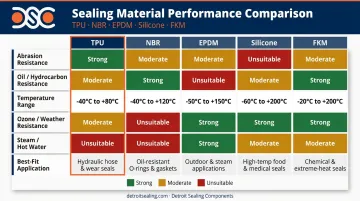
TPU Seals vs. Other Common Sealing Materials
| Criterion | TPU | NBR | EPDM | Silicone | FKM |
|---|---|---|---|---|---|
| Abrasion resistance | Excellent (2–3× NBR) | Good | Low | Low | Good |
| Oil/hydrocarbon resistance | Good | Good | Poor | Poor | Excellent |
| Temperature range | -35°C to 100°C | -30°C to 100°C | -50°C to 150°C | -60°C to 200°C | -20°C to 200°C |
| Ozone/weather resistance | Good | Low | Excellent | Good | Excellent |
| Steam/hot water | Not suitable | Not suitable | Excellent | — | Good |
| Best-fit applications | Dynamic hydraulic seals | Static oil seals | Steam, water, glycol | Temperature extremes | Aggressive chemicals/fuels |
TPU vs. NBR
Both offer solid oil resistance, but TPU outperforms NBR in abrasion resistance and tear strength — making it the preferred choice wherever seals experience sliding metal contact. NBR is a cost-effective option for static oil-service seals, where wear resistance matters less than material price and availability.
TPU vs. EPDM
TPU and EPDM are built for different environments. EPDM excels in hot water, steam, and glycol-based brake fluids — media where TPU degrades or loses dimensional integrity. Where abrasive particles or high mechanical loading are present, TPU is the stronger choice; EPDM wears through quickly under those conditions.
TPU vs. FKM (Viton)
FKM handles fuels, aromatic solvents, and continuous high temperatures that exceed TPU's capabilities. The trade-off is cost. For applications where the operating conditions fall within TPU's range — mineral oils, moderate temperatures, dynamic sliding contact — TPU delivers comparable sealing performance at lower material cost. When conditions push beyond those limits — sustained temperatures above 100°C or aggressive chemical exposure — FKM is the right specification.
Chemical Compatibility and Temperature Limits
Where TPU Performs Well
- Mineral-oil hydraulic fluids (DIN 51524 grades)
- Lubricating oils and greases
- Silicone oils and greases
- Aliphatic hydrocarbons (slight swelling possible)
- Water up to 50°C (Parker) / 60°C (Freudenberg)
- Dilute acids and alkali solutions in limited concentrations
Where TPU Should Not Be Specified
Specifying TPU in any of the following media risks swelling, softening, or outright seal failure:
- Ketones (acetone, MEK)
- Esters and ethers
- Alcohols and glycols
- Aromatic hydrocarbons (benzene, toluene)
- Concentrated acids or alkalis
- Amines
- Hot water or steam above 50°C
Parker's eHandbook excludes all of these from polyurethane compatibility. Covestro's Desmopan documentation similarly warns of higher swelling risk with aromatics and confirms limited resistance to acids and low-concentration alkaline solutions.
Temperature Considerations
Chemical resistance and thermal limits go hand in hand when evaluating TPU for a specific application. The standard operating band of -35°C to 100°C covers most hydraulic and general industrial use cases. Specialty compounds — such as Parker's Resilon series — extend service to 135°C in specific petroleum-fluid conditions. For applications approaching the upper limit or involving continuous hot-water exposure, always verify against compound-specific data sheets, not blanket TPU ratings.
Selecting the Right TPU Seal
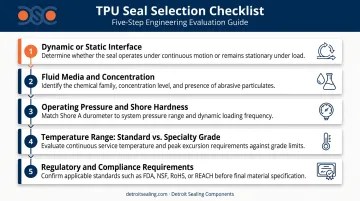
Key Evaluation Criteria
Before specifying a TPU seal, confirm these application parameters:
- Dynamic or static interface — TPU's abrasion advantage is most valuable in dynamic applications; static seals may not justify the material cost over NBR
- Fluid media and concentration — cross-reference against the compatibility list above; aromatic and polar solvents disqualify TPU
- Operating pressure — select Shore hardness to resist extrusion at peak system pressure (92A and 94A grades for high-pressure hydraulic service)
- Temperature range — standard compound vs. specialty grade decision point
- Regulatory requirements — FDA-compliant TPU compounds exist (Parker Ultrathan lists P5600 with food-contact substance approval); confirm compliance requirements before ordering
Standard vs. Custom TPU Seals
Off-the-shelf TPU seals in O-ring, U-cup, and rod seal profiles at 80A–95A Shore hardness cover the majority of general-purpose dynamic sealing requirements. Standard profiles in common sizes typically offer the fastest path to installation.
Custom-compounded or custom-geometry TPU seals make sense when:
- The sealing interface requires a non-standard cross-section or profile
- Operating media falls outside standard compound compatibility
- Tolerance requirements or pressure ratings exceed catalog specifications
- Regulatory compliance demands compound-level documentation
DSC's technical team supports custom compound development through its ISO 17025 accredited lab. FEA-based design validation covers stress distribution, sealing force, and assembly force analysis — providing a documented basis for specifications in demanding or unusual applications.
Avoiding Costly Field Failures
Whether you're choosing between standard and custom, always request compound-specific material data sheets rather than relying on general TPU claims. Material properties vary widely between formulations — tensile strength alone spans 15 MPa to 55 MPa across Parker's Ultrathan range. DSC can cross-reference your fluid, temperature, and pressure conditions against compound-level compatibility data before you commit to a specification.
Frequently Asked Questions
Frequently Asked Questions
Can TPU be used for seals?
Yes. TPU is widely used for O-rings, U-cup seals, rod seals, piston seals, wiper seals, and custom-profile gaskets. Its combination of high abrasion resistance, oil resistance, and mechanical strength makes it the standard material for dynamic hydraulic sealing applications.
Is TPU a rubber or plastic?
TPU occupies its own category as a thermoplastic elastomer (TPE): it processes like a thermoplastic through injection molding or extrusion, but behaves like rubber in service, with elasticity and resilience that rigid plastics cannot match.
What temperature range can TPU seals handle?
Standard compounds are rated for approximately -35°C to 100°C (-31°F to 212°F). Specialty grades can extend to 135°C in defined petroleum fluids. TPU is not recommended for hot water or steam service above 50°C due to hydrolysis risk.
What chemicals are TPU seals resistant to?
TPU performs well with mineral oils, lubricating oils, greases, and aliphatic hydrocarbons. Avoid applications involving ketones, esters, aromatic hydrocarbons (benzene, toluene), concentrated acids, amines, glycols, and steam.
How does TPU compare to NBR for sealing?
Both offer good oil resistance, but TPU delivers 2–3× the abrasion resistance of NBR, making it the preferred choice for dynamic seals with sliding contact. NBR remains a cost-effective option for static seals in oil environments.
What Shore hardness is typically used for TPU seals?
Most TPU seals are produced in the 80A to 95A range. Softer grades (80A–85A) offer more conformability and lower seating force; harder grades (92A–95A) provide better extrusion resistance under high system pressures in hydraulic applications.