Introduction
A hydraulic cylinder seal fails mid-stroke on an excavator. The rod begins weeping fluid, pressure drops, and the arm loses holding force. Work stops. The machine gets tagged out.
Between the lost production hours, fluid cleanup, and emergency part sourcing, what started as a worn seal becomes a multi-thousand-dollar problem before the replacement even arrives.
This scenario plays out regularly across construction sites, manufacturing lines, and oil fields — and it's almost always preventable.
Hydraulic systems depend on precision sealing across every pressure-bearing interface. The seal between your cylinder rod and gland, the O-ring at a valve body port, the wiper keeping grit off the rod — each one is a potential failure point if specified incorrectly or allowed to degrade. Seal selection is a system-level decision with direct consequences for uptime, fluid loss, and component life.
This guide covers the full scope of hydraulic sealing — component types, material selection, failure modes, design parameters, and what separates a reliable seal supplier from one that ships you the wrong compound under pressure.
Key Takeaways
- Contamination causes an estimated 65–90% of hydraulic system failures, making seal and wiper selection a contamination control decision
- Rod seals, piston seals, wipers, rotary seals, O-rings, and back-up rings each serve distinct functions with specific material requirements
- Material choice must account for fluid type, operating pressure, temperature range, and motion type. No single material covers all applications.
- Surface finish, groove tolerances, and clearance gaps directly determine seal service life
- Seal failure costs far more than the seal itself: fluid loss, component scoring, unplanned downtime, and environmental exposure compound quickly
Why Sealing Components Are Critical to Hydraulic System Performance
Hydraulic systems generate and transmit force through pressurized fluid. Sealing components are what keep that pressure contained, directed, and controllable. Without them, none of it works.
The functions they serve go beyond simply "stopping leaks":
- Pressure containment — maintaining differential pressure across the piston to generate usable force
- Contamination exclusion — keeping external debris and moisture from entering through the rod passage
- Actuator control — enabling smooth, predictable rod travel without bypass or drift
- System protection — preventing fluid from contacting components it can score, pit, or corrode
When Seals Fail, Costs Compound
A small leak rarely stays small. According to Machinery Lubrication, a single hydraulic leak of one drop per second accumulates to 420 gallons of fluid loss over 12 months. That's wasted fluid, environmental exposure risk, and the kind of slow drain on system efficiency that often goes unnoticed until something breaks.
Internal leakage — fluid bypassing the piston between pressure chambers — is harder to see but just as destructive. Research published in Measurement (2022) identifies seal wear as the primary factor in internal cylinder leakage. The result: reduced actuator force output and degraded motion control precision.
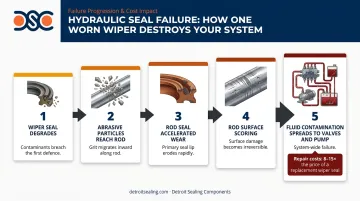
Beyond fluid loss, seal failure creates cascading damage: abrasive particles introduced through a failed wiper score the rod surface, which then accelerates wear on the rod seal behind it. A contaminated fluid supply damages valve spools and pump internals. At that point, the cost of the original seal is a footnote.
Not All Hydraulic Sealing Interfaces Are Equal
Sub-system requirements vary significantly:
- Cylinder rod and piston seals handle dynamic linear motion under high-cycle loading
- Rotary shaft seals face continuous rotational stress and shaft runout
- Valve and port seals are static but must withstand pressure spikes and thermal cycling
Each interface type demands a seal specified for its actual operating conditions — pressure range, motion type, temperature, and fluid compatibility — not just the system's nominal pressure rating.
Types of Sealing Components Used in Hydraulic Systems
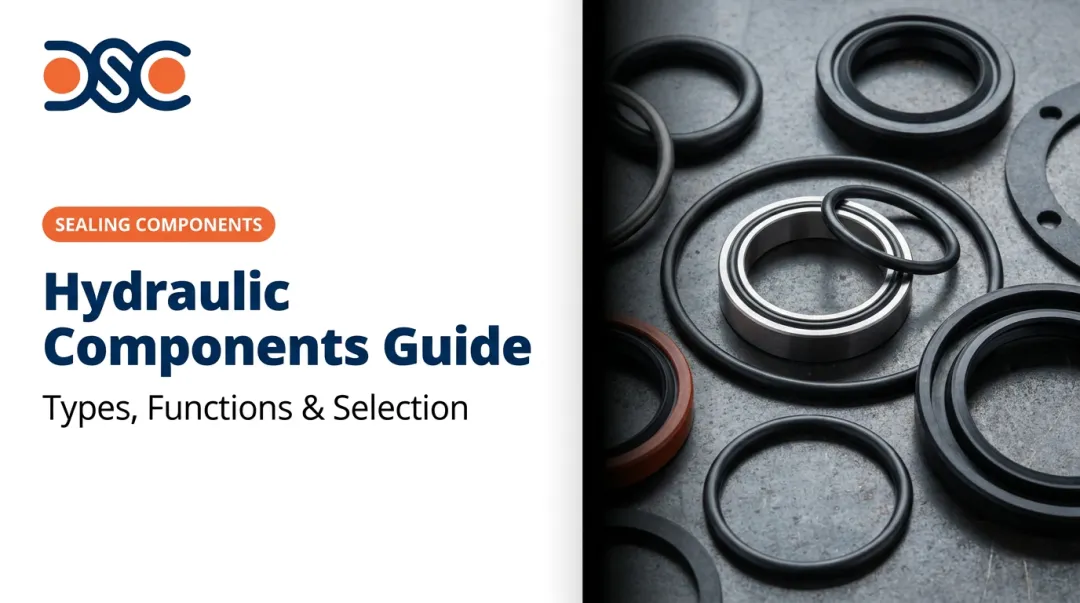
Rod Seals
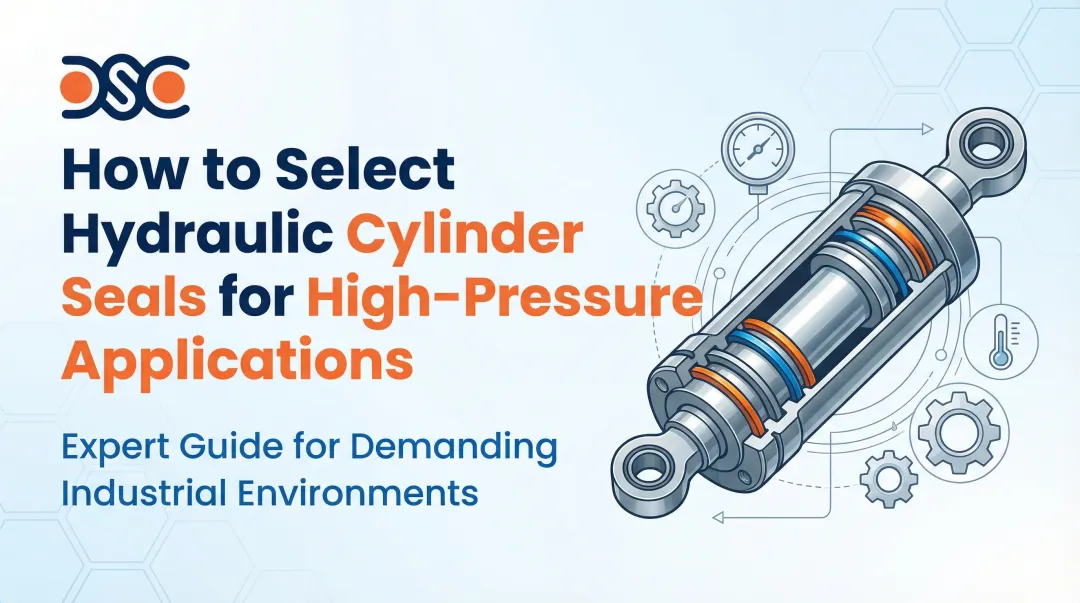
Rod seals sit in the cylinder head/gland and prevent pressurized fluid from escaping along the piston rod during extension and retraction. They're the most wear-intensive seal in a cylinder — they handle dynamic motion on every stroke and must maintain a static hold when the actuator is stopped under load.
DSC stocks symmetrical rod and piston seals (UF1, UF2, UF4, UH1, UH2) in engineered, abrasion-resistant materials suited for common hydraulic cylinder applications.
Piston Seals
Piston seals divide the cylinder bore into two pressure chambers. They're what make bi-directional force output possible. When a piston seal wears or bypasses, fluid crosses between chambers — the actuator loses power, precision, and holding capability. This internal leakage is often the first sign of piston seal degradation.
The UC6 piston seal in DSC's catalog is designed specifically for this application.
Wiper/Scraper Seals
Wipers are the outermost seal — positioned on the external face of the cylinder head to remove dirt, debris, and moisture from the rod before it retracts into the cylinder. Their condition directly affects the rod seal behind them. A degraded wiper introduces abrasive particles that accelerate rod seal wear significantly faster than normal operating conditions.
DSC's UA2 and UA4 wiper seal models address this function for standard hydraulic cylinder configurations.
Rotary Shaft Seals
Not all hydraulic components move in a straight line. Hydraulic motors, pumps, and rotary actuators use rotary shaft seals rather than linear cylinder seals — and the distinction matters. Rotary seals face continuous loading through a full 360° cycle, and their lip geometry must accommodate shaft runout and misalignment: loading conditions that linear seals never encounter.
Static Seals: O-Rings, Gaskets, and Back-Up Rings
Not every hydraulic interface moves. Port connections, valve bodies, and end caps require static seals — and O-rings handle the majority of these applications. DSC stocks O-rings across all major standards in sizes from 0.5mm ID to 1600mm ID:
- AS568 (American standard)
- Metric
- JIS
- BS (British standard)
Back-up rings pair with O-rings at high-pressure interfaces. They're anti-extrusion devices that close the clearance gap between the O-ring gland and mating hardware, eliminating the gap into which an O-ring would otherwise extrude under pressure spikes.
DSC stocks back-up rings sized for the complete AS568 series in both 90 durometer NBR and FKM.
Material Selection for Hydraulic Sealing Components
The right seal geometry in the wrong material will still fail. Material selection must account for four intersecting variables: fluid type, operating pressure, temperature range, and whether the application is dynamic or static.
| Material | Strengths | Limitations | Best For |
|---|---|---|---|
| NBR (Nitrile) | Petroleum-fluid resistance, cost-effective, widely available | Limited with water-glycol fluids; reduced performance at high temps | General hydraulic cylinders, petroleum-based systems |
| Polyurethane (AU/EU) | Superior abrasion resistance, high-pressure performance | Not suited for high-temperature or aggressive fluid chemistries | Rod seals, wiper seals in mobile equipment |
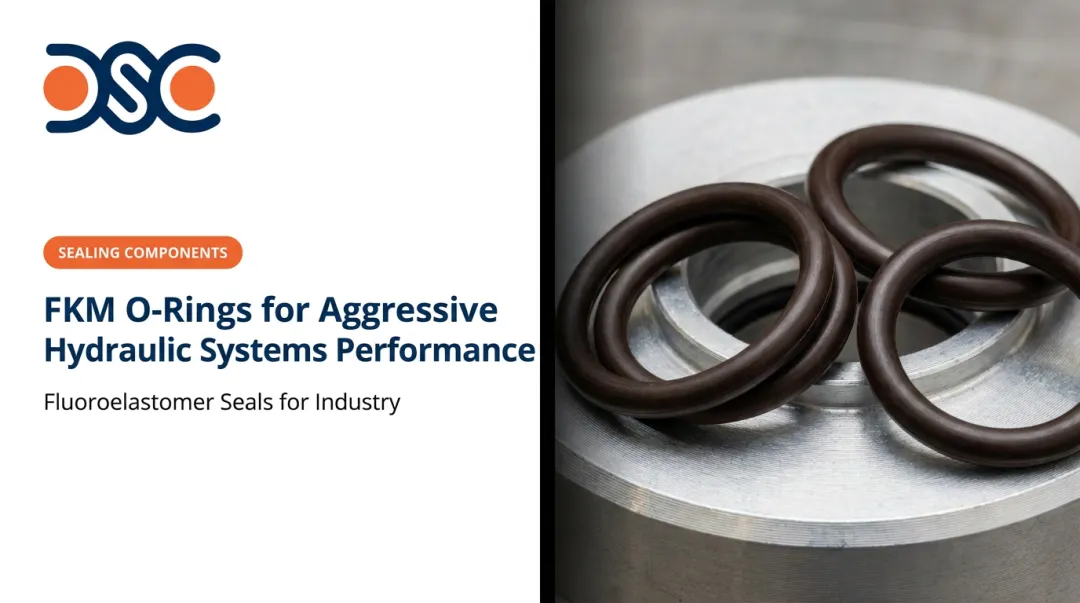
| FKM (Fluorocarbon) | High-temperature and chemical resistance, broad fluid compatibility | Higher cost; not required for standard petroleum applications | Fire-resistant fluids, elevated-temperature systems |
| PTFE / Composite | Low friction, high-speed/high-pressure capability | Requires energizing (spring or elastomeric element) — no inherent elasticity | Servo hydraulics, precision actuators |
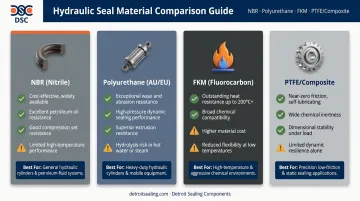
Two of these materials warrant closer attention for common hydraulic applications.
Polyurethane is the standard choice for dynamic seals in construction and agricultural equipment — applications where abrasive contaminants on the rod surface are unavoidable and seal wear is the dominant failure mode.
PTFE composite seals are selected where friction and heat generation must be minimized: servo systems, proportional valve actuators, and high-cycle precision equipment. Because PTFE lacks elasticity, it always requires an elastomeric or spring energizer to maintain sealing contact.
Water-glycol, phosphate ester, and fire-resistant hydraulic fluids are a different category entirely. Standard NBR will fail prematurely in these environments — often through swelling or loss of elasticity. FKM or a custom-developed compound tested to ISO 6072:2011 (the standard for evaluating elastomer compatibility with hydraulic fluids) should be specified.
DSC maintains access to hundreds of compounds across all rubber types. For edge cases where no standard material fits, DSC's ISO 17025 accredited lab handles custom compound development and validation from the ground up.
Common Hydraulic Seal Failure Modes and How to Prevent Them
Extrusion and Nibbling
When pressure spikes or clearance gaps are too large, seal material extrudes into the gap between the hardware components. Each cycle progressively damages the seal lip until it fails completely. Two measures address this directly:
- Proper groove tolerancing per ISO 7425-1:2021
- Back-up rings at any interface where pressure spikes are expected
Contamination-Induced Wear
Contamination accounts for an estimated 65–90% of hydraulic system failures. Abrasive particles in the fluid — or on the rod surface — act as grinding media against the seal lip. Prevention requires:
- Maintaining fluid cleanliness within the target ISO 4406 cleanliness code (particle counts rated at ≥4, ≥6, and ≥14 µm thresholds)
- Functional wiper seals inspected regularly
- Abrasion-resistant materials (polyurethane) for dynamic seals exposed to contaminated environments
Thermal Degradation and Chemical Incompatibility
Seals operating outside their design temperature range or in contact with incompatible fluids harden, swell, or lose elasticity — leading to leakage and physical fragmentation.
Prevention starts at specification: confirm fluid chemistry, operating temperature range, and any anticipated fluid changes before finalizing seal material. A system converted from petroleum-based fluid to water-glycol without replacing the seals will degrade rapidly — seal swell and blowout are predictable outcomes.
Key Factors in Sealing System Design
Surface Finish and Tolerances
Seal performance is inseparable from the quality of mating surfaces. SKF's technical guidance (referenced to ISO 4287:1997 roughness parameters) provides verified target values for hydraulic cylinder interfaces:
- Ra ≤ 0.8 µm — pressure-exposed static sealing surfaces and the static side of dynamic rod/piston seals
- Ra ≤ 1.6 µm — guide ring and wiper seat diameters
- Ra ≤ 3.2 µm — axial faces of seal grooves
Ra value alone isn't the full story. SKF notes that surfaces with identical Ra values can produce different lubrication film thickness and wear rates depending on their material-ratio profile. Evaluating Rz and Rmr alongside Ra gives a more complete assessment of seal-surface compatibility.
Piston seal housing dimensions and tolerances are governed by ISO 7425-1:2021 for elastomer-energized plastic-faced seals, and ISO 6547 for housings incorporating bearing rings.
Pressure, Speed, and Stroke Parameters
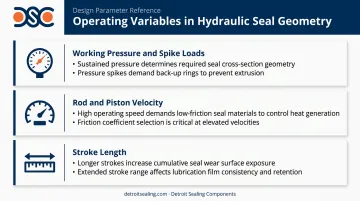
Three operating variables drive seal geometry selection:
- Working pressure and spike loads — sustained pressure defines seal cross-section; frequent spikes make back-up rings mandatory
- Rod/piston velocity — high-speed or high-frequency cycling demands lower friction coefficients to control heat generation and protect hydraulic efficiency
- Stroke length — longer strokes increase cumulative wear exposure and affect lubrication film consistency
System Fluid and Operating Environment
Confirm the hydraulic fluid type, operating temperature range, and external exposure conditions (UV, moisture, chemical splash) before finalizing any seal specification.
Environmental factors matter beyond fluid chemistry alone. A polyurethane seal well-suited to a controlled factory environment may degrade quickly on outdoor mobile equipment subjected to UV radiation and temperature cycling.
Choosing the Right Hydraulic Sealing Components Supplier
Evaluating a sealing supplier involves more than catalog breadth or price. The practical questions are:
- Do they stock both standard and custom seal types — rod, piston, wiper, O-ring, back-up ring?
- Can they develop or validate materials for non-standard fluid environments?
- Do they have engineering support (FEA, CAD, application expertise) for custom projects?
- Can they deliver reliably — stocking distributor or build-to-order only?
DSC (Detroit Sealing Components) is a stocking distributor with in-house engineering support and decades of experience in precision molded rubber. Their hydraulic sealing inventory spans wiper seals, rod and piston seals, O-rings, and back-up rings — with tooled sizes for standard cylinder applications.
For non-catalog needs, DSC can design and tool custom sizes as needed.
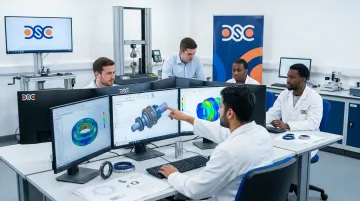
DSC's engineering team applies CAD and finite element analysis to custom seal design, with bench testing against customer conditions before production commitment. Their ISO 17025 accredited lab supports custom compound development and validation for fluid environments outside standard material profiles, including:
- Water-glycol hydraulic fluids
- Fire-resistant hydraulic fluids
- Synthetic hydraulic fluid formulations
These capabilities support customers across oil and gas, agriculture and construction, automotive, aerospace, and general industrial markets — served from DSC's Plymouth, Michigan headquarters with nationwide distribution.
Frequently Asked Questions
What is the most common type of seal used in hydraulic cylinders?
Rod seals and piston seals are the primary dynamic seals in hydraulic cylinders. O-rings are the most common static seals, used at port connections, end caps, and valve body interfaces throughout the assembly.
How do I know when hydraulic seals need to be replaced?
Watch for these warning signs:
- Visible fluid weeping along the rod
- Cylinder drift or loss of holding force under load
- Increased cycle times
- Visible seal extrusion or cracking on the rod seal and wiper
What causes hydraulic seals to fail prematurely?
The most common causes are:
- Fluid contamination
- Incorrect material selection for the operating fluid or temperature
- Installation damage — cuts, twists, or abrasion during assembly
- Operating beyond the seal's pressure or velocity design limits
What materials are best for high-pressure hydraulic sealing applications?
Polyurethane is the standard choice for dynamic high-pressure cylinder seals due to abrasion resistance. PTFE-based composite seals are preferred for high-pressure, low-friction applications such as servo hydraulics where heat generation must be minimized.
What is the difference between a rod seal and a piston seal?
Rod seals prevent pressurized fluid from escaping the cylinder along the moving rod — external leakage you can see. Piston seals prevent fluid from bypassing between the two pressure chambers — internal leakage that reduces force output and actuator control precision.
Can hydraulic sealing components be custom-manufactured for non-standard applications?
Yes. Custom-molded seals can be designed for non-standard bore sizes, non-standard shapes, or specialized fluid environments. DSC's ISO 17025 accredited lab supports custom compound development and validation for applications where standard materials fall short.