Introduction
High-pressure hydraulic applications operating at 300+ bar (4,350+ psi) demand precision seal selection to prevent catastrophic failures, fluid leaks, and costly equipment downtime. In manufacturing environments, seal failures can trigger losses between $50,000 and $200,000 per hour, with contamination events escalating repair costs by 300–500% beyond simple component replacement.
The consequences are especially severe in heavy equipment, mining, and industrial operations. Incorrect seal selection leads to extrusion, explosive decompression, system contamination, and fluid injection injuries — hazards that go well beyond mechanical failure. This guide walks through the key selection criteria — material compatibility, pressure ratings, seal geometry, and groove design — so you can match the right seal to your application before failure becomes an option.
Key Takeaways
- High-pressure seals must withstand 300–400+ bar while resisting extrusion and maintaining integrity across temperature extremes
- Key selection factors include pressure range, temperature, material compatibility, hardware tolerances, and backup ring requirements
- PTFE compounds, FKM, HNBR, and reinforced TPU each offer specific advantages for pressure resistance and chemical compatibility
- Matching seal type — rod, piston, or buffer — to your specific operating conditions prevents premature failure
- Custom-engineered seals often outperform off-the-shelf solutions in demanding applications
What Are Hydraulic Cylinder Seals for High-Pressure Applications?
Hydraulic cylinder seals are specialized sealing components that maintain fluid containment, prevent contamination, and enable controlled motion at elevated pressures—typically 300 bar (4,350 psi) and above. At these pressures, seals face challenges that standard-duty applications never encounter: extrusion risk, higher contact stresses, and accelerated wear rates.
Understanding where your application falls on the pressure scale shapes every seal selection decision.
Pressure Classifications:
- Standard-duty: Up to 160 bar (2,320 psi)
- Medium-duty: Up to 250 bar (3,625 psi)
- Heavy-duty/high-pressure: 300–400+ bar (4,350–5,800+ psi)
Primary Seal Types in High-Pressure Cylinders
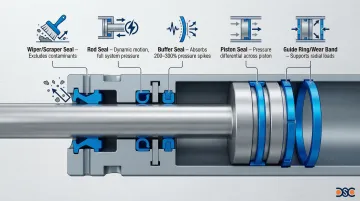
Each position in a hydraulic cylinder serves a distinct sealing function. Here's how the five primary seal types divide that responsibility:
- Rod seals prevent pressurized fluid from escaping along the piston rod while keeping a thin lubrication film intact—handling continuous dynamic motion under full system pressure.
- Piston seals maintain the pressure differential across the piston. Without them, fluid bypasses between chambers and the cylinder loses force generation.
- Buffer seals absorb pressure spikes that can reach 200–300% of normal operating pressure. In systems exceeding 350 bar with shock loads or rapid direction changes, they're what keeps primary rod seals intact.
- Wiper/scraper seals don't bear pressure, but they exclude abrasive contaminants that would otherwise degrade the seals that do—making them essential in dirty field environments.
- Guide rings/wear bands support radial loads and prevent metal-to-metal contact. At higher operating pressures, pressure-induced side loads intensify, making alignment more critical.
Key Factors to Consider When Selecting High-Pressure Hydraulic Seals
High-pressure seal selection requires balancing multiple technical factors — operating conditions, material properties, hardware dimensions, and fluid chemistry — each of which directly affects seal life, system uptime, and safety.
Operating Pressure Range and Pressure Spikes
Maximum operating pressure and the frequency/magnitude of pressure spikes are the primary selection criteria. At pressures above 300 bar, seals must resist extrusion into clearance gaps when pressure forces attempt to deform the seal material.
Applications with frequent pressure transients exceeding 400 bar typically require backup rings or reinforced seal designs. Research shows that dynamic loading can create force spikes of 200-300% above rated pressure, making spike tolerance a critical specification parameter.
Pressure management considerations:
- Running at 80-100% of rated pressure drops seal life significantly — at full rated pressure, expect roughly half the normal service life
- Systems above 250-300 bar always require backup rings or anti-extrusion geometries
- Above 350 bar, transient spike protection is non-negotiable
Temperature Extremes and Thermal Cycling
High-pressure applications often involve elevated temperatures (90-110°C or higher) that affect seal material properties including hardness, compression set, and chemical resistance. Heat reduces tensile strength, making seals more susceptible to extrusion and abrasion.
Understanding both continuous operating temperature and intermittent temperature spikes is essential. Thermal cycling accelerates seal degradation through repeated expansion and contraction, with temperature life factors dropping to 0.25 at 100°C compared to 1.0 at 50°C.
Seal Material Selection for Pressure Resistance
Material properties—specifically elastic modulus (stiffness), Shore hardness, and compression set resistance—determine a seal's ability to resist extrusion and maintain sealing force under high pressure.
Materials like PTFE compounds and reinforced elastomers offer superior extrusion resistance compared to standard rubbers. Bronze-filled PTFE is the standard for extreme pressure applications up to 500 bar, while high-hardness polyurethane grades (95 Shore A) provide excellent extrusion resistance in heavy-duty mobile equipment.
Hardware Dimensions, Tolerances, and Surface Finish
Extrusion gaps (clearance between rod/bore and groove) must be minimized in high-pressure applications. Tighter tolerances reduce seal damage risk, with allowable gaps decreasing as pressure increases—from approximately 0.60 mm at 160 bar to just 0.25 mm at 700 bar.
Surface finish works alongside tight tolerances to protect seal life. Optimal roughness is 0.1-0.4 µm Ra (4-16 µin) for rods and 0.4-0.8 µm Ra for bores in high-pressure cylinders. Surfaces rougher than 0.3 µm accelerate abrasion; those smoother than 0.05 µm prevent the lubrication film from forming, causing adhesive wear instead.
Fluid Compatibility and Chemical Resistance
Beyond mechanical factors, fluid chemistry is a frequent source of seal failure. Hydraulic fluid type — mineral oil, synthetic ester, water glycol, or phosphate ester — and its additive package affect seal material swelling, hardening, and long-term integrity. High-pressure systems using fire-resistant or biodegradable fluids often require seal materials that differ from standard mineral-oil configurations.
Incompatible pairings accelerate chemical attack, particularly at the elevated temperatures typical of high-pressure operation. For example, standard NBR seals exposed to phosphate ester fluids can swell and lose sealing force within a fraction of their rated service life.
Backup Ring Requirements for Extrusion Prevention
Backup rings are rigid support elements—typically PTFE, nylon, or reinforced polymers—installed adjacent to pressure seals to prevent extrusion into clearance gaps. They close the extrusion gap, allowing seals to operate at higher pressures without damage.
When backup rings are essential:
- Pressure exceeds 250-300 bar
- Extrusion gaps are larger than ideal due to manufacturing tolerances
- Using softer seal materials in high-pressure applications
- Double-acting cylinders requiring bidirectional pressure resistance
Single backup rings suffice for unidirectional pressure applications, while double-acting cylinders typically require backup rings on both sides of the seal.
Understanding Seal Types for High-Pressure Applications
High-pressure hydraulic cylinders rely on multiple seal types working together as an integrated system. Each seal is optimized for a specific function — rod sealing, piston sealing, or pressure buffering — to handle the extreme forces and temperatures common in 300+ bar applications.
Rod Seal Configurations for High Pressure
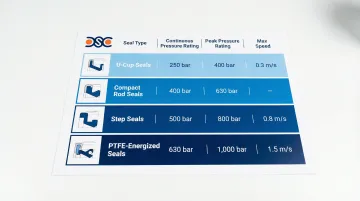
High-pressure rod sealing systems often combine a primary rod seal with a buffer seal to manage pressure spikes. Common profile designs for 300+ bar applications include:
U-Cup Seals: Standard U-cups handle up to 250 bar continuous pressure with peak capabilities to 400 bar at speeds up to 0.3 m/s. While economical, they require backup rings for pressures exceeding 250 bar.
Compact Rod Seals: Designed for 400 bar continuous pressure with peak ratings to 630 bar, these profiles incorporate optimized geometries that reduce installation space while improving pressure resistance.
Step Seals: Advanced designs rated for 500 bar continuous pressure and peak pressures to 800 bar. The stepped geometry provides enhanced extrusion resistance at speeds up to 0.8 m/s.
PTFE-Energized Seals: Purpose-built for extreme pressure, these seals combine PTFE sealing elements with elastomer energizers. These seals handle 630 bar continuous pressure with peak ratings to 1,000 bar at speeds up to 1.5 m/s.
Piston Seal Design Considerations
Piston seals in high-pressure applications must handle full differential pressure across the piston. Double-acting piston seals are common, often featuring wear-resistant materials or energizer/slide ring designs for consistent sealing force.
Two widely referenced designs illustrate the range of performance available:
- Parker's OK profile piston seal handles up to 800 bar using filled modified thermoplastic rings
- Trelleborg's Turcon Glyd Ring D is rated for heavy-duty applications up to 500 bar
Both designs incorporate backup rings and use materials with a high elastic modulus to resist extrusion under sustained load.
Buffer Seals and Secondary Sealing Elements
Buffer seals reduce pressure peaks reaching the primary rod seal, extending seal life in applications with shock loads. Positioned between the rod seal and piston in the cylinder head, they absorb transient pressure spikes before they reach the primary seal.
SKF RBB buffer seal profiles are rated up to 690 bar (10,000 psi), providing critical protection in systems where pressure transients are common. Buffer seals become essential in systems exceeding 350 bar or those experiencing frequent directional changes and shock loading.
Material Selection for High-Pressure Performance
Seal material selection is the most consequential decision in high-pressure applications. Material properties directly determine extrusion resistance, wear life, and pressure capacity. The challenge lies in balancing mechanical properties (hardness, modulus), chemical compatibility, and temperature resistance.
Critical Material Properties for High-Pressure Seals
Elastic modulus (stiffness) and Shore hardness are central to resisting extrusion. Harder materials—90+ Shore A or Shore D range—better resist deformation under pressure, though they may increase friction and require more precise surface finishes.
Compression set resistance indicates a material's ability to recover after prolonged compression. Low compression set values (<25% after standard testing) indicate better pressure retention over time, meaning the seal maintains sealing force throughout its service life rather than permanently deforming and allowing leakage.
PTFE and PTFE Compounds
PTFE-based seals are a top-tier choice for high-pressure applications — delivering exceptional extrusion resistance, low friction (coefficient of 0.04-0.10), chemical inertness, and a wide temperature range (-200°C to +260°C).
Virgin PTFE has limited mechanical strength, so fillers are essential:
Bronze-Filled PTFE: Rated for pressures up to 500 bar with maximum wear and extrusion resistance. Hardness typically 55-65 Shore D; temperature range of -190°C to +280°C.
Glass-Filled PTFE: Delivers dimensional stability and wear resistance across -190°C to +260°C. The go-to for general hydraulic applications where pressure resistance is the primary requirement.
Carbon-Filled PTFE: Best suited to water-based fluids, with high thermal conductivity and a temperature range of -200°C to +300°C for high-load thermal applications.
Spring-energized PTFE seals combine PTFE sealing elements with metal springs, providing consistent sealing force across extreme pressure ranges and temperature variations.
Fluoroelastomers (FKM/Viton) and HNBR
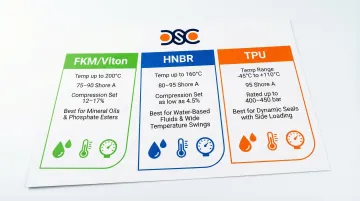
FKM offers excellent chemical resistance and high-temperature capability up to 200°C with good pressure resistance when properly compounded. Suitable for aggressive fluids and high-temperature/high-pressure combinations, FKM typically features 75-90 Shore A hardness for high-pressure applications.
Compression set resistance is excellent, with values of 12-17% (70 hours at 200°C) for Viton A. FKM excels with mineral oils and phosphate esters but generally isn't compatible with water-based fluids.
Where water-based fluids or wider temperature swings are a factor, HNBR (hydrogenated nitrile) steps in. It offers superior extrusion resistance over standard NBR, with higher temperature tolerance (up to 160°C), better ozone resistance, and hardness ratings of 80-95 Shore A. Compression set values reach as low as 4.5% (22 hours/100°C), and HNBR holds up well against explosive decompression.
Thermoplastic Polyurethanes (TPU) and Custom Compounds
TPU offers excellent abrasion resistance, high tear strength, and good extrusion resistance in high-hardness grades. Effective for dynamic seals in high-pressure mobile equipment, TPU is rated up to 400-450 bar in 95 Shore A formulations without backup rings in specific designs.
Temperature range typically spans -45°C to +110°C, with abrasion resistance values around 18-25 mm³ (DIN 53516). The material's toughness makes it ideal for applications with side loading and contamination.
For extreme high-pressure applications or unique operating conditions, custom-engineered seal compounds are worth specifying. Detroit Sealing Components runs an ISO 17025 accredited lab with access to hundreds of compounds across all rubber types — enabling compound optimization matched to your exact pressure, temperature, and fluid requirements when off-the-shelf materials fall short.
How DSC Can Help You Select the Right High-Pressure Seals
Selecting the right high-pressure hydraulic seal involves more variables than most buyers anticipate — material compatibility, geometry, pressure cycling, temperature range. DSC brings the technical depth and product breadth to help engineers and procurement teams get those decisions right the first time.
DSC's High-Pressure Sealing Capabilities
Laboratory and Material Development
DSC's ISO 17025 accredited lab and ISO 9001:2015 certified quality system handles custom compound development, testing, and performance validation under simulated high-pressure conditions. With hundreds of compounds across PTFE, FKM, HNBR, TPU, and specialty elastomers, they can match material selection to your specific pressure, temperature, and fluid compatibility requirements.
Engineering and Design Support
CAD modeling and finite element analysis (FEA) let DSC's team predict seal behavior under pressure before a single part is produced. Geometry is optimized upfront — reducing development cycles and avoiding costly redesigns after the fact.
Product Range
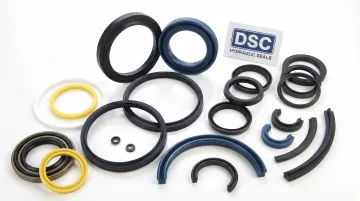
DSC stocks and sources sealing solutions from standard O-rings to complex custom-molded profiles. For hydraulic applications specifically, their catalog includes:
- Piston seals (UC6)
- Symmetrical rod and piston seals (UF1, UF2, UF4, UH1, UH2)
- Wiper seals (UA2, UA4)
- Backup rings in 90 durometer NBR and FKM
Delivery and Technical Support
DSC's location near high-traffic shipping corridors in Plymouth, MI supports fast, cost-effective nationwide delivery — important when a seal failure means production downtime. Their technical staff consult directly on material selection, seal design, and failure diagnosis. Reach them at +1 313-887-4695.
Frequently Asked Questions
What is the best material for hydraulic seals in high-pressure applications?
PTFE and PTFE compounds remain the top choice for extreme high-pressure applications (400+ bar) due to superior extrusion resistance and broad temperature range. That said, the optimal material depends on your specific conditions — FKM, HNBR, and reinforced TPU each offer advantages where chemical compatibility or elevated temperature is a factor.
What are the different types of hydraulic cylinder seals used in high-pressure systems?
High-pressure systems rely on five seal types working together:
- Rod seals — prevent fluid leakage along the piston rod
- Piston seals — maintain pressure differential across the piston
- Buffer seals — absorb pressure spikes before they reach the rod seal
- Wiper/scraper seals — exclude external contaminants
- Guide rings — support radial loads
Each component is optimized for its role within the integrated sealing system.
What is the difference between piston seals and rod seals in high-pressure applications?
Piston seals maintain the seal between the piston and cylinder bore, carrying the full differential pressure to control cylinder motion. Rod seals prevent pressurized fluid from escaping to the external environment. Both face high-pressure demands, but rod seals must also maintain a controlled lubrication film under dynamic conditions — a more complex balancing act.
Why are backup rings important in high-pressure hydraulic cylinders?
Backup rings are rigid support elements installed adjacent to seals to prevent extrusion—seal material being forced into clearance gaps under pressure. They are essential in applications exceeding 250-300 bar because extrusion can cause rapid seal failure, leakage, and system damage. Backup rings close the extrusion gap, allowing seals to operate safely at higher pressures.
What is the typical life expectancy of hydraulic cylinder seals in high-pressure applications?
Seal life ranges from 500 to 10,000+ hours depending on pressure, temperature, contamination control, and material selection. Properly specified seals in well-maintained systems can achieve multi-year service — but wrong material choices or neglected maintenance can cause failure within weeks.
How do I prevent seal extrusion in high-pressure hydraulic cylinders?
Four key practices prevent extrusion:
- Install backup rings adjacent to pressure seals
- Select high-modulus materials such as PTFE or reinforced elastomers
- Minimize clearance gaps with tighter hardware tolerances
- Follow ISO 7425 groove design standards
Always build in a pressure safety factor, and inspect seals regularly to catch early signs of extrusion before failure occurs.