This article covers what "hermetic" actually means by technical standard, the four main seal types and where each fits, the industries that depend on them, and the selection factors that separate an adequate seal from one that holds for the life of the equipment.
Key Takeaways
- A hermetic seal prevents gas and liquid transmission to a quantified leak rate standard, not merely a general sense of "airtight"
- Glass-to-metal and ceramic-to-metal seals deliver the highest pressure and temperature performance
- Epoxy and elastomeric seals trade some performance for flexibility and easier serviceability
- Seal type selection depends on pressure range, temperature cycling, chemical exposure, and dimensional constraints
- Helium mass spectrometer leak testing is the primary verification method for hermetic performance
- Evaluate hermetic seal decisions on total cost of ownership, not unit price alone
What Does "Hermetic" Actually Mean?
"Hermetic" is not a marketing term for a good seal. It has a specific technical meaning tied to measurable leak performance.
MIL-STD-883 Method 1014 defines hermetic seal testing for microelectronic packages in units of atm-cm³/s of air. For the most demanding package class (Hybrid Class K, volumes ≤0.05 cm³), the failure threshold is 1×10⁻⁹ atm-cm³/s, a threshold requiring mass spectrometer detection.
At the vacuum component level, a leak rate below 1×10⁻⁹ cc He/sec is the commonly cited benchmark, though the exact threshold varies by package volume and governing specification.
Hermetic vs. Standard Seals
The distinction matters practically. A standard seal may slow contamination ingress (water vapor, corrosive gases, or process chemicals) but it does not prevent it. A hermetic seal stops gas and moisture transmission across a pressure boundary at a verified, quantified rate.
As SCHOTT notes, glass, metal, and ceramic materials provide near-zero permeation and form the basis for true hermetic claims. Polymer-based seals may pass short-term leak tests but allow moisture permeation over time — making them non-hermetic by definition, regardless of day-one performance.
Two Primary Pressure Contexts
Hermetic sealing applies in two distinct environments, each with different design requirements:
- High-pressure environments (subsea, hydraulic, oil & gas): seals must hold against external pressure differentials without compression failure or extrusion
- Vacuum environments (semiconductor chambers, space simulation): seals must prevent gas permeation inward, where even trace ingress disrupts process chemistry or contaminates electronics
Types of Hermetic Seals for Critical Applications
No single seal technology is universally optimal. The right choice depends on operating pressure, temperature range, chemical exposure, conductor requirements, and whether the seal needs to be serviceable.
Glass-to-Metal Seals
Glass-to-metal seals (GTMS) fuse glass, an electrical conductor, and a metal housing through a controlled heating and annealing cycle. The result is a rigid, permanently bonded inorganic seal that can be fully verified by helium leak testing.
Two subtypes serve different applications:
- Compression seals: The metal housing has a higher coefficient of thermal expansion (CTE) than the glass. As the assembly cools, the metal contracts around the glass, placing it in compression — well-suited to high-pressure applications, with specific designs achieving pressures exceeding 3,000 bar
- Matched seals: Metal, glass, and conductor CTE values are closely aligned (within ~10%), minimizing residual stress. These are preferred for electronics packages where dimensional stability and stress control matter more than pressure rating
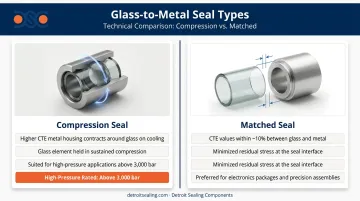
For positive-pressure feedthrough applications, GTMS can exceed 30,000 psi — significantly above the ceiling for epoxy alternatives.
Ceramic-to-Metal Seals
Ceramic-to-metal seals extend performance beyond what glass-to-metal can deliver in the most demanding environments. Ceramic materials offer superior electrical insulation, chemical resistance, and temperature performance.
Ceramic-to-metal assemblies can withstand:
- Temperatures from -269°C to +450°C (cryogenic to high-temperature service)
- Pressures above 1,700 bar
- Ultra-high vacuum and corrosive or caustic media
Cost and manufacturing complexity are higher: ceramic seals are more labor-intensive to produce and more brittle than glass alternatives. They're standard in aerospace modules, UHV chambers, and diagnostic medical equipment where those constraints are justified by the operating environment.
Elastomeric and Rubber-Based Seals
Elastomeric seals — O-rings, X-rings, custom molded shapes, and rubber-metal bonded components — seal through compression and conformance to mating surfaces. They're well-suited for dynamic sealing, vibration absorption, and irregular or complex geometries that rigid inorganic seals can't accommodate.
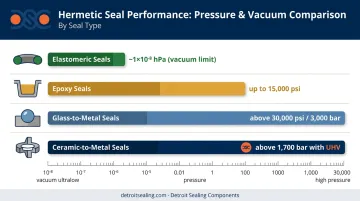
The critical caveat: Pfeiffer Vacuum's materials guidance notes that all elastomers are inherently gas-permeable. FKM-sealed vacuum systems rarely achieve better than 1×10⁻⁸ hPa working pressure. Elastomeric seals function as high-performance environmental and vacuum seals — not as permanent hermetic barriers equivalent to glass or ceramic alternatives.
Material selection within the elastomeric family is the primary performance lever:
| Material | Approximate Temperature Range | Primary Strength |
|---|---|---|
| EPDM | -45°C to +150°C | Steam, hot water, ozone resistance |
| FKM (Viton) | -20°C to +200°C | Fuels, oils, solvents, vacuum |
| Silicone (VMQ) | -50°C to +175°C | Wide temperature range, dielectric |
| FFKM | -25°C to +240°C (some to +325°C) | Broadest chemical resistance |
| Nitrile (NBR) | -30°C to +100°C | Mineral oils, petroleum fluids |
DSC maintains access to hundreds of compounds across all of these families, including NBR, HNBR, FKM, FFKM, EPDM, VMQ, FVMQ, and LSR. When a standard material doesn't meet application requirements, DSC can custom develop and test compounds through its ISO 17025 accredited laboratory.
Epoxy-Based Seals
Epoxy hermetic seals bond to metals, plastics, glass, and PCBs, enabling high conductor density through small ports. They can convert standard commercial off-the-shelf connectors into hermetically rated assemblies through back-potting, and they simplify wire pass-throughs where continuity must not be broken — making them practical for design scenarios where rigid inorganic seals aren't feasible.
Epoxy seals top out at roughly 15,000 psi and operate reliably in the -200°C to +200°C range. For UHV applications, outgassing from polymer materials is a real concern. Epoxy is a strong choice for design flexibility and cost — not where glass-to-metal or ceramic performance is required.
Industries That Rely on Hermetic Sealing
Aerospace, Defense, and Medical
These sectors set the most demanding hermetic seal specifications, and for clear reasons — seal failure is not recoverable in service.
MIL-DTL-38999 qualified hermetic interconnects provide 1×10⁻⁷ leak-rate performance for high-density circular connectors across aerospace and defense platforms. Components must withstand:
- Sustained pressure differentials and mechanical vibration
- Radiation exposure across full mission life
- Wide temperature swings with no mid-mission re-inspection
Medical devices face equally unforgiving standards. The FDA requires helium mass spectrometer leak detection for implantable electronics — pacemakers included. Body-fluid intrusion into inadequately sealed housings has caused documented device failures with lethal outcomes.
Oil & Gas and Semiconductor Manufacturing
These industries present chemical and pressure challenges that require careful material compatibility planning:
- Subsea oil & gas: corrosive saltwater, high hydrostatic pressure, hydrogen sulfide exposure, and RGD (rapid gas decompression) risk for elastomeric components
- Semiconductor fabrication: UHV process chambers, aggressive etch chemistries, and plasma environments where seal outgassing contaminates process results
Not every application demands UHV-level performance. Food & beverage processing, water treatment, and agriculture/construction equipment also depend on hermetic or near-hermetic sealing — primarily to protect control systems and prevent contamination ingress, though at less extreme performance thresholds.
Automotive and Renewable Energy
Electrification is pulling hermetic sealing into sectors that once relied on standard environmental protection. Battery enclosures, EV power electronics, and hydrogen fuel system components must stay sealed against moisture and gas infiltration for the product's full service life — often 10–15 years of variable thermal cycling.
Key Factors for Selecting the Right Hermetic Seal
Operating Pressure and Vacuum Requirements
Start with pressure or vacuum range as the first screening criterion:
- Elastomeric seals: best evaluated by material permeability and gland design rather than a single pressure ceiling; vacuum performance typically limited to ~1×10⁻⁸ hPa with FKM
- Epoxy seals: up to approximately 15,000 psi
- Glass-to-metal seals: above 30,000 psi; specific compression designs to 3,000 bar
- Ceramic-to-metal seals: above 1,700 bar with UHV compatibility
Temperature Range and Thermal Cycling
Absolute temperature limits matter — but thermal cycling frequency and rate matter equally. A seal that performs at a single temperature may crack or delaminate under repeated thermal cycles if CTE values between the seal material and housing are mismatched.
For glass-to-metal seals, matched-seal designs require CTE alignment within approximately 10% between glass, housing, and conductors. Compression seal designs deliberately use CTE mismatch to maintain compressive stress on the glass — substituting one design for the other without a stress review is a common engineering error.
Chemical Compatibility
Every chemical the seal will contact must be evaluated: process fluids, cleaning agents, lubricants, and ambient gases. For elastomeric seals, compound selection across the rubber families is the primary design lever.
No single compound covers every combination of chemical exposure, temperature, and permeation requirement — which is why access to a broad material portfolio matters at the selection stage. DSC's technical staff work through compound selection across the full range, from standard NBR and EPDM to specialized FFKM formulations, and validate the selection through compound testing in DSC's ISO 17025 accredited lab. Where no existing compound meets the application's requirements, DSC can develop a custom formulation.
Mechanical and Dimensional Constraints
Form factor directly narrows viable technology options:
- Available compression space and gland geometry
- Conductor count for electrical feedthroughs
- Dynamic vs. static sealing requirement
- Housing material compatibility with the seal
DSC's CAD and finite element analysis capabilities allow custom seal geometry to be evaluated for stress distribution and sealing force before tooling is committed — reducing trial-and-error cost in development.
Total Cost of Ownership
Unit price is the wrong evaluation metric for hermetic seals in critical applications. The relevant calculation includes:
- Seal service life under actual operating conditions
- Replacement frequency and associated downtime
- Cost of downstream equipment damaged by seal failure
- Qualification time required for a new seal specification
A lower-cost seal that fails prematurely in a semiconductor chamber or medical device almost always costs more than the correct specification upfront. DSC's compound development capability and ISO 17025 lab testing directly address this risk — reducing the probability of field failures and the downstream costs that follow.
How Hermetic Seal Performance Is Tested
Helium Fine Leak Testing
The helium mass spectrometer leak test is the primary verification method for hermetic seals. A mass spectrometer detects helium molecules passing through the seal assembly, with UHV-grade performance defined at leak rates below 1×10⁻⁹ cc He/sec.
Helium is used because it is:
- Inert and non-toxic
- Non-condensable and non-flammable
- Small enough atomically to pass through leak paths other gases cannot
- Present in air at only 5 ppm, keeping background signal negligible
One important limit: helium fine leak testing detects leaks in the 10⁻⁴ to 10⁻¹⁰ atm-cc/sec range but cannot accurately detect gross leaks above 10⁻⁴ atm-cc/sec, because tracer gas can be evacuated before measurement.
Additional Test Methods
For positive-pressure applications and gross leak detection, additional methods apply:
- Bubble/gross leak tests: pressurized gas followed by liquid immersion; used after fine leak testing or for lower-sensitivity requirements
- Pressure decay tests (ASTM F2095): detects leaks of 1×10⁻⁴ sccs or greater in sealed packages
- Pressurized system verification: required for higher-pressure hardware where the governing specification mandates proof testing
Beyond Factory Acceptance
Passing initial acceptance testing is only the starting point. MIL-STD-883 defines additional methods to validate that hermeticity holds across the component's full service life:
- Temperature cycling: confirms seal integrity through repeated thermal expansion and contraction
- Thermal shock: validates performance under sudden, extreme temperature transitions
- Steady-state life testing: simulates long-term operational stress on the seal assembly
- Thermal leak conditioning: screens for latent defects that only emerge under sustained heat exposure
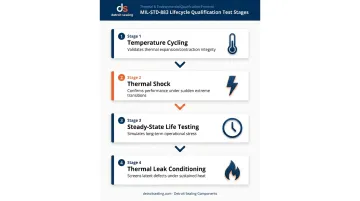
For aerospace, defense, and implantable medical applications where in-service re-inspection isn't possible, accelerated life testing and documented qualification data are non-negotiable requirements.
Frequently Asked Questions
What are the different types of hermetic seals?
The four primary types are glass-to-metal, ceramic-to-metal, elastomeric/rubber-based, and epoxy. The right choice depends on the application's pressure range, temperature extremes, chemical environment, and whether the seal requires electrical feedthroughs or serviceable replacement.
How long do hermetic seals last?
Glass-to-metal and ceramic-to-metal seals in stable environments can last decades. Elastomeric seals in demanding thermal cycling or chemical environments may require periodic inspection and replacement. Proper material selection and validated testing are the primary drivers of service life.
What is the difference between a hermetic seal and a standard seal?
A hermetic seal prevents gas and liquid transmission to a verified, quantified leak rate — typically measured in cc He/sec. A standard seal slows ingress but does not guarantee airtight containment. Hermetic seals are required wherever even trace contamination would compromise sensitive electronics, chemical processes, or biological systems.
How is hermetic seal performance measured and verified?
The helium mass spectrometer leak test is the industry standard, with UHV-grade performance defined at leak rates below 1×10⁻⁹ cc He/sec. Positive-pressure applications may use bubble tests or pressurized system verification depending on the governing specification.
What industries use hermetic seals the most?
Aerospace, defense, medical devices, oil & gas, and semiconductor manufacturing have the most demanding hermetic requirements. Automotive/EV and renewable energy sectors are growing rapidly, driven by battery and hydrogen system components that must hold seal integrity across the full product service life.