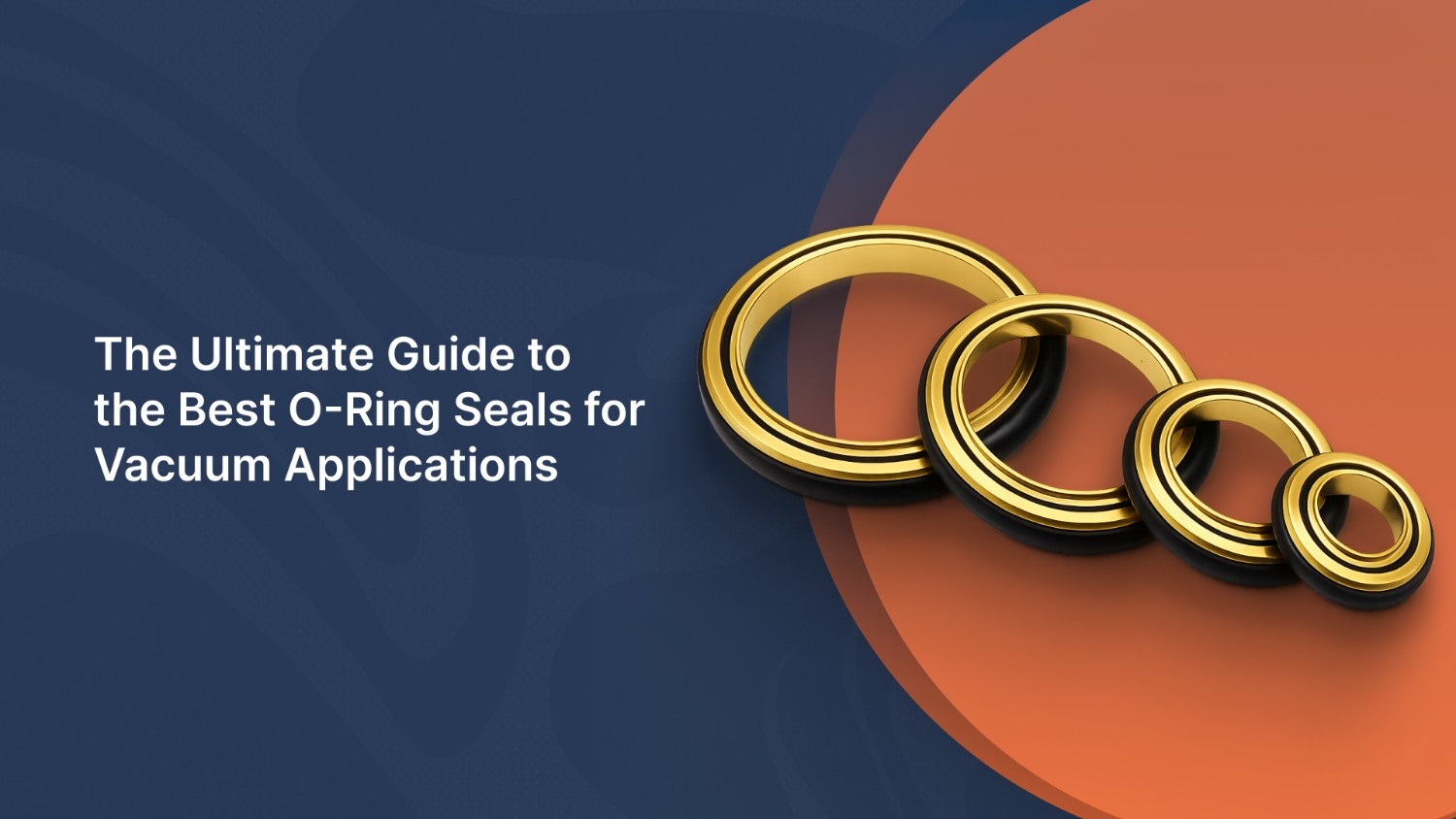
Vacuum systems place unique demands on sealing components. Even minor leaks can compromise system efficiency, contaminate processes, or prevent a vacuum chamber from reaching target pressure levels. Selecting the best O-ring seal for vacuum applications requires careful consideration of material properties, outgassing behavior, compression performance, and environmental conditions.
Unlike pressure sealing, vacuum sealing focuses on preventing gas ingress rather than fluid leakage. Material selection, surface finish, and proper sizing all play a critical role in long-term vacuum integrity.
This guide explains how O-rings perform in vacuum environments, which materials work best, common failure modes, and how to select the right O-ring for reliable vacuum sealing.
Need to know
Vacuum applications require O-ring seals with low gas permeability, low outgassing, and strong compression set resistance to maintain stable vacuum levels.
FKM and FFKM are commonly preferred for high and ultra-high vacuum systems, while EPDM, silicone, and NBR are typically limited to low-vacuum or specialized use cases.
Proper O-ring design, sizing, groove geometry, and surface finish are just as important as material choice for reliable vacuum sealing.
Routine inspection, diagnostics, and preventive maintenance help reduce leakage risk, contamination, and unplanned downtime in vacuum systems.
Why Vacuum Applications Require Specialized O-Ring Seals
In vacuum systems, the primary sealing challenge is preventing atmospheric gases from entering the system. Unlike pressurized systems, where seals resist outward force, vacuum seals must maintain integrity under inward pressure and molecular diffusion.
Key challenges in vacuum sealing include:
Gas permeation through elastomer materials
Outgassing, where trapped gases are released from the O-ring
Compression set, which can reduce sealing force over time
Surface imperfections that allow micro-leaks
Choosing the correct O-ring material and design helps maintain stable vacuum levels and system performance.
Key Performance Requirements for Vacuum O-Ring Seals
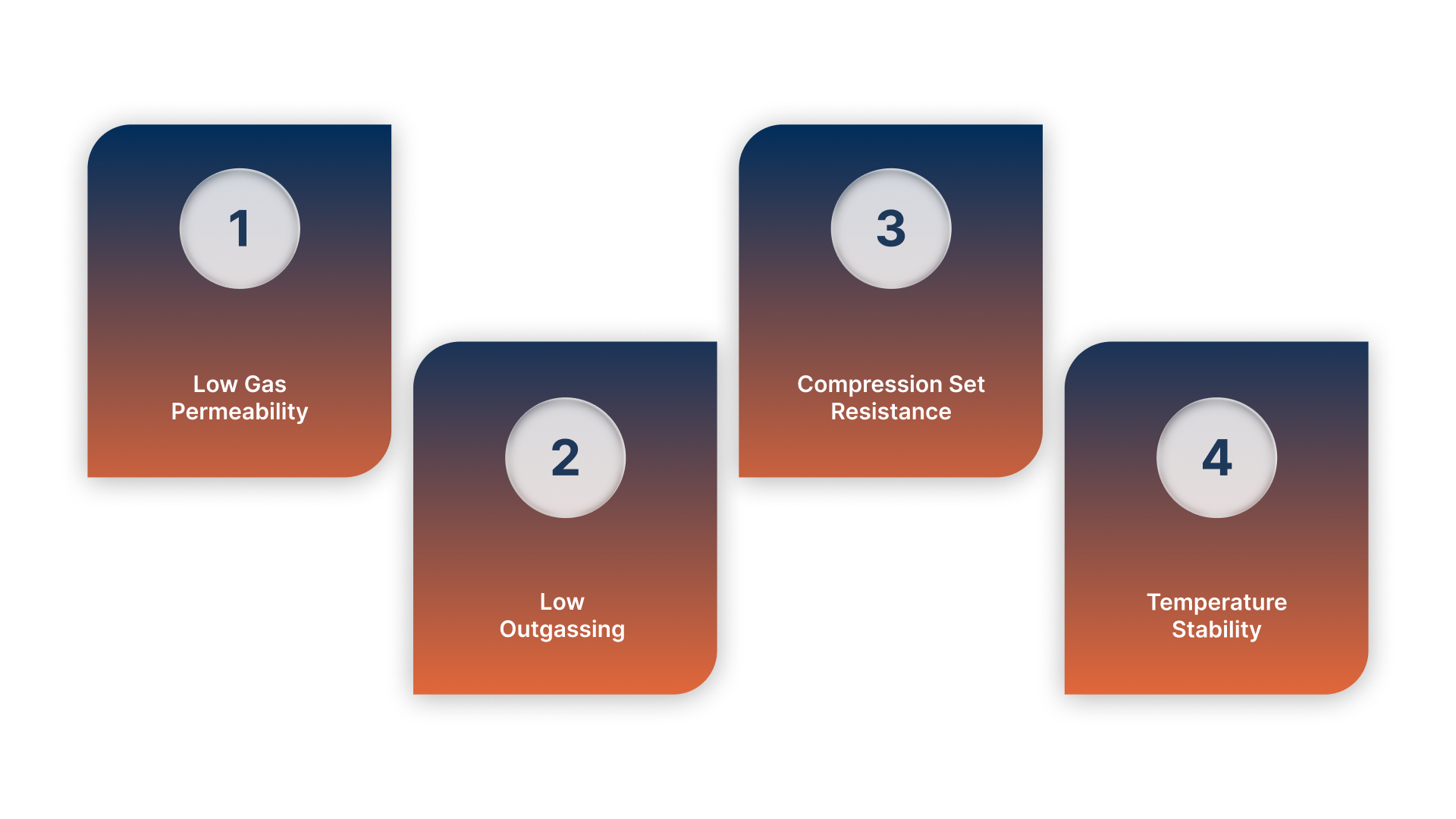
Vacuum sealing places very different demands on O-rings compared to pressure or atmospheric applications. In vacuum environments, even small material limitations, such as gas permeability, outgassing, or loss of elasticity, can compromise system performance. Understanding these key requirements helps ensure stable vacuum levels, reduced contamination, and long-term sealing reliability.
1. Low Gas Permeability
Gas permeability refers to the rate at which gases diffuse through an elastomer. In vacuum systems, higher permeability can make it difficult to achieve or maintain deep vacuum levels.
Materials with lower permeability slow gas diffusion across the seal
Reduced permeation helps improve pump-down time and vacuum stability
For reference, elastomers can vary significantly in permeability, often by an order of magnitude or more depending on material type and formulation, making material selection critical for vacuum performance.
2. Low Outgassing
Outgassing occurs when volatile compounds trapped in an elastomer are released under vacuum conditions. This released gas can contaminate the vacuum chamber and degrade system cleanliness.
Low-outgassing materials help maintain clean vacuum environments
Especially critical in high-vacuum and ultra-high-vacuum (UHV) systems
Outgassing rates are commonly evaluated using standardized vacuum test methods
In sensitive vacuum applications, even trace levels of outgassing can affect system performance, optics, or downstream processes.
3. Compression Set Resistance
Compression set measures an O-ring’s ability to recover its shape after prolonged compression.
Low compression set helps maintain sealing force over time.
A poor compression set can lead to leakage during long vacuum holds
Particularly important where seals remain static for extended periods
Vacuum systems often operate continuously, making long-term elastic recovery essential for seal integrity.
4. Temperature Stability
Vacuum applications frequently involve wide temperature ranges due to process heat, bake-outs, or cryogenic conditions.
O-ring materials must remain flexible across operating temperatures.
Loss of elasticity can lead to cracking, leakage, or seal failure.
Temperature stability ensures consistent sealing during thermal cycling
Many vacuum systems require seals to perform reliably across tens to hundreds of degrees of temperature variation, depending on the process.
O-Ring Design Considerations for Vacuum Sealing
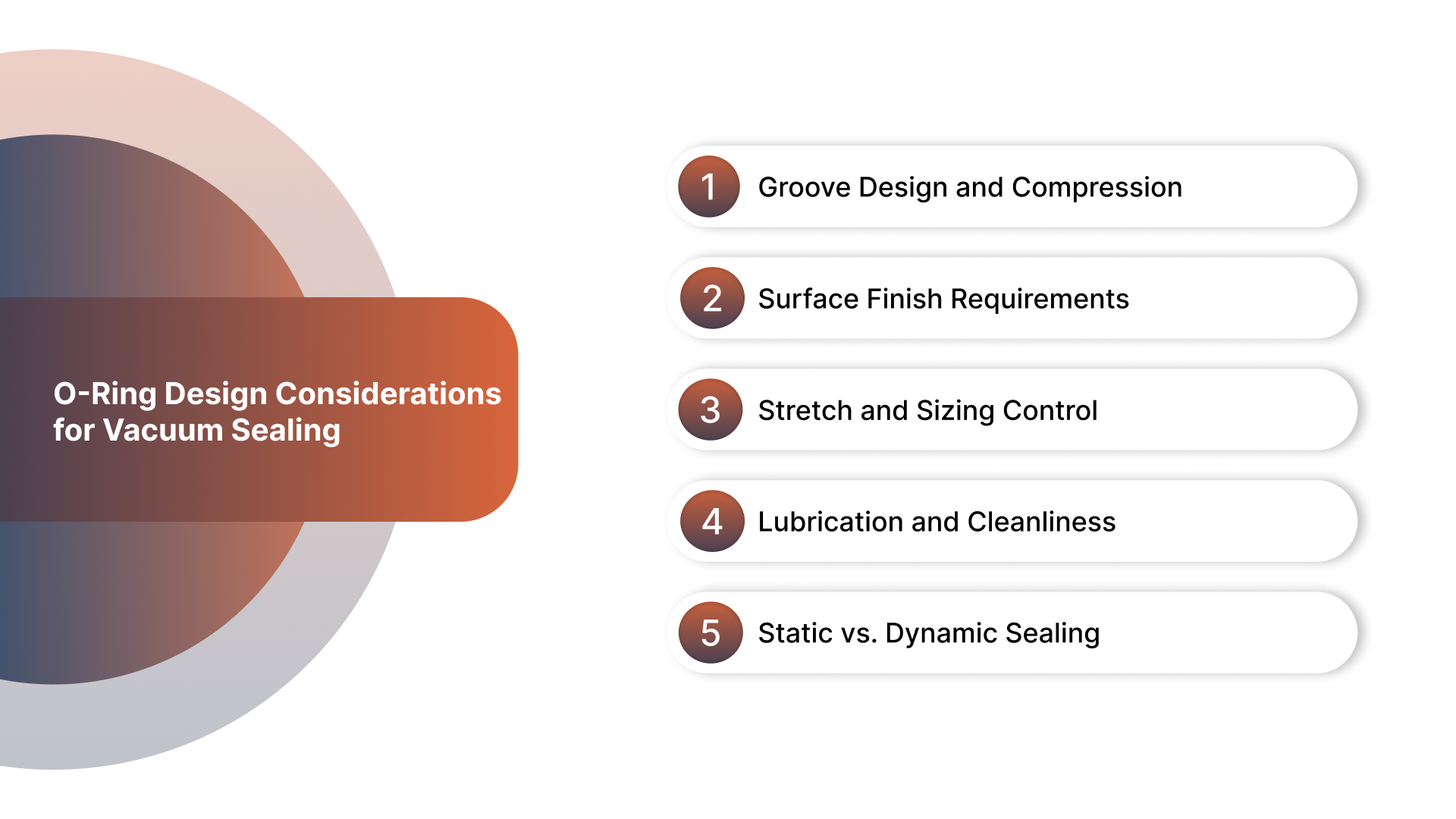
Material selection is critical for vacuum applications, but O-ring design and installation factors play an equally important role in achieving and maintaining a reliable vacuum seal. Even the best vacuum-compatible elastomer can fail if groove design, compression, or surface finish are not properly controlled.
Key design considerations include:
1. Groove Design and Compression
Proper groove dimensions ensure the O-ring is compressed enough to seal without causing excessive deformation.
Typical compression for vacuum O-rings ranges from 20–30%, depending on material and application.
Insufficient compression can lead to leakage.
Excessive compression can increase compression set and outgassing over time.
Groove geometry should account for thermal expansion and long-term material behavior under vacuum.
2. Surface Finish Requirements
Vacuum sealing relies on intimate contact between the O-ring and mating surfaces.
Smoother surface finishes reduce micro-leak paths.
Rough surfaces can compromise sealing performance, even with correct compression.
Clean, defect-free sealing surfaces are especially important in high and ultra-high vacuum systems.
3. Stretch and Sizing Control
O-rings should be sized to avoid excessive stretch during installation.
Excessive stretch can thin the O-ring cross-section
Uneven stretch may lead to localized leaks
Proper sizing helps maintain uniform sealing force around the entire circumference.
4. Lubrication and Cleanliness
In vacuum systems, lubrication must be used carefully.
Only vacuum-compatible lubricants should be used, if required
Many applications avoid lubrication entirely to reduce outgassing
O-rings and sealing surfaces should be cleaned to remove oils, dust, or residues before installation
5. Static vs. Dynamic Sealing
Most vacuum O-ring applications are static, which simplifies design requirements.
Dynamic vacuum seals introduce additional challenges, such as wear and particle generation.
Static designs allow better control over compression and leak rates
Where motion is unavoidable, material selection and surface finish become even more critical.
Careful attention to these design considerations helps minimize leakage, reduce outgassing, and maintain stable vacuum levels over extended service life, especially in clean or high-vacuum environments.
For vacuum applications with strict leakage, cleanliness, or material performance requirements, Detroit Sealing Components can support O-ring material selection, sizing, and design considerations to help ensure reliable vacuum sealing.
5 Best O-Ring Materials for Vacuum Applications
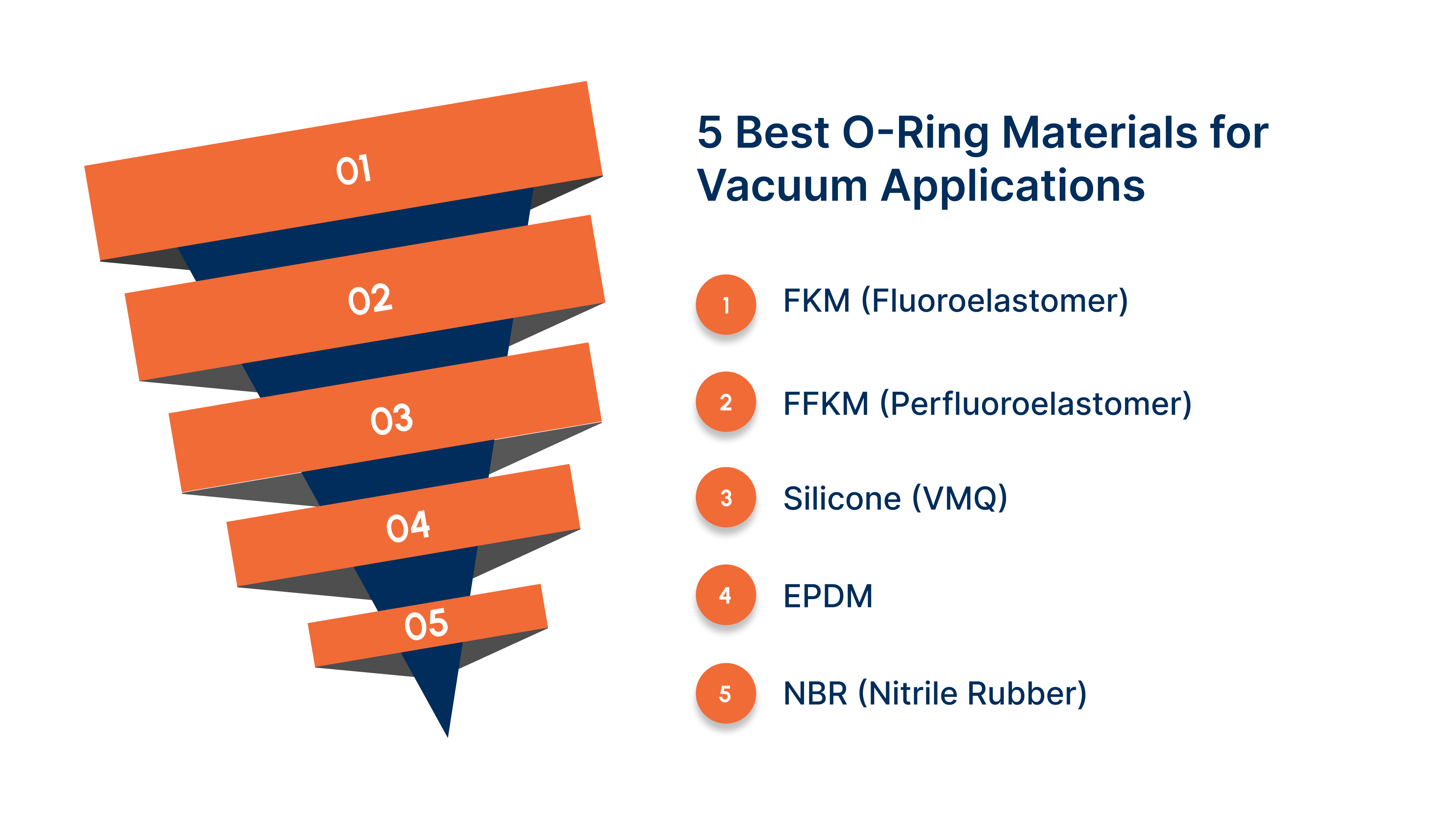
Different elastomers behave very differently under vacuum conditions, so material choice should be based on permeability, outgassing behaviour, temperature stability, and chemical exposure.
Below are commonly used O-ring materials for vacuum applications and where they are typically specified.
1. FKM (Fluoroelastomer)
FKM is widely used in vacuum systems due to its low gas permeability and good resistance to heat and chemicals. It performs reliably in moderate to high vacuum environments and is commonly specified for industrial vacuum equipment.
Typical use cases include:
Industrial vacuum chambers
Semiconductor manufacturing equipment
Pumps and valves exposed to heat and chemicals
FKM is generally suitable where cleanliness and long-term sealing stability are required.
2. FFKM (Perfluoroelastomer)
FFKM is selected for demanding vacuum environments where contamination control and chemical resistance are critical. It offers extremely low outgassing and excellent performance in ultra-high vacuum (UHV) systems.
Typical use cases include:
Semiconductor and wafer processing
Aerospace and space simulation chambers
High-purity and research vacuum systems
FFKM is often chosen when seal failure or contamination is unacceptable.
3. Silicone (VMQ)
Silicone O-rings maintain flexibility across a wide temperature range, which can be beneficial in certain vacuum applications. However, silicone materials typically have higher gas permeability and outgassing compared to fluorocarbon elastomers.
Typical use cases include:
Low to moderate vacuum systems
Applications requiring extreme temperature flexibility
Laboratory or enclosure sealing where ultra-clean conditions are not critical
Material selection should account for potential outgassing in sensitive environments.
4. EPDM
EPDM can be used in select vacuum applications, particularly where water, steam, or mild chemicals are present. However, its higher gas permeability compared to fluorocarbon materials limits its use in high-vacuum systems.
Typical use cases include:
Low-vacuum environments
Systems exposed to water-based media
Non-oil, non-hydrocarbon applications
EPDM is generally not recommended for high or ultra-high vacuum levels.
5. NBR (Nitrile Rubber)
NBR is occasionally used in vacuum systems but is typically limited to low-vacuum applications. Its higher outgassing and lower temperature resistance make it less suitable for deeper vacuum environments.
Typical use cases include:
Low-vacuum industrial equipment
Systems where oil resistance is required but vacuum levels are modest
NBR is usually selected only when oil compatibility is a primary concern.
Material choice should always be evaluated alongside vacuum level, temperature range, chemical exposure, and cleanliness requirements.
O-Ring Material Comparison for Vacuum Applications
Selecting the right O-ring material is critical in vacuum systems, where gas permeability, outgassing, temperature stability, and compression set directly affect achievable vacuum levels and system reliability. Comparing common elastomers side by side helps clarify which materials are best suited for different vacuum conditions and cleanliness requirements.
O-Ring Material | Gas Permeability | Outgassing Performance | Temperature Range (Typical) | Chemical Compatibility | Vacuum Application Suitability |
FKM (Viton®) | Low | Low | -20°C to +200°C | Excellent (many chemicals, oils) | High vacuum, industrial and process systems |
FFKM | Very Low | Very Low | -15°C to +325°C | Outstanding (broad chemical resistance) | Ultra-high vacuum, semiconductor, critical environments |
EPDM | Moderate | Moderate | -40°C to +120°C | Good (water, steam, mild chemicals) | Limited vacuum use, non-oil systems |
NBR (Nitrile) | Moderate to High | Moderate | -30°C to +100°C | Good (oils, fuels) | Rough vacuum, cost-sensitive systems |
Silicone | High | High | -60°C to +200°C | Moderate | Not recommended for high or ultra-high vacuum |
Note: Performance can vary based on compound formulation, vacuum level, temperature, and system cleanliness requirements.
To achieve consistent sealing performance in vacuum systems, material selection is critical. Detroit Sealing Components offers support to help match O-ring materials to vacuum operating conditions.
Diagnostic Checklist for Vacuum O-Ring Performance
Routine inspection and early diagnosis help prevent vacuum leaks, contamination, and unplanned downtime. This checklist can be used during maintenance, troubleshooting, or system qualification to assess O-ring condition and sealing performance in vacuum applications.
1. Visual and Physical Inspection
Check for surface cracks or brittleness: Indicates ageing, thermal exposure, or incompatible material selection.
Inspect for flattening or loss of elasticity: Signs of compression set that reduce sealing force.
Look for swelling or softening: Often caused by chemical incompatibility or lubricant exposure.
Examine for cuts or nicks: May result from improper installation or sharp gland edges.
2. Fit and Installation Review
Confirm proper groove dimensions: Ensure gland depth and width match O-ring specifications for vacuum service.
Verify correct squeeze: Too little squeeze leads to leaks; too much increases compression set risk.
Check for twisting or rolling: Installation errors that compromise sealing integrity.
Ensure clean assembly surfaces: Debris or residue can prevent full sealing contact.
3. Vacuum Performance Indicators
Monitor leak rates: Gradual increases may indicate material permeation or seal degradation.
Check for pressure instability: Fluctuations can signal intermittent sealing loss.
Inspect for contamination: Residue inside the system may point to outgassing or material breakdown.
4. Preventive Maintenance Actions
Replace seals showing early wear: Do not wait for visible failure in critical vacuum systems.
Review operating temperature history: Extended exposure outside material limits accelerates failure.
Confirm material compatibility: Reassess elastomer selection if process gases or conditions change.
Test before full production: When possible, perform a trial installation to confirm fit, seating, and sealing performance before committing to long production runs.
Using a structured diagnostic approach helps maintenance teams extend seal life, maintain vacuum integrity, and reduce unplanned downtime in critical systems.
Detroit Sealing Components: Your Partner in O-Ring Solutions
Detroit Sealing Components (DSC) is a trusted distributor of high-quality O-ring seals and engineered sealing solutions for industrial applications. From standard sizes to custom designs, DSC supports sealing requirements where performance, reliability, and consistency matter.
What Detroit Sealing Components Provides
O-Rings: Standard and custom O-rings for static and dynamic applications, available in international sizes with optional coatings and lubricants.
Backup Rings: High-hardness solutions designed to prevent extrusion in high-pressure environments.
Hydraulic and Pneumatic Seals: Engineered for demanding pressure, temperature, and wear conditions.
Metal-Bonded Rubber Seals: Rubber-to-metal bonded components for strength-critical applications.
O-Ring Kits: Pre-sorted kits for maintenance, repair, and field service needs.
Infinite Size O-Rings: Custom O-rings with virtually unlimited diameters for large or non-standard applications.
Explore the full range of sealing solutions from Detroit Sealing Components to find the right O-ring for your vacuum or industrial application. Check out our product catalog today!
Wrapping Up
Selecting the right O-ring seal is critical for maintaining vacuum integrity, system efficiency, and long-term reliability. Understanding vacuum-specific requirements and choosing the appropriate O-ring material and design, manufacturers can reduce leakage risk, minimize downtime, and extend equipment service life.
Detroit Sealing Components offers a broad range of standard and custom O-rings, supported by engineering expertise and reliable supply, to meet the demands of vacuum applications across industries. Contact our team today to discuss your vacuum sealing requirements and identify the right O-ring solution for your application.
FAQs
1. What is the best O-ring seal for vacuum applications?
The best O-ring seal for vacuum applications depends on the vacuum level, temperature range, and cleanliness requirements. Common materials include FKM, silicone, EPDM, and FFKM, selected based on permeability and outgassing performance.
2. Why is low outgassing important in vacuum O-rings?
Low outgassing prevents volatile compounds from being released into the vacuum system, which can contaminate equipment, reduce vacuum efficiency, or interfere with sensitive processes.
3. Can standard O-rings be used in vacuum systems?
Standard O-rings may work in low-vacuum applications, but high or ultra-high vacuum systems often require specially formulated materials and controlled manufacturing to reduce permeability and outgassing.
4. How does compression set affect vacuum sealing performance?
High compression set reduces an O-ring’s ability to recover its shape after long-term compression, which can lead to leakage and loss of vacuum over time.
5. When should custom O-rings be used for vacuum applications?
Custom O-rings are recommended when standard sizes, materials, or cross-sections do not meet vacuum performance requirements, temperature limits, or system tolerances.