Introduction
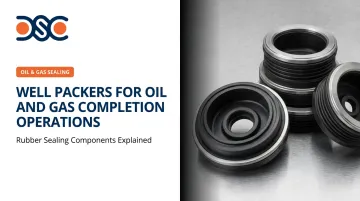
Drilling a well is only half the job. The completion phase is where that hole in the ground becomes a producing asset, and few tools are more central to that transition than the well packer.
Getting packer selection wrong has real consequences. Poor zone isolation allows cross-flow between reservoir intervals, compromising production efficiency. An incompatible elastomer compound degrades under downhole conditions, threatening well integrity.
A setting method mismatched to wellbore geometry can result in a packer that never properly energizes — a failure mode that's costly to diagnose and even costlier to remediate.
This guide walks completion engineers and procurement teams through packer fundamentals: components, types, setting methods, and how to match the right tool to specific well conditions — with close attention to the sealing element decisions that determine seal integrity under sustained downhole pressure and temperature.
Key Takeaways
- A well packer seals the annular space between production tubing and casing, isolating reservoir zones for controlled production or injection
- Permanent packers offer higher pressure/temperature ratings; retrievable packers prioritize operational flexibility
- Three setting methods — mechanical, hydraulic, and wireline/electric — suit different well geometries and depths
- Elastomer selection (NBR, HNBR, FKM, AFLAS/FEPM, FFKM) depends on temperature, fluid chemistry, H2S/CO2 exposure, and RGD risk
- Under API 11D1, V0 is the highest packer qualification grade — the benchmark for demanding downhole conditions
What Is a Well Packer?
Before selecting the right packer for a completion, it helps to understand exactly what the tool is doing downhole. SLB's Energy Glossary defines a packer as "a device that can be run into a wellbore with a smaller initial outside diameter that then expands externally to seal the wellbore." In production applications, a packer isolates the annulus and anchors the bottom of the tubing string — creating a controlled boundary between the tubing flow path and the casing annulus.
Where Packers Fit in the Completion Sequence
Packers are deployed after casing is run and cemented, typically positioned just above the producing zone or perforations. From there, they serve as the primary barrier that separates what flows through the tubing from what happens in the annulus.
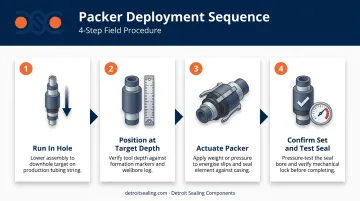
The deployment sequence follows four core steps:
- Run the packer into the wellbore in its compact, unexpanded state
- Position it at the target depth using wireline, tubing weight, or pump pressure references
- Actuate the packer — mechanically, hydraulically, or electrically — to expand the slips and energize the sealing element against the casing wall
- Confirm set and test the seal before completing the tubing string above
API 11D1: The Governing Standard
Packer design and performance validation are governed by API Specification 11D1, "Packers and Bridge Plugs," Fourth Edition (March 2021), with Addendum 1 issued April 2022. The standard defines validation grades that matter when comparing packer specifications:
| Validation Grade | What It Requires |
|---|---|
| V6 | Supplier/manufacturer-defined validation |
| V5 | Liquid pressure test |
| V4 | Liquid test plus axial loads |
| V3 | Liquid test, axial loads, and temperature cycling |
| V2 | Gas test plus axial loads |
| V1 | Gas test, axial loads, and temperature cycling |
| V0 | Gas test, axial loads, temperature cycling, and zero-bubble acceptance |
Severity increases as the grade number decreases: V0 is the most demanding, V6 the minimum. When evaluating packer specs, the validation grade tells you how rigorously the tool has been tested, not just what ratings the manufacturer claims.
Key Functions of Well Packers in Completion Operations
Zone Isolation
This is the primary reason packers exist. By sealing the annular space, a packer separates distinct reservoir intervals, preventing cross-flow between producing zones. In a multi-zone well — say, a completion targeting two independent pay intervals at different depths — individual packers allow operators to produce each zone selectively, control injection profiles, or shut off a water-producing zone without abandoning the entire well.
Without isolation: high-pressure zones communicate with lower-pressure intervals, commingling fluids and corrupting production data.
Pressure Management and Well Control
By blocking annular communication between reservoir and surface, packers prevent high-pressure fluids from migrating up the casing-tubing annulus. Uncontrolled pressure migration in the annulus is a precursor to blowout conditions — making this a well-control issue, not just an efficiency one.
BSEE technical data explicitly lists packer and plug failures among the descriptors in loss-of-well-control datasets, confirming that packer integrity is a regulatory and safety concern.
Casing Protection
Without a packer, corrosive produced fluids — including brines, CO2, and H2S — can circulate in the annulus and attack the production casing. Packers confine these fluids to the tubing string, shielding casing from corrosion, high differential pressures, and thermal cycling. The result is longer casing service life and fewer costly workovers.
Supporting Artificial Lift and Multi-Zone Completions
Packers enable several advanced completion configurations:
- Gas lift: lift gas injects through the annulus above the packer; production flows up the tubing
- ESP completions: packer anchors the tubing string and isolates the pump intake zone from annular pressure
- Stacked packer systems: paired with sliding sleeves, stacked packers allow individual zone management without wellbore intervention
When NOT to Use a Packer
Packers are not always the right tool. Omit or reconsider a conventional production packer when:
- The well is produced up both tubing and annulus simultaneously (high-volume wells where annular flow is intentional)
- The completion relies on annular gas venting — in rod-pumped wells, free gas breaking out of solution should vent up the casing-tubing annulus; a packer blocks that path unless a gas separator or alternate vent is incorporated into the design
Core Components of a Well Packer
Mandrel
The mandrel is the central structural body. Everything else mounts to or around it, and it provides the through-bore conduit for fluid flow. Material selection is critical: L80 and 13CR handle moderate corrosion, Duplex stainless handles chloride-heavy environments, and Inconel alloys are reserved for the most aggressive high-temperature, sour-gas applications.
Slips and Cone
Slips are wedge-shaped elements with hardened teeth (called wickers) that bite into the casing wall to anchor the packer mechanically. The cone is the driving element: when setting force is applied, it wedges behind the slips and drives them outward into the casing.
Slip designs vary by application:
- Dovetail slips — high-grip, used in compression-set designs
- Rocker slips — allow slight rotation during setting
- Bidirectional slips — resist both upward and downward forces, common in permanent packers
Packing Element System
This is the most application-sensitive component. The elastomeric sealing element expands outward to create a hydraulic seal between the packer body and the casing inner diameter. Common configurations include single-element designs with an expansion ring, three-piece element systems, and spring-loaded designs that maintain contact under variable pressure.
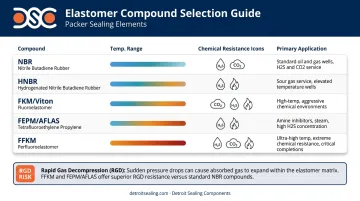
Compound selection drives performance. The wrong elastomer degrades under downhole conditions — chemically or mechanically — and seal failure follows.
| Compound | Temperature Range (approx.) | Best Suited For |
|---|---|---|
| NBR (Nitrile) | -22°F to +212°F | Mild conditions, no severe H2S |
| HNBR | -40°F to +320°F | Tougher oilfield service, moderate sour gas |
| FKM (Viton) | -60°F to +437°F | High temperature, aggressive hydrocarbons |
| FEPM (AFLAS) | +5°F to +419°F | Amines, sour/high-temperature water-gas service |
| FFKM | High-temperature extremes | Most aggressive chemical environments |
Rapid gas decompression (RGD) resistance is a separate but equally important requirement. When high-pressure gas rapidly depressurizes, it can cause explosive damage inside elastomer elements. For high-pressure gas wells, compound datasheets must specifically confirm RGD capability.
Matching compound to well conditions — RGD requirements included — is exactly where sourcing decisions get consequential. Detroit Sealing Components (DSC) engineers custom elastomeric packer elements across these compound families, with access to hundreds of formulations and an ISO 17025 accredited lab for material development and validation.
For applications where no standard compound meets well conditions, DSC can develop and test a custom formulation. That includes FEA-supported design review to evaluate stress distribution, sealing force, and deformation behavior before the element goes downhole.
Lock Ring and Accessory Components
The lock ring (or body lock ring) transmits axial loads and locks the setting force into the packer permanently. It allows only unidirectional motion: once the slips and element energize, they cannot back off.
Additional components that complete the assembly include:
- Expansion joints — compensate for tubing movement in thermally dynamic or deep wells
- Seal bore receptacles — provide a polished bore for tubing seal assemblies to stab into
- On/off tools — allow the tubing string to be disconnected and reconnected above a set packer
Types of Well Packers: Permanent vs. Retrievable
Permanent Packers
Permanent packers are designed to stay in the well for the life of the completion. Key design advantages include:
- Higher pressure and temperature ratings — Halliburton publishes permanent packers rated up to 20,000 psi at 475°F
- Smaller OD for better running clearance in tight casing strings
- Larger ID, compatible with monobore completions
- Simpler mechanical design with fewer moving parts
Removal requires milling — an intervention that adds rig or coiled-tubing exposure and complexity. Permanent packers are the right choice when long-term production integrity matters more than future retrieval flexibility, particularly in HPHT wells.
Retrievable Packers
Retrievable packers can be unset and pulled using a retrieving tool or tubing string manipulation. They're well-suited for:
- Wells with active re-completion or secondary recovery plans
- Workover-intensive operations
- Applications where repositioning may be needed
The trade-off is lower ratings — retrievable models typically top out around 15,000 psi at 400°F — and more complex mechanical designs. Common subtypes include:
- Hydraulic-set retrievable
- Mechanical-set retrievable
- Tension-set retrievable
Premium retrievable designs from manufacturers like Baker Hughes can approach permanent-packer sealing performance while retaining workover flexibility. Always verify against the specific model datasheet before specifying.
Service Packers
Service packers occupy a third category entirely. These are temporary tools used for stimulation, squeeze cementing, acidizing, and well testing. They're not production packers and aren't designed for long-term downhole deployment. Treating them as production packers during completion planning is a specification error worth avoiding.
Packer Setting Methods
Mechanical Set
The packer sets by applying tubing weight (compression), tension, or rotation. Best suited for:
- Shallow, vertical, or low-inclination wells
- Wells where tubing manipulation is reliable and predictable
- Simpler completions with moderate pressure differentials
Subvariants include compression-set, tension-set, and rotation-set designs — the Baker Hughes R-3 packer, for example, sets with a one-quarter-turn right-hand rotation.
Hydraulic Set
Tubing pump pressure drives the cone behind the slips and energizes the element. The body lock ring locks in the setting force. Hydraulic setting is preferred when:
- The well is deviated, highly inclined, or horizontal (where rotation is restricted by torque and drag)
- Multiple downhole tools are being run simultaneously
- The packer needs to be set before the wellhead is installed
According to EIA data, horizontal wells grew from 10% of U.S. wells in 2014 to 22% in 2024 — nearly all new crude oil and gas wells are now horizontal or directional. That shift makes hydraulic and hydrostatic setting methods the standard choice for most new completions.
That trend has also driven adoption of hydrostatic variants like Baker Hughes' SB-3H, which uses absolute well pressure and a rupture disc to set the packer without a running tool. These designs are particularly practical in deep wells where hydrostatic head is substantial and minimizing intervention trips is a priority.
Wireline/Electric Set
Used primarily for permanent packers. An explosive charge, detonated via electric current, simultaneously drives the slips and energizes the element. Key advantages:
- Precise depth placement before tubing is run
- Well-suited for deep wells and complex multi-zone completions
- No tubing manipulation required
Inflatable packers — set by pumping fluid pressure to expand a bladder element — are used in openhole or irregular-bore applications where conventional slip-and-element designs can't get consistent casing contact.
Selecting the Right Packer for Your Completion
Well Geometry and Casing Condition
Start here. Well inclination determines whether tubing rotation is practical (it often isn't in horizontal wells). Casing ID, drift diameter, ovality, and corrosion condition all affect slip engagement and element seal contact area. An openhole completion requires an inflatable or swellable design; a cased-hole completion uses conventional slip-anchored packers.
Pressure, Temperature, and Fluid Exposure
This narrows the field quickly. Map your well conditions against API 11D1 validation grades — a V3-rated packer is appropriate for many standard production applications, while sour gas wells with cycling temperatures may require V1 or V0.
For elastomer selection, the critical inputs are:
- Maximum static and flowing temperature
- Differential pressure and cycling
- Produced fluid chemistry — H2S partial pressure, CO2 content, aromatics, brine salinity
- Stimulation chemical exposure — acids, amines, scale inhibitors
- RGD risk — present in any high-pressure gas application
For H2S-containing environments, metallic components must be qualified per ANSI/NACE MR0175/ISO 15156 for sour-service cracking resistance. Elastomer qualification is separate — require compound-specific supplier data, not generic material family claims.
When standard compounds fall short, DSC supports engineers through compound screening, FEA-based element design review, and custom formulation development. DSC's ISO 17025 accredited lab provides the material validation documentation operators and OEMs require before a custom element goes into service.
Operational Requirements
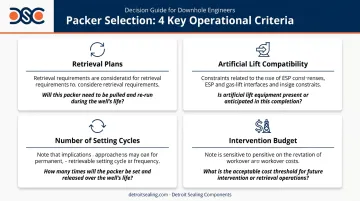
Once environmental conditions are mapped, operational planning shapes the final selection. Consider:
- Retrieval plans — if re-completion or secondary recovery is likely within the completion's life, a retrievable design avoids future milling costs
- Artificial lift compatibility — ESP and gas lift systems have specific feed-through and seal bore requirements
- Number of setting cycles — service packers used for stimulation see more cycles than production packers and must be rated accordingly
- Intervention budget — milling a permanent packer adds rig time and coiled-tubing exposure; factor this into the total completion cost when choosing between permanent and retrievable designs
Frequently Asked Questions
What is a packer in oil and gas?
A well packer is a downhole sealing device that expands to seal the annular space between production tubing and the casing or liner. It isolates different wellbore zones, enabling controlled production, injection, or well treatment by preventing unintended fluid communication between intervals.
What is the difference between a permanent and a retrievable packer?
Permanent packers remain in the well for the life of the completion and must be milled out to remove ; they offer higher pressure and temperature ratings with simpler design. Retrievable packers can be unset and pulled for re-use or repositioning, at the cost of lower pressure and temperature ratings.
What materials are used in packer sealing elements?
Elastomeric compounds — NBR, HNBR, FKM (Viton), FEPM (AFLAS), and FFKM — are selected based on downhole temperature, pressure, and fluid chemistry, including H2S and CO2 exposure. For high-pressure gas applications, RGD resistance must also be confirmed at the compound level.
How is a well packer set?
The three primary setting methods are mechanical (tubing weight, tension, or rotation), hydraulic (tubing pump pressure), and wireline/electric (explosive charge). Selection depends on well inclination, depth, conveyance method, and completion design.
When should you not use a packer in a well completion?
Conventional production packers are typically omitted when the annulus is needed as a flow conduit — such as in high-volume wells produced through both tubing and annulus simultaneously, or in rod-pumped wells where free gas must vent up the casing-tubing annulus to prevent gas lock at the pump.