Key Takeaways
- Mechanical seal failure in renewable energy equipment causes unplanned downtime — and often far more costly repairs than the seal itself
- Wind, hydro, solar thermal, and hydrogen systems each impose unique pressure, temperature, and fluid conditions — seal selection must match the specific application
- Elastomer choice (HNBR, FKM, EPDM, NBR) is the most consequential decision; fluid compatibility and temperature range are the primary drivers
- Dual and split seal configurations offer key advantages for hazardous or remote renewable energy applications
- DSC supplies sealing components for standard and custom configurations, backed by an ISO 17025 accredited lab for material validation and compound development
Why Mechanical Seals Are Critical for Renewable Energy Systems
Mechanical seals prevent fluid or gas from escaping the interface between a rotating shaft and a stationary housing. In wind turbines, hydro turbines, heat transfer fluid pumps, and hydrogen compressors running continuously under variable loads, that function becomes mission-critical. Seal failure in these systems carries consequences far more serious than a simple leak.
The stakes are higher here for three reasons:
- Leaks at ecologically sensitive sites—mountain watersheds, offshore marine environments, desert conservation zones—can trigger regulatory violations and remediation costs that dwarf the seal replacement itself.
- Unplanned maintenance at offshore wind nacelles, underground hydro facilities, or remote solar installations carries steep costs in travel, crane time, and lost generation that a scheduled seal swap avoids.
- Pumping systems account for roughly 20% of the world's electrical energy demand (U.S. Department of Energy). Mechanical seals reduce parasitic friction compared to gland packing, which translates into measurable efficiency gains across every pump and rotating machine on a renewable energy site.
Mechanical Seals vs. Gland Packing in Renewables
Gland packing was the default sealing solution for decades, but it's a poor fit for renewable energy applications. The differences matter in practice:
| Factor | Mechanical Seal | Gland Packing |
|---|---|---|
| Leakage rate | Near-zero | Requires deliberate leak to lubricate |
| Shaft wear | Minimal | Progressive wear over time |
| Flush water consumption | Low | High—continuous flush required |
| Maintenance frequency | Low | High—regular adjustment needed |
| Remote site suitability | Excellent | Poor |
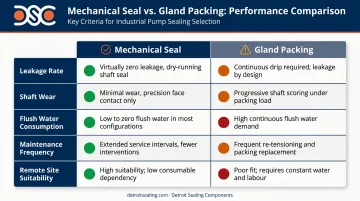
For operators managing equipment in remote or access-restricted locations, the low-maintenance profile of mechanical seals isn't just convenient—it directly reduces lifecycle costs and unplanned downtime.
Mechanical Seals Across Renewable Energy Sectors
The sealing principle is universal. The operating conditions are not. Each renewable energy sector presents a distinct combination of fluid types, pressure ranges, temperatures, and contamination risks.
Wind Energy
Wind turbines contain multiple sealing points, each with its own challenge profile:
- Main shaft bearings — Oil- or grease-lubricated, subject to high circumferential speeds and vibration
- Main gearboxes — High-speed rotating interfaces with industrial gear oil exposure
- Blade pitch systems — Hydraulic or electric actuators demanding tight sealing under cyclic loads
- Yaw systems — Slow-rotating but constant positional adjustment
- Offshore transition pieces — Saltwater immersion, ozone exposure, and UV degradation
The central challenge for wind turbine seals is service life. Modern turbines are designed for 25+ years of operation, and accessing a nacelle—especially offshore—costs thousands of dollars per visit. Seals must maintain performance across extreme temperature swings, resist ozone and UV degradation, and function without adjustment for years at a time.
Hydropower
Main shaft seals on large hydro turbines have historically been the most problematic sealing point in the entire facility. Conventional seals on these large-diameter shafts often leak significantly and require a continuous supply of clean, filtered flush water to prevent sediment from infiltrating the sealing interface.
That flush water system is expensive to operate, consumes treated water, and adds infrastructure complexity.
Advanced sealing approaches—including split mechanical seal designs combined with solids-handling features—can reduce or eliminate flush water requirements. Research on axial polymer seals for hydro turbine main shafts demonstrates near-leak-free performance under the variable load cycling typical of hydropower operations, where generation output responds to grid demand and water flow conditions.
Split seal configurations offer a practical maintenance advantage here: technicians can replace seals without fully disassembling large turbine shafts.
Solar Thermal and Geothermal
Mechanical seals appear in heat transfer fluid (HTF) circulation pumps, brine re-injection pumps, and heat exchanger circuits in both technologies. The defining challenge is chemically aggressive media at elevated temperatures:
- Solar thermal HTF systems can operate above 400°C in molten salt configurations
- Geothermal brine is corrosive, often silica-saturated, and delivered at high pressure
- Glycol-based fluids in lower-temperature solar systems cause swelling in incompatible elastomers
- Thermal cycling between standby and operating temperatures stresses seal faces and secondary elastomers repeatedly
Hydrogen Production and Storage
Green hydrogen applications present the most technically demanding sealing environment of any renewable energy sector. Hydrogen is the smallest molecule—it permeates elastomers and metals that would contain any other gas. Electrolyzer stacks, hydrogen compressors, and high-pressure storage vessels all require seals that:
- Contain hydrogen at pressures up to 700 bar in refueling station applications
- Prevent cross-contamination between process streams (oxygen and hydrogen sides of an electrolyzer)
- Hold up against hydrogen embrittlement and permeation over long service cycles
- Deliver zero fugitive emissions—any leakage is both a safety hazard and a direct efficiency loss
Material Selection for Renewable Energy Seal Applications
Material selection is where most renewable energy seal failures actually originate. The wrong elastomer doesn't fail dramatically — it degrades gradually, losing elastic recovery, developing compression set, and eventually losing sealing force until leakage appears.
The four elastomer families that cover most renewable energy applications:
HNBR (Hydrogenated Nitrile Butadiene Rubber)
Best for oil- and grease-lubricated bearing seals in wind turbines. HNBR outperforms standard NBR in ozone resistance, thermal stability, and oxidation resistance. Its low-temperature elasticity makes it suitable for arctic and cold-climate wind installations where standard nitrile compounds become brittle. DSC stocks HNBR across multiple hardness grades (70–90 Shore A) for both standard and custom seal geometries.
FKM (Fluoroelastomer)
The preferred choice for high-temperature applications and compatibility with industrial gear oils. Main gearboxes, electrical pitch systems, and geothermal brine pump seals all benefit from FKM's outstanding chemical and thermal resistance. FKM maintains sealing integrity up to 200°C continuously — well beyond the 120°C threshold where NBR and EPDM begin to soften.
EPDM (Ethylene Propylene Diene Monomer)
Excellent for static seals in exposed locations—nacelle exteriors, offshore transition pieces, solar system enclosures. EPDM resists UV, ozone, and saltwater over decades of exposure without cracking or hardening. Avoid pairing it with petroleum-based oils; keep it in static or water-contact roles.
NBR (Nitrile Butadiene Rubber)
A versatile, cost-effective option for hydropower and solar thermal pump seals where lubricant compatibility and mechanical strength are the primary requirements. NBR is also a practical fit for blade bearing seals where flexibility and media resistance are priorities and budget constraints are real.
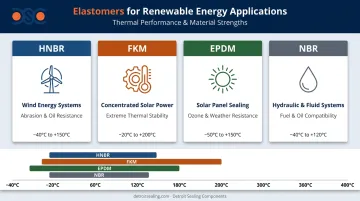
Temperature range is a design-critical parameter. A seal that performs at operating temperature but loses elastic recovery at cold-start — −40°C for arctic wind farms, or after seasonal shutdown in mountain hydro plants — will leak from the first rotation.
DSC's ISO 17025 accredited lab tests and validates custom compounds against the full thermal cycle of a specific application, from cold-start through peak operating load, not just the steady-state maximum.
Seal Types and Configurations for Renewable Energy
Choosing the right configuration is as important as choosing the right material.
Primary Configurations
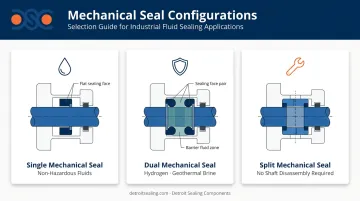
- Single mechanical seals: Suitable where the process fluid is non-hazardous and minor leakage to atmosphere is acceptable. Common in standard hydropower pump circuits and lower-temperature solar thermal systems.
- Dual mechanical seals (double/tandem): Required where the process fluid is hazardous, flammable, or environmentally sensitive. Double seals use a pressurized barrier fluid; tandem seals use an unpressurized buffer fluid. Both configurations prevent process fluid from reaching the atmosphere — essential in hydrogen compressors and geothermal brine applications.
- Split mechanical seals: Installable around the shaft without full equipment disassembly. Cuts maintenance costs significantly on large rotating equipment, particularly hydro turbine main shafts where conventional teardown requires extended downtime.
Seal Support Systems
The seal support system is a critical part of the assembly — not an optional add-on. In remote renewable energy sites, a support system failure causes the same downtime as a seal failure itself.
API 682 flush plan selection should match the specific application. Key criteria include:
- Clean, compatible flush fluid that won't contaminate the process
- Controlled pressure differential across the sealing faces
- Adequate heat removal to prevent face distortion or wear
- Reliable supply continuity in remote or unmanned installations
Beyond pump and compressor applications, standards vary by technology type. For wind turbine systems, IEC 61400-8:2024 sets design requirements that directly inform how sealing systems integrate into the broader turbine drivetrain architecture.
How to Choose the Right Mechanical Seal for Your Renewable Energy Application
Correct seal selection requires specific inputs. Missing even one of them increases the risk of a mismatch that won't surface until the seal is in service—often at an inconvenient location.
Required specification inputs:
- Operating pressure and temperature range — Both minimum (cold-start) and maximum (peak operating)
- Fluid type and chemical compatibility — Including any additives, inhibitors, or contamination present
- Shaft diameter and rotational speed — These determine face geometry and spring loading requirements
- Environmental exposure — Onshore vs. offshore, climate zone, UV and ozone levels
- Maintenance interval expectations — How long must the seal operate between service visits?
- Applicable standards or OEM specifications — API 682, IEC 61400-8, or OEM-specified requirements
Standard catalog seals work well for many applications. Custom or application-engineered solutions become necessary when shaft sizes are non-standard, fluid chemistry falls outside typical ranges, temperature extremes push beyond standard compound limits, or service life requirements exceed catalog ratings.
DSC supports both scenarios. With access to hundreds of rubber compounds across all elastomer families and CAD/FEA capabilities for custom seal geometry, DSC can source and validate standard or custom sealing components for renewable energy projects. Their ISO 17025 accredited lab performs material validation under application-specific conditions. Nationwide distribution from their Plymouth, MI warehouse keeps project timelines on track.
Frequently Asked Questions
What are the most common types of mechanical seals used in renewable energy systems?
Single seals, dual (double and tandem) seals, and split seals cover the majority of renewable energy applications. The right choice depends on process fluid hazard level, pressure, and how accessible the equipment is for maintenance—split seals are especially practical for large hydro turbine shafts.
Why do renewable energy applications place such high demands on seal materials?
These systems operate in conditions most industrial seals never face: offshore saltwater, arctic cold starts, 400°C molten salt, or 700-bar hydrogen pressure. Add limited maintenance access and multi-decade service life requirements, and the margin for material compromise essentially disappears.
What is the difference between a wet mechanical seal and a dry gas seal in renewable energy?
Wet seals use a thin liquid film—process fluid or barrier fluid—to lubricate and cool the faces; they're standard in hydro and solar thermal pumps. Dry gas seals use a pressurized gas film instead, making them the right choice for hydrogen compressors where liquid contamination is unacceptable.
How do mechanical seals support sustainability goals in renewable energy?
Mechanical seals prevent fluid leakage into sensitive environments, lower friction losses compared to gland packing, and extend equipment service intervals—reducing both maintenance visits and lifecycle costs. Better sealing translates directly to better energy output over the system's life.
What seal materials are best for offshore wind turbine applications?
Material selection depends on the application within the turbine:
- HNBR / NBR — bearing seals where low-temperature flexibility and lubricant compatibility are the priority
- FKM — gearbox and pitch system seals requiring chemical and thermal resistance
- EPDM — static nacelle and transition piece seals exposed to decades of UV, ozone, and saltwater
When should I use a dual mechanical seal instead of a single seal?
Choose a dual seal when the process fluid is hazardous, flammable, or environmentally sensitive—hydrogen, geothermal brine, and aggressive heat transfer fluids are the main examples. It's also the right call when the process fluid is a poor lubricant and an external barrier fluid is needed to keep seal faces from running dry.